
How to Calculate Asphalt Tonnage for a Driveway
Calculate driveway asphalt tonnage from area, compacted thickness and density. See a worked example, coverage table and checks before ordering.
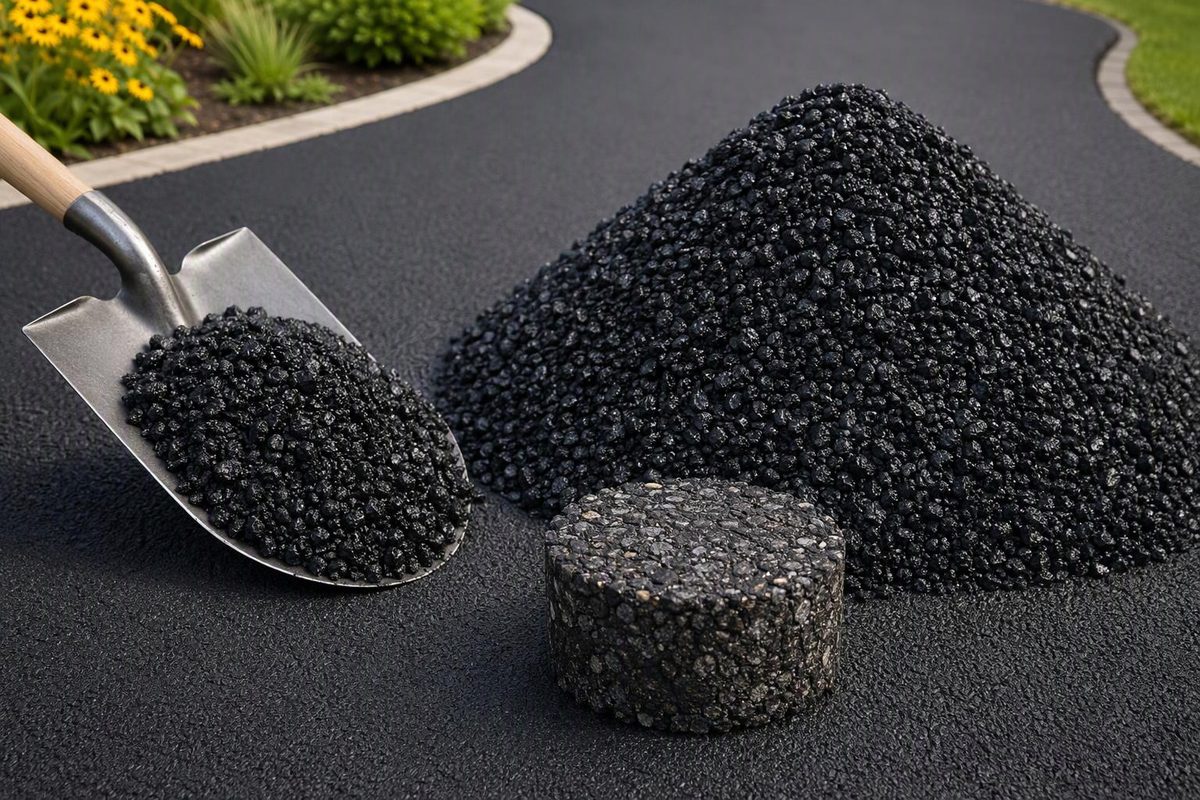
To estimate hot-mix asphalt for a driveway, multiply the paved area by the finished, compacted thickness and the asphalt density, then convert pounds to tons.
Using a planning density of 145 pounds per cubic foot:
Asphalt tons = area in square feet × compacted thickness in inches × 145 ÷ 24,000
A rounded shortcut is area × thickness × 0.00604. These are U.S. short tons of 2,000 pounds, not metric tonnes. The result estimates the asphalt in the finished pavement, before any separate ordering allowance.
Vulcan Materials’ asphalt calculator uses 145 lb/ft³ as its default, but notes that actual density varies with the mix components. Use the supplier’s expected compacted density when available.
1. Measure the paved area
For a rectangular driveway:
Area = length in feet × width in feet
A driveway 50 feet long and 12 feet wide has an area of 600 square feet.
For an irregular driveway, divide it into simpler shapes and add their areas:
- Rectangles: length × width.
- Triangles: base × perpendicular height ÷ 2.
- A straight, evenly tapered section: length × average of the two end widths.
Include parking pads, turnarounds and the entrance apron if they are part of the paving scope. Exclude islands or other unpaved areas. Calculate sections with different asphalt thicknesses separately.
2. Use compacted thickness—not loose placement depth
Ask the contractor what thickness the driveway will have after rolling. Do not substitute the depth of the loose asphalt before compaction.
The Minnesota Asphalt Pavement Association’s calculator specifically uses planned nominal compacted thickness. Its estimating assumption is 110 pounds per square yard per inch, equivalent to about 146.7 lb/ft³—slightly higher than the 145 lb/ft³ assumption used here.
If your quote specifies two asphalt layers, calculate each layer using its own compacted thickness and density, then add the tonnages. Do not include the crushed-stone foundation in asphalt thickness.
A thickness used in a calculation is not a design recommendation. Have the paving scope establish the required layers and finished depths before estimating quantity.
3. Calculate the tons: a 600-square-foot example
Assume a 50-by-12-foot driveway with 3 inches of compacted asphalt at 145 lb/ft³.
| Step | Calculation | Result |
|---|---|---|
| Paved area | 50 × 12 | 600 ft² |
| Thickness in feet | 3 ÷ 12 | 0.25 ft |
| Compacted volume | 600 × 0.25 | 150 ft³ |
| Asphalt weight | 150 × 145 | 21,750 lb |
| U.S. short tons | 21,750 ÷ 2,000 | 10.875 tons |
That is about 10.9 tons before an ordering allowance.
The formula’s 24,000 divisor comes from multiplying 12 inches per foot by 2,000 pounds per ton. Keep full precision through the calculation and round the final result.
Quick coverage table
These quantities use the same 145 lb/ft³ assumption and exclude any allowance. The thicknesses are calculation examples, not recommended driveway specifications.
| Compacted thickness | Tons per 1,000 ft² | Approximate ft² covered by one ton |
|---|---|---|
| 2 inches | 12.08 | 82.8 |
| 3 inches | 18.13 | 55.2 |
| 4 inches | 24.17 | 41.4 |
4. Keep the ordering allowance separate
The geometric estimate assumes the measured area and planned thickness are accurate. Ask the contractor or supplier what additional quantity is needed for this particular job; Vulcan also advises obtaining local assistance for more exact product estimates.
For illustration, if the agreed allowance were 5%:
10.875 × 1.05 = 11.41875 tons, or about 11.4 tons.
That 5% is an example, not a universal ordering rule. State the allowance separately so you can distinguish the pavement quantity from extra material.
Do not add another compaction multiplier when you have already used compacted thickness and compacted density. That would count compaction twice.
Use the estimate to check a driveway quote
Before comparing bids or ordering material, confirm:
- Area: Are the apron, widening and turnaround included?
- Thickness: Is it explicitly the finished compacted thickness, by layer?
- Density: Is the calculation using a planning assumption or the supplier’s mix-specific figure?
- Quantity: Does the quoted tonnage include an allowance, and how much?
- Billing: Is payment a fixed project price or based on delivered tons? For ton-based billing, request the load weight tickets.
As a sensitivity check, one additional inch across the 600-square-foot example adds 3.625 tons at the assumed density. A depth misunderstanding can therefore matter more than rounding the estimate.
Tons multiplied by a supplier’s price per ton gives a material subtotal, not an installed driveway price. Compare removal, base work, drainage, delivery and paving separately using the asphalt driveway cost guide.
This calculation is for hot-mix asphalt pavement. For loose reclaimed asphalt millings, ask the supplier for the appropriate bulk density and placement basis rather than reusing 145 lb/ft³; see the recycled asphalt driveway trade-offs.