
Cost to Pave an Asphalt Driveway by Job Type and Site
For 600 sq. ft., national planning ranges are $4,200–$7,800 for new paving, $4,800–$9,000 for full replacement or $1,800–$4,200 for a basic overlay.
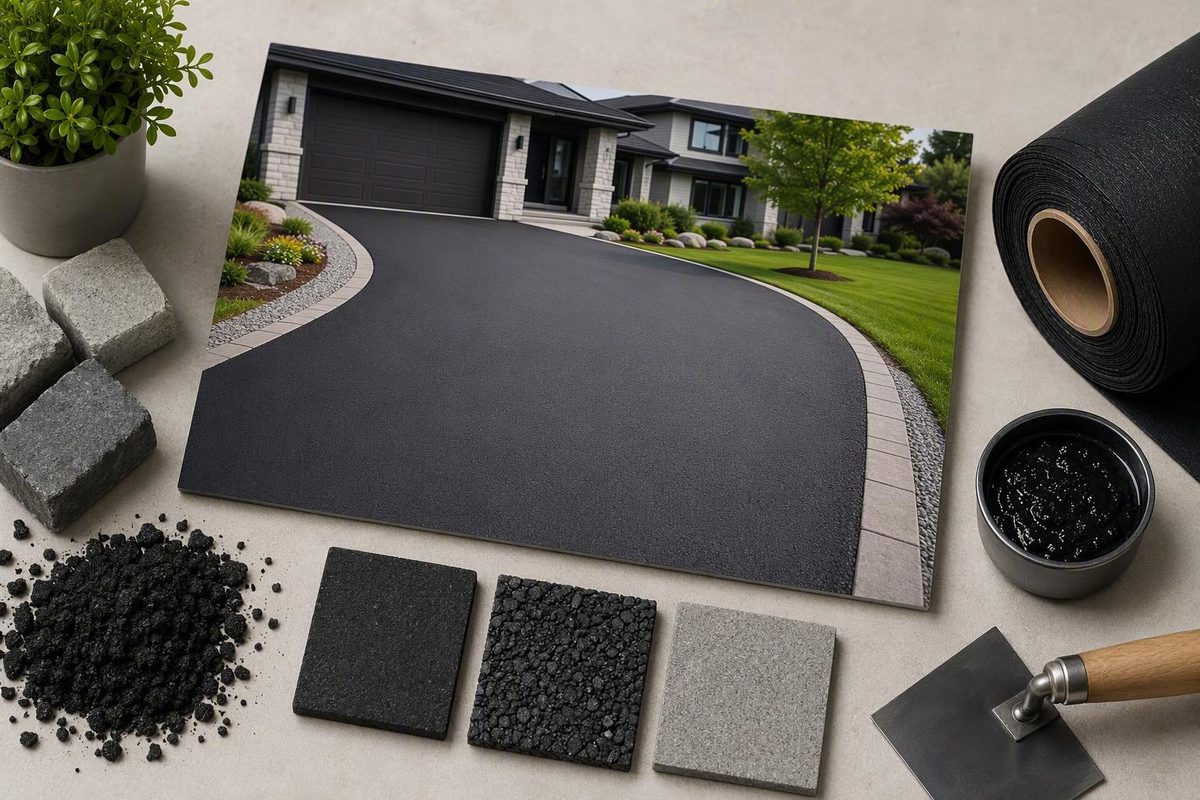
*By Rita Delgado, who spent 15 years estimating paving jobs. *
Methodology: This guide compares current consumer-cost data, estimating guidance, and regional contractor examples. The core national ranges rely substantially on Angi’s consumer-cost data and overlapping commercial estimating guidance, not on a single independently validated national database of residential bids. All figures are planning benchmarks; a firm price requires an on-site assessment.
The short answer: asphalt driveway cost by project type
For a current U.S. planning estimate, start with the type of work your driveway needs—not one blended national average.
| Project type | National planning rate | What the range generally assumes |
|---|---|---|
| New asphalt paving | $7–$13 per sq. ft. | A suitable base already exists or only limited base preparation is required |
| Full replacement | $8–$15 per sq. ft. | Existing pavement is removed and replaced; deeper base work may vary |
| Basic asphalt overlay | $3–$7 per sq. ft. | Existing pavement and its base are structurally suitable for resurfacing |
Angi reports these project-specific rates, along with an average asphalt-driveway project cost of $5,343 and a typical total range of $3,149–$7,542. Its average does not establish one standard driveway size, asphalt thickness, base specification, or removal scope, so it should not be treated as a quote for every property. See Angi’s 2026 asphalt-driveway cost data.
Commercial estimating guidance publishes the same $7–$13, $8–$15, and $3–$7 project-type ranges, but that overlap should not be mistaken for multiple independent datasets. Use the numbers as national planning benchmarks rather than validated local bid prices. TruTec explains the scope assumptions behind each range.
Resurfacing can also exceed the basic overlay range. In some markets it may approach $10 per square foot when the work includes substantial patching, leveling, crack preparation, edge rebuilding, drainage transitions, or similar preparation. Jet-Black reports a broader resurfacing range of approximately $3–$10 per square foot.
The distinctions are important:
- New paving creates an asphalt surface where no asphalt driveway currently exists.
- Replacement removes an existing surface and installs new pavement.
- Overlay or resurfacing places new asphalt over pavement that is sound enough to remain.
All three ranges are national planning estimates. A simple rectangular driveway with good access, straightforward drainage, and a usable base may fall within them. A steep or poorly drained site with unstable soil, restricted access, or a failed base can reach or exceed the high end.
Calculate a preliminary estimate from your driveway dimensions
The basic area calculation is:
Length in feet × width in feet = driveway area in square feet
Then calculate a preliminary budget:
Square feet × applicable installed rate = preliminary project total
For example, a driveway measuring 50 feet long by 12 feet wide has an area of:
50 × 12 = 600 square feet
Applying the national planning rates produces three different budgets:
- New paving: 600 × $7–$13 = $4,200–$7,800
- Full replacement: 600 × $8–$15 = $4,800–$9,000
- Basic overlay: 600 × $3–$7 = $1,800–$4,200
For an irregular driveway, divide the surface into measurable rectangles. Calculate the parking pad, driveway lane, turnaround, and other sections separately, then add the areas. Do not multiply the widest length by the widest width unless the driveway actually fills that entire rectangle.
The table below contains arithmetic derived from the national planning rates—not observed contractor quotes.
| Driveway area | New paving at $7–$13/sq. ft. | Replacement at $8–$15/sq. ft. | Basic overlay at $3–$7/sq. ft. |
|---|---|---|---|
| 400 sq. ft. | $2,800–$5,200 | $3,200–$6,000 | $1,200–$2,800 |
| 600 sq. ft. | $4,200–$7,800 | $4,800–$9,000 | $1,800–$4,200 |
| 800 sq. ft. | $5,600–$10,400 | $6,400–$12,000 | $2,400–$5,600 |
| 1,000 sq. ft. | $7,000–$13,000 | $8,000–$15,000 | $3,000–$7,000 |
| 1,500 sq. ft. | $10,500–$19,500 | $12,000–$22,500 | $4,500–$10,500 |
This calculation is only a first-pass budget. It does not account for unusual demolition, extensive base reconstruction, drainage installation, major grading, permits, restricted equipment access, long hauling distances, landscaping restoration, or minimum mobilization charges.
It also does not determine which project category applies. An overlay calculation is not useful if the base has failed. Likewise, a new-paving calculation can understate the cost of building on raw or unstable ground.
New paving, replacement, and overlay are different jobs
Contractors and cost guides do not always use project labels consistently. Before comparing prices, define what must happen both above and below the visible surface.
New paving constructs an asphalt driveway where no asphalt pavement currently exists. On a favorable site, that may mean fine-grading and compacting an existing aggregate base before paving. On raw or unstable ground, it can require clearing, excavation, subgrade correction, aggregate installation and compaction, drainage work, and then asphalt.
Replacement begins with an existing driveway. The old asphalt, concrete, or other surface must be removed before new pavement is installed. Some projects can retain a sound aggregate base after localized correction. Others require deeper excavation because the base is contaminated, inadequately built, poorly drained, or unstable.
Replacement can cost more because it may add:
- Saw cutting or breaking up the old surface
- Loading and hauling removed material
- Disposal or recycling charges
- Grade corrections
- Aggregate-base repair or reconstruction
- Additional compaction before paving
Removal is commonly estimated at approximately $1–$2 per square foot in the cited consumer guidance, but that is not a universal charge. It may already be included in the replacement rate, while concrete, thick pavement, buried reinforcement, limited access, or long disposal trips can change the cost.
An overlay, also called resurfacing, places a new asphalt layer over pavement that is structurally sound enough to remain. Preparation may include cleaning, crack work, localized reconstruction, leveling depressions, rebuilding edges, applying a bonding treatment, and correcting transitions at the garage, sidewalk, street, or drains.
The lower overlay price is possible because the project retains the existing pavement and base. It is not a shortcut for correcting structural movement. If the driveway is sinking because the soil or aggregate beneath it is moving, the new layer will move with it.
When requesting estimates, do not ask only for the price of a “new driveway.” State whether the site is unpaved, already has an aggregate base, has an old surface that must be removed, or is being considered for resurfacing. That description does not replace an inspection, but it reduces the chance of comparing fundamentally different jobs.
Why published prices range from $3 to $15 per square foot
Online asphalt prices often appear contradictory because they describe different scopes, regions, publication years, and levels of preparation.
A figure near $3 per square foot might represent:
- A basic overlay
- Paving over an existing usable base
- A large, production-efficient project
- Favorable access and site conditions
- Older contractor pricing
- A lower-cost regional market
- Asphalt material rather than complete installation
- A price that excludes important preparation
Material pricing cannot be compared directly with installed driveway pricing. A material figure may cover only the asphalt mixture at the plant or its delivery to the job. A complete installed price may also include labor, trucks, rollers, paving equipment, mobilization, grading, preparation, fuel, waste, insurance, overhead, and profit.
Regional examples illustrate local variation but should remain regional. One Minneapolis contractor publishes an overall installation range of $3.95–$9.03 per square foot and identifies size, existing conditions, soil, base quality, grading, drainage, permits, and replacement method as variables. Those figures are specifically framed for Minneapolis and the surrounding market.
Larger driveways generally cost more in total but may cost less per square foot. A crew still has to transport equipment, set up the site, coordinate trucks, and complete transitions and edge work. Those fixed or partly fixed expenses represent a larger share of a 300-square-foot project than of a 1,500-square-foot project.
Older figures require particular caution. A New Jersey and Pennsylvania contractor quoted $3–$4 per square foot in an article published in March 2019. That figure may describe its regional market and scope at that time, but it is not a current national baseline. The original contractor article supplies the date and regional context.
Contractor blogs and estimating-software companies can provide useful ballparks, but many do not publish a complete dataset or pricing methodology. Repetition of the same range across commercial pages is not necessarily independent confirmation. The safer approach is to identify the scope behind each number and compare it with itemized local bids.
The site conditions and add-ons that change the final price
The headline square-foot rate is only a starting point. A contractor must also price the conditions below the proposed pavement and the logistics of completing the work.
Driveway area and shape
Total cost generally rises with paved area, although the unit rate may fall as fixed setup and mobilization costs are distributed across a larger project.
Curves, narrow sections, turnarounds, islands, irregular borders, and areas requiring extensive handwork can reduce production efficiency. Measure these sections separately and make sure every bidder is pricing the same footprint.
Demolition, hauling, and disposal
Ask whether the quote includes complete removal and off-site disposal. “Removal” could otherwise mean breaking up the old material and leaving it elsewhere on the property.
Soil and subgrade
Soft, wet, expansive, clay-rich, disturbed, or otherwise unstable soil may require excavation or stabilization.
Possible additions include:
- Spot excavation
- Imported fill or aggregate
- A specified geotextile or other stabilization measure
- Additional compaction
- Undercutting and replacement of unsuitable soil
These measures are not automatically necessary on every property. Their purpose and quantity should be tied to actual site conditions.
If the full condition cannot be determined before excavation, the bid should explain how hidden conditions will be documented and priced.
Aggregate-base condition
A driveway can look worn while retaining a serviceable base.
The quote should distinguish among:
- No base work
- Localized base repair
- A stated allowance
- Complete base reconstruction
“Base as needed” is too vague unless the bid explains how need will be determined, what material will be installed, and what unit or change-order rate will apply.
Grading, slope, and drainage
The finished driveway should direct water appropriately rather than trap it in low areas or send it toward vulnerable structures. Standing water, steep grades, poor roadside drainage, garage transitions, and drain installation can add excavation, aggregate, pipe, drainage structures, and labor.
Angi reports grading and leveling at $5–$10 per square foot in some consumer-cost contexts, but that is not a universal surcharge. It may describe extensive work, overlap with excavation or base installation, or already be incorporated into a broader paving price.
Drainage work may also include:
- Regrading low areas
- Adjusting driveway transitions
- Installing or tying into a drain
- Correcting roadside or apron flow
- Rebuilding edges or shoulders
- Coordinating with work in a public right-of-way
The quote should explain both what will be corrected and what drainage defects will remain.
Asphalt thickness and mix
More compacted asphalt generally requires more material, trucking, and placement work. Mix selection can also affect price and may depend on local availability, climate, expected loads, lift thickness, and supplier or contractor practices.
Do not accept “two inches” or “three inches” without clarification. Ask whether the number describes loose asphalt before rolling or the final compacted thickness. Those are not equivalent specifications.
Equipment access and mobilization
Narrow gates, low overhead clearances, weak bridges, tight turns, retaining walls, landscaping, and limited truck access may require smaller equipment or more handwork.
Small projects can also be affected by minimum crew, truck, equipment, or plant-order costs. This is one reason a short driveway can carry a relatively high square-foot price.
Labor, hauling, and the local market
Local wages, fuel, insurance, asphalt availability, and contractor competition influence bids. Distance from the asphalt plant also matters because the contractor must transport hot mix while coordinating production and placement.
Long hauling distances can increase truck time and freight expense. Current material prices and regional labor conditions can therefore move an otherwise similar project above or below a national planning range.
Permits, transitions, and restoration
Depending on the property and local requirements, the project may need to address:
- Permits
- Apron or right-of-way work
- HOA paperwork
- Utility coordination
- Garage, sidewalk, gate, or street transitions
- Landscaping removal
- Shoulder or lawn restoration
- Final cleanup
These items are not automatically included merely because a proposal gives one price per square foot.
For each potential extra, ask the contractor to classify it as:
- Included in the base bid
- Excluded
- Carried as a stated allowance
- Priced at a defined unit rate
- Subject to a change order after excavation
That structure makes budget risk visible before work begins.
Can the driveway be overlaid, or does it need replacement?
An overlay is a candidate when deterioration is mainly at the surface and the existing pavement and underlying base remain structurally sound. Possible examples include oxidation, surface wear, modest cracking, or localized damage that can be reconstructed before resurfacing.
Warning signs that may favor replacement include:
- Widespread alligator or spiderweb cracking
- Repeated or deep potholes
- Sinking or shifting sections
- Severely crumbling edges
- Evidence of subbase failure
- Major drainage problems
- Multiple existing asphalt layers
A contractor should inspect the pavement, elevations, drainage, failed areas, and exposed edges where possible.
An overlay does not stop movement below the pavement. If the aggregate base or subgrade shifts, the new surface can crack or deform.
One Eastern Iowa contractor describes an overlay as a typical 1.5- to 2-inch layer and estimates overlays at roughly 30%–50% less than replacement. Those figures are regional contractor guidelines, not universal specifications or guaranteed savings. The economic advantage depends on retaining a sound base and limiting the amount of preparation required. Pate Asphalt also identifies deep cracks, sinking, failed subbase, crumbling edges, and multiple layers as reasons to consider replacement.
Before accepting an overlay proposal, ask the contractor to document:
- Why the existing pavement and base are considered suitable
- Which cracks and failed areas will be repaired
- Whether weak areas will be excavated and reconstructed
- How edges and transitions will be handled
- Whether drainage defects will remain
- How existing cracks affect the warranty
- Which future failures the warranty excludes
A low overlay bid can be good value when the existing structure is sound. It can be false economy when it merely covers evidence of deeper failure.
Thickness, base, drainage, and compaction: what the price should buy
Asphalt thickness matters, but it is only one part of the pavement system.
Pavecon describes approximately 2 inches as standard for a residential driveway used by one or two cars and indicates that 3 inches may be appropriate for a heavier vehicle or parked heavy trailer. Its guidance is contractor guidance rather than a universal pavement-design rule. Pavecon also uses an assumed asphalt density of 145 pounds per cubic foot.
TruTec’s estimating guidance commonly uses approximately 3 inches for cars and light trucks. The correct specification depends on expected loads, climate, subgrade support, base strength, mix design, and whether the stated depth is compacted.
A contractor should not merely write “2-inch asphalt” on the proposal. The bid should clarify:
- Whether the stated depth is loose or compacted
- Whether asphalt will be installed in one lift or more
- What mix will be used
- What base material and depth are included
- Which base repairs are included
- How the subgrade, base, and asphalt will be compacted
- How drainage and transitions will be formed
Thickness alone cannot compensate for saturated soil, inadequate aggregate, poor drainage, or insufficient compaction. A thinner pavement over a sound supporting system is not equivalent to a thicker layer over a failed base—but that does not justify prescribing one universal depth for every driveway.
Use tonnage as a reasonableness check
A density-based quantity calculation can help determine whether proposed asphalt tonnage is broadly consistent with the stated area and thickness.
Using an assumed asphalt density of approximately 145 pounds per cubic foot:
Estimated tons = area in square feet × thickness in inches × 0.00604
For 1,000 square feet at 3 inches:
1,000 × 3 × 0.00604 = 18.12 tons
Rounded, that is approximately 18.1 tons.
The constant converts the 145-pound-per-cubic-foot density assumption into tons for each square foot and inch of thickness. Actual mix density, varying placement depth, transitions, and ordered quantity can differ from this simplified calculation.
Tonnage is not a project price. It does not include:
- Excavation
- Aggregate
- Demolition and disposal
- Labor
- Equipment
- Trucking
- Mobilization
- Waste
- Overhead
- Local delivery conditions
Use the calculation to ask questions rather than to accuse a contractor of under-ordering. If the tonnage in a bid differs substantially from the simplified estimate, ask whether the difference reflects compacted thickness, variable depth, mix density, waste, transitions, or an area you did not include.
Compare asphalt paving bids—and budget beyond installation
Obtain at least three itemized local bids based on the same written scope. Comparing three headline totals is not enough when each contractor may be proposing different work.
A useful bid checklist includes:
- Measured area: Total square footage and measurement method
- Project type: New paving, overlay, or replacement
- Asphalt thickness: Final compacted depth, not only loose placement depth
- Asphalt mix: Mix designation or clear application-specific description
- Base: Material, depth, and required compacted condition
- Demolition: Existing surface and depth to be removed
- Hauling and disposal: Whether removed material will be taken off-site
- Excavation: Included quantity, allowance, or unit price
- Base repairs: Localized correction versus complete reconstruction
- Grading: Proposed elevations, slope, and correction of low areas
- Drainage: Surface flow, drains, transitions, and excluded defects
- Compaction: Equipment and general method for subgrade, base, and asphalt
- Permits: Who determines requirements, obtains approvals, and pays fees
- Transitions: Garage, street, sidewalk, apron, gates, and adjoining pavement
- Edge work: Supported edges, rebuilt shoulders, or other treatment
- Cleanup and restoration: Debris, landscaping, lawn, and access
- Schedule: Work sequence and weather contingencies
- Warranty: Duration, covered failures, exclusions, and maintenance conditions
- Exclusions: Every item omitted from the base price
- Change orders: Labor, equipment, excavation, aggregate, and disposal rates
Equal per-square-foot prices do not necessarily provide equal value. A $10-per-square-foot proposal that includes removal, base repair, drainage correction, disposal, and a defined compacted thickness may be more complete than another $10 proposal that excludes those items.
Where practical, ask contractors to separate fixed or mobilization costs from area-dependent work. This is particularly useful for small driveways, where equipment transport, crew setup, and minimum material orders can dominate the unit price.
Also distinguish a fixed price from an allowance. An allowance for a stated quantity of aggregate is more informative than “base repair included as necessary,” but it should still include a rate for quantities above or below the allowance.
Plan for ownership costs, not just installation
A qualified planning expectation is that an asphalt driveway commonly lasts approximately 15–20 years, with longer service possible under favorable construction, drainage, climate, use, and maintenance conditions. NerdWallet also reports minor-repair planning estimates of $1–$3 per linear foot for small cracks and $2–$5 per square foot for minor sinking, crumbling, or potholes. These are national planning figures rather than guaranteed local prices. See NerdWallet’s lifespan and repair-cost benchmarks.
Future cost categories may include:
- Crack repair
- Sealcoating
- Localized patching
- Edge repair
- Drainage correction
- Resurfacing
- Eventual replacement
There is no single maintenance schedule appropriate for every driveway. Climate, traffic, pavement condition, product choice, and warranty terms differ. Ask the installer what maintenance is recommended, what the warranty requires, and whether exclusions apply if cracks or drainage problems are not addressed.
Frequently asked questions
How much does a 600-square-foot asphalt driveway cost?
Using the cited national planning rates, a 600-square-foot driveway is approximately $4,200–$7,800 for new paving, $4,800–$9,000 for full replacement, or $1,800–$4,200 for a basic overlay. Angi publishes the underlying $7–$13, $8–$15, and $3–$7 project-type rates.
These are arithmetic estimates, not contractor quotes. Extensive excavation, base reconstruction, drainage work, restricted access, or minimum mobilization charges can increase the total.
Is asphalt priced by the square foot or by the ton?
Homeowners commonly receive installed driveway bids as a total price or a price per square foot. Contractors and suppliers may purchase or track asphalt mix by the ton.
The two measures answer different questions. Square-foot pricing describes the paved area and installed scope. Tonnage estimates how much asphalt is associated with a stated area and thickness. A per-ton material figure should not be compared directly with a fully installed per-square-foot price.
Does an asphalt paving quote normally include removal, grading, and base work?
Do not assume that it does. Some replacement proposals include removal and ordinary grading, while others list those items separately. “Base work” may mean anything from minor reshaping to complete excavation and aggregate replacement.
The bid should state whether demolition, hauling, disposal, grading, drainage, base repair, aggregate, permits, and cleanup are included. If hidden conditions will be handled through change orders, obtain the relevant unit rates before signing.
Is a 2-inch asphalt driveway thick enough?
It can be appropriate for some residential designs, but 2 inches is not universally sufficient. Pavecon cites approximately 2 inches for a home driveway used by one or two cars and indicates that 3 inches may be needed for a heavier vehicle or parked trailer. TruTec’s estimating guidance commonly uses approximately 3 inches for cars and light trucks. The two-inch and heavier-load guidance appears in Pavecon’s asphalt calculator.
Confirm that the bid states the final compacted depth. The appropriate design also depends on vehicle loads, subgrade stability, aggregate-base strength, drainage, climate, mix, and compaction.
How long does an asphalt driveway typically last?
A reasonable planning range is approximately 15–20 years, although actual service life can be shorter or longer. Construction quality, base stability, drainage, climate, vehicle loads, utility cuts, maintenance, and timely repairs all affect the outcome. NerdWallet reports the 15–20-year planning range.
Treat longer lifespan claims as conditional rather than guaranteed. When comparing bids, evaluate the construction scope and warranty instead of relying only on an advertised service life.
The bottom line
A useful asphalt-driveway estimate begins with scope. Measure the driveway, identify whether the project is new paving, replacement, or an overlay, and apply the corresponding planning rate. Then account for demolition, base condition, drainage, grading, access, thickness, and local market conditions.
Before treating any price as firm, obtain at least three itemized local bids based on the same written scope. Each should specify compacted asphalt thickness, base work, drainage, demolition, disposal, allowances, exclusions, and change-order rates. An on-site assessment is the only reliable way to turn a national planning estimate into a property-specific price.