
Asphalt Crack Sealing vs Patching: Protect or Rebuild?
A narrow crack beside a sinking or moving area may require deeper repair. Use six checks to choose the method, assess patch depth and spot wider failure.
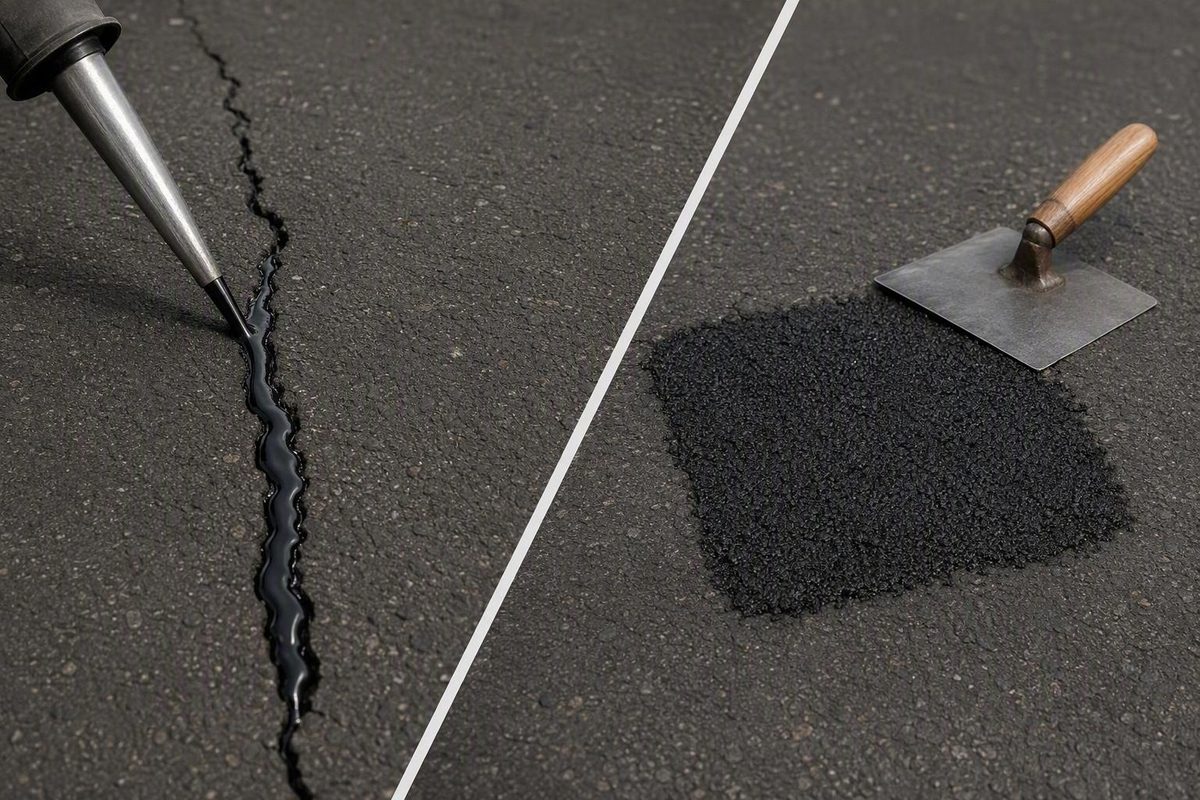
The short answer: sealing protects sound pavement; patching rebuilds failed pavement
Consider crack sealing when the damage is an isolated crack and the surrounding asphalt remains firm, level, and intact. Consider patching when asphalt is loose, missing, sunken, soft, crumbling, broken into a pothole, or no longer adequately supported.
Crack sealing places a flexible, adhesive material in or over a suitable crack. Its purpose is to restrict water, debris, and incompressible material from entering the opening while accommodating some pavement movement. Patching goes further: it removes or rebuilds a localized failed area with asphalt patch material. If the failure extends below the asphalt, a deeper patch may also remove and replace unstable base material.
The functional distinction is protection versus restoration:
- Sealing protects an asphalt system that is still substantially intact.
- Patching restores material in an area that has locally failed.
Sealant does not replace missing pavement or restore load-bearing capacity. Conversely, excavating and patching a sound, isolated crack may create unnecessary work and disruption. A contractor overview of the two methods makes the same basic distinction between sealing smaller cracks and replacing asphalt in potholes or failed areas (Sipes Asphalt & Concrete).
| Comparison point | Crack sealing | Asphalt patching |
|---|---|---|
| Primary purpose | Protect a suitable crack from infiltration and contamination | Rebuild a localized area where asphalt has failed |
| Suitable damage | Isolated or limited cracks with firm edges and stable surrounding pavement | Potholes, missing asphalt, crumbling areas, failed edges, depressions, and unstable pavement |
| Typical materials | Flexible rubberized or otherwise compatible crack sealant | Cold patch, hot-mix asphalt, or another patch system selected for the repair |
| Work scope | Inspect, clean, dry, and seal the crack; routing may be used in some applications | Define the area, remove failed material as needed, inspect or repair supporting layers, place asphalt, and compact |
| Relative disruption | Usually lower because excavation and heavy compaction are not ordinarily required | Usually higher because material may need to be cut, removed, replaced, and compacted |
| Can it address base failure? | No | Only if the repair is deep enough to expose and correct the failed material |
| Main limitation | Cannot rebuild lost material or stabilize unsupported pavement | A shallow patch can fail if the actual problem remains below or beside it |
Neither method is universally better. They address different levels and types of deterioration. One driveway may legitimately need a structural patch in a wheel path, crack sealing along a stable transverse crack elsewhere, and drainage correction beside both.
The practical question is not simply, “How wide is the crack?” It is: What part of the pavement system is still sound?
Editorial note: This guide synthesizes trade, contractor, equipment-vendor, and homeowner guidance. It is a residential triage tool, not a site-specific structural diagnosis. Commercial and road-repair principles may not transfer directly to a driveway because traffic, access, equipment, materials, and project specifications differ.
Diagnose the damage before relying on crack width
Begin by looking for material loss or movement, not by immediately reaching for a ruler.
Walk the driveway when it is dry and inspect it from several angles. Ask:
- Is asphalt missing, loose, or crumbling?
- Has the surface become a pothole or broken into movable pieces?
- Does the area sit lower than the surrounding driveway?
- Does it feel soft or visibly move under a vehicle?
- Are the crack edges intact, or are they breaking away?
- Is the crack isolated, or does it connect to many nearby cracks?
- Has the same location failed after a previous repair?
- Does water collect there or flow into the damaged area?
An isolated longitudinal, transverse, edge, thermal, or similar crack may be a sealing candidate when its sides remain intact and the surrounding asphalt is firm and level. The crack may still open and close as conditions change, which is one reason compatible flexible sealants are used.
Interconnected cracking deserves more caution. A dense pattern of small polygons is commonly called alligator or fatigue cracking. That pattern can indicate repeated structural strain, inadequate support, or deterioration extending beyond the visible crack lines. Sealing each segment may cover the openings temporarily, but it does not restore support beneath the cracked asphalt.
Appearance alone does not establish the depth of failure. A small, localized fatigue area might need a full-depth patch, while a broad pattern may justify comparing reconstruction with other larger-scale repairs. Excavation or further investigation may also show that the problem is concentrated in one layer or beside a drainage defect. Contractor guidance commonly identifies potholes, sinking pavement, soft areas, and alligator cracking as reasons to evaluate patching or deeper work instead of relying on sealant alone (Asphalt Coatings Company).
Why width is only one clue
Published width rules conflict. Some commercial guides favor sealing only relatively narrow cracks, while others accept substantially wider, non-interconnected cracks when the pavement remains structurally sound. Trade guidance also distinguishes conventional crack sealant from specialized mastic used for larger openings.
A “wide crack” can represent several different conditions:
- A stable construction joint that has opened but retains sound edges
- A thermal crack that changes width over time
- A deep void with unsupported or deteriorating sides
- A gap beside a settled pavement section
- A missing strip of asphalt that is effectively a narrow pothole
- A stable opening suited to a specialized mastic or backer-supported system
The first or second condition might be sealable with an appropriate product. The third, fourth, or fifth may require removal and rebuilding. A specialized mastic or backer-supported treatment may suit some wide but stable openings, but that does not make generic crack sealant suitable for every large gap. AsphaltPro, an industry trade publication, presents its dimensional guidance as treatment-specific and directs very wide openings toward mastic rather than conventional crack sealing (AsphaltPro crack-sealing guidance).
A practical decision flow
Use this sequence to triage the damage:
1. Is material missing or loose? If yes, move toward patching. Sealant cannot recreate the asphalt structure.
2. Does the area sink, flex, rock, or visibly move under a vehicle? If yes, investigate the supporting layers. A surface-only treatment is unlikely to correct the cause.
3. Are the cracks interconnected? If no, and the pavement is otherwise stable, sealing may be appropriate. If yes, treat the pattern as a warning of fatigue or support loss.
4. Is the damage localized? A single failed spot may be suitable for a patch. Similar failures across much of the driveway call for a broader comparison among patching, resurfacing, and reconstruction.
5. Is the surrounding pavement firm? A patch needs sound material to tie into. A seal also needs stable crack edges to support adhesion.
6. Are drainage or recurring-failure signs present? Standing water, runoff entering the defect, sinking former patches, or repeated potholes justify looking below and beside the visible damage.
Seek a professional assessment when an area visibly deflects under traffic, repeatedly fails after repair, has substantial settlement, holds water, or exhibits widespread fatigue cracking. Those conditions may require excavation, drainage evaluation, or a broader pavement assessment rather than another surface treatment.
When crack sealing is the appropriate repair
The best sealing candidate is an isolated or limited crack in otherwise serviceable asphalt. Its edges should be firm, and the nearby surface should remain level and stable. There should be no pothole, missing pavement, loose pieces, substantial settlement, or obvious movement of the surrounding area.
Flexible crack sealant is intended to remain bonded while accommodating some opening and closing of the crack. It also limits the entry of water and debris. That makes sealing a preservation treatment: it helps protect what remains but does not rebuild what has already been lost.
A sound crack-sealing workflow
Products and systems differ, so there is no universal application recipe. A reasonable workflow is:
- Inspect the crack and surrounding pavement. Confirm that you are treating a crack rather than a failed strip or unsupported area.
- Remove vegetation and loose material. Roots, dirt, detached repair material, and crumbled asphalt interfere with the repair.
- Clean the crack. The selected system may call for brushing, blowing, or another preparation method.
- Make sure it is dry. Moisture can interfere with adhesion and may become trapped beneath the repair.
- Route only when appropriate. Routing can form a cleaner, more uniform reservoir, but it is not automatically suitable for every crack.
- Apply a compatible sealant. Match the material to the crack condition, expected movement, climate, and pavement use.
- Follow the manufacturer’s requirements. Product instructions should control heating, weather limits, application dimensions, curing, personal protection, and reopening.
Routing removes material along the crack to create a more predictable reservoir. It can support consistent application in suitable pavement, but it adds another operation and may be inappropriate where asphalt is weak or densely cracked. Equipment-vendor guidance also notes that routing is not always required (Haaker Equipment Company).
Preparation matters as much as material selection. Dirt, vegetation, moisture, oil contamination, unsuitable weather, or an incompatible product can prevent a durable bond. Applying the material incorrectly or reopening the driveway before the product permits can also compromise the work.
Do not substitute generic online temperatures or cure times for the label, safety data, or technical instructions supplied with the actual product. Cold-pour homeowner products, heated rubberized materials, mastics, and other systems can have different requirements.
What crack sealant cannot do
Crack sealing cannot:
- Replace missing or disintegrated asphalt
- Level a depression
- Reinforce a soft area
- Carry vehicle loads across a failed base
- Rebuild a pothole
- Correct broad settlement
- Stop movement caused by continuing loss of support
If the sides of a crack crumble during cleaning, the opening may no longer have sound edges for the sealant to bond to. Reassess the repair category instead of simply adding more material.
Crack sealing versus crack filling
Terminology is inconsistent in residential and commercial marketing. Some contractors use “filling” and “sealing” interchangeably. Technical descriptions commonly associate crack sealing with moving or “working” cracks treated with flexible material, while crack filling is associated with less-active cracks and sometimes less-flexible products.
For a homeowner, the specification matters more than the label. Determine what the material is designed to do, which crack conditions it accepts, how much movement it accommodates, and what preparation it requires.
When patching is necessary—and how patch depth changes the repair
Patching becomes the likely repair category when the driveway has lost pavement material or local stability. Common candidates include:
- Potholes
- Broken or missing asphalt
- Loose, detached, or crumbling material
- Localized depressions
- Failed driveway edges
- Sinking former repairs
- Areas that move under traffic
- Localized fatigue cracking where the support condition needs to be exposed
Patching is a category, not one uniform procedure. The word can describe anything from placing temporary material in a pothole to excavating the asphalt and rebuilding the underlying base. A quote that says only “patch damaged area” does not identify which layers will be repaired.
Surface patching
A surface patch addresses shallow deterioration where the supporting layers remain sound. The crew may remove loose surface material, prepare the area, place asphalt, and compact it without excavating deeply.
This can be reasonable when the deterioration is genuinely confined to the surface. It cannot correct a weak, wet, poorly compacted, or displaced base beneath the repair.
Partial-depth patching
A partial-depth repair removes deterioration through part of the asphalt layer. It may be appropriate where the upper asphalt has failed but the lower pavement and base remain stable.
The important question is whether removal reaches sound material.
Full-depth patching
A full-depth patch removes failed asphalt through its full thickness and allows the exposed support material to be inspected. If the base is unstable, contaminated, displaced, or inadequately compacted, the scope may include removing and replacing that material before new asphalt is placed.
Commercial pavement guidance distinguishes surface, partial-depth, and full-depth work because they address failure at different levels. It also cautions that localized patching may be temporary where underlying or widespread deterioration remains (General Pavement Management).
What a structural patch involves
Although project details vary, a substantial patch generally follows this logic:
- Define the failed area and extend the repair to sound pavement.
- Remove loose, fractured, or unstable asphalt.
- Inspect the exposed layers.
- Correct unstable base material or a localized drainage defect where required.
- Establish sound, workable edges.
- Place an appropriate asphalt material at the required depth.
- Compact the repair adequately, including edges and separate lifts where applicable.
- Protect the repair from use until the selected material and method permit reopening.
A patch that merely covers failed material can leave the cause untouched. The repair may initially appear level, but weak material beneath it can continue to compress or move.
Cold patch, hot mix, infrared, and other labels
Cold patch can be useful for restoring access or addressing an urgent pothole when more substantial work is not immediately available. It should not automatically be equated with an excavated, base-corrected, and compacted structural repair.
Other terms describe different methods or aspects of a repair:
-
Saw-cut patching uses defined cut edges and removal of the failed area.
-
Hot-mix patching identifies the asphalt material but does not, by itself, specify excavation depth or base correction.
- Full-depth repair describes how deeply the failed pavement is removed.
These labels do not establish that the methods are interchangeable or rank their performance. Ask what will be removed, what will be inspected, how exposed base material will be handled, how asphalt will be placed, and what equipment will compact it. A paving-contractor guide lists throw-and-roll, saw-cut, infrared, and full-depth repairs as distinct options rather than equivalent procedures (S&S Paving and Construction).
A symptom-by-symptom repair decision table
This table is a triage tool, not a conclusive diagnosis of concealed pavement layers.
| Visible symptom | Questions to check | Likely repair category | Escalation trigger |
|---|---|---|---|
| Isolated transverse or longitudinal crack with intact edges | Is the pavement level and firm? Is the crack free of loose material? Does the surrounding area remain stable under traffic? | Potential crack-sealing candidate after cleaning and confirming stability | Crumbling edges, settlement, movement, or nearby interconnected cracking |
| Wide but stable opening | How deep is it? Are both edges sound? Does it move? Is it truly a crack rather than missing pavement? | Product-specific sealant, mastic, or backer-supported treatment may be possible | Unsupported edges, loose material, depression, or a product that does not approve the opening |
| Pothole or missing asphalt | How far does loose material extend? Is the bottom firm? Does water collect in it? | Patch; sealant cannot replace pavement material | Soft or wet support material, recurring pothole, or broad cracking around the opening |
| Localized depression or sinking former patch | Does it move under a vehicle? Is runoff entering the area? Was the previous repair only surface-deep? | Investigate base, drainage, moisture, and compaction before choosing patch depth | Continuing settlement, standing water, or repeated patch failure |
| Localized alligator cracking | Is the pattern confined to one area? Is there deflection, moisture, or wheel-path settlement? | Structural investigation; full-depth patching may be needed | Pattern extends beyond a practical patch area or support problems continue nearby |
| Widespread interconnected cracking or broad settlement | Are failures present across several areas? Have previous patches also failed? | Compare resurfacing and reconstruction rather than defaulting to repeated spot repairs | Widespread movement, extensive base deterioration, or unresolved drainage failure |
| Stable cracks near one failed section | Are the cracks outside the failed area still firm and isolated? | Patch the failed section and seal suitable cracks elsewhere | Cracks connect into the failed area or show the same movement and support loss |
Alligator cracking warrants particular care. It commonly signals fatigue or inadequate support, but appearance alone does not prescribe one repair depth. The response might range from a localized full-depth patch to broader reconstruction, depending on the pattern’s extent and what inspection reveals underneath.
The same caution applies to wide cracks. A large opening with intact, stable edges is not automatically a patching job. Conversely, a narrow crack accompanied by settlement or movement may indicate a problem much larger than its width suggests.
Why sealed cracks and asphalt patches fail
A repair can fail because the wrong method was selected, because the work was poorly executed, or because the condition causing the damage continued after the repair.
Water is one contributor. It can enter open cracks or failed edges, weaken supporting material, and contribute to larger cracks, depressions, and potholes. In freeze-thaw conditions, freezing water can intensify deterioration. Water is not the only cause: traffic loading, thermal movement, oxidation, inadequate support, construction quality, roots, disturbed utility areas, and unresolved drainage can also affect performance.
Common crack-sealing failure risks
Crack sealing is vulnerable when:
- The area was structurally failed before sealing began
- The crack contains dirt, vegetation, moisture, or oil
- Loose edges were not removed or reassessed
- The sealant is unsuitable for the crack’s movement or dimensions
- Product temperature or weather requirements are ignored
- The material is under-applied, over-applied, or poorly bonded
- The driveway reopens before the product permits it
- Dense cracking is treated as a collection of isolated cracks rather than a failed area
From above, the opening can look treated while water and debris continue entering beside the material.
Common patch failure risks
A patch can fail when:
- Weak asphalt remains beneath or immediately around it
- The repair stops above the actual failure
- An exposed base problem is ignored
- Patch edges are poorly prepared
- Material is placed over dirt, standing water, or loose debris
-
Compaction is insufficient or inconsistent
-
Surface drainage continues directing water into the repair
- The driveway continues settling or moving below it
Recurring potholes, sinking patches, standing water, and movement under load are reasons to investigate rather than repeat the same surface treatment. Even a carefully installed surface patch may not remain sound if the supporting layers continue to move or lose strength.
Pre-repair checklist
Before sealing or patching, check:
- Drainage: Where does roof, yard, and driveway runoff travel?
- Standing water: Does water remain in or beside the defect?
- Firmness: Are the asphalt and exposed materials solid?
- Movement: Does the area deflect, rock, or visibly move under traffic?
- Crack density: Is this one crack or a connected failure pattern?
- Edges: Are they intact or crumbling?
- Cleanliness: Can dirt, plants, oil, and loose material be removed?
- Dryness: Does the selected system require a dry surface and crack?
- Weather: Are conditions within the product’s requirements?
- Compatibility: Is the material intended for this crack or patch condition?
- Compaction: If patching, is suitable compaction equipment available?
- Access: Can failed material be removed and replacement material delivered without compromising the work?
This checklist helps separate a straightforward maintenance task from a problem requiring deeper investigation.
Cost, disruption, durability, and DIY boundaries
Crack sealing generally involves less work and disruption because it ordinarily does not require excavation, disposal, asphalt replacement, and heavy compaction. Patching usually involves more labor and equipment because failed pavement may need to be cut, removed, replaced, and compacted. One contractor comparison similarly characterizes sealing as quicker and less disruptive while noting that patching can require saws, milling equipment, rollers, or pavers (Asphalt Coatings Company).
That work-scope difference does not prove that sealing is always less expensive over the driveway’s full life. Sealing a failed area may merely postpone the correct repair and create additional removal work later. An unnecessarily deep patch for a stable crack can likewise exceed the work the condition requires.
Avoid comparing bids solely by unit price. A sealing proposal may be priced by linear foot, while a patch may be priced by area, material quantity, pothole, or project. Those units measure different types and depths of work. Ask whether each quote includes preparation, mobilization, minimum project charges, disposal, base correction, drainage work, and reopening requirements rather than treating published unit rates as a complete project price.
Actual bids and repair performance can vary with:
- Region and contractor availability
- Contractor minimums and mobilization
- Damage depth and quantity
- Access for trucks and compaction equipment
- Asphalt and sealant type
- Patch method
- Drainage work
- Traffic or access control
- Climate and season
- Disposal requirements
- Edge preparation and base correction
- Workmanship
For these reasons, there is no dependable universal price or lifespan for either treatment. A homeowner cost guide publishes method-specific unit estimates but also notes regional variation and distinguishes limited cold-patch work from more substantial hot-mix repairs; its figures should not be treated as representative of a particular local project (Remodel Cost Calculator).
Durability is conditional. Sealing may preserve a suitable crack, but it cannot make failed pavement sound. Patch performance depends heavily on whether the repair reaches the failed layers and whether continuing movement, loading, moisture, or drainage problems are corrected.
Reasonable DIY work
A homeowner may be able to clean and seal a stable crack using a product specifically designed for homeowner application. The work still requires correct crack selection, preparation, weather compliance, and adherence to the manufacturer’s label, safety data, application instructions, curing requirements, and reopening limits.
A bagged cold patch may restore temporary access at a small pothole. Treat it as a limited or emergency measure unless the product and preparation method are specifically suitable for the site.
Indicators for professional work
Professional assessment or repair is appropriate when the job involves:
- Hot-applied materials
- Saw cutting or milling
- Excavation
- Heavy compaction equipment
- Work exposed to moving vehicles
- Uncertain base conditions
- Substantial settlement
- Widespread fatigue cracking
- Repeated repair failure
- Drainage alteration
- A comparison among patching, resurfacing, and reconstruction
This is general risk triage, not a complete safety procedure. Heated materials, powered cutting equipment, excavation, compaction machinery, and traffic exposure introduce hazards that a general driveway article cannot address. Follow the product safety data, equipment manuals, applicable local requirements, and instructions from qualified contractors rather than attempting unsupported hot-applied or structural work.
When comparing proposals, request a written scope rather than accepting “repair cracks and potholes.” The scope should identify preparation, removal depth, treatment of exposed weak material, asphalt type, compaction, drainage work, and assumptions about concealed conditions.
When to combine repairs—or move beyond both
Crack sealing and patching are often complementary. A property-level maintenance plan might:
- Patch localized areas where asphalt has broken, sunk, or lost support.
- Seal isolated, stable cracks elsewhere.
- Correct downspouts, runoff channels, low spots, or edge drainage contributing to deterioration.
- Reassess the broader driveway after failed areas have been opened and inspected.
Sealing suitable cracks near a completed patch may help restrict continued infiltration, provided those cracks remain stable and have sound edges. Do not use sealant to conceal cracking that forms part of the same unsupported area.
Patching versus an overlay or reconstruction
A patch repairs a localized section.
An overlay places asphalt across a larger area while generally retaining much of the existing pavement below.
Reconstruction removes and rebuilds pavement more comprehensively and may include supporting base layers.
An overlay can improve a worn or broadly deteriorated surface when the underlying pavement is an appropriate candidate. It does not inherently correct a failed base. If the driveway continues moving underneath, cracking or settlement can recur or reflect through the new layer.
Widespread fatigue cracking, broad settlement, recurring patch failures, or extensive base deterioration can make repeated localized repairs poor value. No universal percentage of distressed driveway automatically determines whether resurfacing or reconstruction is required. Published thresholds are rules of thumb, not substitutes for site conditions, drainage, repair geometry, access, and local scope comparisons.
Final action checklist
Before choosing a contractor or material:
- Photograph and map the damage pattern.
- Mark isolated cracks separately from interconnected areas.
- Check for movement and soft spots.
- Note water flow during rain and standing water afterward.
- Determine whether material is merely cracked or actually missing.
- Decide whether the problem is localized or repeated across the driveway.
- Ask each bidder to state the proposed repair depth.
- Ask what happens if weak or wet base material is exposed.
- Ask how patch edges will be prepared.
- Ask what equipment will compact the replacement material.
- Ask whether drainage correction is included or excluded.
- Ask when vehicles may return based on the actual material used.
- Compare complete scopes, not just unit prices.
The concise decision rule is: seal an intact pavement system, patch a localized failure, and investigate or rebuild when failure is widespread or rooted below the surface.
Frequently asked questions
Is there a crack width at which asphalt must be patched instead of sealed?
No single width universally determines the repair.
Width helps with material selection, but it does not establish whether the pavement is structurally sound. Published recommendations differ, and specialized systems may use mastic or backer material for some wide but stable openings. Meanwhile, a narrow crack beside a sinking or moving area may require a deeper repair.
Evaluate edge condition, depth, movement, missing material, settlement, crack pattern, and surrounding pavement stability. Then follow the dimensional limits for the specific sealing, mastic, or patch system.
Can alligator cracks be sealed?
Applying sealant to individual alligator cracks does not restore support or load-bearing capacity. The pattern commonly warns of fatigue, repeated movement, or support problems, so sealing alone is unlikely to be adequate.
That does not mean every alligator-cracked area requires the same repair. A localized area may be suitable for full-depth patching after inspection. Widespread fatigue cracking, settlement, or recurring failure may justify reconstruction or a broader pavement strategy. The necessary depth cannot be confirmed from the pattern alone.
Can I patch failed areas and seal other cracks on the same driveway?
Yes. This is often a sensible maintenance plan.
Patch potholes, sunken sections, crumbling edges, and other localized failures. Seal separate cracks where the surrounding pavement remains firm, level, and intact. Also address drainage or runoff conditions contributing to either type of damage.
Do not assume that every crack immediately beside a failed section is independent. If those cracks move with the failed area or form part of an interconnected pattern, include them in the structural assessment.
What is the difference between crack sealing, crack filling, and sealcoating?
Crack sealing generally uses flexible material intended for cracks that experience movement. Crack filling is often associated with less-active cracks, although contractors and product sellers may use the terms interchangeably.
Sealcoating is a broader surface treatment applied over the asphalt. It is not a substitute for repairing cracks or rebuilding potholes. Necessary crack and pavement repairs should generally be completed first because sealcoat does not replace missing asphalt or restore structural capacity. A commercial comparison likewise separates targeted crack repair from whole-surface sealcoating (Capital Paving & Sealcoating).
Always read the product specification. Its approved crack conditions, movement capability, preparation requirements, application limits, and intended pavement use matter more than the name on the container.
When should I call a professional instead of repairing the asphalt myself?
Call a professional when pavement sinks, moves under traffic, repeatedly fails, holds water, has widespread alligator cracking, or contains substantial soft or crumbling areas. Those symptoms can require excavation or investigation of concealed support and drainage conditions.
Professional work is also appropriate when the repair requires hot-applied material, powered cutting, removal of failed asphalt, base replacement, heavy compaction, traffic management, or a comparison among patching, overlay, and reconstruction.
A stable isolated crack may be manageable with a homeowner-grade product used according to its instructions. A visibly failed pavement section is a different problem: repair quality depends not only on what is placed at the surface, but also on what is removed, what is found underneath, and how the replacement layers are compacted.