
Driveway Sealing Cost and Quote Factors
For professional asphalt-driveway sealing, use about $250–$865 as a preliminary benchmark, not a standardized price.
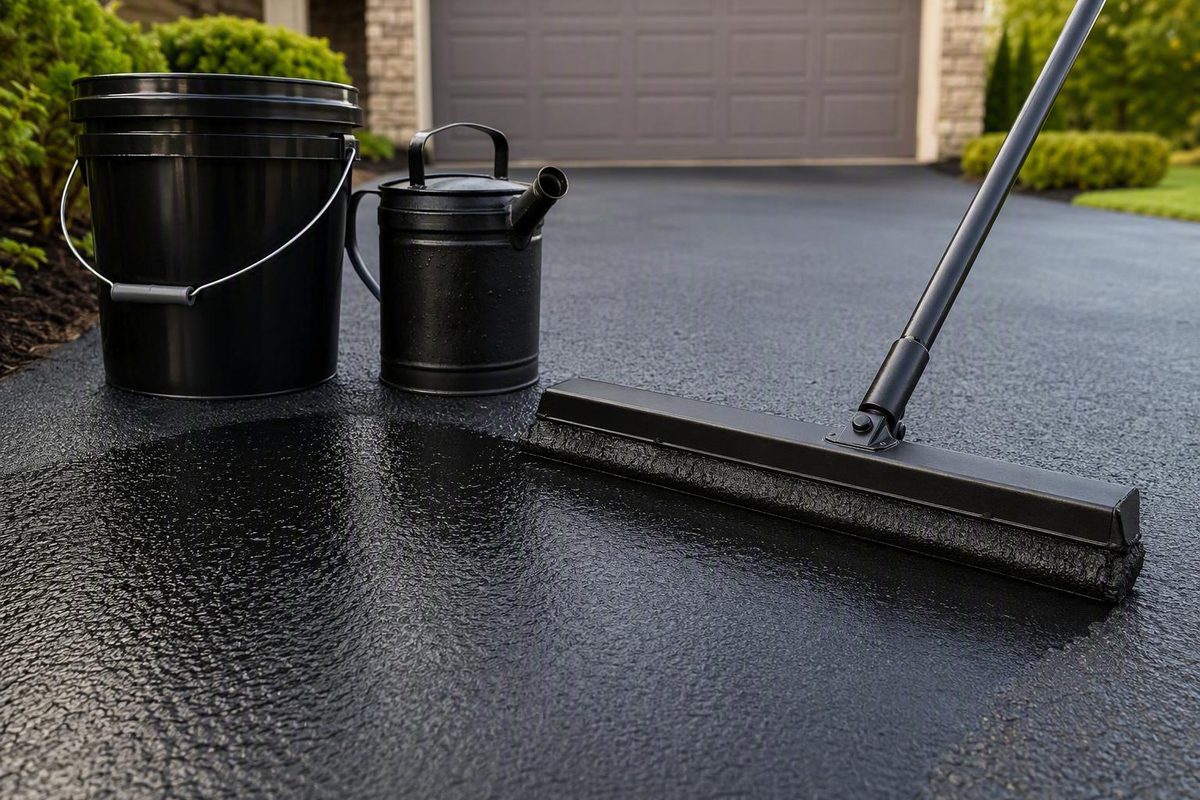
Driveway sealing cost at a glance
For a preliminary U.S. budget, treat about $250–$865 as a published-guide benchmark for many professional asphalt-driveway sealing projects—not as a standardized national price. Reported project ranges extend from roughly $150 to $2,000 or more when a driveway is unusually large, damaged, difficult to access, or preparation-intensive.
A useful starting rate is approximately $0.50–$1.00 or more per square foot installed. That is a planning range rather than a universal contractor rate, and it does not guarantee that cleaning, repairs, or multiple coats are included.
| Planning benchmark | Preliminary amount | How to use it |
|---|---|---|
| Common professional project range | About $250–$865 | A synthesis of published benchmarks, including regional figures near $281–$862 and standard-driveway estimates beginning around $200–$500 (regional cost example) |
| Broader reported project range | About $150–$2,000+ | Allows for low-cost jobs and unusually large, damaged, or complicated work |
| Installed planning rate | About $0.50–$1.00+ per sq. ft. | Multiply by measured asphalt area, then account for the minimum charge and add-ons (installed-rate basis) |
| Typical minimum charge | About $150–$250 | A possible price floor for small jobs; published examples include $150–$200 and $200–$250 (minimum-charge data) |
The broader range is supported by published estimates extending from approximately $150 to $2,000, although actual local prices and included services vary substantially. These figures are planning benchmarks, not quotes.
Yelp reports a higher quote-based rate of $0.80–$1.50 per square foot and estimates $360–$600 for a 20-by-20-foot, or 400-square-foot, driveway. Its guide says the figures are based on 286 business quotes and notes that small projects may carry a $150–$200 minimum charge.
National averages are less consistent than they initially appear:
| Published guide | Reported average or typical figure |
|---|---|
| Inch Calculator | Approximately $500 (cost guide) |
| Angi | Approximately $573 (cost guide) |
| Thumbtack | Approximately $806 (cost guide) |
These are not measurements of one standardized job. The guides use different datasets, locations, driveway sizes, and definitions of what a contractor provides. Their reported ranges also differ substantially, which is why a measured local estimate is more useful than selecting any one national average.
This article distinguishes among marketplace cost guides, regional contractor examples, supplier coverage specifications, and arithmetic illustrations. Contractor figures are presented as local examples rather than independent national surveys.
The guide primarily covers sealcoating an asphalt driveway. Do not apply these figures to concrete sealing, which involves different products, preparation methods, coverage rates, and contractor scopes.
Estimate the price from your driveway’s square footage
Start by measuring only the asphalt that will receive sealer.
For a rectangular driveway:
Square footage = length × width
A driveway measuring 20 feet wide by 25 feet long contains 500 square feet:
20 × 25 = 500 square feet
For an L-shaped or irregular driveway, divide the surface into rectangles. Calculate each rectangle separately and add the results. Exclude lawns, landscape islands, unpaved shoulders, buildings, and other areas that will not be coated.
For example:
- Main section: 20 feet × 30 feet = 600 square feet
- Side parking pad: 10 feet × 20 feet = 200 square feet
- Total asphalt area: 600 + 200 = 800 square feet
Use this estimating model:
Preliminary total = greater of contractor minimum or (square footage × local installed rate) + separately priced cleaning + repairs + optional work
The “greater of” step matters. If an area calculation produces $150 but the contractor has a $225 minimum, the minimum will probably determine the base price.
Baseline calculations
Using the published residential planning rate of $0.50–$1.00 per square foot installed, the arithmetic works as follows (rate source):
| Asphalt area | At $0.50 per sq. ft. | At $1.00 per sq. ft. | Baseline planning range |
|---|---|---|---|
| 400 sq. ft. | $200 | $400 | $200–$400 |
| 500 sq. ft. | $250 | $500 | $250–$500 |
| 800 sq. ft. | $400 | $800 | $400–$800 |
| 1,000 sq. ft. | $500 | $1,000 | $500–$1,000 |
These are editorial calculations, not price predictions. They assume reasonably straightforward asphalt and do not automatically include substantial washing, crack treatment, pothole patching, oil-spot treatment, premium products, unusual access, or an extra coat.
Published totals do not always reconcile neatly with advertised square-foot rates. One cost guide cites approximately $281–$865 for 1,000 square feet, with an average near $569. That is below the upper part of the $500–$1,000 calculation, demonstrating how datasets and project scopes can produce different answers.
Editable driveway-sealing worksheet
Copy this worksheet into a note or spreadsheet and replace the blanks:
| Budget item | Your figure |
|---|---|
| Driveway length and width, or section measurements | ____ |
| Total asphalt square footage | ____ sq. ft. |
| Local installed planning rate | $____ per sq. ft. |
| Area-based subtotal: square footage × rate | $____ |
| Contractor minimum charge | $____ |
| Base price: greater of subtotal or minimum | $____ |
| General cleaning or pressure washing | $____ |
| Crack treatment | $____ |
| Pothole or localized patching | $____ |
| Oil-spot treatment | $____ |
| Additional coat | $____ |
| Additives or special product upgrade | $____ |
| Access, travel, or mobilization charge | $____ |
| Other adjacent surfaces | $____ |
| Taxes | $____ |
| Final estimated total | $____ |
Do not add both the area-based subtotal and the minimum unless the contractor explicitly treats the minimum as a separate service fee. Ordinarily, the minimum replaces a lower area calculation.
Calculate the effective square-foot cost
To compare quotes, divide each complete quoted total by the measured asphalt area:
Effective price per square foot = complete quote ÷ asphalt square footage
Suppose a 400-square-foot driveway receives these bids:
- Bid A: $320 base price plus $100 in crack work = $420 total
- Bid B: $390 complete, including crack work
- Bid C: $300 base price, with repairs not yet priced
Bid A has an effective price of $1.05 per square foot. Bid B is approximately $0.98 per square foot and appears less expensive—but only if its crack treatment is comparable. Bid C cannot yet be evaluated because its scope and final total are incomplete.
This method exposes the effect of minimum charges and add-ons. It is more informative than comparing advertised base rates alone.
Why your quote may exceed the advertised square-foot rate
Sealcoating includes both fixed costs and variable costs.
Fixed costs do not change much with driveway size. They may include:
- Travel to the property
- Crew and equipment mobilization
- Equipment setup and cleaning
- Initial inspection
- Edge preparation
- Barricades or closure materials
- Administrative and scheduling costs
- A minimum service charge
Variable costs generally rise with area or workload. They include sealer, application labor, cleaning time, crack material, patching, and additional coats.
Published minimum-charge examples span approximately $150–$250, although each contractor sets its own policy. A minimum may be built into the quote, listed separately, or applied only when the square-foot calculation falls below a specified amount. One New Jersey contractor, for example, publishes a $200–$250 minimum; that is a regional contractor policy, not a nationwide rule.
Consider a 200-square-foot driveway:
- At $0.50 per square foot: $100
- At $1.00 per square foot: $200
- Contractor minimum: $200
In this arithmetic example, the base price could be $200 even if the contractor advertises $0.50 per square foot. Cleaning and repairs could still be added.
This is also why larger driveways sometimes cost less per square foot while costing more overall. A $200 fixed cost spread over 200 square feet equals $1 per square foot before substantial variable work. Spread over 1,000 square feet, it equals $0.20 per square foot.
Variables that change the final price
Square footage is only the beginning. Contractors may adjust a quote for:
- Pavement condition: Deteriorated asphalt generally requires more preparation.
- Cracks and potholes: These may need separately priced treatment.
- Cleaning requirements: Embedded dirt, vegetation, and debris take time to remove.
- Surface texture: Coarse or porous asphalt can consume more product.
- Oil spots: Contaminated areas may require cleaning or compatible treatment.
- Sealant type: Product prices and application requirements differ.
- Number of coats: Additional coats require more product and labor.
- Driveway shape: Curves, narrow sections, islands, and numerous edges can slow production.
- Slope: Steep surfaces may complicate application and material control.
- Access: Gates, parked vehicles, long equipment routes, or limited staging space can add labor.
- Local labor market: Contractor costs vary by region.
- Season and scheduling: Demand and workable weather windows affect availability.
- Geographic market: Travel distances, material supply, regulations, and competition differ.
Regional prices are useful only as local examples. Figures from Michigan, New Jersey, Ohio, California, Rhode Island, or British Columbia should not be converted into national benchmarks.
Before accepting a quote, ask whether travel, setup, edging, barricades, and final cleanup are included. A low square-foot rate can produce a much higher project total if routine tasks are added later.
Base sealing price versus cleaning, cracks, repairs, and extra coats
“Driveway sealing” does not describe a standardized package. One contractor may include routine sweeping, edging, limited crack treatment, two coats, and cleanup. Another may quote only cleaning and one sealer application.
Use an itemized scope to determine what you are buying.
| Work item | May be part of a basic sealing scope | May be an add-on or exclusion |
|---|---|---|
| Basic sweeping or blowing | Often | Confirm how extensive it is |
| Edging along lawns or curbs | Sometimes | May cost extra on long or overgrown edges |
| Sealant application | Yes | Confirm product, method, and coat count |
| Routine cleanup | Often | Confirm debris and container disposal |
| Pressure washing | Not always | Possible add-on where intensive washing is required |
| Crack filling or sealing | Varies widely | Ask about crack type, material, and quantity |
| Pothole patching | Usually separate | Should be defined as repair work |
| Oil-spot treatment | Often separate | Method and limitations should be specified |
| Additional coat | Often separate | Confirm whether the price includes one or two coats |
| Traction additive | Varies | Compatibility and price should be listed |
| Walkways, patios, or courts | Usually separate | Measure and price independently |
| Barricades or closure setup | Sometimes | Ask whether it is included |
| Drainage or structural repair | Not sealcoating | Requires a separate assessment |
Angi lists pressure washing at approximately $0.27–$0.39 per square foot as a planning estimate. It is not a universal surcharge: some driveways need only sweeping or blowing, while others require more intensive cleaning.
One New Jersey contractor lists $50–$100 for minor crack work, $100–$200 for major repairs, and a 30%–50% premium for a second coat. These are regional, commercially published estimates rather than national prices (contractor pricing example).
An additional coat increases material and labor. Although published estimates place the premium around 30%–50%, that does not mean every driveway needs two coats or that every contractor applies the same percentage.
Sealcoat is not crack or pothole repair
Applying sealcoat over a defect does not repair the defect beneath it.
The contractor should identify whether the proposed intervention is:
- Cosmetic surface preparation
- Crack filling or crack sealing
- A localized patch
- Edge repair
- Drainage correction
- Resurfacing
- Full-depth pavement replacement
A quote that simply says “repair as needed” is too vague for a fair comparison.
Porous surfaces can require more material
Manufacturer coverage rates are based on particular products, methods, and surface assumptions. A coarse, porous, weathered, or deteriorated driveway may consume more sealer than a smooth, dense surface of the same size.
That difference affects DIY product quantities and professional bids. If one contractor expects substantially more product use, ask whether the reason is surface texture, coat count, application method, or a different product specification.
Budget by preparation level
Instead of forcing every driveway into one national total, classify the preparation it needs.
Low preparation
- Sound asphalt
- Little vegetation or debris
- No substantial staining
- Few or no defects
- Straightforward shape and access
The square-foot rate or minimum charge may provide a reasonable baseline.
Typical preparation
- Ordinary sweeping or blowing
- Edge trimming
- Limited crack treatment
- A few stains or minor surface irregularities
- Normal residential access
Budget for the base application plus clearly identified preparation.
High preparation
- Intensive cleaning
- Numerous cracks or localized failures
- Potholes or deteriorated edges
- Coarse or porous pavement
- Difficult access, steep slope, or complicated geometry
- Multiple extras or additional coats
For high-preparation projects, the advertised base rate may account for only part of the complete price. An itemized repair and preparation assessment is more useful than a simple square-foot calculator.
Sealant choice, coat count, and material cost
Material prices and installed prices answer different questions.
A material-only rate describes the approximate sealer cost allocated across an area. It does not necessarily include labor, cleaning, crack treatment, application tools, equipment, travel, minimum charges, waste, or taxes.
Published guides place the broad material-only range across the sealants they discuss at approximately $0.06–$0.40 per square foot. The following examples combine category figures from those guides; they are not complete project rates (material-cost breakdown).
| Sealant category | Approximate material-only planning figure |
|---|---|
| Asphalt emulsion | $0.08–$0.10 per sq. ft. |
| Oil-based product | $0.15–$0.20 per sq. ft. |
| Latex acrylic | About $0.20–$0.25 per sq. ft. |
| Eco-friendly option in one guide | $0.25–$0.38 per sq. ft. |
| Broad range across products discussed | $0.06–$0.40 per sq. ft. |
These categories do not guarantee equal performance or suitability. Product names and formulations vary, and a generic category does not replace the manufacturer’s technical instructions.
Do not multiply one material rate by square footage and call the result a complete project budget. A usable DIY or contractor estimate must also account for:
- Product-specific coverage
- Number of coats
- Pavement texture and absorption
- Application method
- Cleaning and repairs
- Applicators and tools
- Labor
- Waste and leftover quantities
- Container sizes
- Rentals
- Taxes
Coverage is product-specific
One commercial seller states that its product covers approximately 100 square feet per gallon for one sprayed coat, 50 square feet per gallon for two sprayed coats, and 50–60 square feet per gallon for manual application. Those figures apply to that seller’s product and described methods; they are not universal coverage rules (product-specific calculator).
Actual consumption can change with:
- Surface porosity
- Pavement texture
- Product solids and formulation
- Application thickness
- Spray, brush, roller, or squeegee application
- Coat count
- Waste and container residue
- Weather and surface conditions permitted by the product
Follow the instructions for the exact product selected. Do not import dilution percentages, coverage rates, temperature limits, or coat guidance from another manufacturer’s sealer.
Coal-tar products have been banned in some areas because of environmental concerns, according to Yelp’s cost guide. Check current municipal, county, and state requirements before selecting a product rather than relying on a nationwide assumption.
DIY driveway sealing versus professional service
DIY can reduce paid labor, but comparing a few buckets of sealer with a complete professional quote creates a misleading savings estimate. Compare equivalent scopes.
If a professional bid includes cleaning, crack treatment, edging, two coats, barricades, and cleanup, the DIY budget must account for those same tasks and supplies.
DIY cost checklist
Include all applicable items:
- Driveway sealer
- Crack filler or repair products
- Degreaser or surface cleaner
- Oil-spot treatment
- Applicator, squeegee, roller, or brush
- Edge brushes
- Mixing paddle and compatible drill
- Buckets or mixing containers
- Broom, blower, or pressure washer
- Rental charges and deposits
- Protective clothing, gloves, footwear, and eye protection
- Masking and protection for adjacent surfaces
- Barricades or caution tape
- Product waste and extra material
- Sales tax
- Disposal or cleanup supplies
- Homeowner preparation and application time
One national guide estimates $150–$200 for DIY tools and preparation supplies before buying sealant, plus approximately $50–$120 per day for a pressure-washer rental. These costs can materially reduce the apparent savings if the homeowner does not already own suitable equipment.
An Ohio contractor estimates $125–$330 in DIY materials for a 600–1,000-square-foot driveway. Keep the location and commercial context attached to that figure: it is a 2026 Ohio contractor estimate, not a national retail survey (Ohio DIY breakdown).
A Canadian contractor calculated approximately $350–$410 for a 1,000-square-foot DIY job. The figures appear to be Canadian dollars, assume the homeowner already owns several tools, and exclude some possible repair costs. They should not be combined with U.S. estimates without checking currency, taxes, and local retail prices (British Columbia calculation).
Will DIY actually save money?
It may, particularly when:
- The driveway is sound and manageable
- Preparation is limited
- The homeowner already owns suitable tools
- The selected product is available locally
- The homeowner can follow its preparation and application instructions
- Weather and access allow uninterrupted work
Savings can narrow when the project requires:
- Equipment rental
- Several repair products
- More sealer than expected
- Replacement of unsuitable tools
- Extensive edge and surface preparation
- Correction of application mistakes
- Disposal and cleanup
- A substantial amount of homeowner time
Professional service may be more practical where the driveway has numerous defects, substantial staining, uncertain preparation requirements, difficult access, or a complicated shape. Convenience, experience, equipment, and a written scope are legitimate decision factors, but they do not guarantee that professional work will always last longer or cost less over time.
The fairest comparison is:
Complete DIY cost, including tools and time, versus the complete professional price for the same preparation, product category, coat count, repairs, and cleanup.
When sealing is not the same as repairing the driveway
Sealcoating means applying a coating to a prepared asphalt surface.
Existing cracks and potholes generally require treatment before sealing because coating the surface does not repair those defects. Thumbtack similarly notes that cracks and potholes should be addressed first and that coarse asphalt may require more sealant.
Before requesting estimates, inspect and photograph:
- Individual cracks
- Interconnected or widespread cracking
- Potholes
- Depressions
- Loose or crumbling edges
- Areas where water stands
- Heaved or settled sections
- Surface raveling or loose aggregate
- Oil-contaminated areas
- Previous patches that are separating
Avoid relying on an unsupported visual rule such as “seal if cracks are under a certain width.” The appropriate intervention depends on the type, pattern, movement, and cause of deterioration.
Isolated defects may be handled as preparatory repairs before sealcoating.
Ask every bidder to separate prices for:
- Cleaning and preparation
- Crack treatment
- Pothole or localized patching
- Drainage correction
- Sealcoat application
- Additional coats or additives
- Resurfacing
- Replacement
This separation prevents a sealing proposal from being compared with a fundamentally different repair proposal. It also avoids the assumption that a dark new coating has corrected defects underneath.
The available cost evidence in this guide overwhelmingly concerns asphalt. Owners of concrete driveways should request a concrete-specific product recommendation and estimate rather than applying asphalt sealcoating rates.
How to compare driveway-sealing quotes
Obtain two or three itemized local estimates. Published national figures and regional prices vary enough that several comparable local bids provide a more useful benchmark than any one average.
Give each bidder the same measurements, photos, known drainage concerns, and list of surfaces. Then use the same checklist for every proposal.
Quote checklist
Ask each bidder to specify:
- Measured asphalt square footage
- Measurement method
- Minimum service charge
- Observed pavement condition
- Basic cleaning method
- Whether pressure washing is included
- Edge trimming and preparation
- Crack-treatment method and quantity
- Pothole or localized patching
- Oil-spot cleaning or priming
- Product name, manufacturer, or general type
- Number of coats
- Application method
- Traction or other additives
- Adjacent surfaces included
- Travel or mobilization charges
- Barricades or closure setup
- Taxes
- Cleanup and disposal
- Explicit exclusions
- Complete project total
Ask whether the number shown is a complete project total or only a base price subject to additional preparation and repair charges. If quantities cannot be known until work begins, request unit prices or a written approval process for change orders.
Weather and access restrictions
Ask the bidder to state:
- Acceptable surface and air conditions
- Required rain-free window
- What happens if weather interrupts the work
- How long people must remain off the surface
- How long vehicles must remain off the surface
- When sprinklers or other water sources can resume
- Whether shaded areas require different handling
Do not assume one contractor’s curing rule applies to every product. Follow the written instructions for the specified sealer and the contractor’s documented requirements.
Warranty questions
If a warranty is offered, ask:
- What does it cover?
- How long does it apply?
- What conditions void it?
- Does it cover only the coating?
- Does it also cover crack treatment or patches?
- Are peeling, discoloration, tire marks, or wear treated differently?
- Is drainage-related damage excluded?
- Who pays for preparation if corrective work is required?
A warranty should not be treated as a promise that the underlying pavement will remain free of cracks or future damage.
Fill-in bid-comparison table
| Scope category | Bidder 1 | Bidder 2 | Bidder 3 |
|---|---|---|---|
| Measured square footage | |||
| Minimum charge | |||
| Base sealing price | |||
| Cleaning method | |||
| Pressure washing | |||
| Edging | |||
| Crack treatment | |||
| Pothole patching | |||
| Oil-spot treatment | |||
| Product name or type | |||
| Number of coats | |||
| Application method | |||
| Additives | |||
| Barricades or closure | |||
| Cleanup | |||
| Taxes | |||
| Warranty | |||
| Exclusions or unclear items | |||
| Complete quoted total | |||
| Effective cost per sq. ft. |
Highlight every blank or ambiguous line. A missing item is not necessarily included.
Driveway-sealing cost FAQs
How much does it cost to seal a standard two-car asphalt driveway?
There is no universal standard size, but Inch Calculator describes a typical two-car driveway as approximately 24 by 20 feet, or 480 square feet. At the $0.50–$1.00 installed planning rate, the arithmetic baseline is about $240–$480 before substantial cleaning, repairs, premium products, extra coats, or a contractor minimum.
As a regional example rather than a national price, the New Jersey contractor cited above quotes approximately $300–$450 for a 400–600-square-foot two-car driveway. The best estimate for a specific property still comes from measured area and an itemized local scope.
Why does a small driveway cost more per square foot to seal?
Travel, mobilization, setup, equipment cleaning, and administrative time do not disappear when the driveway is small. Contractors may therefore impose a minimum charge.
If a 200-square-foot driveway calculates to $100 at $0.50 per square foot but the contractor’s minimum is $200, the effective base rate becomes $1 per square foot. A larger driveway spreads those fixed costs over more area, potentially reducing its effective square-foot price even as the total bill increases.
Does driveway sealing include crack filling and pothole repair?
Sometimes limited crack treatment is included, but there is no standard rule. Other contractors price all crack filling and pothole patching separately.
Do not assume sealcoat itself repairs defects. Ask the bidder to identify the cleaning, crack treatment, patching, and oil-spot work included in writing. Potholes, extensive cracking, failed edges, and drainage problems may require a separate repair assessment before sealing.
Is sealing an asphalt driveway yourself cheaper than hiring a professional?
It can be, but savings are not guaranteed. A complete DIY budget includes sealer, crack filler, cleaner, applicators, mixing supplies, protective equipment, rentals, taxes, waste, and homeowner time.
DIY tends to be more practical for a sound, manageable driveway when the homeowner already owns suitable tools and can follow the selected product’s instructions. Professional estimates may be preferable when repairs, intensive cleaning, difficult access, uncertain product needs, or a complicated application make the project harder to control.
Compare equivalent preparation, repairs, coat count, and cleanup rather than placing DIY material prices beside a complete professional service.
Do these asphalt sealcoating prices apply to a concrete driveway?
No. The evidence and planning ranges in this guide primarily concern asphalt sealcoating.
For a concrete driveway, request a concrete-specific assessment that identifies the surface condition, selected product, preparation, application method, and complete installed price.
Build your final driveway-sealing budget
Measure the asphalt area first. Calculate a baseline using a locally relevant installed rate, then apply the contractor’s minimum if it exceeds the area-based subtotal. List cleaning, crack treatment, patching, additional coats, access charges, and taxes separately.
Next, obtain two or three itemized local quotes built around the same scope. Compare each complete total and effective square-foot price—not merely the advertised base rate.
The most useful price is not the lowest headline number. It is the complete cost of the preparation, product, coat count, and repairs the driveway actually needs.