
Asphalt Overlay vs. Replacement by Pavement Condition
A hybrid treatment can preserve sound pavement while rebuilding isolated failed sections, creating a practical middle path between the two main options.
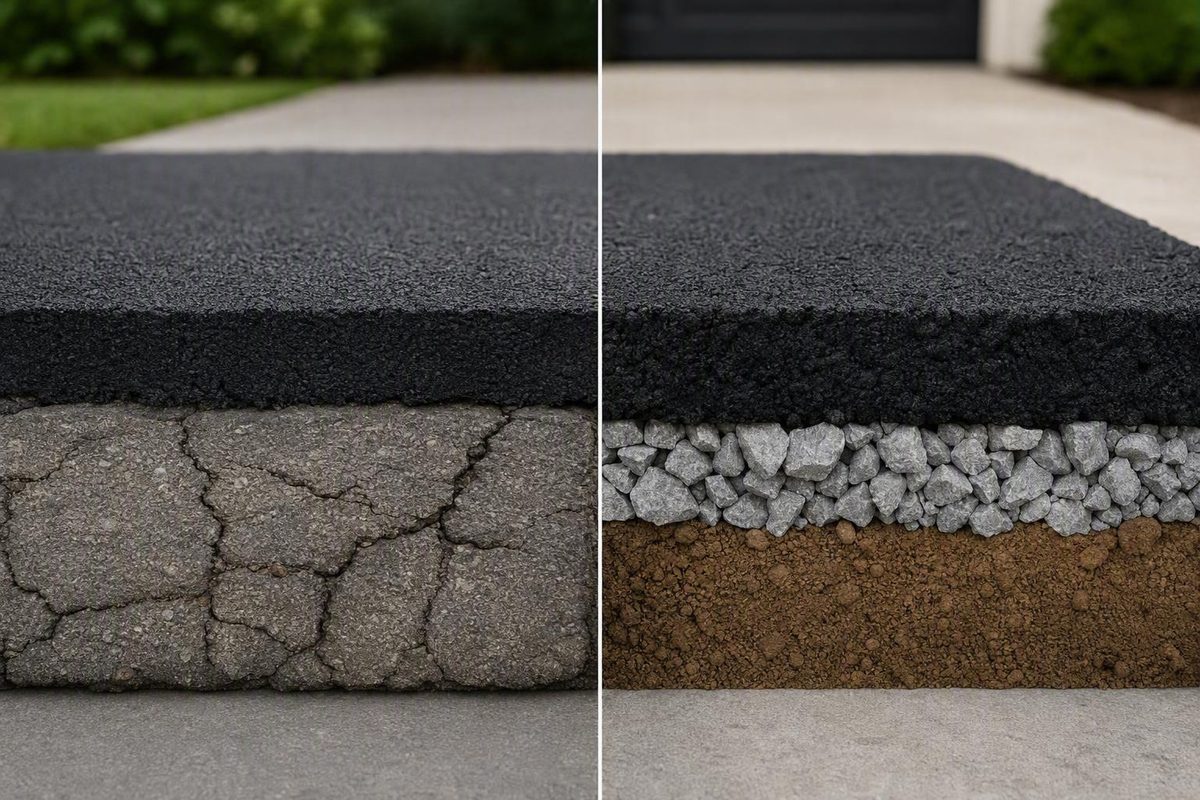
The short answer: choose by structural condition, not appearance
An asphalt overlay retains the existing pavement structure and adds a new asphalt surface. Full-depth replacement removes the existing pavement and repairs or rebuilds deficient base, subgrade, grading, or drainage components as the project requires before new asphalt is installed.
The practical decision rule is:
- Surface deterioration over stable support: investigate a direct overlay.
- Stable pavement with elevation, tie-in, or surface-irregularity constraints: investigate a mill-and-overlay.
- A few isolated structural failures: consider full-depth repairs in those areas, followed by an overlay.
- Widespread base failure, unstable soil, extensive settlement, or unresolved drainage failure: investigate full replacement or engineered reconstruction.
Contractor-authored guidance commonly treats a sound base and subgrade as prerequisites for overlay and identifies structural or drainage failure as a reason to consider replacement. These are screening principles, not proof of what is happening at a particular property. Surface appearance alone may not reveal the condition below the asphalt, which is why a site assessment may be needed before choosing a treatment (Pinnacle Paving).
Contractor comparisons also generally describe overlay as the lower-cost and lower-disruption option upfront because it preserves more existing pavement, while replacement involves more removal, hauling, labor, and material. That financial advantage applies only when the retained pavement is suitable for reuse (Kilgore Companies).
| Decision factor | Direct overlay | Mill-and-overlay | Localized full-depth repair plus overlay | Full replacement |
|---|---|---|---|---|
| Structure retained | Existing asphalt and supporting layers | Lower asphalt layers and supporting structure | Sound pavement retained; failed sections rebuilt | Existing asphalt removed; deficient supporting layers addressed as required |
| Corrective scope | Surface renewal and limited preparation | Upper-surface removal, transition work, surface correction, and repaving | Structural repair in defined areas plus broader resurfacing | Base, subgrade, grading, or drainage correction within the designed scope |
| Relative upfront expense | Usually lower when little preparation is required | Often above direct overlay | Depends heavily on repair quantity | Usually higher because demolition and reconstruction are broader |
| Relative disruption | Usually least | More equipment and hauling than direct overlay | Moderate and dependent on patching | Usually greatest |
| Principal limitation | Preserves hidden defects and raises elevation | Surface removal alone does not repair failed support | Can become inefficient when failure is widespread | Greater demolition, hauling, cost, and interruption |
| Most suitable conditions | Stable structure, workable elevations, surface wear | Stable structure with height, tie-in, irregularity, or limited slope concerns | Isolated failures within otherwise sound pavement | Widespread structural distress or support and drainage problems |
Price does not establish technical suitability. An inexpensive overlay can be poor value if the retained pavement is moving or water-damaged. Conversely, severe fading, roughness, or widespread surface aging does not prove that the base has failed. Sound pavement should not automatically be demolished because it looks tired.
Think of the alternatives as a continuum rather than a binary choice:
- Direct overlay
- Mill-and-overlay
- Localized full-depth repairs followed by overlay
- Full-depth replacement or reconstruction
Do not make a final choice from photographs, pavement age, or a single crack-width rule. Crack width is also incomplete evidence: pattern, movement, depth, location, extent, and surrounding deformation affect what the crack means.
What each paving option actually includes
A direct overlay places a new asphalt course over prepared existing pavement without first removing the entire asphalt structure. The old pavement remains part of the finished system.
A typical workflow includes:
- Walking the pavement and mapping visible defects.
- Identifying areas that need patching, leveling, or deeper repair.
- Repairing potholes, severe cracks, depressions, or failed spots as specified.
- Cleaning dirt, vegetation, debris, and loose material from the surface.
- Applying tack coat to promote adhesion between the old and new asphalt.
- Placing the specified asphalt mix.
- Compacting the new course and checking the finished surface and transitions.
These steps vary by project. The important point is that “overlay” should not mean simply covering every visible defect. Inspection, preparation, repairs, bonding, placement, and compaction all belong in a properly defined scope.
Terminology is inconsistent. Some contractors use overlay to describe direct paving over the old surface. Others use the same term for work that includes milling first. One contractor expressly separates direct overlay, milling, and full replacement and describes tack coat as a way to improve adhesion between retained pavement and the new course (American Paving).
Never assume that two bids labeled “overlay” include the same work. Ask whether each proposal includes:
- Milling, including its area and depth
- Transitional milling at garages, roads, curbs, drains, or concrete
- Crack treatment
- Leveling material
- Full-depth patching
- Tack coat
- A defined compacted asphalt thickness
- Edge and drainage work
- Utility adjustments
- Final elevation and transition checks
A mill-and-overlay removes a selected upper depth of existing asphalt before new asphalt is placed. Milling can remove deteriorated surface material, preserve finished elevations, improve tie-ins, correct some surface irregularities, and modify limited surface slopes. It may be useful where a direct overlay would leave the pavement too high at a garage, sidewalk, curb, drain, utility cover, or road connection.
Milling is not reconstruction. Removing the upper surface does not restore a weak aggregate base, stabilize pumping soil, or repair failed subsurface drainage. If the lower pavement or supporting material is moving, deeper work is still needed.
A full replacement begins by removing existing asphalt. The contractor can then inspect and address deficient materials or conditions beneath it. Depending on observed conditions and the project design, the work may include:
- Removing unsuitable or water-saturated material
- Repairing soft spots
- Stabilizing or regrading the subgrade
- Installing or supplementing aggregate base
- Correcting drainage components
- Compacting supporting layers
- Placing one or more asphalt courses
- Restoring edges, shoulders, striping, or adjacent areas
“Full replacement” does not necessarily mean excavating every base layer across the entire site. If part of the existing base is sound and suitable for reuse, the design may retain it. Excavation depth should follow observed conditions, loading needs, drainage requirements, and the specification—not a sales label.
Replacement is not free of uncertainty.
Do not treat a frequently quoted overlay thickness as a universal specification. Appropriate compacted thickness depends on the existing pavement, asphalt mix, expected vehicles, climate, supporting layers, intended use, and project design. A lightly used residential driveway and a commercial loading lane should not automatically receive the same pavement section.
Read the pavement: surface wear versus structural distress
Visible symptoms help identify risk, but they rarely provide a complete diagnosis. Use them to decide what should be investigated next.
The matrix below reflects conditions repeatedly identified in contractor-authored guidance. It is a screening tool, not an engineering standard or a substitute for site-specific evaluation (Wright Construction).
| Symptom | What it may mean | Sensible next step |
|---|---|---|
| Oxidation or fading | Surface aging and binder exposure | Check brittleness, cracking, drainage, and structural stability; overlay may be possible |
| Raveling or aggregate loss | Deterioration of surface material | Determine depth and extent; remove or repair loose and failed areas before resurfacing |
| Isolated stable cracks | Localized thermal, shrinkage, joint, or minor movement distress | Evaluate movement and depth; treat cracks and confirm support is stable |
| Block cracking | Aging and shrinkage in a block-like pattern | Check whether cracking is confined to the surface or accompanied by movement |
| Alligator cracking | Fatigue distress potentially associated with repeated loading, inadequate pavement structure, or weakened support | Investigate depth, moisture, support condition, and extent; do not simply conceal widespread areas |
| Recurring potholes | Repeated water entry, failed patch edges, weak pavement, or deficient support | Excavate selected areas or otherwise investigate below the surface |
| Rutting | Surface instability, compaction problems, repeated loading, or deeper deformation | Determine whether deformation is confined to asphalt or extends into supporting layers |
| Settlement | Loss of support, consolidation, erosion, utility-trench movement, or another subsurface change | Investigate the affected section and likely cause before choosing a surface treatment |
| Heaving | Upward movement associated with soil, roots, frost, or trapped moisture | Identify the source and likely depth of movement |
| Pumping or visible water movement | Water and fine material moving under loading | Investigate drainage and support conditions |
| Soft spots | Weak, wet, poorly compacted, or deteriorated material | Probe or excavate and repair to sound material |
| Chronic ponding | Inadequate surface slope, settlement, blocked drainage, or subsurface failure | Survey elevations and distinguish surface geometry from a deeper drainage problem |
Oxidation, fading, roughness, limited raveling, and a small number of stable cracks may be compatible with overlay when the underlying pavement and drainage remain sound. That does not eliminate preparation. Loose material, open cracks, depressions, damaged edges, and isolated failures still need to be addressed within the bid.
Alligator cracking appears as interconnected cracks resembling reptile skin. Contractor guidance commonly treats it as fatigue distress that can be associated with repeated loading, insufficient pavement structure, or weakened support.
Extent matters. One small alligatored area near a repeatedly loaded edge may be a candidate for excavation and full-depth patching. Interconnected cracking across much of a driveway or throughout traffic lanes raises a different question: whether enough stable pavement remains to justify preserving it.
Recurring potholes, soft areas, settlement, heaving, pumping, shifting, and severe rutting are warning signs because they suggest movement or weakness rather than simple surface aging. None proves that every part of the pavement must be replaced. Each does weaken the case for an uninvestigated direct overlay.
Standing water also requires diagnosis rather than a reflexive treatment. A shallow low spot may be correctable through milling, leveling, or adjustment of surface slopes. Ponding can also result from settlement, failed drainage infrastructure, inadequate outlet elevation, or moisture-weakened support.
Avoid universal cutoffs such as “replace if any crack is wider than X” or “overlay if ruts are shallower than Y.” The contractor sources in the evidence base offer different thresholds, but they do not establish independent standards. Crack pattern, seasonal movement, depth, area affected, vehicle loading, underlying materials, and adjacent distress all matter.
The homeowner-friendly rule is: visual clues can show where risk exists, but they cannot prove that the base and subgrade are sound.
Why overlays fail: reflective cracking, water, and elevation
Reflective cracking occurs when cracks, joints, or movement in retained pavement propagate into the new asphalt. The new layer may initially look uniform, but it still rests on the old pavement. If that pavement opens, moves, or settles, the stress may eventually appear above.
An overlay renews the surface; it does not automatically remove the cause of:
- Deep cracking
- Base movement
- Settlement
- Unstable soil
- Repeated deformation
- Water intrusion
- Failed drainage components
It would be misleading to promise when a crack will return. Contractor sources provide conflicting estimates, and actual performance depends on the old pavement’s condition, preparation, climate, traffic, materials, bonding, compaction, water exposure, and maintenance. The defensible conclusion is that reflective cracking remains a risk—not that it follows a universal timetable.
A direct overlay also raises the finished pavement elevation. Before approving one, check:
- Garage slabs and door clearances
- House and outbuilding thresholds
- Sidewalks and concrete aprons
- Curbs and curb reveal
- Catch basins, trench drains, and other inlets
- Utility covers and valve boxes
- Road and alley tie-ins
- Edges where water must leave the pavement
- Accessible routes and transitions
- Gates, tracks, and low-clearance doors
Added height can flatten a needed slope, trap water behind a high edge, reduce usable inlet depth, or direct runoff toward a building. Contractor guidance on overlay feasibility similarly identifies buildings, concrete joints, pitch, and available elevation as factors that can make milling or lowered transitions necessary (Wolf Paving).
Separate these surface-elevation problems from subsurface drainage failure. Milling may restore curb reveal, improve a tie-in, or help reshape a limited low area. It cannot repair a collapsed pipe, create an absent outlet, stabilize water-saturated support, or stop groundwater movement by itself.
Tack coat promotes adhesion between old and new asphalt and helps reduce separation between layers. Good bonding is important, but it cannot compensate for unstable support. A well-bonded overlay can still crack or deform if the structure below it moves.
Prior overlays are another assessment factor, not an automatic disqualifier. Ask:
- How many layers are present?
- Are the layers bonded?
- Are they cracked or slipping?
- Is there enough clearance for another course?
- Does the combined pavement have suitable capacity for the expected loading?
- Can water still drain as intended?
- Would milling expose sound, stable material?
Accumulated height may rule out another direct overlay even where support remains stable. Milling may make the elevations workable, but reconstruction may still be necessary if retained layers, supporting materials, or drainage systems have failed.
The middle path: localized repairs followed by an overlay
Not every project must choose between covering everything and removing everything. A hybrid treatment can preserve sound pavement while rebuilding isolated failed sections.
The process generally works like this:
- Map distress across the driveway or lot.
- Classify areas as surface wear, localized structural failure, or widespread structural failure.
- Mark the boundaries of failed areas.
- Excavate those areas to sound material.
- Repair localized soft support, water pathways, or base defects.
- Restore the pavement section and compact the required layers.
- Repair or level remaining surface defects.
- Overlay the stable pavement and repaired sections.
This approach is strongest when failures are genuinely isolated. A few repairable areas do not necessarily justify tearing out every sound square foot. Conversely, interconnected fatigue cracking, recurrent depressions, and numerous soft spots may leave too little reliable pavement to serve as the foundation for a new surface.
Depressions, deep potholes, and severe cracks should not simply be hidden. Depending on their cause, they may need full-depth patching, crack treatment, or leveling before paving. Otherwise, the new course may inherit poor support or an irregular profile.
Consider a residential driveway that is oxidized but firm across most of its area. One outer edge settles when vehicles drive over it, perhaps because it lacks lateral support or the material below is soft. A reasonable proposal might reconstruct that edge to sound material, improve support, repair the transition, and overlay the stable remainder. Removing the entire driveway would add work without necessarily correcting anything beyond the isolated failure.
A utility-cut failure can be approached similarly. If the trench area settled but the surrounding driveway remains stable, the failed section may be excavated and rebuilt before the broader surface is overlaid. The contractor still needs to investigate why the trench settled and establish sound patch boundaries.
In a parking lot, treatment can vary by loading zone. Full-depth repair or reconstruction may be appropriate in heavy-load lanes while stable stalls receive a mill-and-overlay. Clean boundaries, transitions, drainage, and traffic staging must still be designed.
Mill-and-overlay occupies another middle position. It may suit structurally stable pavement whose upper surface is deteriorated, irregular, poorly bonded, or too high for another direct lift. A contractor’s description of a typical overlay project includes inspection, repairs, optional milling, cleaning, tack coating, placement, and compaction, illustrating why the detailed scope matters more than the label (HMA Contracting).
There is no supported universal percentage of failed pavement at which replacement automatically becomes preferable. The crossover depends on:
- Whether failures are isolated or interconnected
- Excavation and mobilization costs
- Whether water problems can be isolated
- The condition between failed areas
- Transition complexity
- Expected traffic
- Future maintenance risk
- Whether extensive patching would leave a fragmented foundation
- The owner’s analysis period and tolerance for uncertainty
Ask bidders to price the hybrid honestly rather than assuming it is always the winning compromise. Once full-depth patches, extensive milling, drainage corrections, and complicated transitions accumulate, broader reconstruction may become competitive. That is a project-specific financial conclusion, not a universal rule.
How to verify what is happening below the asphalt
A contractor should assess more than the visible black surface before recommending an overlay.
Use this pre-bid checklist:
- Distress map: Where are cracks, potholes, ruts, depressions, soft spots, and edge failures?
- Repair history: Which patches or cracks have returned?
- Prior overlays: How many layers appear to exist, and where?
- Drainage paths: Where should water flow, and where does it actually flow?
- Ponding locations: How broad are low areas after rain?
- Elevations and transitions: Is there room at garages, concrete, curbs, drains, and roads?
- Edge condition: Are edges supported, broken, eroded, or lower than adjacent soil?
- Traffic type: Does the pavement carry cars, delivery vehicles, garbage trucks, buses, trailers, or heavy trucks?
- Loading pattern: Where do vehicles turn, stop, park, or repeatedly track?
- Soil and moisture concerns: Are there wet areas, clayey soils, springs, utility trenches, or eroding slopes?
- Seasonal movement: Do cracks open, close, heave, or settle during particular seasons?
A visual walk-through is useful for locating symptoms and deciding where further investigation may be needed. It may not establish the thickness, bonding, composition, moisture condition, or structural quality of hidden layers.
Pavement cores remove samples at selected locations. Core locations should be selected to compare distressed and apparently sound areas or answer a specific uncertainty.
Where settlement, pumping, extensive fatigue cracking, or unexplained recurring failures are present, further investigation may include:
- Test pits
- Probing or excavation at failed areas
- Subgrade or soil evaluation
- Drainage inspection
- Elevation survey
- Moisture investigation
- Review of original plans or repair records
- Other pavement or geotechnical evaluation appropriate to the property
Some contractor guidance also identifies core sampling and ground-penetrating radar as possible tools for investigating hidden pavement conditions. These methods reduce uncertainty but do not turn selected observations into a guarantee for the entire site (S&S Paving).
Ask every bidder: What evidence supports your statement that the base is sound?
A useful answer should identify its basis, such as visual observations, cores, test pits, drainage behavior, known construction records, material exposed during prior repairs, or an engineering evaluation. “It looks fine” is weaker than a documented explanation of why the distress is believed to be surface-level.
Also ask the contractor to distinguish among:
- A surface-grade problem that milling or leveling may improve
- A support problem that requires base or subgrade work
- A drainage-infrastructure problem that requires an outlet, pipe, inlet, underdrain, or broader redesign
More formal evaluation is especially prudent for heavy-truck areas, extensive commercial properties, complicated drainage, repeated pavement failures, substantial settlement, or conflicting contractor diagnoses. Its purpose is to reduce risk—not guarantee a particular service life.
Cost, downtime, and lifecycle value without misleading averages
An overlay generally involves less demolition, excavation, hauling, labor, and new material than full replacement. Contractor-authored comparisons therefore commonly present it as less expensive and less disruptive upfront when the pavement is genuinely overlay-ready.
No universal savings percentage should be promised. Bid prices vary with:
- Geographic market
- Total pavement area
- Mobilization
- Site access
- Milling quantity and depth
- Number and depth of patches
- Excavation and disposal
- Base repair
- Drainage work
- Grading and elevation control
- Asphalt mix and compacted thickness
- Traffic control
- Striping and markings
- Utility adjustments
- Local labor and material prices
- Project phasing and working hours
Commercial cost guides publish planning ranges, but the supplied examples are contractor-authored rather than neutral national benchmarks. One such guide identifies property size, access, traffic control, disposal, drainage, and grading among the factors affecting project cost (The Pavement Group).
Contractor estimates also commonly assign overlays a shorter expected service period than full replacement. Those ranges should not be merged into a promise. Performance depends on retained pavement condition, design, preparation, soil, water, traffic, climate, materials, construction quality, and maintenance.
The apparent price gap can narrow quickly when an overlay requires:
- Transitional milling
- Numerous full-depth patches
- Leveling material
- Removal of unstable layers
- Drainage improvements
- Utility-cover adjustments
- Edge reconstruction
- Multiple mobilizations
- Extensive traffic control
On a small or complicated site, the preparation needed to make an overlay viable may eliminate its initial advantage. Replacement may then offer a more coherent scope, although unforeseen soil, moisture, utility, or drainage conditions can still affect its price. On other sites, the existing pavement is sound enough that demolition would spend money without addressing a demonstrated need.
Use a lifecycle worksheet instead of comparing only headline totals:
| Cost or value item | Direct overlay | Mill-and-overlay | Hybrid repair plus overlay | Replacement |
|---|---|---|---|---|
| Initial bid | ||||
| Preparatory repairs | ||||
| Drainage and transition work | ||||
| Expected crack and surface maintenance | ||||
| Access or business downtime | ||||
| Likely future rehabilitation | ||||
| Analysis period | ||||
| Estimated remaining value at period end | ||||
| Risks excluded by warranty |
Use the same analysis period and scope boundaries for every option. Ask bidders to provide locally qualified assumptions for maintenance, reopening, and future rehabilitation, and document what each estimate excludes. Where future performance or repair scope is uncertain, compare low, expected, and high scenarios rather than relying on one precise prediction.
Do not compare an overlay that may require another intervention during the analysis period with a replacement bid while omitting that future intervention. Likewise, do not assume replacement has zero maintenance cost or guaranteed residual value.
Replacement may offer better lifecycle value where structural defects would cause an overlay to deteriorate prematurely. Overlay may offer better value where stable pavement would otherwise be demolished unnecessarily. Neither conclusion is universal.
Schedule should also be compared in relative, site-specific terms. Ask bidders to include:
- Mobilization and staging
- Demolition or milling
- Base and drainage repairs
- Paving
- Cooling before reopening
- Weather allowances
- Striping or marking
- Phased access for residents, tenants, customers, or deliveries
“Paving takes one day” is not the same as “normal access returns in one day.” The complete access plan matters more than machine time.
Environmental comparisons require similar caution. Preserving pavement can reduce demolition and demand for new material. Replacement may allow removed asphalt to be reclaimed for future pavement production. Hauling distance, recycled content, equipment use, repeated maintenance, and actual service life all influence the overall comparison.
A decision tree and bid checklist for choosing confidently
The following decision tree summarizes common contractor guidance rather than establishing a universal engineering standard. Use it to organize questions and proposals, not to replace a site-specific assessment (Pinnacle Paving).
1. Is the distress primarily limited to the surface?
- No, or uncertain: investigate support, moisture, and drainage before selecting a treatment.
- Yes: continue to Step 2.
2. Are the base, subgrade, and retained asphalt demonstrably stable?
- No: consider full-depth repair, replacement, or engineered reconstruction.
- Yes: continue to Step 3.
3. Are structural failures isolated?
- Yes: investigate localized full-depth repairs followed by overlay.
- No structural failures are evident: continue to Step 4.
- Failures are widespread: investigate full replacement or reconstruction.
4. Is there enough elevation for a direct overlay at transitions and drains?
- Yes: consider direct overlay after specified preparation and repairs.
- No: continue to Step 5.
5. Can milling create adequate room and transitions while retaining sound pavement?
- Yes: consider mill-and-overlay.
- No: replacement or more substantial reconstruction may be required.
6. Is ponding caused only by correctable surface geometry?
- Yes: include measured milling, grading, or leveling in the proposal.
- No, or drainage infrastructure or support has failed: include deeper drainage or reconstruction work.
Residential driveway context: A lightly used driveway usually has different loading, traffic-management, and access concerns from a commercial lot. Garbage trucks, delivery vehicles, trailers, poor edge support, or a frequently loaded turnaround can still create localized high-stress areas.
Parking lot and heavy-load context: Loading docks, fire lanes, bus routes, dumpster approaches, truck lanes, and tight turning areas warrant more rigorous structural evaluation. Do not apply a residential driveway section unchanged to pavement carrying repeated heavy loads.
Normalize proposals before comparing prices. Every bid should address the same items:
- Measured pavement area
- Areas excluded from measurement
- Removal or milling area and depth
- Compacted asphalt thickness, not merely loose placement depth
- Asphalt mix or course description
- Number and purpose of asphalt courses
- Tack coat
- Crack treatment
- Leveling course or material
- Full-depth patch locations and boundaries
- Base and soft-spot repair method
- Unit pricing for unforeseen repair quantities
- Drainage and grading work
- Finished elevations and transitions
- Edge treatment and shoulder restoration
- Compaction method and quality control
- Hauling and disposal
- Utility adjustments
- Traffic and access management
- Striping or markings
- Landscaping or concrete restoration
- Weather and schedule assumptions
- Explicit exclusions
- Warranty terms
A bid that says only “overlay driveway” is not adequately defined. A lower number may omit milling, patching, tack coat, drainage work, transition work, or a meaningful response to soft areas.
Compare warranties for exclusions related to:
- Reflective cracking
- Drainage
- Ponding
- Settlement
- Ground movement
- Pre-existing base failure
- Utility trenches
- Edge failure
- Heavy or unanticipated vehicle loads
These exclusions do not necessarily make a warranty unreasonable. They show which risks remain with the owner and whether the proposed treatment addresses the diagnosed cause.
Ask every bidder these five questions:
- What caused the existing damage?
- How was base stability evaluated?
- What preparation and repair work is included?
- What hidden conditions would trigger a change order, and how would it be priced?
- Why is this option preferable to direct overlay, mill-and-overlay, localized repair plus overlay, and replacement?
Frequently asked questions
Can you put new asphalt over a cracked driveway?
Yes, but only after determining what the cracks represent. A driveway with limited, stable surface cracking over sound pavement may be repaired and overlaid. The cracks should be mapped and treated as specified, and failed areas should be rebuilt rather than covered.
An overlay is a poor stand-alone answer where cracks reflect active movement, widespread fatigue, settlement, or failed support. Existing defects can propagate into the new course as reflective cracking, although no universal return time can be promised (J&W Asphalt). Do not rely on one crack-width threshold; pattern, depth, movement, extent, and surrounding deformation matter.
What is the difference between an asphalt overlay and a mill-and-overlay?
A direct overlay places new asphalt over the prepared existing surface without first removing the upper course. A mill-and-overlay removes a selected upper depth and then installs new asphalt.
Milling can help preserve elevation, improve transitions, remove deteriorated surface material, and adjust limited surface slopes. It does not repair an unstable base merely by removing the top layer. Because contractors use “overlay” inconsistently, confirm whether the bid includes milling and identify the area, depth, and transition details.
Will an asphalt overlay fix standing water?
Sometimes—but only when the ponding is caused by correctable surface geometry and the proposed work creates a reliable drainage path. Milling, leveling, or reshaping may improve certain low areas; contractor guidance on mill-and-overlay identifies some correctable surface-drainage problems as possible candidates for that treatment (Bituminous Roadways).
An overlay will not repair a failed drain, absent outlet, water-saturated base, subsurface erosion, or continuing settlement. Added height can make drainage worse by reducing slope, burying curb reveal, or directing water toward a building. Require the contractor to identify the cause of ponding and show the proposed finished elevations.
How can a contractor tell whether the asphalt base is sound?
The assessment may combine distress mapping, repair history, drainage observations, elevation checks, edge inspection, traffic information, and examination of exposed material at failed areas. Where uncertainty remains, selected cores, test pits, moisture or soil evaluation, drainage inspection, or an engineering review may be appropriate.
No single core or visual observation proves the condition of an entire site. Ask where the contractor investigated, what was observed, what remains uncertain, and how the findings support the recommended treatment.
Is asphalt overlay always cheaper than replacement?
No. Contractor-authored comparisons usually present overlay as less expensive upfront when the existing pavement is stable and requires limited preparation because it avoids broad demolition and preserves more material. Extensive milling, full-depth patching, drainage correction, utility adjustment, difficult access, or transition work can narrow or eliminate that advantage (The Pavement Group).
Compare complete scopes and lifecycle scenarios, not labels. Replacement may be better value when an overlay would preserve the cause of recurring failure. Overlay may be better value when replacement would unnecessarily demolish sound pavement.
Make the decision about the structure, not the surface color
A new surface is valuable only when the structure retained beneath it is worth preserving. If the pavement is stable, elevations are workable, drainage has a reliable path, and distress is repairable, a direct overlay or mill-and-overlay deserves serious consideration.
If movement is widespread, failures keep returning, support is unstable, or drainage remains unresolved, investigate full-depth repair, replacement, or engineered reconstruction.
The next step is not to accept the lowest headline price. Obtain comparable proposals that explain the cause of distress, document how hidden conditions were evaluated, and specify the repairs, materials, drainage work, transitions, exclusions, warranties, and remaining risks.