
Is It Too Hot to Pave a Driveway? Usually Not
Hot weather can double an asphalt mat’s rolling window. See when 95°F helps driveway compaction, when crews should pause, and when cars can return.
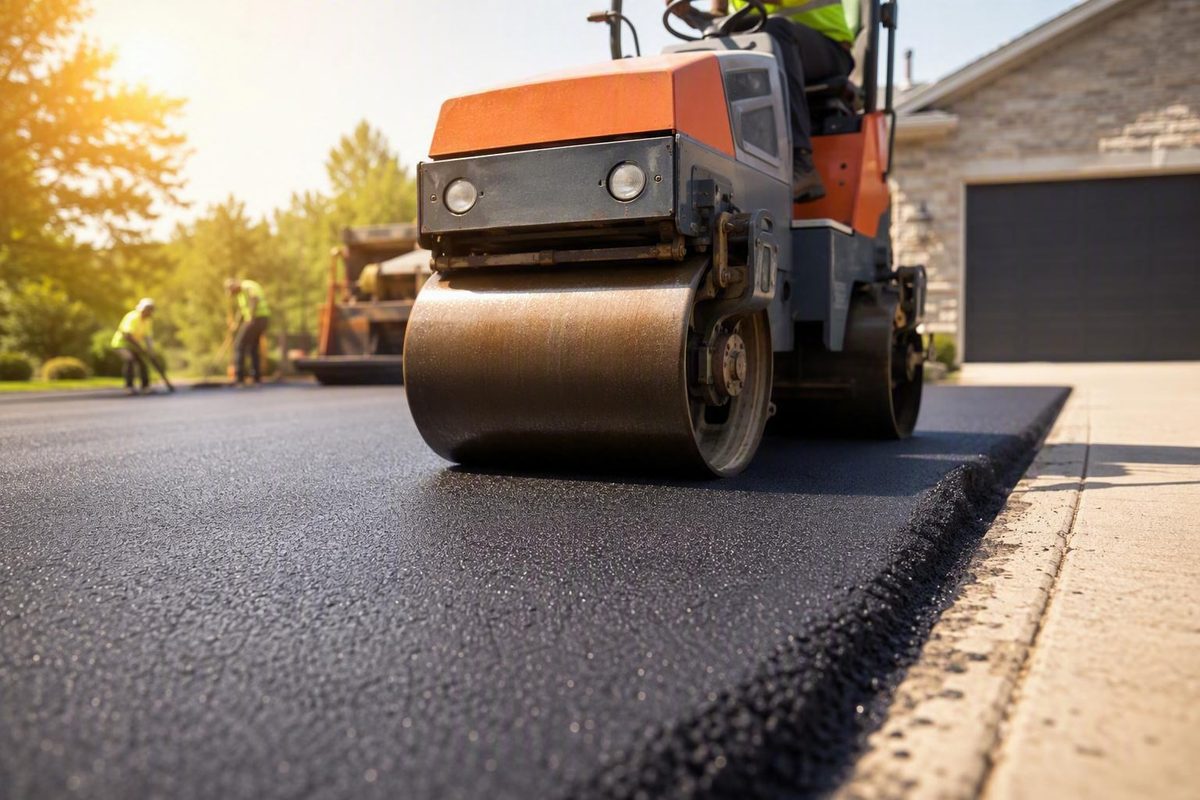
A heat-wave day is often better for paving an asphalt driveway than a cool fall day: a 2-inch lift may have only about 16 minutes before it reaches the roughly 175°F compaction cutoff, and hotter air and a hotter base stretch that short rolling window. Heat does not excuse an unstable mix, wet base, unsafe working conditions or premature traffic, but 95°F is not automatically too hot to pave.
That distinction matters because compaction density is what the driveway retains after the weather changes. Inadequate compaction is associated with reduced fatigue life, accelerated aging, rutting, raveling and moisture damage. A warm day gives a competent crew more time to establish density; it does not create density by itself.
The practical drawbacks come after placement. Fresh asphalt can remain soft and scuff-prone longer in strong sun, so vehicles may need to stay off it beyond the contractor’s ordinary reopening time.
The Cooler-Weather Consensus Has a Reasonable Basis
Homeowners often postpone July and August work because the crew will be laboring around hot mix in extreme heat, the finished surface may stay soft and a cooler day feels easier to control. Those concerns are legitimate.
An excessively fluid mat can shove, wave or move beneath a roller instead of consolidating predictably. Asphalt can stick to drums or suffer surface pickup. Direct sun can also prolong softness after installation, making tire marks and concentrated loads more likely during the first days.
Worker heat exposure is a separate and decisive issue. A temperature that helps the asphalt does not establish that it is safe for people to work. The contractor remains responsible for following current occupational-safety requirements and maintaining an effective heat-safety plan.
Where the consensus goes wrong is treating cooler air as inherently better for the pavement. Cooling is the enemy during compaction. Thin residential lifts lose workable temperature quickly, and waiting for fall can shorten an already brief rolling window.
Hot Air Gives the Rollers More Time
Hot-mix asphalt must be consolidated while its binder is workable. Rolling rearranges the aggregate structure and reduces internal air space. As the mat cools, the binder becomes more viscous and increasingly resists movement.
For some dense-graded hot-mix asphalt, approximately 175°F is a commonly cited cessation temperature. Below the applicable cutoff, additional passes may affect smoothness or texture but generally produce little meaningful increase in density. The exact cessation temperature remains mixture-specific rather than a universal driveway specification (Pavement Interactive’s compaction guidance).
The cooling clock is especially severe on residential lifts. Pavement Interactive’s cooling table gives approximately nine minutes for a 1-inch lift to reach 175°F and about 16 minutes for a 2-inch lift. Hotter air and base temperatures remove heat from the mat more slowly, increasing the time available for compaction.
That extra time lets the crew complete its rolling pattern and attend to joints and edges before the asphalt stiffens. It also leaves more room to respond when a roller pass or delivery sequence takes longer than expected.
The effect is not theoretical. During a July 2026 Yellow Alert near Rochester, New York, a crew paved at a reported air temperature of 95°F with mix leaving the hopper at 320°F. The crew completed four jobs and placed about 90 tons. Its contractor said the heat produced better compaction without seams or blemishes, while acknowledging the need to manage worker exposure (News10NBC’s report on the 95°F paving day).
That is one contractor’s experience, not proof that every 95°F job will succeed. It does illustrate why experienced crews often value summer slots: the mat’s cooling window, rather than crew comfort, governs the opportunity to compact it.
Set the air temperature, base temperature and lift thickness; the calculator compares your estimated rolling window with a 55°F reference day.
Compare a driveway mat under your conditions with the same lift on a 55°F air and 55°F base reference day.
Hot-day slot wins: ~32 minutes above 175°F
The 55°F reference provides ~16 minutes for the same 2-inch lift.
Estimated gain: ~16 minutes, or 2.0× the reference window.
| Conditions | Lift | Window | Basis |
|---|---|---|---|
| Published cooling benchmark | 1 in. | ~9 min | To 175°F |
| Published cooling benchmark | 2 in. | ~16 min | To 175°F |
| 55°F air / 55°F base | 2 in. | ~16 min | Calculator reference |
| Default 95°F air / 95°F base | 2 in. | ~32 min | Simplified estimate |
| Reported New York job | — | — | 95°F air; 320°F mix |
How the estimate works: lift thickness is anchored to the published ~9-minute 1-inch and ~16-minute 2-inch benchmarks. The calculator averages air and base temperature, then applies a simplified temperature factor relative to 55°F.
It holds wind, sunlight, mix design, haul time, moisture and roller operation constant. Values marked ~ are estimates, not job specifications.
Sources: Pavement Interactive cooling and HMA compaction guidance; News10NBC report of a 95°F paving day with mix at 320°F. Unknown values are shown as —.
The calculator is deliberately simplified. Its thickness anchors are the cited nine-minute and 16-minute cooling benchmarks, and its default temperature comparison reflects the brief’s roughly doubled window at 95°F. It cannot account for wind, mix design, sunlight, haul time, roller choice or moisture, so it is a planning comparison rather than a paving specification.
Air Temperature Is Only One of Four Measurements
A weather forecast reports ambient air temperature. It does not report the prepared base temperature, delivered-mix temperature or in-place mat temperature during rolling.
The base matters because it receives the new asphalt directly. A cold surface draws heat from the mat quickly; a warm one slows that loss. A shaded base and a sun-baked base can therefore produce different compaction windows under the same forecast.
Delivered-mix temperature reflects production, mixture properties, transport time and weather. In-place mat temperature changes after placement and is the measurement most directly connected to roller timing. On the reported New York job, the material left the hopper at 320°F even though the surrounding air was 95°F.
Wind accelerates heat loss. Rain and evaporating moisture cool the mat, while a saturated or pumping base creates a separate structural problem. Thin lifts cool faster than thick lifts. Long haul times can consume usable heat before the material reaches the driveway.
Mixture design matters as well. Aggregate gradation and shape, binder properties, binder content and the support beneath the mat all affect how asphalt responds to rolling. Pavement Interactive identifies these material, environmental and construction variables as factors in compaction and explains why insufficient density contributes to premature pavement distress (Pavement Interactive’s HMA compaction reference).
No favorable forecast can repair a weak base, unsuitable mixture or delayed rolling pattern.
Asphalt Can Be Too Fluid Even When the Weather Helps
Warm surroundings preserve workability, but a mat can initially be too hot or unstable to accept a productive roller pass. The distinction is between beneficial ambient heat and uncontrolled movement within the asphalt itself.
A crew should recognize shoving, waves, lateral movement, roller pickup and deformation beneath the equipment. Those signs mean the aggregate structure is not settling predictably. The appropriate response may involve changing roller timing or operation, allowing limited cooling or pausing placement. The correct action depends on the supplied mixture and observed behavior.
Hot weather never justifies deliberately overheating asphalt. Excessive production temperature can damage the binder and create emissions. Production and delivery limits must come from the mixture requirements and supplier rather than the idea that hotter is always better.
A high-quality installation therefore needs both sides of the temperature window: enough retained heat to complete compaction, but enough stability for the mat to remain controllable beneath the roller.
Wet Bases and Uncontrolled Mats Still Require a Delay
A high air temperature is not a reason to cancel when the base is dry and stable, the supplied mix is appropriate, mat temperatures can be monitored and the rollers are developing controlled compaction. Under those conditions, summer heat is an advantage.
Scheduling adjustments can still be sensible. An early start may reduce worker exposure or avoid intense afternoon sun that would keep the finished surface soft longer. Changing the hour is a mitigation, not evidence that asphalt cannot be placed at 95°F.
Postponement is appropriate when the base is saturated, soft, pumping or unstable; rain threatens active placement; the mat moves uncontrollably; the equipment cannot achieve stable compaction; or unavoidable traffic would be placed on a very soft surface. Work must also pause or move if the contractor cannot maintain required heat protections for the crew.
The installer’s decision should connect measured conditions to a defined rolling plan. Neither “it is hot, so paving is bad” nor “summer is always ideal” is an adequate explanation.
Fresh Asphalt May Need More Time Without Traffic
Successful compaction and readiness for vehicles are different questions. A driveway can achieve satisfactory density and still remain vulnerable to scuffs, depressions and tire marks while its surface is hot.
There is no single waiting period in the supplied evidence that applies to every mixture, pavement structure and weather condition. Reopening depends on pavement temperature, direct sunlight, expected loads and how the installed material is firming.
Follow the contractor’s site-specific restriction. Ask whether the surface has cooled enough for ordinary passenger vehicles and whether heavy trucks, trailers, motorcycles, dumpsters or other concentrated loads require more time. If the driveway remains visibly soft or begins marking, keep traffic off and contact the installer.
Access limitations should be discussed before paving. A household that cannot keep cars off the driveway may need a different placement time even when the hot weather is favorable for compaction.
Crew Heat Safety Remains the Contractor’s Responsibility
Material workability does not override worker-safety requirements. On the reported 95°F New York job, workers used water, monitored one another, watched for signs of heat exhaustion and had access to air-conditioned trucks.
Those reported practices describe one crew; they are not a complete or universal heat-illness protocol. Hydration quantities, work-rest schedules, exposure thresholds and emergency procedures must come from current official guidance and the legal requirements that apply to the contractor and location.
A homeowner does not need to design that protocol. It is reasonable to confirm that the company has one, knows who can stop work and can shift the schedule if its controls become inadequate. If the crew cannot work safely, the job should move regardless of how favorable the asphalt temperature remains.
A Competent Contractor Can Explain the Controls
Before accepting or rejecting a heat-wave slot, ask what mixture will be supplied and why it suits the local climate and expected driveway traffic. The contractor should know the supplier’s production and delivery limits, the relevant rolling range and the criterion used to stop compaction.
Ask how the crew will check delivered-mix, base and in-place mat temperatures. A weather app alone cannot establish whether the asphalt is arriving hot enough, whether the base is drawing heat rapidly or whether rolling is still productive.
The contractor should also be able to describe the roller sequence, how lift thickness affects timing and what field signs would cause an adjustment. A credible answer addresses shoving, sticking, rain, base instability and traffic reopening rather than relying on a general claim that asphalt likes summer.
The warning sign is not a contractor willing to pave at 95°F. It is a contractor unable to explain the mixture, temperature measurements, compaction plan, stop criteria, reopening restriction or worker heat protections.
Common Heat-Day Decisions
A 95°F Forecast Is Usually Workable
There is no universal maximum ambient-air temperature in the supplied evidence at which asphalt driveway paving must stop. At 95°F, warm air and a warm base can substantially extend the rolling window.
Proceed only when the base is ready, the mat remains controllable, the crew can achieve compaction and required worker protections are in place.
A Hot Mat Can Still Resist Proper Rolling
An excessively fluid mat may shove, wave, deform or stick instead of consolidating. That does not negate the benefit of warm weather; it means the crew must respond to the actual mixture and mat temperature.
The correct production temperature and roller timing are mixture-specific. More heat is not always better.
Wind, Rain and Lift Thickness Can Override the Forecast
Wind and a cool base accelerate cooling. Thin lifts lose heat particularly quickly. Rain can cool the material, and a wet or unstable base can justify postponement even on a hot day.
The calendar does not determine driveway quality. A dry, prepared base and controlled compaction on a 95°F day are generally preferable to a thin mat losing its rolling window on a cool fall surface.