
Rain 12 Hours After Sealing: Is It Ruined?
Damage is possible, not certain. Let it dry, then check for runoff, streaking, pooling or patchy coverage before considering repairs.
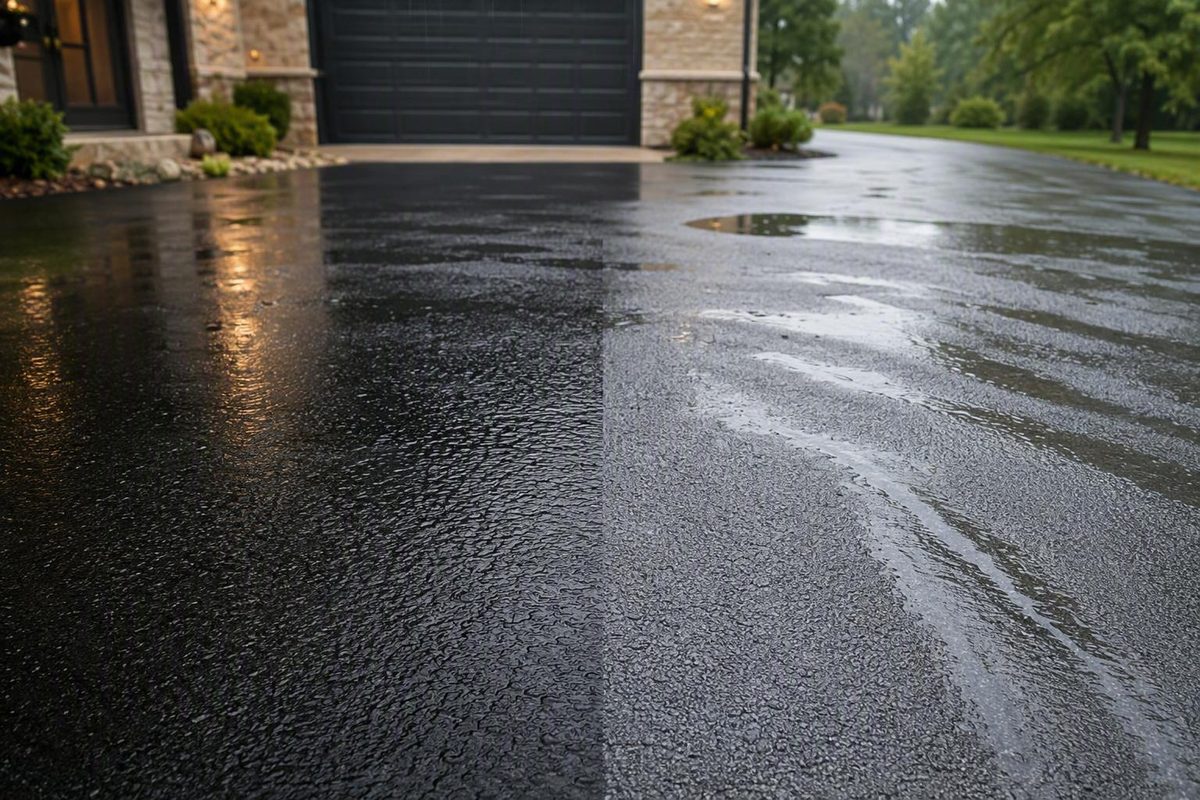
Rain 12 hours after sealing an asphalt driveway may affect the finish, but it does not prove the driveway is ruined. Twelve hours is earlier than one paving contractor’s general drying window of 24–48 hours, depending on weather, so the sealer may still have been vulnerable when the rain arrived. This is general contractor guidance, not a universal specification for every product. American Asphalt recommends keeping water off newly sealed asphalt until the sealer has dried completely. Let the surface dry, inspect it for runoff or patchy coverage, and consult the product instructions or installer before attempting a repair.
Related: Driveway Sealing Cost and Quote Factors.
The short answer: damage is possible, not certain
The decisive question is not simply how many hours passed before the rain. It is whether the sealer was still wet when the rain began.
The cited contractor does not evaluate rainfall at exactly the 12-hour mark, and its guidance cannot determine what happened on a particular driveway. The actual outcome also depends on the product and application, neither of which can be assessed from elapsed time alone.
According to the contractor, rain contacting wet sealer may produce pooling, runoff, streaking, or patchy coverage without necessarily destroying the entire job. In practical terms, the rain may have changed the appearance, disturbed coverage in limited areas, or caused no visible problem after drying.
Do not assume that the entire driveway needs another coat solely because rain arrived after 12 hours. The condition of the dried surface and the instructions for the specific sealer are more useful than the clock alone.
What to do immediately after the rain
First, check the sealer label or application sheet. Look separately for:
- Rain-ready timing
- Foot-traffic-ready timing
- Vehicle-ready timing
Follow the product or installer’s restrictions rather than substituting the contractor’s general 24–48-hour range for product-specific instructions.
Until those restrictions are known, avoiding vehicles and unnecessary foot traffic is a cautious interim measure, especially while the surface is visibly wet or tacky. This is not a universal product rule; the label or installer should control the decision.
Do not make an immediate repair based on how the driveway looks in the rain. Wait until visible water is gone and any relevant product-defined interval has passed before deciding whether the coating looks different.
Likewise, treat adding more sealer to a wet surface as a repair question for the product maker or installer, not as an automatic next step. If a contractor performed the work, photograph the driveway before cleaning, brushing, or altering the surface, particularly if warranty coverage may apply.
Inspect the driveway after it dries
Inspect the full driveway in consistent daylight. Compare areas receiving similar light, and check both sunny and shaded portions before deciding that a color difference represents missing coverage.
Look for the conditions identified in the contractor guidance:
- Runoff lines: visible trails suggesting that material moved with the water
- Streaking: pronounced bands or irregular marks that remain after drying
- Pooling is water that forms puddles What Happens if it Rains After Sealing Driveway – American Asphalt LLC.
- Patchy coverage: obvious gaps or areas that look substantially different from surrounding coverage
Uneven color alone does not prove that protection was lost.
Also note any areas that still appear wet or tacky after the applicable product-defined drying interval. The available contractor source does not establish tackiness as a diagnostic test, so report it to the installer or manufacturer rather than treating it as proof of failure.
Photograph the overall pattern as well as close-up details. Include a normal-looking section for comparison. This gives the installer more context than an isolated image of one mark.
Use this post-rain decision table
This table is a triage framework, not a diagnosis or a universal repair specification. The appropriate response depends on the particular sealer, the dried surface, and product-specific guidance.
| What you see after drying | Reasonable next step | Why |
|---|---|---|
| No visible change | Continue following the product or installer’s restrictions. | Rain does not necessarily ruin a sealed driveway. |
| A few clearly patchy areas | Document them and ask whether a spot touch-up is appropriate after complete drying. | Patchiness may be addressed by touch-up, but its extent alone does not determine the correct repair. |
| Widespread streaking, runoff, or exposed-looking asphalt | Contact the installer before recoating. | The evidence does not establish that spot treatment is sufficient for extensive effects. |
| Persistent tackiness, soft-looking material, or pooling | Avoid using the affected area until you obtain product-specific guidance. | These conditions require assessment rather than an unsupported repair attempt. |
The contractor recommends allowing affected sealer to dry before touching up patchy areas. That recommendation does not mean every visible patch needs treatment or that localized repair will correct widespread runoff.
Information to gather before calling the installer
A useful assessment begins with identifying what was applied and what occurred before the rain. Record:
- The sealer brand, product name, and formulation
- The application date and approximate completion time
- The number of coats applied
- The label’s stated rain-ready time
- The separate foot-traffic-ready and vehicle-ready times
- Whether the coating appeared wet or tacky when the rain began
- Whether the rain was brief or prolonged
- The location and extent of runoff, streaking, pooling, or patchiness
Take dated photographs of the entire driveway from several angles, followed by close-ups of each affected-looking area. If possible, include comparable sections that appear normal.
When contacting the installer or manufacturer, describe what remains after the driveway has dried—not only that it rained after 12 hours. Ask whether the product-specific response is continued waiting, a limited touch-up, or broader recoating. Do not assume one outcome before the coating has been assessed.
Rain after 12 hours warrants inspection, not panic. Once the surface is dry, use any remaining runoff, streaking, pooling, or clearly patchy coverage—together with the sealer’s instructions and the installer’s assessment—to decide what happens next.