
Driveway Sinkhole Warning Signs: What to Do
See which changes warrant investigation, when to stop access, who to contact, and why the underlying drainage, utility, or soil problem comes first.
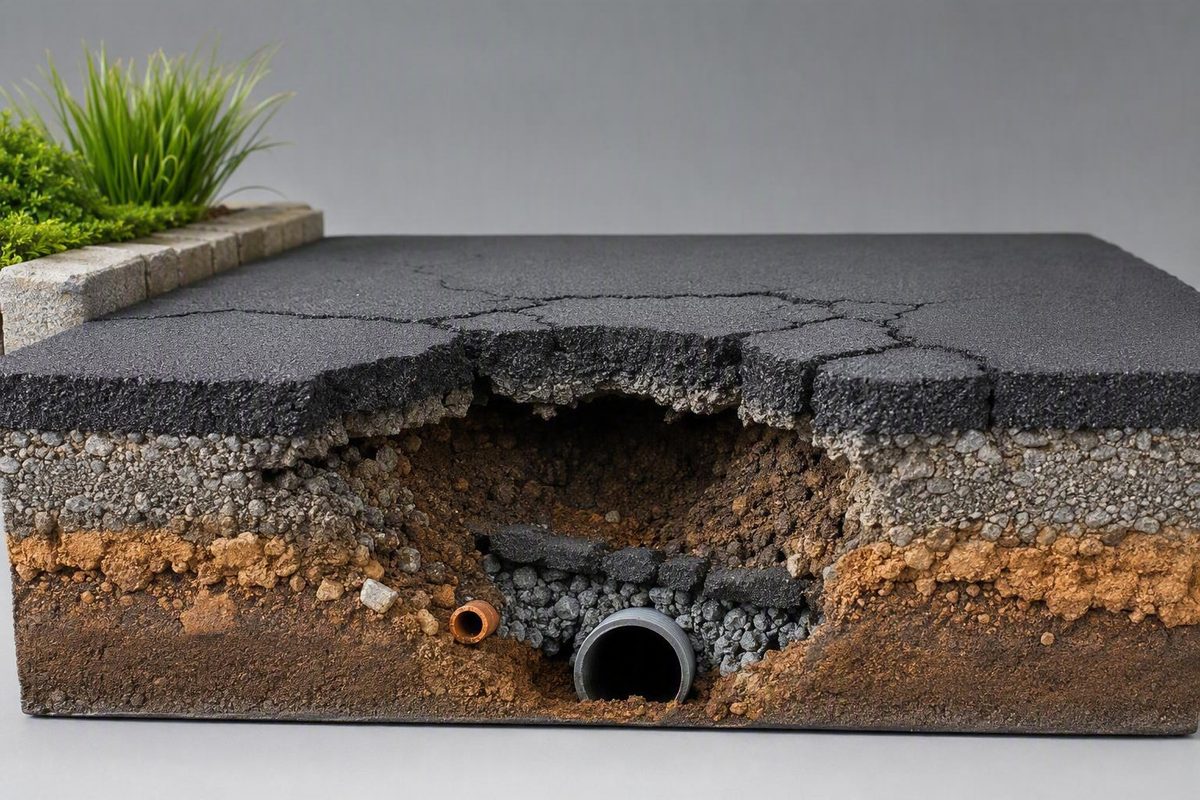
A new dip, widening crack, open hole, unusual ponding, or sinking pavement can indicate subsidence, but it does not prove that a natural sinkhole is forming. Treat an unexplained or changing area as a possible subsurface hazard: stop using it, look for utility and drainage clues from stable ground, arrange the appropriate assessment, correct the underlying problem, and repair the driveway only afterward.
If the driveway is actively sinking, stop using the area
Safety first
Keep vehicles, people, children, and pets away from an open, unexplained, or actively growing depression. Block access without approaching the edge. Do not enter the hole or test the area by driving over it. Florida geological guidance advises securing a suspected hole, keeping children and pets away, and contacting local authorities when physical harm is possible (Florida Department of Environmental Protection sinkhole guidance).
Do not direct a hose, downspout, sump discharge, or other water toward the affected area. Water can move through loose or poorly compacted soil, carry material away, and create or enlarge underground voids. Before any remediation work is done, the extent and cause of the sinkhole should be determined Sinkhole - Solving Drainage and Erosion Problems | Northern Virginia Soil and Water Conservation District.
Call local emergency authorities when physical harm may be possible. If a house, garage, or other nearby structure is sinking, sagging, or developing cracks alongside active ground movement, stay out of the affected structure and seek urgent guidance from local authorities and an appropriate structural or geotechnical professional.
Contact the relevant utility promptly if gas, electric, water, sewer, storm-drain, or septic infrastructure may be damaged or contributing to the problem. USGS guidance specifically directs property owners to the appropriate utility when underground lines may be affected (USGS guidance for suspected private-property sinkholes).
The reviewed guidance does not establish a safe crack width, depression diameter, depth, vehicle weight, or setback distance for an unexplained void.
Possible warning signs in and around a driveway
Driveway sinkhole warning signs are reasons to investigate, not a visual diagnosis. The same symptoms can result from failed base material, drainage erosion, leaking pipes, frost movement, poor compaction, buried debris, or ordinary pavement deterioration.
Look for changes such as:
- A new bowl-shaped or roughly circular depression
- A depression that is becoming wider or deeper
- One section of pavement dropping relative to the adjoining driveway
- An open hole or an area that continues to settle
- Deepening or widening cracks
- Separation between slabs or paved sections
- Cracking accompanied by a new difference in elevation
- New, deep ponding where water did not previously collect
- Runoff disappearing into a crack, joint, or opening
- Unexplained wet soil or surface water
- Exposed roots, fence posts, foundation surfaces, or other previously buried objects
- Newly leaning posts, trees, walls, or other site features
- Small circular areas of stressed or wilting vegetation
Government geological guidance supports treating a new depression, continued settling, and sudden ground openings as possible subsidence conditions. Commercial property-warning guides also list exposed objects, leaning features, pavement separation, new ponding, and localized vegetation stress, but these signs remain nonspecific and should not be treated as proof of a sinkhole.
The useful distinction is not the crack pattern alone, but whether it accompanies continued sinking, separation, a growing depression, or other evidence that support below the driveway is changing.
Check nearby buildings from a safe location. Growing wall or floor cracks, doors or windows that begin sticking, sloping floors, displaced trim, and gaps where walls meet floors or ceilings can increase concern when they progress alongside driveway settlement. Individual symptoms can have many causes; several developing together justify closer professional assessment.
A single old crack, shallow rut, or puddle may be routine driveway deterioration.
The absence of warning signs does not establish that the ground is stable. A cover-subsidence sinkhole can form as a gentle depression over a long period, while a cover-collapse sinkhole can open abruptly with little useful surface warning.
Decision table: sinkhole, leak, washout, weak fill, or pothole?
Surface appearance cannot reliably distinguish a natural sinkhole from a leaking pipe, washed-out soil, failed utility-trench backfill, buried debris, or ordinary pavement failure. More than one mechanism may be present—for example, a leaking drain may wash soil from an already weak trench.
| Observation | Plausible causes | Useful clues | Appropriate next contact |
|---|---|---|---|
| Isolated shallow pavement failure without surrounding movement | Pothole, surface deterioration, localized base failure | Damage is confined to paving, with no active settlement, opening, unusual water, utility clues, or related movement | Paving contractor |
| Depression or crack aligned with a buried utility route | Leaking pipe, settled or poorly compacted trench backfill | Linear settlement, recurring moisture, or plans showing a line beneath the defect | Relevant utility or qualified plumber |
| Unexplained water, sewer odor, increased water use, or water heard underground | Water or sewer leak, drain failure, underground flow | Wet ground during dry weather, bill or meter change, odor, or sound near the depression | Utility or qualified plumber first |
| Settlement near a downspout, ditch, culvert, or concentrated runoff path | Erosion, washout, drainage-related soil loss | Movement follows rain, runoff enters the area, or an outlet or culvert is damaged | Drainage contractor, civil or geotechnical professional, or public works |
| Gradual settlement over an old excavation or landscaped area | Poorly compacted fill, decomposing stump, construction debris, buried material | Known excavation history or irregular or linear settlement | Geotechnical professional or relevant local authority |
| Collapse near an old well, cistern, septic component, tank, or abandoned structure | Deteriorated cover or hazardous buried cavity | Records or site history indicate former infrastructure | Local authority, environmental or septic professional, or geotechnical professional |
| Circular depression with disappearing drainage and progressive movement in karst-prone geology | Natural sinkhole activity is plausible but unconfirmed | Several symptoms, recurrence after rain, and soluble bedrock in the area | State geological survey for context; professional geologist or geotechnical engineer for the site |
A pothole generally results from failure of the paving materials. Subsidence involves loss, compression, or movement of material beneath the surface. Poorly compacted soil, buried debris, leaking lines, abandoned infrastructure, and old excavations can all create holes that may be casually called sinkholes even when natural karst processes are not involved.
Do not let a familiar surface pattern create false confidence. The practical questions are whether movement is continuing and why the material beneath the driveway is losing support.
Why water and local geology change the risk
A natural sinkhole is a closed depression caused when subsurface material is removed and the surface gradually subsides or collapses into the resulting void. Sinkholes are most common in karst terrain, where groundwater can dissolve limestone, other carbonate rock, gypsum, or salt beds and form underground openings.
The soil above those openings affects how failure appears. In cover-subsidence conditions, loose material may gradually move downward and create a slowly developing depression. In cover-collapse conditions, cohesive soil can temporarily bridge an enlarging cavity before failing abruptly, sometimes over a matter of hours. The USGS explanation of sinkhole types and susceptible geology also explains that altered drainage and groundwater changes can trigger sinkhole development where the underlying conditions are already susceptible.
Driveway drainage matters, but a misplaced downspout does not automatically create a natural sinkhole. Concentrated runoff may:
- Wash loose or poorly compacted soil from beneath pavement
- Follow a utility trench and carry away backfill
- Enter an existing crack or opening
- Saturate or weaken supporting soil
- Accelerate erosion where a cavity or susceptible geology already exists
- Erode soil around a damaged culvert, drain, or pipe
Correcting harmful water movement is often part of the repair, but the source and route of the water should be identified before the driveway is rebuilt.
Local geology provides context, not a diagnosis. State geological surveys may publish karst or bedrock maps, while soil information and property records may identify weak fill, former excavations, abandoned wells, or other relevant site history. Mapped karst makes a geological cause more plausible but does not prove that one driveway depression is a sinkhole. Being outside mapped karst does not rule out a hazardous pipe washout, buried structure, human-made cavity, or unstable fill.
How quickly can a suspected void get worse?
Some depressions develop gradually over months or years. Others change quickly. Government geological guidance notes that cover-collapse sinkholes can open suddenly and that an opening may continue growing for minutes, hours, or days. Edge erosion may also continue after the initial collapse, especially during heavy rain.
A September 2026 collapse beneath a coastal Malibu driveway is a bounded example of how quickly an established opening can disrupt access. KTLA reported a cavity approximately 25 to 30 feet deep, 30 feet wide, and 60 feet long, with evacuations and vehicle-access restrictions affecting nearby homes; the report connected the event with rainfall, high surf, and continuing coastal erosion (KTLA report on the Malibu driveway collapse).
A second report said emergency crews responding to a gas-leak call found that the opening had grown beyond 30 feet wide and collapsed inward. It also described evacuations and concern that rain and high tides could worsen conditions (Global News coverage of the Malibu collapse). The reports do not establish whether the reported gas leak preceded or followed the collapse.
This was an atypical coastal event involving storm conditions, high surf, and erosion, not a model for an ordinary inland residential driveway. The reports did not document useful pre-collapse warning signs. The case shows that a developed opening can enlarge and cut off access; it does not show that a particular crack, dip, or puddle predicts a similar collapse.
Document the problem without testing the ground yourself
It cannot confirm a sinkhole, and collecting it should not require approaching an unstable edge.
From stable ground, record:
- Dated photographs from the same safe viewpoints
- The location relative to the driveway, garage, house, road, drains, and property lines
- The approximate visible extent, without stepping beside or across the area
- When the change was first noticed
- Whether it appears unchanged, gradually progressive, or rapidly changing
- Recent heavy rain or recurring changes after storms
- Changes to downspouts, grading, ditches, culverts, or drainage outlets
- Recent construction, excavation, utility work, landscaping, or heavy-equipment traffic
- Where visible runoff enters and leaves the area
- Sewer odors, unexplained water, or sounds of running water underground
- Unusual changes in water use, meter readings, or bills
- Leaning objects, exposed roots or posts, or movement in nearby walls and slabs
- Similar settlement on neighboring properties, public roads, or roadside drainage features
Review available property records, utility plans, septic drawings, surveys, and previous construction documents. Note whether the depression appears to follow a water, sewer, drain, gas, electrical, or septic route, but do not try to locate buried infrastructure by digging, probing, or driving stakes into the ground. Government erosion guidance advises establishing a hole’s cause and extent before repair and warns that unstable walls can collapse.
If public pavement, a roadside ditch, or a utility easement is affected, record the location and report it to the responsible authority. Take photographs against fixed, distant reference points rather than standing beside the opening to obtain exact measurements.
Who to call—and when paving work should begin
The appropriate first call depends on the hazard and the clues present:
- Emergency authorities: Call when physical harm may be possible.
- Affected utility: Contact the gas, electric, water, sewer, storm-drain, or septic operator when its infrastructure may be damaged or contributing to the problem.
- Qualified plumber: Start here when unexplained water, sewer odor, increased water use, or another clue suggests a private plumbing or drainage leak.
- Local public works or building authority: Contact the relevant office when a public road, culvert, drainage system, right-of-way, retaining wall, or occupied structure is involved.
- State geological survey: Use it for local bedrock, karst, mapping, reporting, and geological context.
- Professional geologist or geotechnical engineer: Hire one when the cause, depth, extent, soil condition, or geological mechanism must be established.
- Structural or foundation specialist: Seek appropriate structural expertise when a house, garage, retaining wall, or other structure shows movement.
- Paving contractor: Bring in a paving contractor after active or unexplained settlement, utility problems, drainage problems, and other subsurface hazards have been addressed.
USGS provides general geological information but does not inspect individual suspected sinkholes on private property. It recommends first considering human causes such as leaking underground pipes, settled construction pits, and buried material, then contacting the relevant utility, state geological survey, professional geologist, or geotechnical engineer as appropriate.
Use this repair sequence:
Isolate the area → investigate the cause → stop harmful water flow or utility problems → stabilize or remediate the subsurface condition → choose the pavement repair.
Treat unexplained driveway settlement as a subsurface problem before treating it as a paving problem.