
Best Polymeric Sand for Pavers: 5 Products Compared
Compare polymeric sand for driveway pavers by joint width, base type, traffic and rain window, with clear picks for overlays and permeable systems.
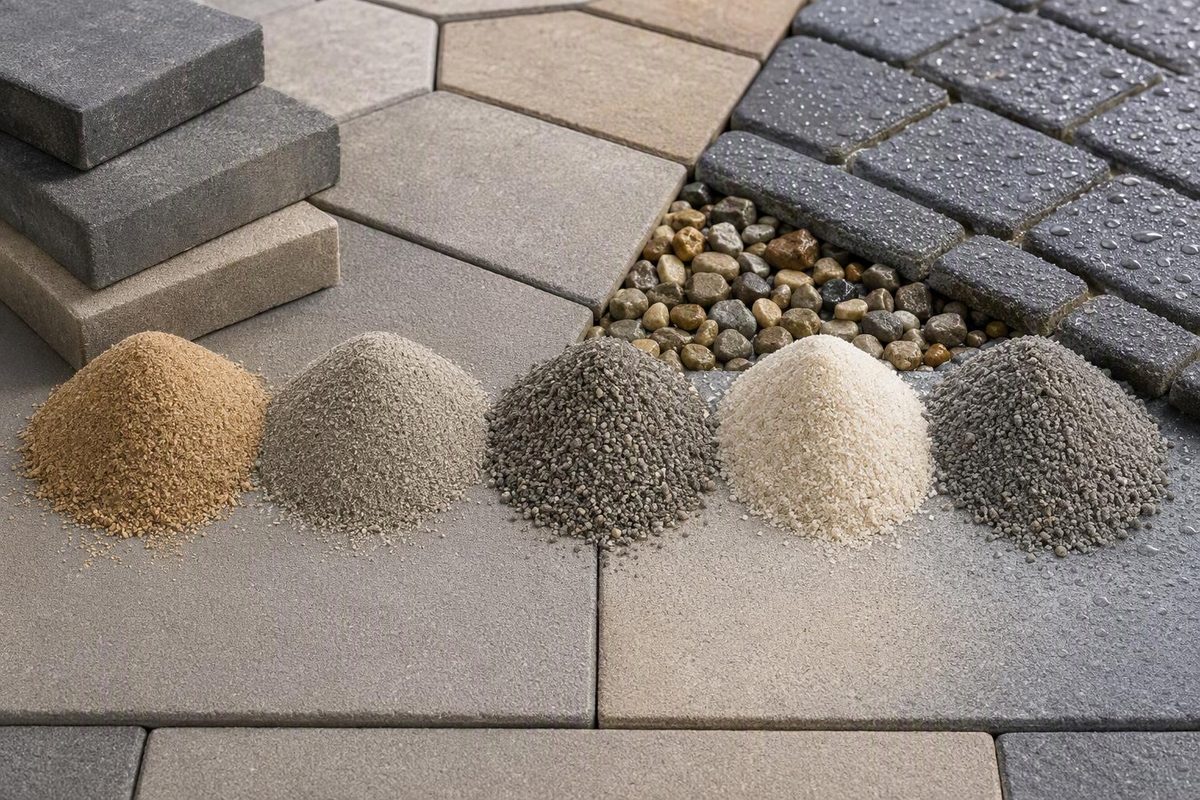
For a conventional, non-permeable residential paver driveway, Techniseal HP NextGel is the best default specification match in this group. The manufacturer recommends it for heavy traffic, high humidity, steep slopes and joints from 1/16 to 2 inches. Alliance Gator Maxx G2 is a better fit for a properly drained concrete overlay or joints wider than 2 inches, while SRW Pavermate Z3 has the shortest published rain-safe interval among these options.
These comparisons reflect published manufacturer specifications, not independent product testing. Confirm that the current technical sheet covers your paver material, joint dimensions and pavement assembly before buying.
Choose the pavement assembly and widest continuous joint to see which specifications fit.
Polymeric Sand Specification Picker
Use the widest continuous joint, not an isolated intersection.
Techniseal HP NextGel
Its published 1/16- to 2-inch range and heavy-traffic positioning make it the default match for a conventional driveway.
SmartSand may fit ordinary residential work at this width, but Techniseal directs demanding sites and replacement-sand work to HP NextGel.
Source: Manufacturer specifications cited in the article. A width match does not override paver, depth, drainage, weather or curing restrictions.
Polymeric Sand Shortlist
| Product | Best fit | Important published limits |
|---|---|---|
| Techniseal HP NextGel | Conventional driveway, slope or demanding site | For 1/16- to 2-inch joints and surfaces exposed to heavy traffic or high humidity. Temperature must remain above 32°F for 48 hours, and installation needs dry curing conditions. |
| Alliance Gator Maxx G2 | Wide joints or a drained concrete overlay | For 1/8- to 4-inch joints on a traditional base and up to 2 inches on an overlay; minimum depth is 1½ inches. Published as rain-safe after 15 minutes on traditional work but after 24 hours on overlays. |
| Techniseal SmartSand | Standard residential work without substantial vehicle circulation | Designed mainly for 1/16- to 1/4-inch joints, though intersections may be as wide as 1 inch. Requires a 1½-inch minimum depth and a draining sand-set assembly. Techniseal directs replacement-sand work and harsher conditions to HP NextGel. |
| SEK PolySweep / X-Treme Wide Joint | Conventional or unusually wide joints where a longer dry-weather window is available | Regular PolySweep is for joints up to 3/4 inch, with 1 inch accepted at intersections; X-Treme spans 1/8 to 4 inches. The surface must be dry, with no rain forecast for at least 12 hours. |
| SRW Pavermate Z3 | A short post-installation rain window | For joints from 1/16 to 2 inches at intersections, or up to 1 inch on concrete overlays, with a 1½-inch minimum depth. Published as rain-safe after 10 minutes, although SRW recommends a 24-hour rain-free forecast for best performance. |
HP NextGel Is the Default Driveway Choice
Techniseal positions HP NextGel for heavy traffic, high-humidity areas, steep slopes and concrete, wet-cast, textured or clay pavers. Its stated joint range is 1/16 to 2 inches, and the product literature calls for mechanical compaction where possible. That combination makes it a defensible starting point for driveway aprons, turning areas and slopes (Techniseal HP NextGel literature).
This does not make it a structural repair. Full-depth, densely compacted joints are necessary, but polymeric sand cannot correct a settling base, failed edge restraint or rocking pavers.
Gator Maxx G2 Fits Wide Joints and Overlays
Gator Maxx G2 covers a broader range of joint widths and explicitly addresses traditional bases and concrete overlays. Its May 2025 technical sheet permits joints up to 4 inches on a traditional base and 2 inches on an overlay, with a minimum joint depth of 1½ inches. It also includes concrete, clay and wet-cast pavers, natural stone, driveways and steep slopes (Alliance Gator technical data sheet).
Its “rain-safe in 15 minutes” statement applies to a traditional installation after water activation. An overlay requires 24 dry hours. Neither interval means the surface is ready for tires; follow the current sheet’s curing and traffic restrictions.
The Other Products Fit Narrower Use Cases
SmartSand fits ordinary residential installations on a draining sand-set base. Its technical sheet permits residential driveways but recommends HP NextGel for heavy traffic, steep slopes, high humidity, standing water and replacement of sand in an existing installation (Techniseal SmartSand technical sheet).
Pavermate Z3 is the weather-window option: SRW publishes a 10-minute rain-safe interval after activation. The same instructions exclude flagstone, porcelain, pool coping, and wet or heavily shaded areas, and still recommend planning for 24 hours without rain (SRW Pavermate Z3 instructions).
PolySweep and X-Treme form a useful paired range for conventional and very wide joints. Their installation instructions require a dry surface, a forecast with at least 12 rain-free hours, compaction, staged watering and saturation through the joint depth (SEK PolySweep guidance).
Four Checks Determine Product Fit
Permeable Pavements Need Aggregate Joints
Do not fill a true permeable-paver driveway with ordinary polymeric sand. Water must pass through its open joints, which are filled with clean angular chip stone. Unilock identifies ASTM No. 9 and No. 8 aggregate as common joint materials, selected according to joint width (Unilock permeable-paver guidance).
Joint Width and Depth Must Both Qualify
Measure narrow runs and wide intersections separately, then probe the available depth after removing old material. A maximum width listed “at intersections” does not permit that width along every joint. Most products in the table require 1½ inches of usable depth; a thin new cap over old sand does not meet that specification.
Conventional interlocking concrete-paver joints are typically only 1/16 to 3/16 inch wide, according to the Concrete Masonry & Hardscapes Association. A product’s 4-inch maximum is relevant to irregular units, not a reason to leave 4-inch gaps in an ordinary driveway (CMHA application guide).
The Base Determines How Water Escapes
A traditional aggregate base, concrete overlay and open-graded assembly are not interchangeable. Water entering bedding sand over concrete needs an escape route. Manufacturer details may require slab slope, drainage holes or a perimeter outlet; switching brands will not fix trapped water.
The same principle applies to a full-depth driveway. CMHA gives 6 to 8 inches as a general minimum aggregate-base thickness for driveways, while noting that soil strength, drainage, climate and traffic can require more. Check the entire assembly in the brick paver driveway guide, not only the joint filler.
Coverage Falls as Joints Grow
Coverage changes sharply with paver size, joint width and depth. Alliance estimates that one 50-pound bag of Gator Maxx G2 covers 65–85 square feet with 1/8- to 3/8-inch joints, but only 22–42 square feet with 3/4- to 1¼-inch joints in the listed paver configuration. Use measured dimensions and the manufacturer’s calculator rather than comparing bag prices alone.
Installation Usually Causes More Failures Than Product Choice
Reset rocking or sunken pavers and repair failed edging before replacing the joint material. Polymeric sand will not stop movement caused by a weak base or missing restraint.
Remove the old material to the depth required by the selected product. Wait until the pavers and joints are completely dry, then fill and compact as directed. Refill joints that settle during compaction and compact again.
Set the final sand level at the specified recess, commonly 1/8 inch below the surface or chamfer. Remove all residue from the paver face before adding water. Test porous, dark, clay or textured units in an inconspicuous area because residue can be difficult to remove after activation.
Follow the exact watering sequence on the current technical sheet. Too little water can leave dry material below the surface, while flooding can displace sand. Staged watering, spray pattern and saturation requirements differ by product.
Keep vehicles off for the full stated curing period. A product’s “rain-safe” interval describes resistance to an unexpected shower after activation; it is not permission to drive on the pavement.
Polymeric sand helps stabilize joints and resist erosion. If pavers move under a vehicle, diagnose the base, bedding, drainage and edge restraint before choosing another bag.