
Brick Paver Driveways: Cost, Base, Drainage and Quote Checks
Compare brick and concrete driveway pavers, estimate cost, and check base, drainage, edging and maintenance details before accepting a bid.
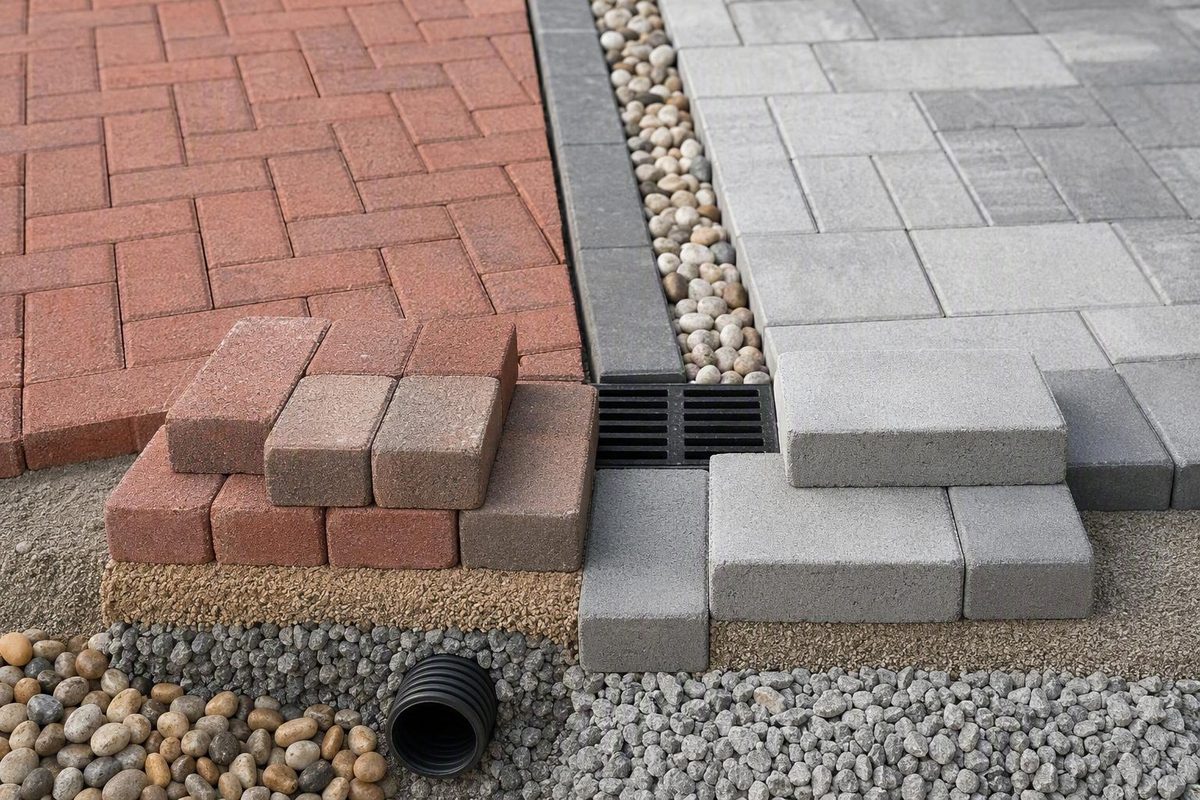
A brick paver driveway can provide a distinctive surface that is repairable one unit at a time, but the visible pavers are only the finish. Soil support, aggregate depth, compaction, drainage and edge restraint determine whether the driveway stays level under vehicle traffic.
Start by clarifying what “brick” means in each quote. Contractors may be pricing kiln-fired clay pavers, brick-shaped concrete pavers or a thin paver overlay on an existing slab. Those are different products and assemblies, so a price comparison is not valid until the scope matches.
First, choose the actual paver system
Interlocking concrete pavers are factory-made concrete units installed over bedding sand and a compacted aggregate base. For residential driveways, the Concrete Masonry & Hardscapes Association (CMHA) recommends 2 3/8-inch concrete pavers; continuously trafficked vehicular pavements typically use 3 1/8-inch units. It also cautions against elongated units with a length-to-thickness ratio of 4:1 or greater in vehicle applications (CMHA). Confirm that the selected model is approved by its manufacturer for driveways rather than patios only.
Clay brick pavers are fired-clay units rather than concrete colored to resemble brick. For a residential driveway in a mortar-set system, the Brick Industry Association recommends clay pavers complying with ASTM C902; its guidance calls for ASTM C1272 units in heavy vehicular applications (Brick Industry Association).
Permeable concrete pavers have enlarged, stone-filled joints and an open-graded stone reservoir below. They are not ordinary pavers with wider gaps. The bedding, joint material and base differ from a conventional sand-set system. EPA says permeable pavement lets rain and snowmelt pass through to soil and gravel layers, reducing runoff and helping filter pollutants (EPA).
Budget the complete driveway, not the paver pallet
For an early comparison, our pavers-versus-concrete cost guide uses a broad installed benchmark of $10–$30 per square foot for standard pavers. That puts a 400-square-foot driveway at roughly $4,000–$12,000, but it is only a planning range.
A second benchmark illustrates why the assembly matters. Homewyse’s May 2026 national model starts a brick paver driveway at $19.75–$25.79 per square foot, but that example is specifically for kiln-fired clay brick set in mortar after minor repairs to an existing concrete structure—not a new sand-set driveway excavated from soil (Homewyse). At 400 square feet, that narrow scenario calculates to about $7,900–$10,316.
Do not average those figures. Instead, ask each bidder to itemize:
- demolition, excavation, haul-off and disposal;
- subgrade correction, geotextile or drainage work;
- aggregate type, compacted depth and number of lifts;
- bedding material and thickness;
- exact paver manufacturer, model, thickness and product standard;
- pattern, borders, cuts and waste allowance;
- edge-restraint type and foundation;
- joint material, compaction and cleanup;
- permeable-system underdrain or overflow, if applicable;
- permits, access surcharges and restoration of adjacent lawn or walkways.
Curves, medallions, multiple colors and extensive cutting increase labor and waste. Weak or wet soil, deep excavation, difficult equipment access and a failing slab can matter more than the paver price.
Treat the base as the main specification
A conventional interlocking driveway is a flexible pavement: compacted soil supports a compacted aggregate base, then a roughly 1-inch bedding layer, pavers and filled joints. CMHA gives 6–8 inches of aggregate base as a minimum driveway range, while stating that soil strength, drainage, climate and traffic can require more (CMHA). That range is not permission to specify the same section for dry sand, wet clay and deep frost.
The quote should state compacted depth, not loose depth. It should also identify how density will be achieved and checked near garage slabs, curbs, utility trenches and other locations prone to settlement. Bedding sand should not be used to fill dips in a poorly graded base; CMHA says those depressions should be corrected with base material and compacted (CMHA).
Edge restraints are structural, not decorative. They contain the pavers and joint sand so the surface remains interlocked. CMHA describes edge restraints as essential and recommends concrete restraints for drives and other vehicular pavements (CMHA). Ask the installer to show the edge detail, particularly at the street, garage apron and any side exposed to tire loading.
For conventional concrete pavers under recurring vehicle traffic, 45- or 90-degree herringbone provides the strongest interlock according to CMHA (CMHA). Running bond and basketweave can still appear in borders or lightly trafficked areas, but the installer should confirm that the chosen product and pattern are warranted for the intended loading.
Drainage decides which assembly works
A conventional sand-set paver driveway still sheds most water at the surface. Grade it away from buildings and route runoff to an approved outlet rather than assuming joints will solve drainage. A mortar-set clay system is also a surface-draining pavement; Brick Industry Association guidance calls for a minimum 2% slope and drainage provisions at pavement edges or area drains (Brick Industry Association). Local grading and stormwater rules control the final design.
Choose permeable pavers only when the whole section is designed hydraulically and structurally. CMHA notes that low-infiltration soils may need underdrains, and the base thickness must satisfy both water-storage and traffic-loading requirements (CMHA). Avoid directing eroding soil or loose mulch onto the surface because sediment can clog the stone-filled joints.
Permeable does not mean maintenance-free. CMHA explains that trapped sediment reduces infiltration over time; joints may need vacuum cleaning and replacement stone, and winter traction sand is not recommended because it can clog the system (CMHA).
Plan for routine maintenance and repair
For a conventional interlocking concrete driveway, inspect in spring and fall, sweep debris and replenish joint sand when it has dropped substantially. CMHA recommends topping up when joint sand is more than 1/2 inch below its intended level (CMHA). Sealing is optional rather than an automatic requirement; it may help with stains or joint stabilization but adds a recurring finish-maintenance decision.
Individual pavers can be removed to reach utilities or correct a localized depression, then reinstated without a monolithic patch. That repair advantage is meaningful only if the cause is fixed: replacing units over a saturated base, washed-out bedding or failed edge restraint will not stop settlement.
In snow country, specify a plow strategy. CMHA advises plowing diagonally to joints and repairing pavers with more than 1/8 inch of lippage before winter so blades are less likely to catch an edge (CMHA). Keep spare matching pavers from the original production run because color and surface texture can vary later.
The bid test
A strong proposal identifies the paver, pavement cross-section, drainage route, compaction method, edge detail and exclusions. A weak one gives only square footage, color and a total price. Before choosing the lowest bid, compare those hidden layers line by line: a brick paver driveway is expensive to reopen, but straightforward to maintain when the support and water management were specified correctly from the start.