
Paver Edge Restraint for Driveways: What to Specify
Compare plastic, metal and concrete paver edge restraints, then check base extension, anchoring, drainage and high-load driveway details.
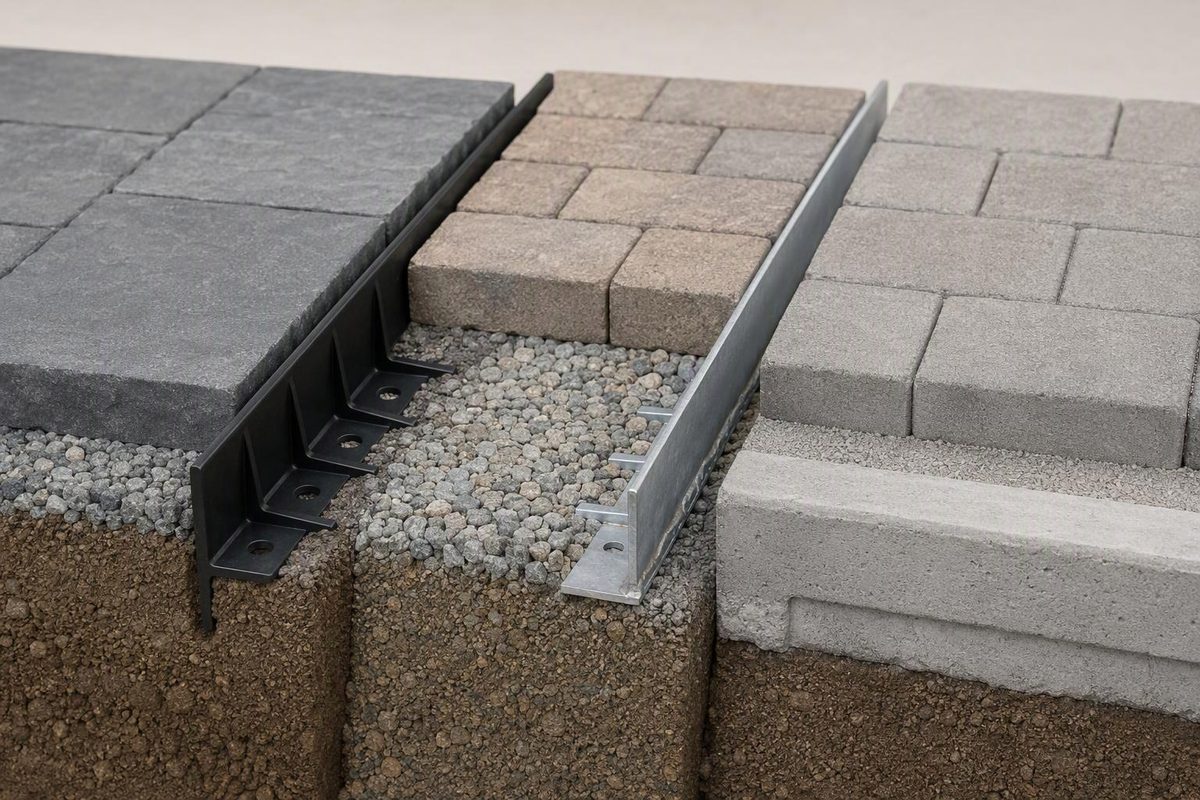
A paver edge restraint is not decorative trim. It keeps perimeter units from moving outward under tire loads so the joints remain tight and the pavers continue working as an interlocked surface. Without effective restraint, widening joints, lost joint material, loose edge pavers and local settlement can follow.
For a driveway, choose the restraint to match the base and vehicle loading—not simply by what is easiest to buy.
Match the restraint to the driveway assembly
| Driveway condition | Practical starting point | Main caution |
|---|---|---|
| Dense-graded aggregate base; passenger vehicles | Paver-specific plastic or aluminum restraint rated for the application and anchored into the compacted base | Landscape edging is not structural; follow the selected product’s spike specification |
| Frequent turning at an apron, narrow curve or parking pad | Consider a precast or cast-in-place concrete curb or another designed heavy-duty detail | Turning and braking impose substantial horizontal loads at the edge |
| Open-graded permeable base | Precast concrete, cut stone or concrete restraint designed as part of the permeable section | Do not assume a conventional spiked detail will work in clean, open-graded stone |
| Pavers over a rigid concrete base | Compatible restraint mechanically anchored to the slab, or a formed concrete edge | Specify fastener type and spacing, and check metal compatibility |
| Edge beside a sound wall, curb or slab | The fixed structure may provide the restraint | It must support the paver edge at the correct elevation and leave no excessive gap |
The Concrete Masonry & Hardscapes Association (CMHA) discusses precast concrete, cut stone, plastic, aluminum, steel and poured concrete restraints, but it does not treat them as interchangeable. Its guidance allows paver-specific plastic in some light-duty applications, recommends the thickest metal edging where pavers carry vehicles and says steel edging should be used only on rigid bases. Flat landscape edging and timber are not acceptable substitutes (CMHA edge-restraint guidance).
A permeable driveway needs a detail designed for its full pavement system. CMHA’s guide specification for permeable interlocking concrete pavement lists precast concrete, cut stone and concrete restraints and says not to use edging with steel spikes in vehicular applications (CMHA permeable-paver specification). The restraint and its support also must not interfere with the system’s designed outlet, underdrain or infiltration path.
The base extension matters as much as the edging
A strong-looking strip attached to a weak edge can still move. A spiked restraint belongs directly on compacted base aggregate—not bedding sand, topsoil or loose backfill. CMHA’s rule of thumb is to extend the base beyond the restraint by at least the base thickness: a 6-inch base should extend at least 6 inches beyond the spikes (CMHA).
That shoulder is easy to omit because it lies outside the visible driveway. Before work starts, distinguish three measurements:
- Finished paver width: the visible driveway surface.
- Excavation width: enough for the pavers, restraint and compacted shoulder.
- Base extension: measured beyond the restraint or its anchoring line, not merely beyond the last paver.
This detail belongs with the base specification. See Paver Base Material for Driveways for dense- and open-graded assemblies and compaction checks.
Fasteners require a product-specific specification
“Install paver edging” is not enough for a quote. Identify the product and specify the fastener material, diameter, length and spacing, including any closer spacing required at curves, corners and high-load locations.
There is no responsible universal spike spacing. A Techo-Bloc driveway installation example uses 8- to 10-inch non-galvanized spikes at 8-inch spacing for its illustrated vehicular application (Techo-Bloc installation guide). An older Snap Edge specification calls for spikes every 12 inches in residential and commercial vehicular work and every 8 inches in commercial vehicular applications (Snap Edge specification). Those different instructions show why a bid should follow the selected system’s current requirements rather than a generic rule copied from another product.
For a rigid concrete base, CMHA describes direct fastening and drilled anchors. Anchor choice and spacing should reflect the expected load. The installer also needs to consider galvanic corrosion between dissimilar metals and whether a washer is required to keep the fastener from pulling through the restraint.
Where a concrete edge may earn its cost
A concrete curb or full-depth precast edge is worth considering where tires turn close to the perimeter, the driveway meets a road, heavy vehicles enter regularly or the shoulder cannot reliably support a spiked system.
Do not confuse a substantial curb with a small wedge of ordinary concrete smeared against the pavers. CMHA limits troweled reinforced-concrete edging to nonfreezing areas and pedestrian or light residential loading; it warns that accelerating, braking and turning vehicles may exceed that detail’s capacity. Its hidden concrete-curb detail for residential driveways has a minimum 8-by-8-inch cross-section with pavers mortared over it. Higher traffic or weak soil may require a larger curb (CMHA).
A concrete restraint still needs properly compacted support. Otherwise, the curb and neighboring pavers can settle together.
Retain bedding material without trapping water
An edge must retain bedding material without blocking the driveway’s drainage path. Where sand could escape beneath the pavers or through restraint joints, CMHA recommends a 12-inch-wide geotextile strip over the base and turned up along the restraint. It says geotextile generally is not required across the entire aggregate-base surface and should not be placed on top of bedding sand (CMHA).
A concrete curb may need joints, filtered weep holes or another designed outlet, depending on the pavement and drainage layout. Coordinate that detail with the driveway slope, catch basins and underdrains instead of adding holes only after water accumulates. For the larger runoff plan, see Driveway Drain Types.
Put these checks in the quote
Ask each bidder to state:
- restraint material, manufacturer and product;
- whether the driveway base is dense-graded, open-graded or rigid;
- restraint locations, including transitions and exposed perimeter edges;
- compacted base depth and extension beyond the anchoring line;
- spike or anchor type, length and spacing;
- the heavier detail, if any, used at aprons, curves and turning areas;
- how bedding material is retained at gaps and joints;
- how water exits beside curbs and at the low side;
- the installation and paver-compaction sequence, including how unrestrained edges will be protected; and
- what soil, sod or aggregate will cover and protect concealed edging afterward.
On an existing driveway, widening perimeter joints, tilted edge units, exposed plastic, lifted spikes or recurring sand loss can indicate a restraint problem. They may also reveal an undersized, poorly compacted or eroded base shoulder. Resetting the pavers and replacing joint sand without restoring that support treats only the visible symptom. If you are comparing the full installation rather than just its edge, use the quote checks in Brick Paver Driveways.