
Pavers vs. Concrete Cost: What Drives the Difference
For 400 sq. ft., broad installed benchmarks put basic concrete at $2,400–$6,000 and standard pavers at $4,000–$12,000.
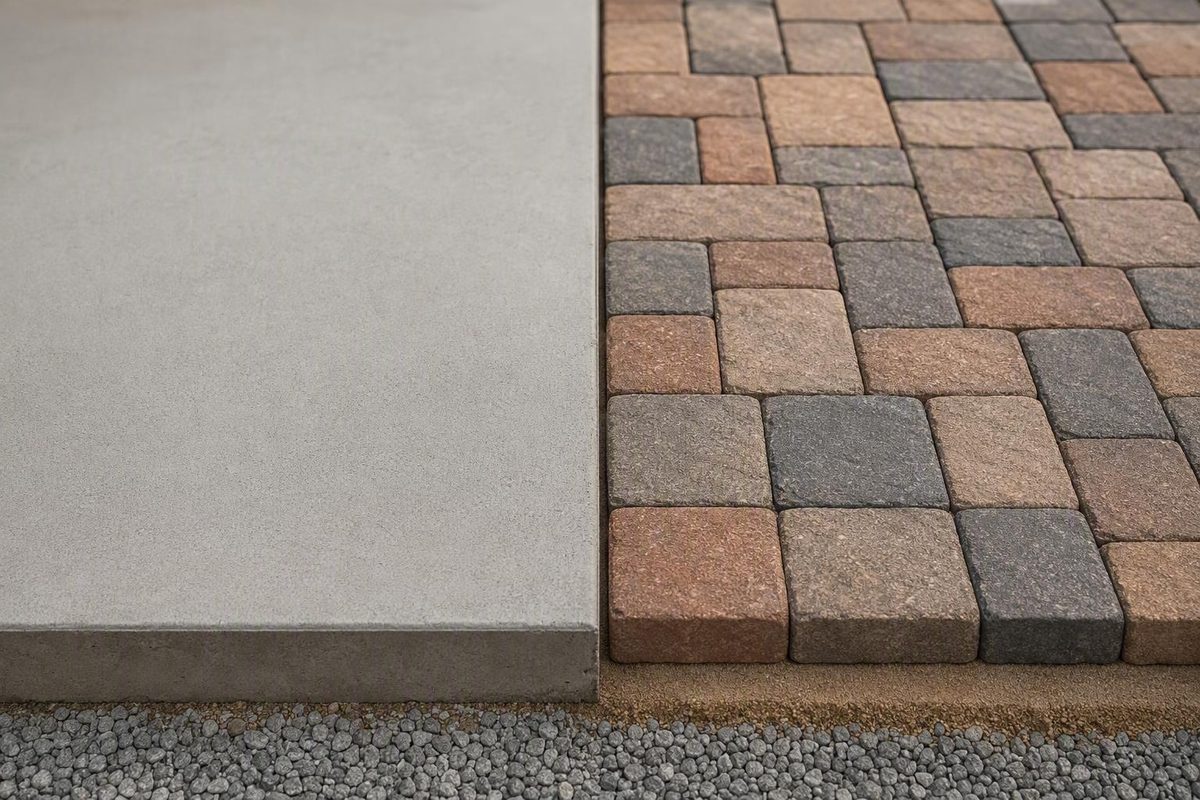
The short answer: concrete usually costs less upfront
Basic poured concrete normally costs less upfront than professionally installed pavers. For early budgeting, use these cautious installed-price ranges:
- Basic poured concrete: about $6–$15 per square foot installed (Pantano Outdoor Supply’s concrete-and-paver comparison)
- Standard pavers: about $10–$30 per square foot installed (2025 patio and driveway estimates)
These are directional benchmarks assembled from commercial cost guides and contractor or supplier estimates. They are not authoritative national averages. The sources use different markets, project types, materials, and pricing methods, and their commercial interests should be considered.
Quick answer
Surface Cautious planning range What the range means Basic poured concrete $6–$15 per sq. ft. Professionally installed benchmark for basic work Standard pavers $10–$30 per sq. ft. Professionally installed benchmark for a standard paver system Material-only pricing Not directly comparable Excludes some or all excavation, base work, labor, equipment, edging, drainage, hauling, and cleanup Do not compare a material-only paver price with a fully installed concrete bid—or vice versa.
A straightforward concrete patio on stable ground with easy access may land near the lower end of its range. Demolition, restricted access, grading, drainage work, decorative finishes, or a small project with high mobilization costs can move it toward or beyond the upper end.
The same principle applies to pavers. A rectangular patio using standard concrete pavers is not equivalent to an intricate driveway made with premium units, multiple borders, numerous cuts, and extensive drainage work. Even projects with identical square footage may require materially different excavation and base correction.
Do not calculate the apparent paver premium until both prices cover the same scope. If the concrete bid includes demolition, hauling, drainage, reinforcement, sealing, and cleanup while the paver price excludes several of those items, the headline per-square-foot comparison is misleading.
For a defensible comparison, define the surface, finish, intended use, excavation, base, drainage, edging, and cleanup first. Then ask local contractors to price that same written scope.
Compare basic concrete, decorative concrete, and pavers separately
“Concrete versus pavers” is too broad to be a useful pricing category. Basic gray concrete, stamped concrete, standard concrete pavers, porcelain, brick, flagstone, travertine, and other premium products do not belong in one undifferentiated comparison.
The table below separates the major choices. The broad planning rows synthesize supplied 2025–2026 commercial guides and are not tied to one geography. The source-specific rows identify their year, market, project type, and installed status.
| Surface category | Published installed benchmark | Year, market, and project context | What to keep in mind |
|---|---|---|---|
| Basic poured concrete | $6–$15 per sq. ft. | Cross-source 2025–2026 planning synthesis; patios and similar professionally installed flatwork; no single national market | Usually the lowest-cost starting point, but demolition, access, drainage, base correction, and finish can push it higher |
| Basic brushed concrete patio | $8–$15 per sq. ft. installed | 2026 Massachusetts supplier estimate | Regional commercial estimate, not a national average |
| Basic concrete patio | $6–$12 per sq. ft. installed | 2025 contractor estimate; geography not established as a transparent national dataset | Described as minimal-design patio concrete |
| Stamped concrete | $15–$22 per sq. ft. installed | Southeast Idaho and Wyoming contractor comparison; publication date not shown | Compares decorative concrete with relatively expensive regional paver work (regional stamped-concrete pricing) |
| Stamped concrete | Approximately $8–$28 per sq. ft. installed | 2026 home-improvement estimate; no defined geographic market | Wide range reflecting differences in design complexity and coloring (2026 stamped-concrete estimate) |
| Standard concrete pavers | $10–$30 per sq. ft. | Cross-source 2025–2026 planning synthesis; professionally installed patios and similar surfaces; no single national market | Material, base construction, labor, access, and pattern can move the price outside the range |
| Premium regional paver patios | $25–$50 per sq. ft. installed | Southeast Idaho and Wyoming contractor estimate; publication date not shown | Illustrates how regional labor, specification, and contractor scope can exceed broad entry-level ranges |
A Massachusetts supplier reports $8–$15 per square foot installed for a basic brushed concrete patio and $15–$30 for pavers in its 2026 market. A separate 2025 contractor guide reports $6–$12 for concrete patios and $10–$25 for patio pavers. Neither source provides a transparent national pricing dataset.
Decorative concrete deserves its own comparison. Added colors, detailed stamping, borders, staining, scoring, and premium sealers can move concrete well above the cost of a basic broom-finished slab. Consequently, an upgraded concrete design can overlap with an entry-level paver installation.
The real choice is often among four tiers:
- Basic concrete with a simple finish
- Decorative concrete with added visual detail
- Standard concrete pavers in a simple layout
- Premium pavers or natural stone with more complex installation
Material terminology also matters. One regional 2026 guide for Evansville, Newburgh, and the surrounding Tri-State market publishes the following installed estimates (regional paver pricing by material):
| Material | 2026 regional installed estimate |
|---|---|
| Concrete interlocking pavers | $10–$18 per sq. ft. |
| Tumbled concrete pavers | $14–$22 per sq. ft. |
| Porcelain | $18–$30 per sq. ft. |
| Bluestone | $22–$35 per sq. ft. |
| Travertine | $20–$32 per sq. ft. |
| Irregular flagstone | $15–$28 per sq. ft. |
These are regional commercial estimates, not interchangeable national prices. Their value is in showing why a quote must identify the actual product instead of saying only “pavers.”
Before comparing bids, obtain the manufacturer, product line, size, color, finish, and pattern for the paver option. For concrete, identify whether the finish is broomed, smooth, exposed aggregate, stained, stamped, scored, or otherwise upgraded. A category name is not a construction specification.
Sample budgets by project size
The simplest preliminary calculation is:
Project area in square feet × applicable installed rate = preliminary surface budget
Then add any site-specific work that the selected rate does not cover.
Using the broad planning benchmarks of $6–$15 per square foot for basic concrete and $10–$30 for standard pavers, the arithmetic is as follows (published installed-price benchmarks):
| Project area | Basic concrete at $6–$15/sq. ft. | Standard pavers at $10–$30/sq. ft. |
|---|---|---|
| 200 sq. ft. | $1,200–$3,000 | $2,000–$6,000 |
| 300 sq. ft. | $1,800–$4,500 | $3,000–$9,000 |
| 400 sq. ft. | $2,400–$6,000 | $4,000–$12,000 |
| 500 sq. ft. | $3,000–$7,500 | $5,000–$15,000 |
| 1,000 sq. ft. | $6,000–$15,000 | $10,000–$30,000 |
These totals are arithmetic illustrations based on broad benchmarks. They are not contractor quotes. Depending on the source and contractor, the rate may exclude demolition, hauling, major grading, drainage structures, permits, difficult access, soil correction, utility work, steps, walls, lighting, or landscape restoration.
A 400-square-foot midpoint example
A midpoint calculation gives a manageable comparison without pretending to predict the final bid:
- Concrete: 400 × $10.50 = $4,200
- Pavers: 400 × $20 = $8,000
- Illustrative difference: $3,800
The $3,800 difference is not an expected or standard premium. It results only from applying the midpoint of each cited planning range to the same area. Different site preparation, access, finishes, or cutting requirements can change the gap.
A Massachusetts supplier gives another useful—but explicitly regional—example. It estimates that a 300-square-foot patio could show a $3,000–$5,000 difference between basic concrete and mid-range pavers in its market (Massachusetts patio comparison). Do not carry that example into another region as a universal expectation.
Square-foot calculations are most useful during the first budgeting pass. After contractors inspect the site, compare their detailed totals instead of forcing every bid back into one rate. A higher per-square-foot quote may be more complete if it includes demolition, drainage, more extensive base construction, sealing, permits, and cleanup that another bidder excluded.
For irregular projects, calculate the finished paved area rather than the dimensions of the surrounding yard. Ask how the contractor treats waste and cuts.
Why pavers usually carry a higher installation price
A professionally installed paver surface is a system, not merely a collection of visible units. Methods vary by project and manufacturer, but the work commonly includes:
- Marking and excavating the project area
- Removing and disposing of excavated material
- Placing aggregate base material
- Grading and repeatedly compacting the base
- Adding and screeding bedding material where specified
- Installing edge restraints
- Laying out the pattern and borders
- Placing and aligning individual units
- Cutting units at edges, curves, obstacles, and transitions
- Filling the joints
- Performing final compaction and cleanup
Pavers generally require more installation labor because individual pieces must be carried, aligned, adjusted, cut, and compacted. A Southeast Idaho and Wyoming contractor attributes much of its regional paver premium to hand placement and to excavation, layered aggregate preparation, leveling, and repeated compaction.
Concrete also requires skilled labor and proper preparation. The distinction is not that concrete requires no preparation. It is that concrete is placed and finished as a continuous surface, while pavers require repeated handling of many separate units.
Geometry can increase paver labor.
A 2026 Evansville and Newburgh guide reports that curved paver patios may cost 15%–25% more than rectangular patios of the same size, difficult access may raise labor by 10%–20%, and complex drainage may add $1,000–$3,000 (regional paver cost factors). These are dated regional estimates, not standard add-on rates. They illustrate how a simple square-foot price can omit substantial site work.
Access matters because materials and equipment must move between the street and the project.
Drainage can affect either surface. Finished pitch, roof runoff, low spots, adjacent grades, walls, and outlet locations may require work that is not visible in a basic rate. Contractors should identify the proposed drainage construction and verify any site-specific requirements that apply locally.
Decorative concrete can narrow the initial gap. Stamping requires coordinated placement and finishing, while multiple colors, stains, borders, scoring, special textures, and sealers add materials and labor. When appearance matters, compare the desired concrete design directly with a named paver product using the same site-preparation and drainage scope.
Patio and driveway costs are not interchangeable
A driveway is not simply a larger patio. Intended traffic, excavation, base construction, edge support, concrete specifications, drainage, and access may differ. A surface designed for chairs and foot traffic is not automatically priced or constructed like one intended for daily vehicle use.
One 2025 contractor comparison lists:
- Concrete patios: $6–$12 per square foot installed
- Paver patios: $10–$25 per square foot installed
- Concrete driveways: $8–$15 per square foot installed
- Paver driveways: $15–$30 per square foot installed
These figures are commercial estimates without a transparent national dataset, so they are best treated as directional (2025 patio-versus-driveway benchmarks).
A broader cost guide publishes these driveway totals:
| Driveway size | Concrete | Pavers |
|---|---|---|
| One-car driveway | $1,200–$4,300 | $2,900–$8,600 |
| Two-car driveway | $2,400–$8,600 | $5,700–$17,200 |
The guide also contains driveway-specific square-foot figures that do not align perfectly with all of its totals. That inconsistency is a warning to focus on dimensions, materials, construction scope, and inclusions rather than treating a published total as definitive.
Regional bids can be higher. A Southeast Idaho and Wyoming contractor estimates its paver driveways at $25–$35 per square foot installed (regional paver-driveway estimate). That figure sits above several broader entry-level estimates and may reflect different products, labor conditions, site assumptions, or construction scopes.
For a driveway, tell every contractor what will use it. The bid should reflect the intended vehicles and operating conditions instead of applying a patio rate to a larger area. Ask each contractor to state the construction specifications included in the price.
Do not assume a universal base depth, slab thickness, reinforcement system, or drainage design from an online guide. Appropriate construction depends on intended use, soil, climate, applicable requirements, product specifications, and site conditions. The useful question is not “What thickness is always correct?” but “What specifications does this bid include, and why are they appropriate for this property and vehicle use?”
Also separate the driveway surface from related work. Aprons, curb transitions, sidewalks, drainage channels, retaining edges, culverts, gates, and transitions to garages or public pavement may be measured and priced separately.
Maintenance and repairs change the ownership cost
Routine upkeep and damage repair are different expense categories. Combining them under a vague label such as “low maintenance” hides the tradeoff.
Routine paver upkeep
Depending on the system and site, paver maintenance may include:
- Sweeping and washing
- Removing organic material from joints
- Weed or moss control
- Replacing joint sand
- Addressing ant activity or material loss
- Re-leveling isolated settled areas
- Applying sealer if selected or recommended
Joint-care frequency depends on the joint material, drainage, shade, vegetation, traffic, cleaning methods, weather, and installation quality.
A Massachusetts supplier recommends re-sanding paver joints every two to three years and sealing every three to five years in its market (Massachusetts maintenance guidance). These are commercial regional recommendations, not universal rules. Obtain written guidance for the specific paver and joint system proposed.
Routine concrete upkeep
Concrete has no sand-filled field joints to replenish, but it is not maintenance-free. Depending on the finish and exposure, upkeep may include:
- Cleaning
- Sealing
- Monitoring joints and cracks
- Removing stains
- Renewing a decorative sealer
- Addressing surface wear or deterioration
An Ohio landscaping contractor recommends sealing concrete every two to three years in its market (Ohio concrete maintenance discussion). Local climate, finish, traffic, product instructions, and contractor recommendations may support a different schedule.
Localized paver repair
When a paver is damaged or a small area settles, units can often be lifted, the underlying material corrected, and the units reinstalled or replaced. This can make localized repair less disruptive than removing part of a continuous slab. Pavers may also be removable if future utility work must pass beneath the surface.
Localized replacement is not necessarily invisible. Keeping a modest quantity of clean spare units from the original installation can improve the chance of a reasonable match.
Concrete crack and surface repair
A concrete crack may be patched or filled, but the repair can remain visible. The appropriate response depends on the cause, width, movement, finish, and extent of the damage. Options can include crack treatment, localized patching, resurfacing, removal of a section, or broader replacement.
One commercial cost guide lists concrete resurfacing at $3–$7 per square foot (published concrete resurfacing estimate). That is a broad estimate, not a guaranteed repair price. Preparation, damage severity, finish, minimum job charges, and local labor can change the total.
The balanced ownership comparison is therefore:
- Concrete avoids paver-joint care and may require less routine attention.
- Pavers may require more joint-related upkeep but often allow smaller areas to be disassembled and repaired.
- Concrete damage can be difficult to conceal on a continuous or decorative surface.
- Paver repairs can still require labor, base correction, replacement materials, and color matching.
Ask contractors what maintenance they recommend, whether sealing is optional or part of the proposed system, and what local companies charge for joint renewal, cleaning, leveling, crack repair, and resurfacing. Written local prices are more useful than adopting a maintenance schedule from another region.
Do pavers become cheaper over the long term?
Not necessarily. The supplied commercial evidence does not establish a universal break-even point or prove that pavers always cost less over their lifespan.
Easier localized repair gives pavers a potential long-term advantage, but a potential saving is not a guaranteed saving. Pavers can retain a higher ownership cost if their initial premium is large and the concrete alternative requires few major repairs during the owner’s time at the property.
Conversely, pavers may become more financially attractive if the initial premium is modest and the site later requires repeated localized correction, access to buried utilities, or replacement of individual damaged units. The outcome depends on actual events rather than a generalized lifespan claim.
Use a lifecycle worksheet such as this:
| Cost category | Concrete estimate | Paver estimate |
|---|---|---|
| Surface installation | $_____ | $_____ |
| Demolition and disposal, if excluded above | $_____ | $_____ |
| Other site work excluded above | $_____ | $_____ |
| Concrete sealing | $_____ | N/A |
| Paver joint cleaning and sand | N/A | $_____ |
| Paver sealing, if selected | N/A | $_____ |
| Paver leveling allowance | N/A | $_____ |
| Concrete crack repair | $_____ | N/A |
| Concrete resurfacing | $_____ | N/A |
| Individual-unit replacement | N/A | $_____ |
| Concrete section replacement | $_____ | N/A |
| Larger paver-area reconstruction | N/A | $_____ |
| End-of-period value or remaining service | $_____ | $_____ |
| Estimated period total | $_____ | $_____ |
Enter each cost only once. If the installation bid already includes demolition, drainage, or other site work, do not repeat that amount on another line.
Complete the worksheet for 10, 20, and 30 years rather than relying on a single “lifetime cost.” For a major financial decision, also consider when future expenses may occur; spending a nominal amount decades from now is not economically identical to spending it today.
Important variables include:
- Initial paver premium
- Expected ownership period
- Sealing and joint-care choices
- Frequency and severity of damage
- Local maintenance and repair prices
- Likelihood of future utility work
- Traffic and use
- Drainage
- Soil movement
- Base design
- Workmanship
- Availability of matching replacement units
Climate should be considered conditionally. Some Massachusetts, Ohio, Idaho, and Wyoming commercial sources favor pavers in freeze-thaw settings because separate units can move and be repaired individually. An Ohio contractor, for example, argues that local freeze-thaw conditions and soil movement strengthen the case for pavers (Ohio-focused comparison). These sources do not provide independent engineering proof that pavers always outperform concrete in every cold-climate site.
Both systems can be affected by poor drainage, unsuitable underlying material, inadequate construction, settlement, heavy traffic, and workmanship problems. A concrete slab is not guaranteed to fail merely because winters are cold.
Published lifespan ranges also vary widely because the sources do not standardize climate, traffic, drainage, base construction, concrete specifications, maintenance, or the definition of failure. Treat those ranges as conditional commercial estimates, not warranties.
Do not use unsupported resale-value percentages to justify a paver premium. Appearance may matter to an owner or buyer, but that does not establish a predictable financial return. Base the decision on costs and benefits you can define: actual bids, desired design, maintenance burden, repair options, and expected ownership period.
How to compare contractor quotes fairly
Broad online ranges can help determine whether a project is roughly a $5,000, $10,000, or $20,000 undertaking. They cannot capture local labor, material availability, access, soil, drainage, permits, or contractor workload.
Request at least three local estimates based on one written scope. Give every bidder the same project dimensions, intended use, surface type, finish, and known site conditions.
Project definition
- [ ] Measured finished area in square feet
- [ ] Drawing or description of project boundaries
- [ ] Patio, walkway, driveway, pool surround, or other intended use
- [ ] Intended vehicle use for a driveway
- [ ] Named paver product or specified concrete finish
- [ ] Pattern, color, borders, and transitions
- [ ] Steps, curves, walls, or associated features
Removal and earthwork
- [ ] Demolition of the existing surface
- [ ] Excavation
- [ ] Removal of weak or unsuitable material
- [ ] Hauling and disposal
- [ ] Final grading
- [ ] Treatment of buried concrete, debris, roots, or other material
- [ ] Pricing method for additional excavation
Base and structural scope
- [ ] Base material
- [ ] Base depth included in the bid
- [ ] Placement method
- [ ] Compaction method
- [ ] Bedding layer, if specified
- [ ] Concrete reinforcement, where specified
- [ ] Paver edge restraints
- [ ] Construction assumptions for intended driveway loads
This checklist does not prescribe one universal depth or reinforcement system. Its purpose is to reveal whether contractors have priced the same construction.
Water management
- [ ] Finished slope and drainage approach
- [ ] Roof or downspout conflicts
- [ ] Drains, channels, or pipe
- [ ] Proposed outlet or discharge location
- [ ] Treatment of low areas
- [ ] Work around adjacent structures or retaining walls
- [ ] Verification of applicable local requirements
A bid that says only “proper drainage included” is difficult to compare. Ask what will actually be built.
Visible finish
- [ ] Concrete color and finish
- [ ] Stamping pattern and release color, if applicable
- [ ] Paver manufacturer, line, size, and color
- [ ] Border details
- [ ] Cutting and waste assumptions
- [ ] Joint material
- [ ] Sealing product and number of coats
- [ ] Appearance of transitions and repaired existing areas
Administration and closeout
- [ ] Permit responsibility and fees
- [ ] Site protection
- [ ] Cleanup
- [ ] Lawn or landscape restoration
- [ ] Final inspection or walkthrough
- [ ] Written warranty and exclusions
- [ ] Start and completion assumptions
- [ ] Payment schedule
- [ ] Change-order process
- [ ] Proof of applicable licensing and insurance
Every bidder should state whether the price is material-only, labor-only, or fully installed. Exclusions should be listed in writing. Do not assume hauling, disposal, permits, sealer, restoration, or cleanup are included merely because they appear necessary.
Ask how surprises will be priced. Weak soil, buried debris, additional excavation, restricted access, drainage conflicts, and undocumented utility work can create legitimate change orders. A unit price or written approval process is preferable to discovering the method after excavation begins.
For driveways, require contractors to identify the intended vehicle loads and the construction specifications reflected in the bid. If one bidder has priced a light-duty residential installation and another has allowed for heavier or more frequent vehicles, the totals are not directly comparable.
Use this decision matrix as a starting point:
| Priority | Material to price first | Why |
|---|---|---|
| Lowest initial cost | Basic poured concrete | Usually provides the lowest professionally installed starting price |
| Generally faster installation and no sand-filled joint care | Basic concrete | Uses a continuous placement rather than individually laid units |
| More colors, shapes, borders, and patterns | Pavers | Offers extensive unit and layout choices |
| Localized repairability | Pavers | Individual units can often be removed, reset, or replaced |
| Decorative appearance at an intermediate budget | Stamped concrete and entry-level pavers | Their installed price ranges can overlap |
| Cold climate or moving soil | Obtain site-specific designs and bids for both | Climate alone does not resolve drainage, soil, base, and workmanship questions |
Basic concrete is normally the practical choice when minimizing initial cost is the priority. Pavers may justify their premium when customization and localized repairability matter enough to the owner. Decorative concrete occupies the overlap between those choices.
Calculate a preliminary range, decide which finish and performance features you need, and compare several local bids using one written scope. The final decision should come from scope-matched prices, not an online square-foot number considered in isolation.
Frequently asked questions
Are pavers cheaper than concrete?
Usually not upfront. Basic poured concrete commonly falls around $6–$15 per square foot installed, while professionally installed standard pavers commonly fall around $10–$30 (commercial concrete-and-paver cost guide).
Pavers can reduce the disruption or scope of some localized repairs, but the supplied evidence does not prove that they always recover their initial premium.
How much do pavers and concrete cost for a 400-square-foot patio?
Using the cited broad installed benchmarks, a 400-square-foot project works out to approximately:
- Basic concrete: $2,400–$6,000
- Standard pavers: $4,000–$12,000
At illustrative midpoint rates, concrete would cost $4,200 and pavers $8,000, a difference of $3,800. These figures are arithmetic planning examples, not quotes. Demolition, drainage, grading, access, permits, and other work may be additional.
When can stamped concrete cost as much as pavers?
Stamped concrete can overlap with entry-level pavers when the concrete design includes multiple colors, complex stamping, borders, staining, scoring, or premium sealing—or when the paver option uses standard units in a simple rectangular pattern.
A 2026 home-improvement estimate places stamped concrete at approximately $8–$28 per square foot installed, while broad standard-paver ranges can begin around $10 per square foot (2026 stamped-concrete comparison). Compare fully specified designs with the same site-preparation and drainage scope.
Do pavers cost less than concrete over 20 or 30 years?
They can, but there is no universal break-even point. The answer depends on the upfront difference, maintenance choices, damage, local repair prices, installation quality, future utility work, ownership period, and the remaining condition of the surface at the end of the comparison.
Model both choices over 10, 20, and 30 years. Include concrete sealing and crack repair, paver joint care and leveling, resurfacing, partial replacement, and expected major reconstruction. Do not assume easier paver repairs automatically offset a much higher initial bid.
What is commonly excluded from a paver or concrete quote?
Possible exclusions include demolition, hauling, disposal fees, additional excavation, weak-soil correction, drainage structures, permits, reinforcement, paver edge restraints, sealing, difficult-access labor, landscape restoration, and cleanup.
Ask the contractor to label the quote as material-only, labor-only, or fully installed and to list every exclusion in writing. The most reliable comparison comes from multiple contractors pricing the same measured area, finish, base work, drainage plan, and closeout scope.