
Cost to Remove and Replace a Concrete Driveway
Estimate concrete driveway removal and replacement by square foot, then compare demolition, base preparation, drainage, slab thickness and quote exclusions.
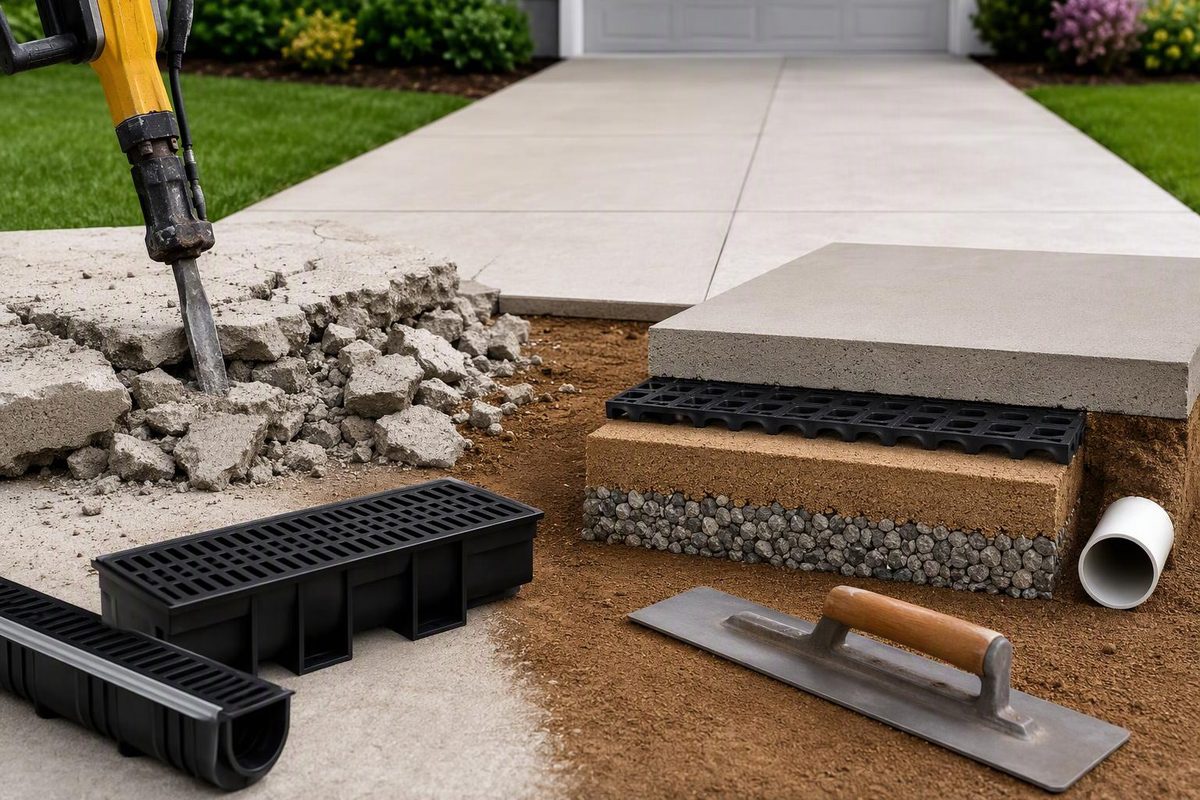
For early U.S. budgeting, the cost to remove and replace a concrete driveway is about $8–$16 per square foot for straightforward work with plain gray concrete. That is $4,800–$9,600 for 600 square feet, before substantial base reconstruction, drainage alterations or other separately priced work. This planning range combines HomeGuide’s published $6–$10 installed standard-concrete range with its $2–$6 old-driveway removal allowance. It is arithmetic from national guide figures, not a local contractor quote. Source: HomeGuide
Enter the area being replaced to calculate the starting range and its removal and installation components.
Replacement Budget by Area
Use the full paved area, including extensions being replaced.
Starting replacement range
600 sq. ft. × $8–$16/sq. ft.
Planning estimate, not a contractor quote. Unpriced extras are not included.
| Component | Per Sq. Ft. | Area Total |
|---|---|---|
| Removal | $2–$6 | $1,200–$3,600 |
| Plain installation | $6–$10 | $3,600–$6,000 |
Scope and unpriced work
Straightforward residential removal and plain gray replacement. Confirm base preparation in the bid. Substantial base reconstruction, drainage alterations, permits, taxes, apron work and restoration may need separate pricing.
Site-specific extras: — (not estimated). Do not add removal again if a contractor’s replacement price already includes it.
Source: HomeGuide national consumer guide: $6–$10/sq. ft. standard installation plus $2–$6/sq. ft. removal. Totals are arithmetic, not local quotes.
A replacement quote should cover three separate jobs: breaking up and hauling away the old slab, preparing its support and drainage, and installing the new concrete. A price for pouring concrete alone is not a replacement price.
What the $8–$16 Budget Covers
Use the starting range for a readily accessible residential driveway, ordinary demolition, a nominal 4-inch slab suitable for the intended vehicles and support conditions, and a simple broom finish. Do not assume the old base can stay merely because it is already there.
| Part of the Job | Scope to Confirm |
|---|---|
| Removal | Existing area and thickness, reinforcement, saw cutting, breaking, loading, hauling and disposal |
| Ground preparation | Excavation depth, unsuitable-soil removal, base material, compacted depth and compaction |
| New slab | Finished area, thickness, concrete mix, reinforcement if specified, forms and finish |
| Water and movement | Finished elevations, runoff route, contraction joints and isolation joints |
| Completion | Curing, protection, cleanup, lawn or edging restoration and reopening instructions |
Major excavation, replacement stone, drains, street-apron work, permits, taxes and landscape repairs must be identified explicitly. Some contractors include several of these; others price them separately. Never add an allowance again if the contractor’s installed rate already includes it.
Published Prices Have Different Scopes
All amounts below are U.S. dollars. These sources are not interchangeable all-in replacement estimates.
| Source and Market | Published Price | Scope That Matters |
|---|---|---|
| HomeGuide, national consumer guide | $6–$10/sq. ft. standard installation; $2–$6/sq. ft. removal | Supports the $8–$16 starting calculation; substantial site work needs separate confirmation |
| Kali Concrete, Minnesota contractor guide | $8–$12/sq. ft. broom-finish installation; $1–$4/sq. ft. removal in its detailed section ($1–$5 in its summary) | Base tier describes 4-inch concrete, standard reinforcement and normal base preparation; additional excavation and drainage are extras |
| Homewyse, September 2026 national estimate | $9.86–$12.11/sq. ft. installation | Excludes demolition, excavation, gravel base and compaction, permit fees and material sales tax |
Using its detailed removal allowance, the Minnesota contractor’s figures imply $9–$16 per square foot before further extras. Homewyse’s installation estimate still needs demolition and base work added. Scope differences can explain a large part of the apparent disagreement.
Calculate the Area Actually Being Replaced
Measure the paved area, including any apron, parking extension or turnaround being replaced. For a rectangle, width in feet × length in feet = area in square feet.
Split an irregular driveway into simpler shapes and add their areas. Have bidders confirm the measurement rather than relying on a “two-car driveway” label.
| Driveway Dimensions | Area | Removal + Plain Replacement |
|---|---|---|
| 20 × 20 feet | 400 sq. ft. | $3,200–$6,400 |
| 20 × 30 feet | 600 sq. ft. | $4,800–$9,600 |
| 20 × 40 feet | 800 sq. ft. | $6,400–$12,800 |
| 24 × 50 feet | 1,200 sq. ft. | $9,600–$19,200 |
These totals use $8–$16 per square foot. They are arithmetic planning totals, not size-specific market quotes. Small jobs can carry higher unit prices because setup and mobilization are spread over fewer square feet. Source: HomeGuide
For a hypothetical 600-square-foot bid, removal at $3 per square foot is $1,800 and installation at $9 is $5,400: $7,200 combined. If that installation rate excludes base replacement or a channel drain, those costs still belong in the project total. The cited figures do not provide a site-specific allowance for those extras.
Conditions That Push Replacement Above the Starting Range
Thick Slabs and Restricted Access Increase Demolition Work
Thick concrete, heavy reinforcement and restricted equipment access increase removal work. Ask whether the disposal charge is fixed and whether the price assumes a particular existing slab thickness. Kali Concrete specifically identifies thick slabs, heavy rebar and hand-loading as factors that can push removal beyond its usual allowance. Source: Kali Concrete
A bid that says only “remove existing driveway” leaves those assumptions unresolved. Have the contractor state what happens if demolition reveals thicker concrete or more reinforcement than expected.
Failed Support and Poor Drainage Need Separate Scope
Replacement exposes the ground beneath the old slab. Soft spots, washed-out support or unsuitable fill should not simply be covered again. NRMCA recommends removing soft spots, providing uniformly compacted support and sloping the slab and subgrade for drainage. Source: NRMCA, CIP 4
Require a written process for unexpected conditions: what triggers extra excavation, the unit price for additional work, and who approves it. That makes a base-repair exclusion usable rather than open-ended.
If water runs toward the garage, specify the corrected elevations and outlet—not just “improve drainage.” See driveway drainage solutions for choosing between grading and a drain.
Greater Thickness Adds Concrete, Not a Fixed Percentage to the Bill
Tell the contractor about RVs, delivery trucks and other regular heavy loads before comparing prices. For 600 square feet, a 4-inch slab contains approximately 7.4 cubic yards of concrete; a 6-inch slab contains 11.1 cubic yards, before waste or thickened edges. That is 50% more concrete volume, not automatically a 50% increase in the entire job.
Confirm the design using our driveway thickness guide. Price color, stamping and decorative borders as alternatives to the plain finish so appearance upgrades remain visible rather than blended into the basic replacement rate.
Compare Bids on the Same Construction Scope
Get bids against the same area, thickness, base scope and finish. A lower total is not a saving if it omits demolition, compaction or drainage work that another contractor includes.
Specify the Mix, Reinforcement, Joints and Curing
Ask whether the concrete mix suits local exposure. NRMCA recommends air-entrained concrete for outdoor slabs exposed to freezing weather.
For reinforcement, require the type, spacing and placement. Steel reinforcement does not prevent cracking; properly located reinforcement can reduce crack width. Both jointing and curing should be included, with a joint layout and curing method rather than vague assurances. These checks follow NRMCA’s cracking guidance.
For a more detailed contract checklist, use concrete driveway quality control.
Resolve Exclusions Before Accepting the Total
The quote should identify who handles permits, apron requirements, utility coordination, restoration and unforeseen ground conditions. It should also state when vehicles can return and what happens if weather delays the pour.
Compare the complete scope, not just the advertised square-foot rate. Where a cost is unknown, keep it marked as unknown until the contractor prices it; treating an unpriced drain or base repair as zero understates the budget.
Check Whether Full Replacement Is Necessary
Do not authorize full replacement solely because the driveway has cracks. NRMCA notes that most early random cracks rarely affect structural integrity or service life.
Stable, localized damage deserves a repair-cost comparison. Widespread deterioration, movement or recurring support problems deserve diagnosis before choosing a new slab. The useful replacement bid addresses the failure beneath or within the old driveway—not merely the price of fresh concrete.