
Cost to Put In Pavers: Driveway Budget and Quote Checks
Budget driveway pavers by area, material and removal costs, then check base depth, drainage, edging and exclusions before comparing contractor bids.
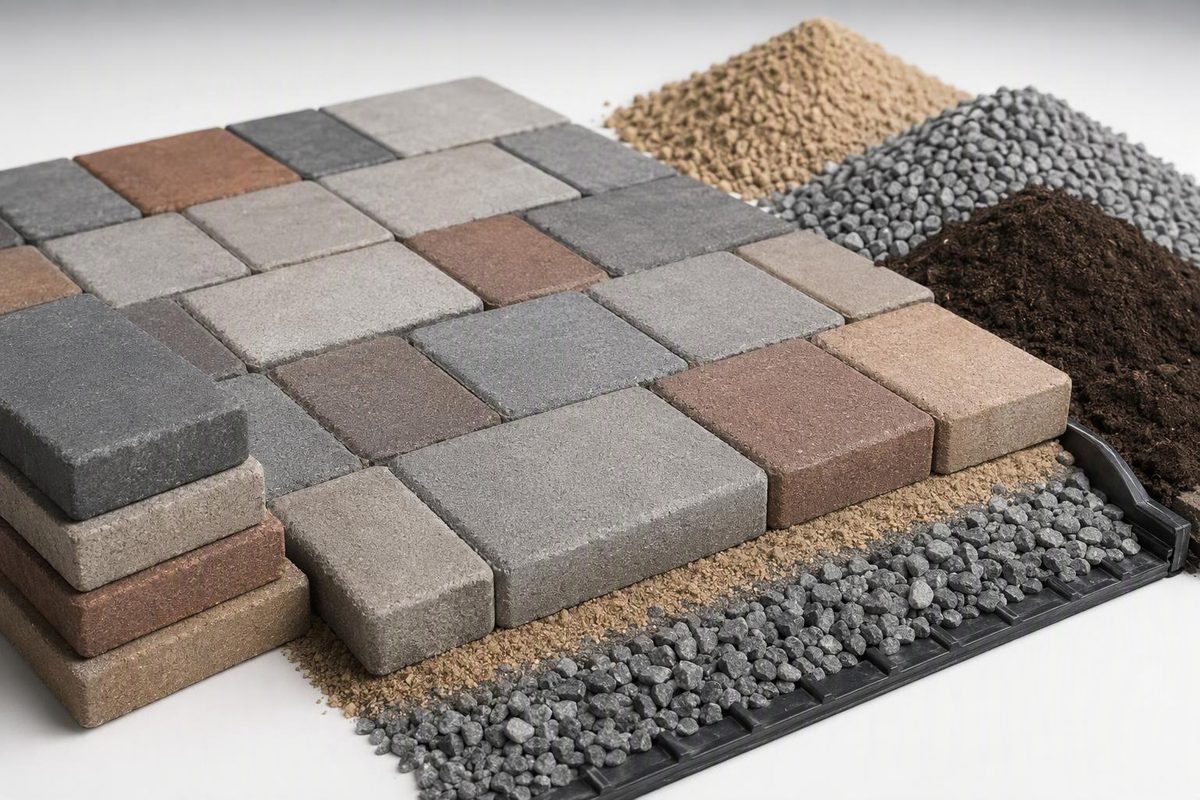
A driveway paver quote should cover more than the blocks: excavation, a load-bearing base, bedding, edge restraints, joint material and installation. Old pavement removal, drainage changes and weak-soil repairs need explicit treatment, whether included or priced separately.
With that scope in mind, $10–$30 per square foot installed is a broad U.S. cost-guide benchmark, though premium materials can exceed it. Concrete driveway pavers have a narrower published range of $10–$20 per square foot. For 600 square feet, that means roughly $6,000–$12,000 for concrete pavers, before separately charged removal or unusual site work. These are driveway figures—not patio installation prices. Source: HomeGuide’s driveway paver cost guide.
Cost ledger: what the numbers represent
Price basis: U.S. dollars; broad U.S. cost-guide benchmarks, not a local contractor bid. HomeGuide’s guide is dated January 6, 2026; prices checked October 9, 2026.
| Quote component | Published benchmark | How to use it |
|---|---|---|
| Paver units alone | $2–$17/sq. ft. | Excludes the foundation and installation |
| Base and ancillary materials | $2–$3/sq. ft. | General allowance; actual depth and specifications matter |
| Installation labor and operations | $6–$10/sq. ft. | The guide groups several prep and operating costs into this allowance |
| Broad installed total | $10–$30/sq. ft. | Includes pavers, base materials and labor |
| Existing concrete removal | Additional $2–$6/sq. ft. | Add only when removal is excluded from the installation quote |
These figures come from HomeGuide’s itemized cost breakdown. The first three rows describe components of the installed total, not extra charges to add on top of it; their range endpoints are approximate. The guide does not establish one standard excavation depth or drainage package for every project.
For a regional reference, Long Island installer Gappsi’s March 5, 2026 guide gives $17–$24 per square foot for basic materials and skilled installation, while discussing demolition and grading as additional preparation costs. This is an installer’s published estimate, not a nationwide rate or an itemized project quote. Source: Gappsi.
Calculate your driveway budget
Measure the actual paved footprint. For a rectangle:
Length × width = square feet
Add the apron, parking bays and turnaround separately. A 12-foot-wide driveway that is 50 feet long contains 600 square feet before those additions.
| Paved area | Concrete pavers at $10–$20/sq. ft. | Broad paver range at $10–$30/sq. ft. |
|---|---|---|
| 300 sq. ft. | $3,000–$6,000 | $3,000–$9,000 |
| 600 sq. ft. | $6,000–$12,000 | $6,000–$18,000 |
| 1,000 sq. ft. | $10,000–$20,000 | $10,000–$30,000 |
Calculated from the HomeGuide benchmarks above; not quotes for particular properties.
For replacement of 600 square feet of existing concrete with concrete pavers, separately priced concrete removal adds $1,200–$3,600. Combined with the concrete-paver installation benchmark, the planning total becomes $7,200–$15,600, still excluding separately charged drainage, extensive soil repair and other special work.
Do not automatically apply a waste percentage to the contractor’s installed square footage. Cuts and spare blocks affect the material order; the contract should distinguish the finished paved area from the quantity purchased.
What pushes the quote up—and what not to cut
Base depth, soil and climate
The foundation is a poor place to reduce scope merely to reach a target price. CMHA’s conventional concrete-paver guidance calls for at least 6 inches of compacted aggregate base for residential driveways on well-drained soils. Continually wet or weak soils and colder climates can require thicker bases. Base depth depends on traffic, soil, moisture and climate—not just driveway area. Source: CMHA construction guidance.
Ask for compacted depth, aggregate specification and compaction method. “Six inches of gravel” does not tell you whether that is loose delivery depth or the finished foundation. Bedding sand is a separate layer; CMHA specifies a nominal 1-inch uncompacted layer and warns against using extra sand to correct an uneven base. Source: CMHA bedding and base guidance.
Driveway-rated pavers and design
Confirm the exact product is suitable for vehicles. CMHA’s guide specification allows 60 mm concrete units for residential driveways with a maximum length-to-thickness ratio of 4:1, while recommending at least 80 mm thickness and a maximum 3:1 ratio for general vehicular applications. Thickness alone does not make every large patio slab suitable for a driveway. Source: CMHA guide specification.
HomeGuide lists installed brick driveway pavers at $10–$25 per square foot and cobblestone at $20–$50. Material choice, borders, curves and cutting can change the bid. Compare the same product and layout—not merely “pavers.” For material distinctions, see our brick paver driveway guide.
Drainage and edge restraints
Have the contractor show where runoff will go and how the finished driveway meets the garage, sidewalk and street. Edge restraints maintain the pavers’ lateral confinement under loads; they are a functional part of the pavement, not just decorative trim. Source: CMHA.
A permeable driveway is a different assembly. It uses permeable stone-filled joints and open-graded aggregate layers; low-infiltration soils may require underdrains. Do not accept a conventional sand-jointed installation as equivalent simply because it has gaps between blocks. Request a separate system specification and maintenance plan. Source: CMHA permeable pavement guidance.
Compare bids on the same scope
Before choosing the lowest total, require each bidder to state:
- Area and product: finished square footage, manufacturer, model, thickness, pattern and borders.
- Removal: pavement demolition, excavation, haul-off and disposal charges.
- Foundation: compacted base depth, bedding material, soil repairs and compaction requirements.
- Drainage and transitions: finished grades, drains, outlets and garage clearance.
- Completion: edge restraints, joint material, final compaction, cleanup and spare matching pavers.
- Commercial terms: taxes, delivery, permits, exclusions, warranty coverage and pricing for unexpected excavation.
If a bidder proposes retaining an existing slab to save demolition costs, compare that as a separate scope; our pavers-over-concrete guide covers the suitability checks.
DIY avoids a contractor’s installation charge, but the paver purchase price is not the DIY total. Budget the base, bedding, edging, joint material, delivery, disposal and equipment as well. Protect the foundation and drainage first; reduce decorative complexity or paved area before accepting an underspecified driveway. If the complete bids exceed your budget, use our pavers versus concrete cost comparison to compare alternatives on equivalent preparation and removal scopes.