
7 Crusher Run Gravel Basics: Uses, Depth and Cost
It can shed runoff across a properly shaped surface, but once compacted it generally provides less through-layer drainage than clean, open-graded stone.
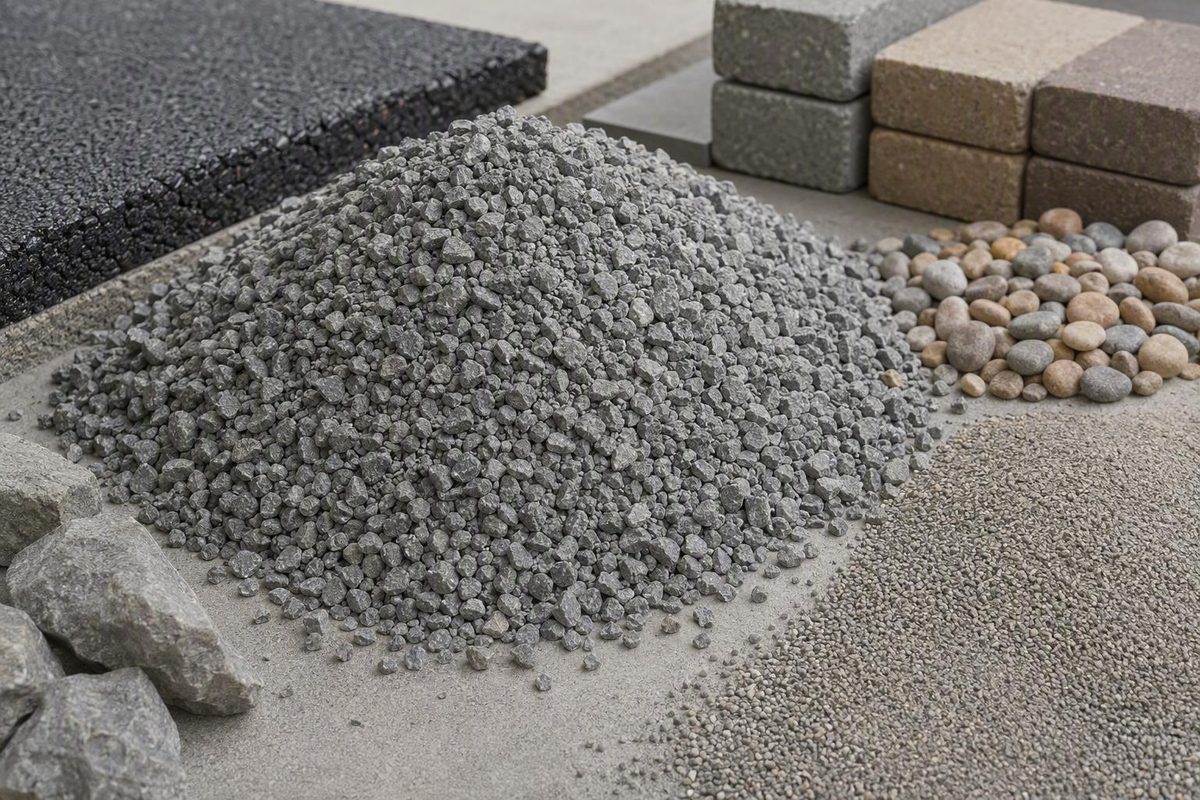
Crusher run gravel can form a dense, stable layer for a driveway, parking pad, walkway, patio, pavers, or pavement. Its strength comes from a graded mixture of angular stone and fines: under mechanical compaction, smaller particles fill spaces between larger pieces and help the aggregate interlock.
That composition also creates an important limitation. Crusher run is not clean drainage stone. A compacted surface can shed runoff when properly shaped, but the layer does not preserve the open voids found in uniformly sized clean stone.
“Crusher run” is not a nationally uniform product, either. Names, source rock, particle sizes, fines content, density, and local specifications vary. Before ordering, confirm the material’s actual gradation and unit weight, then match the depth, drainage plan, quantity, and installation method to the site and expected traffic.
The figures and procedures below are preliminary planning guidance drawn largely from commercial aggregate and equipment sources. They are not a substitute for project specifications, local requirements, equipment instructions, or professional pavement and geotechnical design where conditions are difficult or failure would have significant consequences.
What crusher run gravel is—and what the name does not tell you
Crusher run is a dense-graded aggregate containing angular crushed stone across multiple particle sizes, extending from a nominal maximum size down through fines or stone dust. During compaction, the smaller particles fill spaces between larger stones while the angular pieces interlock. This allows the mixture to form a denser layer than clean, uniformly sized stone.
Although suppliers frequently call it crusher run gravel, manufactured crushed stone and natural gravel are not technically identical. Crushed stone is mechanically broken and typically angular. Naturally occurring gravel is often rounded by water or weathering. Rounded particles do not interlock in the same way, although suppliers and homeowners often use “gravel” as a broad category for both materials. Zimmerman Mulch explains this distinction in its crushed-stone and gravel buying guide.
Depending on the region and producer, compactable base products may be sold as:
- Crush and run or crush ’n run
- Quarry process
- Dense-grade aggregate or DGA
- Graded aggregate base or GAB
- ABC stone or aggregate base coarse
- Road bond
- Road base
- Crusher fines blended with base stone
These labels identify the same general family of materials, but they are not guaranteed equivalents. Numbered products such as Item 4, #411, 21A, or 2A modified can also refer to locally defined gradations. A supplier recognizing two names does not prove that the products meet the same sieve requirements.
A minus designation generally identifies a nominal or specified maximum size while indicating that smaller particles and fines are retained. Thus, ¾-inch-minus is not a pile in which every particle measures ¾ inch. It is a graded blend extending from the named top size downward. Actual tolerances should be confirmed through the producer’s sieve analysis or the governing specification.
Source rock may include limestone, granite, gneiss, trap rock, or another locally quarried stone. Recycled concrete may also be processed into a graded base. Commercial product guidance commonly identifies ¾-inch-minus and approximately 1½- to 2-inch-minus grades, with some products extending to 4-inch-minus, but these are examples rather than a universal classification system according to Gravelshop’s crusher-run overview.
The name alone does not establish:
- Maximum or nominal top size
- Full particle-size distribution
- Percentage or character of fines
- Presence of soil, clay, or recycled components
- Compliance with a transportation or project specification
- Loose or compacted density
- Moisture condition at delivery
- Suitability for a particular pavement, paver, drainage, or structural application
For an informal residential project, ask the supplier for the top size, source rock, fines description, and estimated unit weight. If plans, permits, contracts, or pavement specifications govern the work, order the specified aggregate instead of requesting a generic load of crusher run. A current product sheet, sieve analysis, or reference to the applicable local specification is more useful than a regional nickname.
Where crusher run works—and where it may be the wrong aggregate
Crusher run is commonly marketed for driveway and access-road bases, parking pads, walkways, patios, paver bases, pavement subbases, concrete bases, structural fill, and selected backfill applications. It may serve as the finished surface of an unpaved driveway or as a structural layer beneath clean stone, asphalt, concrete, pavers, or another approved surface.
As a finished gravel surface, compacted crusher run can feel tighter and smoother than loose clean stone. It remains an unbound aggregate, however. Dust, migrating particles, rutting, potholes, erosion, and periodic regrading are still possible. Aggregate alone cannot compensate indefinitely for soft soil, trapped water, insufficient depth, or inadequate compaction.
Two different forms of drainage must be distinguished:
- Surface drainage: Water flows across a crowned or cross-sloped surface toward an outlet.
- Through-layer drainage: Water travels through voids within the aggregate.
Crusher run is designed to close many internal voids during compaction. It can therefore shed water across its surface while allowing less movement through the layer than clean, open-graded stone. That behavior is useful when the objective is a tight structural layer but potentially unsuitable where open drainage voids are essential.
Do not assume that material advertised for general backfill belongs around perforated pipe, in a French drain, behind a retaining wall, or beside septic components. Fines can occupy the voids needed to convey water. The system specification and actual aggregate gradation should control those applications.
Crusher run deserves project-specific review on:
- Steep grades exposed to concentrated runoff
- Persistently wet or pumping ground
- Deep organic soil or uncontrolled fill
- Routes carrying regular delivery trucks, farm equipment, RVs, or commercial vehicles
- Sites with significant freeze-thaw exposure
- Entrances regulated by a road authority
- Work near retaining structures, septic systems, utilities, or drainage infrastructure
- Bases that will later receive a formally specified pavement or paver system
Use five questions as an initial suitability screen:
- Is the soil firm, or does it pump and deform under traffic? Saturated clay, loose fill, and organic soil present different problems from firm, well-drained subgrade.
- Must water move through this aggregate layer? If so, a clean, open-graded product may be required.
- What vehicles will use the surface? Passenger cars impose different demands from loaded trucks, trailers, RVs, and farm machinery.
- Will crusher run be the final surface or a covered base? A finished surface must tolerate maintenance and erosion; a covered base must meet the requirements of the system above.
- Does the delivered product meet the needed gradation? Verify top size, fines, source, density, and any applicable specification.
Crusher run is a plausible choice when the project needs dense structural-base behavior and the site has a workable route for surface runoff. It is a questionable choice when the primary objective is preserving open drainage voids.
Crusher run vs. #57 stone, clean gravel and recycled concrete
“Stability or drainage?” can be the wrong question because some projects need both in different layers. Crusher run and clean stone solve different problems, and a layered section may use each where its behavior is useful.
| Material | Particle character | Compaction behavior | Drainage behavior | Common reasons to choose it | Main cautions |
|---|---|---|---|---|---|
| Crusher run | Angular crushed stone across many sizes, including fines | Forms a dense, compactable matrix | Limited through-layer drainage after compaction; can shed surface water when graded | Structural bases, driveway surfaces, access roads, pads, pavement subbases | Names and gradations vary; fines may retain water or migrate |
| #57 or comparable clean stone | Angular, relatively uniform stone with few fines | Interlocks but does not form the same dense matrix | Open voids permit substantially more water movement | Drainage layers, stabilization and specified drainage structures | Exact gradation depends on the producer and governing specification; surface stone can migrate |
| Naturally rounded gravel | Rounded or subrounded particles, sometimes mixed with sand and fines | Less angular interlock than crushed stone | Varies widely with gradation and fines | Landscaping, decorative surfaces, general fill and some local road products | Should not automatically replace a specified angular base |
| Recycled crushed-concrete base | Processed concrete crushed into a graded blend | Can resemble crusher run when properly processed | Depends on gradation and fines | Construction access, pads, road bases and recycled aggregate applications | Verify contaminants, gradation, density, durability and local acceptance |
Crusher run is generally selected where dense compaction and structural-base behavior are priorities. Clean #57 or comparable open-graded stone is generally considered where water needs to move through the aggregate. The exact meaning of #57 depends on the governing specification and producer; it should not be treated as a universal bag of identically sized stone.
Rounded gravel may still be useful when it has a suitable distribution of coarse particles and fines. The important point is not that all rounded material is unsuitable. It is that the word “gravel” does not prove equivalence to a specified angular, compactable base.
A possible conceptual section for weak or wet ground is:
- Prepared and shaped subgrade
- Site-appropriate geotextile where separation or filtration is needed
- Clean stone or coarser stabilization aggregate
- Compacted crusher run above
- A final surface, if different from crusher run
This is a conditional concept, not a universal design. Komplet America’s commercial contractor guide likewise distinguishes dense crusher run from open #57 stone and discusses layered use on marginal subgrades. The appropriate geotextile, aggregate size, thickness, and drainage outlet still depend on soil, water, loads, and applicable specifications.
Geotextile should be considered a separation or filtration component rather than simply a weed barrier. It may limit mixing between soft soil and aggregate or reduce migration of subgrade particles into an open stone layer. It is not automatically required beneath every driveway, and fabric does not create an outlet for trapped water.
Recycled concrete can be processed into a crusher-run-like base, but it should not be presumed identical to virgin quarry stone. Ask whether steel, brick, soil, asphalt, wood, gypsum, or other debris is controlled; whether the product is processed to a defined gradation; which ordering density applies; and whether local requirements permit its use.
A clean-stone surface can be placed over compacted crusher run when appearance or texture justifies it. The trade-off is movement: clean surface stone may roll, migrate toward edges, collect in low areas, or need replenishment. Edging can limit lateral loss on some patios and walkways, but it does not correct an unstable or poorly drained base.
Choosing particle size and compacted depth
Particle-size and depth figures from aggregate sellers and equipment companies are useful for preliminary budgeting, not universal engineering specifications. The appropriate section depends on the local product, soil strength, groundwater, climate, slope, traffic, compaction equipment, and any surface installed above the base.
Commercial guidance commonly follows this pattern:
- ¾-inch-minus: smoother upper courses, leveling work, walkways, patios, and smaller projects
- Approximately 1½- to 2-inch-minus: lower or heavier base courses
- Up to 4-inch-minus: coarse base or fill applications offered by some suppliers
Larger stone may provide structure in a lower layer, while smaller-minus material generally creates a finer surface. A coarse mix can be difficult to trim smoothly in a thin walkway; a fine product should not automatically be assumed equivalent to a properly graded heavy base.
Common commercial planning ranges include approximately 3–4 compacted inches for some walkways and small patios, about 4–6 compacted inches for many residential driveways on stable, well-drained subgrade, and 8–12 inches or a layered section for weak sites or heavier traffic. GrinderCrusherScreen presents similar approximate ranges while emphasizing that depth depends on the project in its commercial crusher-run base guide.
Always identify whether a stated thickness is loose or compacted. If a design calls for a six-inch base, it should say whether that means six inches immediately after spreading or six inches after compaction. Those quantities are not automatically identical, so ordering from compacted geometry alone can leave a project short.
Variables that can change the required section include:
- Sod, roots, topsoil, peat, or other organic material
- Weak or expansive clay
- Loose sand or uncontrolled fill
- Saturated soil or a high water table
- Freeze-thaw exposure
- Driveway slope
- Concentrated roof, ditch, or roadway runoff
- Expected axle loads and heavy-vehicle frequency
- Width and edge support
- Future asphalt, concrete, or paver installation
- Aggregate gradation and moisture condition
- Available compaction equipment
Depth alone does not establish load capacity. A thick layer of unspecified aggregate placed on pumping soil and lightly tracked by a vehicle is not equivalent to a specified material compacted in controlled lifts over prepared, drained subgrade.
Scenario 1: Light-use walkway
A pedestrian walkway on firm, well-drained soil might be budgeted around 3–4 compacted inches of smaller-minus material. That preliminary range comes from commercial base guidance rather than a universal walkway standard. Organic material still needs to be addressed, and the final surface system may require a separate bedding layer.
Scenario 2: Residential car driveway on stable soil
For passenger cars and light trucks on firm, well-drained subgrade, 4–6 compacted inches is a common preliminary range. Komplet America describes that range for residential driveways on stable subgrade, while also making clear that water and subgrade condition affect the section in its driveway aggregate comparison.
Scenario 3: Driveway carrying RVs or frequent heavy trucks
Commercial guidance may extend the planning range to 8–12 compacted inches, potentially with coarser lower aggregate, stabilization stone, geotextile, or multiple layers. Hello Gravel gives that range for RV or commercial-truck use, but it is vendor guidance rather than a project-specific structural design in its crusher-run project guide.
Weak soil, chronic saturation, steep grades, regulated entrances, or costly consequences of failure warrant local specifications or professional design.
How to calculate cubic yards, tons and truckloads
Start with the dimensions of the finished compacted layer:
Length in feet × width in feet × depth in feet ÷ 27 = compacted geometric cubic yards
Convert inches to feet first:
Depth in inches ÷ 12 = depth in feet
The formula is also presented in commercial crusher-run quantity guidance, but the answer represents geometric volume—not automatically the loose quantity to order as shown by GrinderCrusherScreen.
For an irregular driveway, divide the area into measurable segments, calculate each segment, and add the results. Include curves, flared entrances, turnouts, and shoulders that are part of the intended section.
Keep three quantities separate:
- Compacted design volume: Geometry required after installation
- Loose ordering volume: Material volume before final compaction
- Delivered tonnage: Weight supplied by the quarry or yard
The conversion among them depends on gradation, source rock, moisture, loading method, and required compaction. Ask the selected supplier how many tons or loose yards of its product are normally required to produce one compacted cubic yard under the intended installation conditions.
Gravelshop gives about 1.2 tons per cubic yard, while other commercial guidance uses approximately 1.3; neither figure is a universal density as Gravelshop’s product overview notes.
Worked quantity example
Suppose a parking area measures 20 feet by 40 feet and requires six compacted inches:
-
Convert the depth:
6 ÷ 12 = 0.5 feet -
Calculate cubic feet:
20 × 40 × 0.5 = 400 cubic feet -
Convert to cubic yards:
400 ÷ 27 = 14.8 cubic yards
The result is approximately 14.8 compacted geometric cubic yards before any project allowance. It is not yet the loose order volume.
If—and only if—14.8 cubic yards were a confirmed loose volume, applying the commercial planning factors would produce:
14.8 × 1.2 = 17.8 tons
It should not be treated as the order for a 14.8-compacted-yard design until the supplier provides the product’s loose-to-compacted yield or an equivalent tons-per-compacted-yard figure.
A project allowance may be needed for:
- Irregular excavation or subgrade depressions
- Forming a crown or cross-slope
- Material extending beyond measured edges
- Loose-to-compacted conversion
- Minor spillage, contamination, or rehandling
- Actual width and depth variations
There is no universally correct allowance percentage. A boxed-in patio with controlled excavation differs from a long rural driveway with irregular shoulders. State the reason for any allowance instead of silently adding a standard percentage.
Once the supplier confirms required tonnage and legal payload for the delivery vehicle, estimate loads as:
Total required tons ÷ confirmed payload per truck = estimated truckloads
Round only after asking whether partial loads are available and whether minimum-load or delivery charges apply. Truck capacity, access, route restrictions, and actual material weight may all affect the practical payload.
Do not substitute retail “coverage per yard” statements for dimension-based calculation. Product pages may describe different depths, use loose rather than compacted volume, or contain inconsistent figures. Measure the geometry first, then apply the selected supplier’s density and yield information.
Before requesting a quote, assemble:
- Measured length
- Average or segmented width
- Required compacted depth
- Calculated compacted design volume
- Supplier’s estimated tons per loose cubic yard
- Supplier’s loose-to-compacted yield
- Any allowance and its stated reason
- Confirmed truck payload
- Minimum order or minimum load
- Preferred number and location of dump piles
A practical installation sequence for a compacted base
This sequence is preliminary planning guidance, not a validated construction specification. Local requirements, project documents, site conditions, and equipment-manufacturer instructions should take priority.
1. Locate utilities and check local requirements
Before excavation, arrange utility location through 811 in the United States or the appropriate local service. A documented DIY driveway workflow identifies 811 as a pre-excavation step, but readers should obtain current instructions directly from the relevant utility-location authority as reflected in the Instructables project account.
Ask the appropriate local authority whether permits, driveway-apron rules, culvert requirements, drainage approval, or erosion controls apply. Requirements at a public-road entrance may differ from those governing the private portion of a driveway.
2. Remove unsuitable material
Sod, roots, topsoil, buried vegetation, and other organic material are poor starting points for a structural base because they can compress or change as they decompose. Excavation should account for the entire planned section, including stabilization aggregate, crusher run, bedding, and the final surface.
If excavation exposes soft pockets or debris, pause and assess the condition rather than assuming a thin aggregate layer will solve it.
3. Evaluate and shape the subgrade
Inspect the exposed soil before placing aggregate. Soil that deforms deeply, pumps water, or ruts under construction traffic may allow stone to mix into the subgrade instead of forming a distinct base.
The intended section should have a route for surface water away from structures. Roof flow, hillside runoff, existing ditches, and low areas can affect whether the finished driveway remains serviceable. Where the drainage route is uncertain, seek site-specific guidance rather than relying on a generic crown or slope.
4. Add separation or stabilization where justified
Weak, muddy, or contamination-prone soil may benefit from a suitable geotextile, clean stabilization stone, or both. These measures are conditional: fabric selection, aggregate size, and thickness depend on the soil and the function the layer must perform.
Likewise, adding clean stone without a workable drainage path does not by itself resolve chronic saturation.
5. Place crusher run in separate lifts
Do not assume that a surface compactor can uniformly consolidate the full base depth in one placement. Spread the material in manageable lifts while maintaining the intended grade.
Material gradation, moisture, compactor capability, access, and required density should determine the actual loose-lift thickness according to Hello Gravel’s installation guidance.
Use an appropriate method to monitor elevations and thickness rather than relying solely on visual judgment.
6. Moisture-condition and compact each lift
Commercial and practical guidance commonly recommends light moisture conditioning where needed because suitable moisture may help particles rearrange and reduce dust. There is no supported universal hose time, water quantity, or visual moisture test for every crusher-run product.
Material delivered damp may need little additional water. Saturated material or a subgrade that begins pumping under equipment requires reassessment rather than more passes.
Select mechanical compaction equipment based on the area, lift thickness, material, and manufacturer instructions. Compact one lift before placing the next. If project documents require a measured density, appearance and ordinary vehicle traffic do not verify compliance; arrange the specified field test.
7. Establish the finished drainage shape
After compacting the final lift, establish the intended crown or cross-slope and connect it to a workable runoff route. Inspect the surface after rainfall when possible. Recurring ponding, erosion, or saturation at the edge indicates that the drainage arrangement needs further attention.
Safety sidebar
This evidence pack does not contain authoritative machinery or excavation-safety standards. Before operating compactors, loaders, rollers, or delivery equipment:
- Follow the equipment manufacturer’s operating and protective-equipment instructions.
- Use only equipment you are competent and authorized to operate.
- Obtain current utility-location and excavation requirements from the appropriate authority.
- Keep other people outside the equipment work area.
- Let the carrier determine whether a dump location and overhead clearance are safe.
- Do not improvise around unstable ground, raised dump bodies, steep slopes, or restricted visibility; stop and obtain qualified assistance.
Crusher run cost: material is only one line of the budget
Crusher run prices are highly local.
For broad context, Gravelshop publishes commercial planning ranges of $30–$60 per ton, $50–$90 per cubic yard, $100–$250 per delivery, and $3–$6 per square foot installed. These are the seller’s national estimates, not independently verified averages or predictions of a local quote; its guide says preparation, drainage, labor, distance, access, and region can change the total in its crush-and-run cost breakdown.
Individual listings illustrate local variation but are not benchmarks. In a listing checked August 17, 2026, Cummin Landscape Supply displayed $59 per loose cubic yard and $79 for a one-yard supersack. The page requests a ZIP for pricing and availability, and its weight and coverage figures are internally inconsistent, so buyers should verify all terms directly on the Cummin crusher-run listing.
In another listing checked August 17, 2026, J.F. Krantz Topsoil & Nursery displayed $72 per cubic yard with a three-cubic-yard minimum. The page did not establish comparable delivery, tax, or density terms on its crusher-run product page.
Before comparing prices, normalize each quote for:
- Ton versus cubic yard
- Loose volume versus compacted yield
- Bulk load versus supersack or bag
- Virgin stone versus recycled aggregate
- Delivery included or added
- One dump pile versus spreading
- Sales tax included or excluded
- Fuel surcharge included or excluded
- Minimum quantities and partial-load charges
- Top size, gradation, source, and specification
A low per-yard price is not necessarily the lowest delivered cost if the minimum order is large or multiple deliveries are required. A per-ton quote may also be more or less favorable depending on unit weight and haul distance.
Use a complete worksheet:
| Cost item | Quote or allowance |
|---|---|
| Crusher run material | |
| Delivery or per-truck fee | |
| Minimum-load or short-load charge | |
| Fuel surcharge | |
| Sales tax | |
| Permit or entrance requirements | |
| Excavation and organic-soil removal | |
| Disposal of unsuitable material | |
| Geotextile | |
| Clean stabilization stone | |
| Drainage work | |
| Spreading and grading | |
| Compaction equipment | |
| Labor | |
| Edging or shoulder work | |
| Site cleanup | |
| Future regrading and replenishment |
Delivery cost may depend on supplier distance, truck configuration, load weight, route, elevation, access, and number of loads. A difficult dump location can also create rehandling costs if aggregate cannot be placed near the work.
DIY work may reduce paid labor, but equipment rental, fuel, transport, under-ordering, misplaced piles, and inadequate compaction can offset the savings. Compare quotes in delivered-total terms for the same product, quantity, and dump conditions.
A useful request is:
Quote the delivered total for the estimated tonnage of ¾-inch-minus dense-graded aggregate meeting the stated local specification. Include tax, fuel charges, minimum-load fees, and delivery to the described dump location. State the estimated tons per loose cubic yard, expected loose-to-compacted yield, and whether spreading is included.
Buying, delivery and maintenance checks that prevent expensive mistakes
The best time to discover that a supplier’s crusher run differs from the material expected is before the truck is loaded.
Supplier checklist
Confirm:
- Exact product name and local aliases
- Source rock or recycled source
- Nominal maximum particle size
- Full gradation or representative sieve analysis
- Approximate fines content
- Applicable transportation or project specification
- Moisture condition at loading
- Estimated tons per loose cubic yard
- Expected loose-to-compacted yield
- Whether the quote is by ton, loose yard, bag, or load
- Minimum order and partial-load charges
- Delivered total, including fuel and tax
- Whether quoted volume is loose or compacted
- Whether the driver can spread or only dump
- Whether spreading costs extra
- Rejection or contamination policy
If appearance matters, inspect the current product or stockpile. Photographs may not accurately represent color or particle distribution, and production can vary.
Delivery-access checklist
Review the route with the carrier:
- Usable driveway and gate width
- Overhead wires, limbs, and roof overhangs
- Turning and backing space
- Grade and cross-slope
- Ground condition
- Dump location
- Overhead clearance for a raised body
- Space for multiple piles or loads
One seller reports approximately 10 feet of clearance for smaller trucks and 12 feet for larger trucks, but those are seller-specific dimensions, not universal requirements. The actual carrier must approve access and the dump location on ChattSoil’s delivery product page.
Bulk aggregate can exceed pickup or trailer limits quickly. Use the vehicle manufacturer’s payload, gross-weight, axle, hitch, and towing limits, along with applicable road rules. Do not estimate safe capacity from a generic statement about what “a pickup” can carry.
Plan the dump sequence with the carrier before delivery. If truck access is uncertain, arrange an alternative dump point and account for the equipment and labor needed to move the material.
Diagnose recurring damage before adding stone
When damage repeatedly returns, additional loose stone may conceal the symptom without resolving the cause.
- Ruts or potholes: Consider subgrade softness, water, base depth, segregation, or inadequate compaction.
- Standing water: Review the crown or cross-slope, settled areas, shoulders, and available runoff route.
- Muddy pumping: Consider saturation, mixing between soil and aggregate, or inadequate stabilization.
- Washouts: Look for concentrated runoff entering from roofs, slopes, ditches, roads, or culverts.
- Loose surface stone: Review gradation, compaction, turning and braking areas, edge restraint, and slope.
- Repeated edge breakup: Examine shoulder support, traffic width, and drainage along the edge.
Treat these as diagnostic prompts rather than definitive failure analyses. Complex or recurring problems may require an on-site assessment.
Maintenance should focus on causes. Inspect the surface after heavy rain and seasonal weather changes, keep existing drainage outlets open, regrade displaced compatible material when necessary, and add new material only after considering why the previous layer moved or failed.
Crusher run is a plausible choice when:
- The project needs a dense structural layer rather than an open drainage medium.
- Unsuitable soil can be removed, improved, or addressed in the section.
- The site has a workable surface-drainage plan.
- The local product’s gradation and ordering density are verified.
- The depth reflects soil, climate, slope, and traffic.
- The material can be placed and mechanically compacted in controlled lifts.
- Delivery access and total cost have been confirmed.
It should not be purchased by name alone. Persistently wet ground, heavy loads, steep grades, regulated entrances, and work affecting structures, retaining walls, septic systems, or drainage facilities call for local specifications or qualified design rather than generalized depth rules.
Readers comparing rural driveway surfaces can also review Driveway Source’s guide to recycled asphalt driveway costs, compaction, and trade-offs. Recycled asphalt and crusher run are different materials, but both depend on base preparation, drainage, material quality, and compaction.
Frequently asked questions
Is crusher run good for a driveway surface or only for the base?
It can serve either role. Compacted crusher run is used as the finished surface of some gravel driveways and access roads, where it can create a tighter texture than clean stone. It is also used as a structural base beneath asphalt, concrete, pavers, or another aggregate layer.
As a finished surface, it may develop dust, loose particles, erosion, ruts, or potholes and can require periodic regrading. As a covered base, its gradation, compacted thickness, drainage, and density must be compatible with the system installed above it.
Does crusher run drain well?
It can shed water across a properly shaped surface, but compacted crusher run generally provides less through-layer drainage than clean, open-graded stone. The fines that help it compact also occupy voids through which water could otherwise move.
For perforated pipe, French drains, retaining-wall drainage zones, or other systems that depend on water moving through aggregate, follow the system specification. Do not substitute crusher run merely because it is described broadly as backfill or drainage material.
How much does one cubic yard of crusher run weigh?
Approximately 1.2–1.3 tons per loose cubic yard, or roughly 2,400–2,600 pounds, is a preliminary commercial planning range rather than an exact universal weight. Rock type, gradation, fines, moisture, and loading condition can change the result. Cummin Landscape Supply, for example, lists approximately 1.2 tons per yard while also displaying inconsistent weight figures on the same product page in its crusher-run listing.
Use the selected supplier’s product-specific unit weight and ask whether the stated yard is loose or compacted. Do not use the generic range to determine a vehicle load without checking the vehicle’s specific limits.
Do I need geotextile fabric under crusher run?
Not automatically. Geotextile may be useful where it must separate aggregate from weak soil, limit particle migration, or provide filtration in a designed section. Firm, well-drained subgrade may not require it.
Fabric is not a universal weed barrier and does not replace drainage or stabilization. Muddy, pumping, or chronically wet soil may require a combination of separation, suitable stone, drainage work, and greater structural depth.
Should crusher run be wet before compaction?
Light moisture conditioning is commonly recommended because suitable moisture may help the graded particles consolidate and can reduce dust. That does not mean every load should be soaked. Material may arrive damp, while excessive water can coincide with pumping or unworkable subgrade conditions.
Add water only as needed, distribute moisture as evenly as practical, and compact each lift mechanically in accordance with the equipment instructions. If a formal density is specified, use the required testing method rather than relying on appearance, water beading, ordinary traffic, or the disappearance of surface ridges.