
Limestone Gravel for Driveways: Sizes, Quantity and Cost
Compare crusher run, #57 limestone and larger base stone, calculate quantity, and check drainage, compaction and delivery costs before ordering.
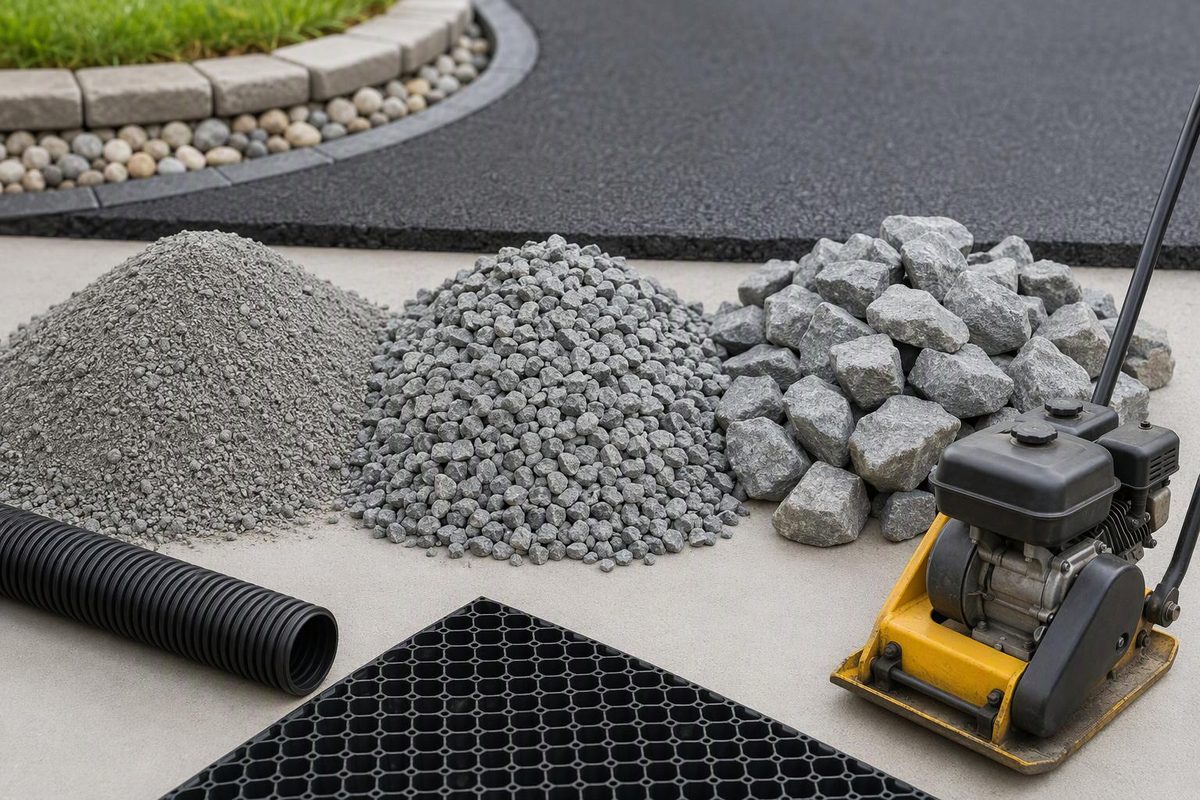
Limestone can make a firm, serviceable driveway, but “limestone gravel” is not a complete order. It identifies the rock, not the gradation, amount of fines, washing, durability or intended use.
For a conventional gravel driveway, dense-graded crushed limestone containing coarse stone and fines is usually the practical base and surface material. Clean, similarly sized limestone serves drainage and stabilization roles, but it does not compact into the same tight wearing surface.
Which limestone should you order?
Supplier names and numbers vary by region. Match the material description to the job rather than ordering by number alone.
| Material | Typical composition | Best driveway role | Main limitation |
|---|---|---|---|
| Crusher run, dense grade or road base | Graded crushed stone from a stated top size down to fines | Compactable base and rural-drive surface | Dusty when dry; compacted fines limit through-drainage |
| Clean #57 limestone | Mostly angular stone around 3/4 to 1 inch, with few fines | Drainage courses, trench stone or occasional top dressing | Does not bind like dense grade and can move under turning tires or a snowplow |
| Clean #2 or #4 limestone | Larger angular stone, often about 1 to 2 1/2 inches | Lower course over soft areas | Too coarse for a comfortable finished surface |
| Screenings or stone dust | Predominantly fine particles | A component in blends or specialized leveling work | Dusty and likely to hold water if used alone |
Numbers such as #304, #411, #53 and #73 are not national guarantees. Indiana’s March 2026 chart, for example, lists #53 and #73 as separate dense-graded products with their own sieve limits (INDOT). An Ohio supplier describes #304 as roughly 1 inch down to dust, while listing #57 as clean, free-draining stone around 3/4 to 1 inch (Kimble Companies). Another local specification may differ.
Ask the quarry for:
- the nominal top size and full gradation;
- whether the material is washed or contains fines;
- the applicable road-base or surface-aggregate specification;
- its tons-per-cubic-yard conversion and whether that figure is loose or compacted;
- delivered cost, truck capacity and minimum-load charges.
Dense grade or clean limestone?
A compactable wearing surface needs particles of different sizes. Fines fill spaces between larger angular particles and help the moist mixture form a hard crust. PennDOT’s unpaved-road guidance describes a wearing course as normally 3/4 inch and smaller and explains the binding role of fines (PennDOT LTAP).
That is why crusher run generally performs better than clean #57 as the only driving surface. It is also why a conventional compacted limestone drive should not automatically be called permeable: after the fines knit together, the surface should shed most runoff toward a stable outlet. Our crusher run guide covers this distinction in more detail.
Clean, open-graded limestone has a different job. Its connected voids can carry water when it is part of a designed drainage section. For example, the City of Santa Barbara’s November 2025 guidance specifies 6–8 inches of compacted, washed, open-graded angular aggregate, a minimum 3/4-inch rock size and no binder for its permeable gravel driveways (City of Santa Barbara). Those requirements belong to a particular local system. Simply placing #57 over wet soil will not fix a failed subgrade.
Base preparation, depth and drainage
Before ordering limestone:
- Identify where water enters and exits. Maintain an outlet to a ditch, swale, culvert or approved infiltration area. Do not leave a ridge at the shoulder that traps water.
- Remove unsuitable material. Topsoil, roots and severely unstable pockets should not remain directly beneath the driveway section.
- Use geotextile for a defined purpose. FHWA guidance describes separation fabric as a way to keep wet silt and clay from pumping into clean aggregate over a weak subgrade. It also warns against driving directly on exposed fabric and generally recommends at least 6 inches of cover in that application (FHWA). Fabric does not replace drainage or adequate stone depth.
- Specify compacted thickness. For initial budgeting, compare 6- and 8-inch full-depth sections rather than assuming one figure fits every site. PennDOT’s unpaved-road guidance calls for an 8-inch compacted aggregate placement in its municipal-road context (PennDOT LTAP). A residential drive on competent soil may need less, while weak clay, frost, poor drainage or repeated heavy-truck traffic can require more or a designed lower course.
- Shape before final rolling. Water should leave the drive without concentrating in wheel paths. PennDOT gives public gravel roads a crown benchmark of 3/8 to 3/4 inch per horizontal foot but notes that special cases vary (PennDOT LTAP). A driveway’s cross-slope must suit its width, terrain, connection to the road and erosion risk.
- Compact while the aggregate is suitably moist. PennDOT recommends moist aggregate, rapid and even spreading, and mechanical rolling; truck traffic alone is not an adequate substitute for compaction (PennDOT LTAP).
On a steep drive, loose clean stone can migrate under braking and runoff. Dense grade can also wash out if water is allowed to travel down the wheel paths. Intercept uphill flow and establish stable outlets before adding stone. See how to lay a gravel driveway for the broader sequence.
How much limestone do you need?
Calculate the required compacted volume first:
Cubic yards = area in square feet × compacted depth in inches ÷ 324
For a 1,000-square-foot driveway with a 6-inch compacted section:
1,000 × 6 ÷ 324 = 18.5 compacted cubic yards
Do not turn that into an order by adding a universal percentage. Loose material contracts during placement, and the conversion varies with gradation, moisture, loading and compactive effort. Give the supplier the dimensions and required compacted depth, then ask for its recommended tonnage or loose-volume factor. Keep any allowance for grade correction or incidental loss separate and explicit.
For resurfacing, do not calculate the layer from the deepest pothole. Repair or regrade failures first, then measure the reasonably uniform compacted layer to be added. If the quarry sells by weight, use its conversion rather than assuming every cubic yard weighs the same; our gravel weight guide gives broader planning context.
What limestone gravel costs
A national delivered price is not very useful without location, quantity and scope. Three dated references illustrate the difference between producer value, quarry pickup and delivered residential work:
| Reference | Price basis | What it does not include |
|---|---|---|
| Waterford, Vermont quarry list, effective January 6, 2025 | Listed crushed-stone base products at $12.50–$14.50 per ton FOB; 3/4-inch ledge stone was $16.25 per ton | Delivery, spreading, grading and compaction (Pike Industries) |
| Osage County, Oklahoma bid tab, January–June 2026 | 3/4-inch crusher-run limestone bids of $9.00–$12.90 per ton | A homeowner’s retail and installed scope; the tab says awards depend on project location and transportation cost (Osage County) |
| U.S. crushed-stone industry, estimated 2025 | $18.50 per metric ton average producer value across all crushed stone | Retail markup, delivery and installation; it is not limestone-driveway pricing (USGS) |
These are reference points, not promises. A quarry price can be a small part of a residential invoice once trucking, minimum loads, excavation, stabilization, drainage, spreading and rolling are included.
Require each bid to state:
- material name, specification and tonnage;
- haul charge, number of loads and minimums;
- excavation and disposal;
- geotextile or stabilization work;
- drainage or culvert work;
- compacted depth, grading and final shape;
- compaction equipment;
- tax, permits and mobilization.
Compare bids by finished compacted section and total scope, not price per ton alone.
Maintenance and drawbacks
Limestone is widely available—limestone and dolomite accounted for about 70% of U.S. crushed-stone production in 2025—but local material still varies in durability (USGS). For heavy use, ask whether the aggregate meets an applicable state specification or has relevant durability test results.
Expect periodic grading, pothole repair, edge recovery and replenishment. Pale limestone can show mud and track light-colored dust onto pavement or garage floors. Some limestone gravels also produce substantial dust in dry weather, as the FHWA gravel-road guide notes.
Avoid creating airborne dust while placing or cleaning up the material. OSHA explains that crushing and handling stone can generate respirable crystalline silica, while a 2025 limestone safety sheet recommends wet methods rather than dry sweeping and calls for eye and respiratory protection as exposure requires (OSHA; U.S. Silica SDS).
The useful order is therefore not simply “limestone gravel.” It is a locally durable gradation matched to the function: dense grade for a compacted base or surface, clean stone for a designed drainage role, and larger rock only where the lower section needs stabilization.