
Does a Paver Driveway Count as Impervious?
Learn when driveway pavers count as impervious, how permeable systems differ, and what to confirm before relying on a lot-coverage exemption.
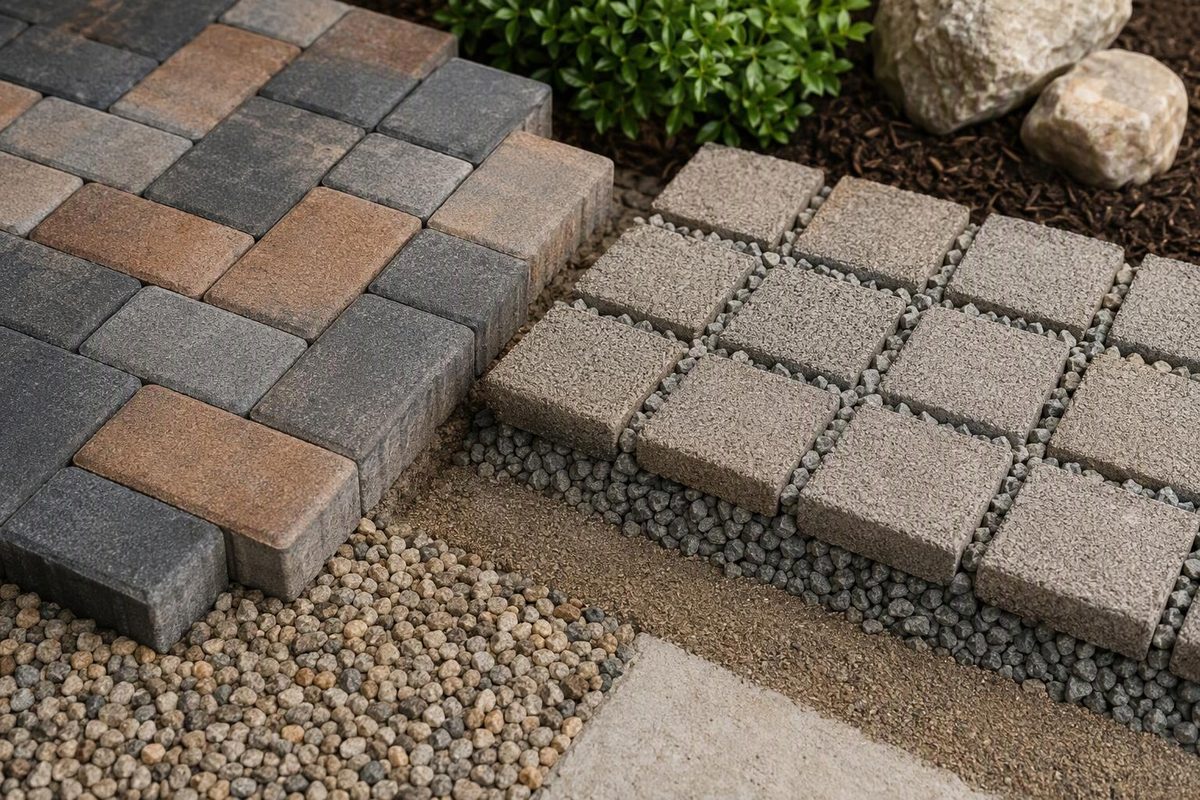
For permit planning, assume a conventional brick or concrete paver driveway counts as impervious unless your local reviewing authority confirms otherwise. A purpose-built permeable paver system may qualify for an exemption or credit, but the word permeable on a product brochure does not settle the calculation.
Local rules can differ sharply. Shorewood, Minnesota, explicitly counts even permeable pavers as impervious in its municipal guidance. Nisswa, Minnesota, says it may grant credit for qualifying permeable systems subject to design, inspection and maintenance requirements. Neither city’s guidance should be applied to a property outside that jurisdiction. (Shorewood guidance, Nisswa guidance)
Ordinary pavers and permeable pavement are different assemblies
An impervious surface prevents or hinders water from entering the soil. The question is not simply whether the driveway has joints; it is whether the installed assembly provides a working path for water and meets the applicable local definition.
Conventional sand-set pavers and permeable interlocking concrete pavement use different assemblies. The Concrete Masonry & Hardscapes Association recommends standard sand-set pavers over a dense-graded aggregate base with concrete-sand bedding for most conventional applications. EPA describes permeable interlocking concrete pavement as units with aggregate-filled permeable joints over stone layers that can temporarily store stormwater. (CMHA guidance, EPA technical guide)
For a permeable driveway, check the complete water path:
- Surface: water enters through the specified joints or openings.
- Bedding and base: permeable stone layers transmit and store water.
- Below the base: water infiltrates into suitable soil or leaves through a designed drainage system.
- Overflow: the design addresses water beyond the system’s capacity.
EPA emphasizes that subsurface design is as important as the surface. Some systems use liners and underdrains where infiltration is unsuitable, so a permeable surface does not necessarily mean all rainfall soaks into the soil beneath it. (EPA technical guide)
The base can also change the classification. Menlo Park, California, states in its stormwater worksheet that permeable pavers are considered impervious when their underlying substrate is highly compacted soil or impermeable aggregate. Do not assume that pavers placed over an existing concrete slab become exempt merely because water can enter their joints. (Menlo Park worksheet)
Drainage performance does not automatically earn coverage credit
Ask separately about impervious-area limits, lot or building coverage, and stormwater-management requirements. Do not assume approval under one calculation answers the others.
Shorewood illustrates the distinction: its guidance encourages treatment systems but grants no credit toward impervious-surface limits for mitigation or treatment. Nisswa’s guidance, by contrast, permits up to 100% pervious credit for qualifying systems, with conditions including annual certification, separation from seasonally saturated soil or bedrock, and location restrictions. (Shorewood guidance, Nisswa guidance)
A reported driveway dispute in Anna Maria, Florida, shows why the installed details matter. The AMI Sun described paver sections separated by six-inch stone-topped channels over an underground retention system. Residents questioned its performance; the builders said it complied. At the time of the report, the mayor said certified plans met city requirements but some deviations in the actual work needed remedy. That report is not a general ruling that stone-separated pavers are exempt—or a final determination that the driveway violated the code. (AMI Sun report)
Confirm the counted area before accepting a bid
Use the local authority’s calculation, not a contractor’s estimated “percent permeability.” For example, a fully counted 20-by-30-foot driveway occupies 600 square feet of impervious area. On an assumed 10,000-square-foot calculation area, that represents 6 percentage points of coverage. It adds that amount to existing coverage only if it replaces previously pervious ground; replacing an already-counted driveway is different. Do not deduct joints or stone strips unless the reviewing authority accepts that treatment.
Send planning staff and the stormwater reviewer a dimensioned plan and the proposed pavement cross-section. Ask for written answers to these questions:
- Does this specific assembly count as impervious for this parcel?
- Is any credit full, partial or unavailable—and under which current code provision?
- What area belongs in the coverage calculation, including borders and driveway apron?
- Are engineered calculations, soil testing, inspections or ongoing certification required?
- Does the drainage plan account for roof runoff entering the driveway system and excess-storm overflow?
Then make the bid match the approved design: identify the paver, joint aggregate, bedding, base depths, drainage components, inspection responsibilities and maintenance requirements. Our permeable paver installation guide explains those bid checks.
Maintenance belongs in that decision. EPA identifies clogging as the main maintenance concern and recommends periodic sediment removal; it also advises against using sand for winter traction around permeable pavement. Where credit depends on continued performance, that upkeep is part of the approval—not an optional cosmetic task. (EPA technical guide)
If your driveway only fits the coverage limit with permeable credit, obtain that acceptance before ordering pavers or authorizing excavation.