
Does Homeowners Insurance Cover a Collapsed Driveway?
Learn when homeowners insurance may cover driveway damage, why sinkholes and washouts are often excluded, and what to document before repairs.
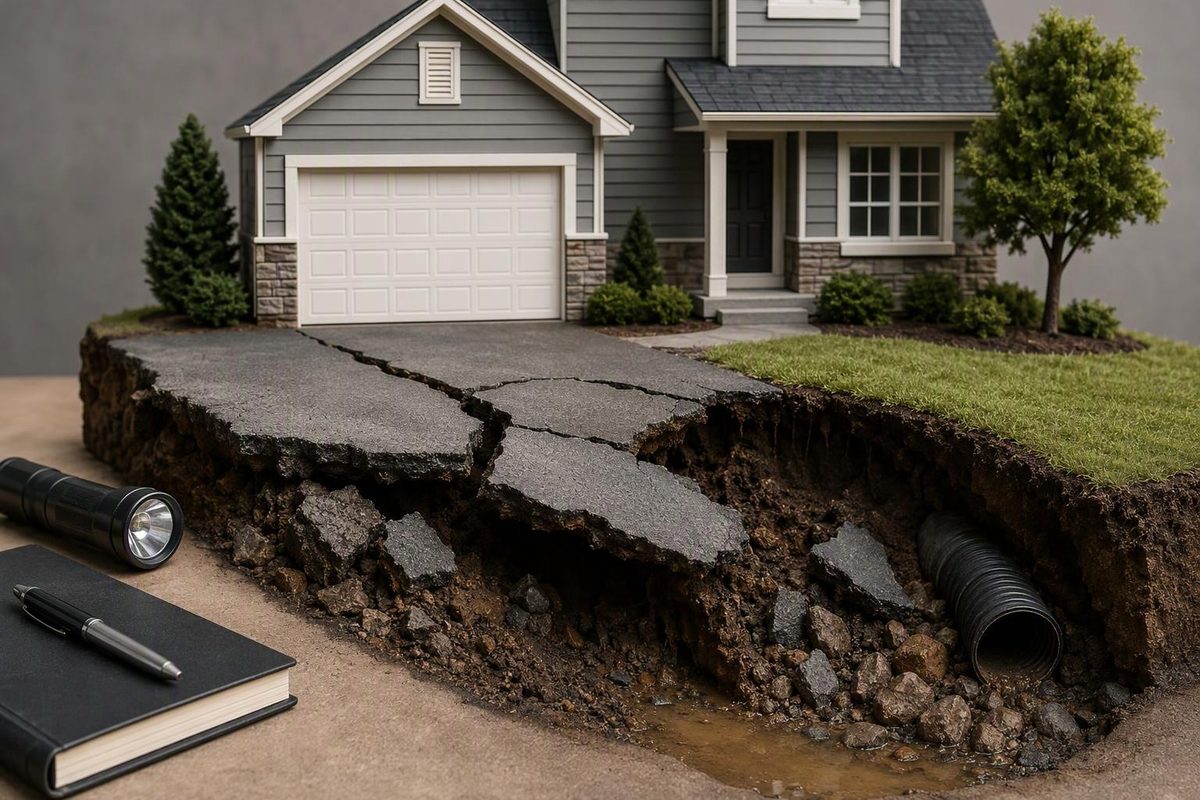
Sometimes—but a sudden collapse is not automatically covered. In the U.S., a driveway may qualify as insured property, yet the cause of its failure can still be excluded. Most property policies exclude earth movement, including sinkholes. Triple-I explains the earth-movement exclusion.
The useful question is not just “Is my driveway covered?” It is “What caused the damage, and which policy provision applies?”
An insured driveway is not insured against every cause
Driveways commonly fall under other structures coverage, often called Coverage B. That coverage typically has a combined limit for structures outside the house—not a separate allowance for each driveway, fence and shed. Nonbuilding structures such as driveways may also be settled at actual cash value, with depreciation deducted, rather than full replacement cost. Peterson Insurance’s coverage guide describes these distinctions.
Ask your insurer to identify the driveway’s classification, applicable limit, deductible and settlement basis. A driveway touching the garage does not, by itself, answer those questions.
Match the claim to the cause
A useful illustration is the HO-3 sample policy hosted by the Oklahoma Insurance Department. It is an older sample, not your current contract, but it shows why apparently similar driveway failures can receive different treatment:
| What happened | Coverage issue to check |
|---|---|
| Fire or a vehicle directly damaged the pavement | Direct damage from a covered peril may be insured; this is different from the ground collapsing beneath it. |
| Pavement settled, cracked or deteriorated | The sample excludes wear, deterioration and pavement settlement, including resulting cracking. |
| Poor grading, inadequate compaction or defective construction caused failure | The sample excludes faulty workmanship, grading and compaction, while preserving ensuing losses not otherwise excluded. |
| A sinkhole, subsidence or shifting ground removed support | Earth-movement exclusions are a major barrier, even when failure is abrupt. |
| Floodwater or waves undermined the driveway | Water exclusions must be checked; “storm damage” is not a coverage category that overrides them. |
A burst pipe needs a closer review. Identify whether escaping water directly damaged the pavement, washed out supporting soil, or caused a separate earth-movement event. Also distinguish repairing the pipe from opening and replacing pavement to reach it. The sample contains an accidental-water-discharge exception, but limits tear-out coverage for other structures to circumstances involving actual water damage to a building. Its earth-movement exclusion also applies when another cause contributes to the loss. Do not assume a pipe break makes access work or the entire driveway repair covered.
Why a “collapse” clause may not help
That same sample defines its additional collapse coverage around a building or part of a building falling down or caving in. It also limits pavement losses under several listed collapse causes unless they directly result from a building collapse.
So a hole beneath an asphalt surface or a concrete slab dropping into a void is not automatically the kind of “collapse” insured by that clause. Ask the adjuster to explain both the collapse wording and any exclusions—not simply confirm that collapse coverage appears in the policy.
Sinkhole and flood insurance have driveway gaps, too
Optional sinkhole coverage may be available as an endorsement or separate policy, depending on the state. Confirm that it covers the driveway itself, not just structural damage to the house. Triple-I describes the available coverage arrangements.
Florida’s required catastrophic ground cover collapse protection is narrower than its name sounds. It requires all four conditions: abrupt ground collapse, a visible depression, structural damage to the covered building including its foundation, and a government condemnation and evacuation order. A driveway-only collapse does not meet those conditions. Florida law also permits insurers to restrict sinkhole and catastrophic-collapse coverage to the principal building. Its definition of a sinkhole concerns underlying rock dissolved by groundwater—not simply any hole caused by washed-out soil. Florida Statutes §627.706.
Separate flood insurance is not a universal solution. The NFIP dwelling policy excludes driveway portions outside the insured building’s exterior walls. Private flood policies need their own review. FEMA’s June 2025 policy commentary, Section IV.9.
What to do before permanent repairs
- Keep vehicles and people away. Do not approach an unstable edge to measure the hole. If utilities or nearby buildings may be affected, contact emergency services, the utility and local building officials as appropriate. Florida’s sinkhole safety guide recommends warning barriers and prompt notification.
- Document from a safe location. Photograph the damaged pavement, surrounding ground, drainage paths and visible pipe damage. Record when you noticed the failure and preserve earlier photos or installation records.
- Notify the insurer promptly. Ask about inspection, reporting deadlines and safe temporary protection. Preserve evidence before demolition where possible, without delaying necessary safety work. Keep receipts; reimbursement is not guaranteed. Triple-I’s claims guidance recommends photographs, reasonable temporary protection and expense records.
- Request a written coverage explanation. Ask which cause the insurer identified, which provisions apply, and whether engineering or plumbing findings would change the decision. If you disagree, contact your state insurance department about review options.
Get a repair scope—not just a paving price
Ask contractors to separate investigation, demolition and disposal, utility repairs, excavation or stabilization, replacement base and compaction, drainage work, and new pavement. Keep repair of existing damage separate from proposed upgrades so the insurer can evaluate each item.
Before accepting resurfacing alone, ask the contractor to explain how the failed support will be addressed. Use our driveway drainage solutions guide to check the water-management scope and concrete removal-and-replacement guide to compare bids. The insurance decision and the repair decision are separate: a denied claim does not make a surface-only fix adequate.