
Cost of a Permeable Paver Driveway: Budget and Quote Checks
Estimate permeable paver driveway cost, compare national and regional prices, and check excavation, stone storage, drainage and maintenance in each bid.
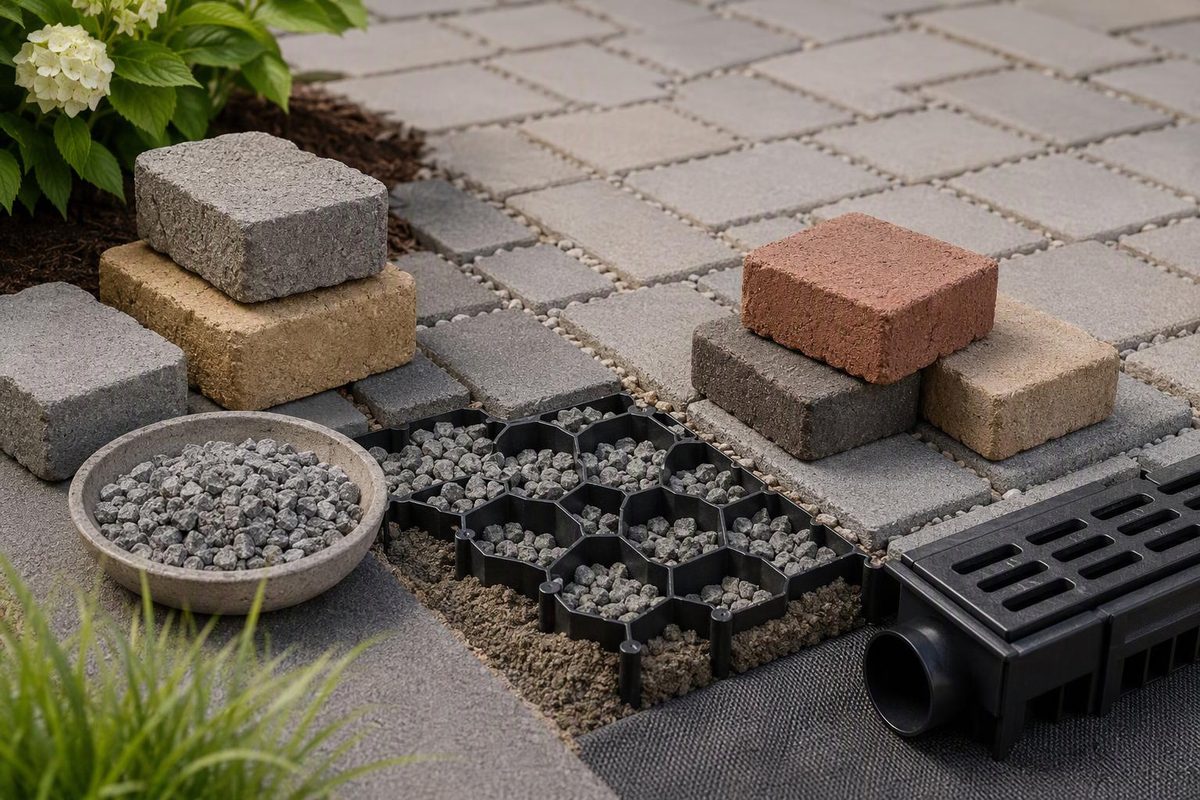
A permeable paver driveway quote should price a load-bearing drainage system, not just the paving blocks. Before comparing square-foot rates, identify whether each bid includes old-driveway removal, excavation and disposal, clean stone layers, pavers and joint stone, edge restraints, and any required drainage outlet.
For an initial U.S. budget, $10–$30 per square foot installed is a published national benchmark—not a dependable ceiling. HomeGuide lists that range for permeable pavers, including an aggregate base, in its guide dated May 27, 2025. Regional figures below run higher. For a 600-square-foot driveway, the national range calculates to $6,000–$18,000 before separately priced removal or other excluded work. Source: HomeGuide
This guide concerns stone-jointed permeable pavers, especially permeable interlocking concrete pavement (PICP). Grass grids, gravel grids, porous asphalt and poured pervious concrete are different systems; their prices should not be substituted into a paver-driveway estimate.
Cost ledger: what the published prices actually mean
These figures were checked October 27, 2026. They are published planning estimates, not itemized bids for your property.
| Source and geographic basis | Published price | Scope and limitations |
|---|---|---|
| HomeGuide, U.S. national guide, dated May 27, 2025 | $10–$30/sq. ft. | Installed permeable pavers with aggregate base. Old-driveway removal is additional. The page reports 23 member project costs behind its overall cost summary, but does not provide individual locations and scopes. |
| NY Pavers, New York City 2026 guide | $22–$32/sq. ft. | Contractor-published installed permeable-paver estimate. Final pricing depends on access, base, demolition and drainage; the table does not fully itemize inclusions. |
| Philadelphia Water Department Rain Check participant sheet | About $40–$60/sq. ft. | Local permeable-paver project estimate before program assistance. Covers projects such as driveways and patios, not a standardized full-driveway bid. |
Do not average these into a supposed national price. They describe different markets and incompletely standardized scopes. The Philadelphia figure is a useful warning against treating $30 per square foot as the maximum reasonable bid.
Turn the rate into a driveway budget
Measure the actual paved footprint, including parking bays and turnarounds. For a rectangular area, multiply length by width.
| Driveway area | At $10/sq. ft. | At $30/sq. ft. | At $50/sq. ft. |
|---|---|---|---|
| 400 sq. ft. | $4,000 | $12,000 | $20,000 |
| 600 sq. ft. | $6,000 | $18,000 | $30,000 |
| 1,000 sq. ft. | $10,000 | $30,000 | $50,000 |
These are arithmetic scenarios using rates within the published ranges, not separate market estimates.
Use this budget structure:
Area × quoted installation rate + excluded removal, site work, design and permit costs = project budget.
Do not add excavation or stone again if they are already included in the installed rate. For replacement work, request a separate removal and disposal scope rather than assuming the surface price covers demolition. If you are replacing concrete, our concrete removal cost guide explains the quantities and quote checks.
Why the base and drainage change the price
PICP lets water enter through stone-filled joints, pass through open-graded bedding, and collect in a stone base or subbase. Water then infiltrates the soil or leaves through designed drainage. CMHA’s construction guidance specifies angular joint aggregate and explains that reservoir thickness depends on water-storage needs and traffic loads. A separate subbase is not required for every residential driveway; the design may instead use a thicker base. Source: CMHA construction guide
That is why “12-inch base included” is not enough information. Ask for each layer’s material and finished thickness, plus the total excavation depth.
For scale, an extra 6 inches of excavation across 600 square feet equals 300 cubic feet, or about 11.1 cubic yards, before accounting for soil expansion during digging. That changes digging, trucking and disposal quantities as well as the stone requirement.
Slow-draining soil does not automatically rule it out
CMHA allows underdrains over low-infiltration soils and describes full-, partial- and no-infiltration systems. Clay therefore requires a drainage design, not a blanket promise that all rain will soak into the ground. Source: CMHA
Before accepting a price, ask:
- What soil infiltration information supports the design?
- Is an underdrain needed, and where can it legally discharge?
- What happens when the reservoir fills?
- How are groundwater, nearby foundations and driveway slope addressed?
Do not assume permeability removes the need for grading or an outlet. Our permeable paver installation guide explains the construction checks in more detail.
What to require in comparable bids
Give each contractor the same measured area and request these items in writing:
- Removal and excavation: existing pavement thickness, digging depth, hauling, disposal and allowances for unexpected unsuitable soil.
- Stone layers: aggregate specifications, compacted thicknesses and compaction procedure—not simply “gravel base.”
- Drainage: underdrains, overflow, outlet work, and any liner or geotextile required by the design.
- Surface: paver manufacturer, model, thickness, joint aggregate, pattern and cutting allowance. CMHA describes concrete pavers in vehicular areas as typically at least 80 mm—about 3⅛ inches—thick. Source: CMHA
- Edges and transitions: restraint detail and finished elevations at the garage, sidewalk and street.
- Closeout: cleanup, landscape restoration, warranty, maintenance instructions and exclusions.
Sand-jointed pavers over a conventional dense-graded base are not an equivalent lower-priced PICP system. CMHA explicitly excludes sand bedding, sand joints and dense-graded aggregate bases from PICP construction. Source: CMHA maintenance guide
Include maintenance before deciding whether the premium is worth it
Sediment gradually reduces infiltration. Budget for debris removal, joint-stone replenishment and occasional vacuum cleaning or restoration—not just the installation.
Ask the installer to include an early joint inspection and top-up: CMHA notes that initial stone settlement often requires replenishment three to six months after installation. Cleaning frequency depends on the site’s sediment exposure, so obtain a local service price and minimum charge rather than assuming a universal annual maintenance cost. Source: CMHA
Keep mulch and soil off the driveway, and avoid winter traction sand that can clog the joints. Do not assume ordinary pressure washing is suitable: Philadelphia’s Rain Check guidance warns that it can push debris deeper into the stone storage. Sources: CMHA, Rain Check maintenance guidance
The strongest reason to pay more is a demonstrated drainage benefit or local stormwater requirement. Compare permeable paving plus its drainage and maintenance against conventional paving plus the drainage work it needs. Count an avoided drain or storage structure as savings only when the site design confirms it can actually be omitted.