
Dry Well vs. French Drain: Which Fits Your Driveway?
Compare dry wells and French drains for driveway water problems, including soil limits, surface runoff, overflow, maintenance and quote checks.
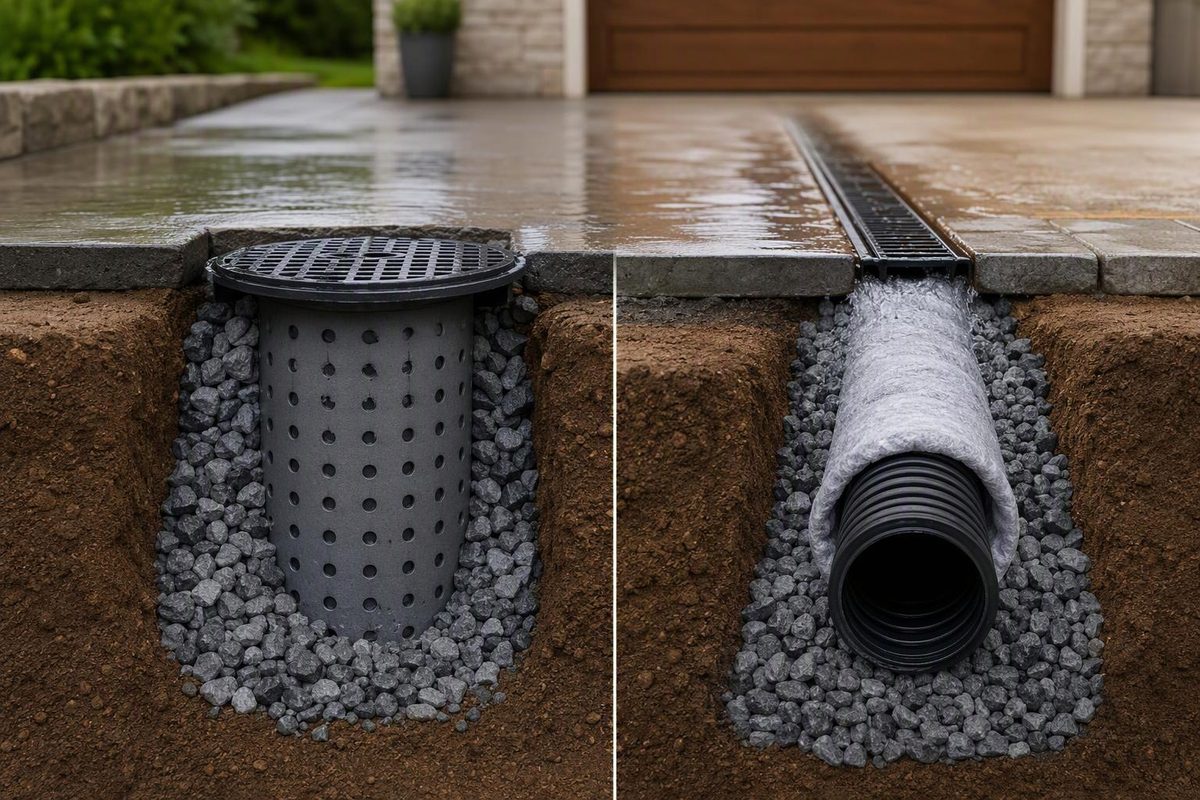
A French drain collects water along a trench and carries it elsewhere. A dry well temporarily stores runoff and lets it soak into the surrounding soil. They solve different parts of a drainage problem—and sometimes work together.
For a driveway, start with two questions: Where is the water coming from, and where can it safely go? A wet driveway edge may need a French drain. Water rushing across pavement toward a garage usually needs surface collection first. A dry well is a possible destination only if soil conditions and local rules allow it.
What each system does
A French drain typically consists of a gravel-filled trench containing perforated pipe. Water enters along the trench, then flows toward a discharge point. It can intercept subsurface seepage beside a driveway; an exposed gravel surface can also admit surface water. The outlet might lead to an approved drainage area or infiltration system, including a dry well. NDS explains this collection-and-conveyance function.
A dry well is a buried chamber or stone-filled pit. A pipe delivers runoff to it, and stored water gradually infiltrates into the ground. Its capacity depends on both available storage and how quickly the soil accepts water—not merely the size of the container. Portland’s drywell guidance describes the chamber, surrounding drain rock and soil requirements.
| Driveway condition | Better starting point | Essential condition |
|---|---|---|
| Persistent wet strip or subsurface seepage beside the driveway | French drain | A workable route to an approved outlet |
| Collected runoff needs an onsite destination | Dry well or another infiltration system | Tested soil, suitable groundwater separation and local approval |
| Water flows across pavement toward the garage | Grading and/or a channel drain | Surface capture plus a discharge destination |
| Wet edge needs interception, but no suitable surface outlet exists | French drain feeding an infiltration system | The receiving system must be approved and sized for that inflow |
| Slow-draining soil with no approved outlet | Neither is a ready-made fix | Resolve the discharge strategy before excavation |
Surface runoff needs a surface inlet
Do not confuse a French drain with the grated channel commonly installed across a driveway. A buried French drain should not be assumed to capture a fast sheet of water flowing over asphalt or concrete.
A channel drain captures surface runoff and sends it through connected pipe to an outlet or infiltration device. NDS identifies driveway hardscapes as an application. Depending on the driveway’s shape, correcting its grade may be preferable to adding a drain—or necessary alongside one.
If your main problem is pavement ponding rather than seepage, compare driveway drain types before committing to either system.
Three checks before choosing a dry well
1. Can the soil accept the water?
Ask for infiltration testing at the proposed location and design depth, plus identification of seasonal groundwater and restrictive layers. Surface soil that looks sandy does not establish what lies below it.
Slowly permeable soil, compacted fill and insufficient groundwater separation can make infiltration unsuitable. The Metropolitan Area Planning Council’s infiltration guidance calls for field testing and flags these limitations. Setbacks and testing criteria must come from your local authority, not a generic installation diagram.
Clay soil does not automatically rule out a French drain that carries water to a suitable outlet. It does undermine the assumption that a dry well will dispose of water quickly.
2. Is driveway runoff allowed?
Do not assume permission to infiltrate roof water also covers driveway water. Runoff can carry sediment, petroleum residues and salts; treatment and groundwater-protection requirements matter.
For example, New Jersey’s March 2021 dry-well BMP chapter limits that particular practice to clean roof runoff and directs other surfaces to different infiltration-system chapters. This is not a nationwide ban, but it shows why the system’s classification matters.
In the U.S., ask whether the design falls under Underground Injection Control requirements. EPA says owners of new regulated stormwater drainage wells must contact their permitting authority before construction. That does not necessarily mean an individual permit is required; confirm the applicable authorization and inventory requirements with that authority.
3. What happens when it fills?
A dry well is not unlimited storage. For scale, 1 inch of rain over 1,000 square feet equals about 623 gallons, assuming all of it becomes runoff. That is a volume illustration, not a sizing recommendation.
The design must account for inflow, infiltration during the storm, drain-down time and overflow. MAPC recommends an overflow route for storms exceeding infiltration capacity. Ask the contractor to identify that route explicitly, rather than letting backup toward the garage become the default.
Compare installed scope, not just component prices
Do not rank these systems by component prices alone. A short trench with an accessible outlet is a different job from a deep chamber requiring pavement removal and hauled spoil.
Request an itemized quote covering:
- Water collection: trench location and length, or surface inlet type and placement.
- Discharge: outlet location and pipe elevations; for infiltration, testing and sizing assumptions.
- Construction: excavation, pipe, clean stone, filter materials, spoil disposal and surface restoration.
- Safety and loading: utility locating, permits, setbacks and structural requirements wherever vehicles may pass.
- Upkeep: accessible cleanouts, sediment pretreatment, inspection access and overflow maintenance.
Sediment control is especially important before an infiltration system: clogging can reduce performance and lead to substantial reconstruction. MAPC’s guidance recommends pretreatment for paved-surface runoff and budgeting for maintenance.
Choose the proposal that explains the complete path—from the wet driveway to a safe destination—not merely the one offering the most drain pipe.