
French Drain Gravel and When to Size Down
Washed, open-graded #57 is the normal yard-drain starting point. Around a 4-inch pipe in a constrained trench, clean #67 may be easier to place.
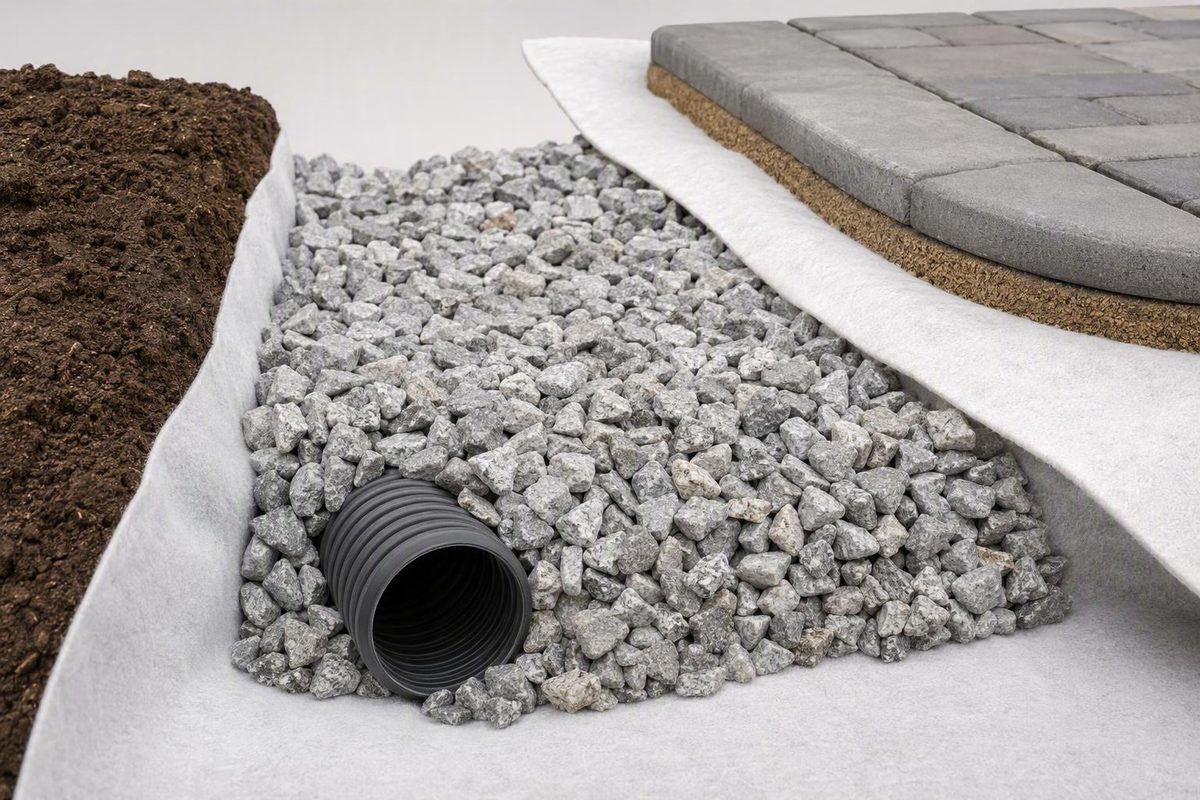
For a typical residential French drain, a practical starting specification is clean, washed, open-graded crushed stone approximately 3/4 to 1 inch in size, commonly sold as #57 stone. Retail drainage listings identify #57 granite and limestone in roughly the 1/2-to-1-inch range, illustrating both the general size category and the need to verify the local product (compare listed drainage aggregates and sizes).
The important words are clean, washed, and open-graded. A drain depends on connected spaces between stones. A load containing abundant sand, stone dust, or crusher fines can include the right-looking large pieces and still be unsuitable for the drainage envelope.
This recommendation is synthesized primarily from supplier and contractor guidance, not independent comparative testing or a universal engineering standard. Soil, geotextile compatibility, pipe design, trench geometry, expected flow, continuous fall, and the outlet all matter. Foundation drainage, groundwater control, unstable slopes, recurrent flooding, and vehicle-loaded installations may require site-specific professional design.
The practical default: washed, open-graded #57 stone
For an ordinary residential yard or driveway-edge French drain, give the supplier this request:
Washed, open-graded #57 drainage stone with minimal dust or fines; please provide the actual size range or gradation.
“#57” is a gradation designation, not a promise that every stone measures exactly 3/4 inch. A graded product contains a distribution of particle sizes within specified limits. Quarry specifications, regional terminology, and everyday product names may differ.
A suitable local product might be sold as:
-
57 stone
- 3/4-inch clean stone
- 1-inch clean stone
- Washed drain rock
- Drainage aggregate
- Clean crushed rock
The name alone is not enough. Ask what size range is actually supplied, whether the material is washed, and whether it intentionally contains fines.
Do not choose by color or geological name alone. Clean crushed granite and clean, properly graded crushed limestone are both sold as drainage materials. Prioritize:
- Gradation: Does the particle distribution create an open aggregate structure?
- Cleanliness: Is the stone washed and substantially free of visible sand, dust, and crusher residue?
- Durability: Is it a sound local aggregate routinely supplied for buried drainage?
- Placement: Can it be distributed continuously around the selected pipe?
- Availability: Can the supplier deliver a consistent product in the required quantity?
Avoid ordering crusher run, road base, stone dust, dense-graded aggregate, or products described as “with fines” for the drainage envelope. Those materials are useful where a compactable base is wanted. A French drain instead needs persistent, connected openings through which water can move. Commercial aggregate guidance distinguishes clean open-graded drainage stone from crusher run, stone dust, and other materials containing void-filling fines (review the aggregate distinctions).
| Classification | Material | Practical interpretation |
|---|---|---|
| Default | Washed, open-graded #57 crushed stone | Practical starting point for a conventional residential French drain |
| Possible alternative | Clean #67 stone | Smaller material may be easier to place in a constrained trench, but regional gradations vary |
| Possible alternative | Larger washed drain rock | May suit some higher-volume or pipe-free designs when supported by the full design |
| Possible alternative | Washed rounded stone | Can transmit water but generally provides less interlock than angular stone |
| Generally avoid | Crusher run, road base, dense-graded aggregate, stone dust | Designed to pack tightly rather than maintain an open drainage structure |
| Generally avoid | Visibly dusty or sandy aggregate | Fine particles can occupy the spaces intended to carry water |
This classification is a buying guide, not proof that one aggregate is best for every soil, climate, load, or drainage volume.
Why washed, low-fines gravel matters
The gravel around a French-drain pipe forms a drainage envelope. Water enters from the surrounding soil or surface, travels through connected spaces between the stones, and reaches the perforated pipe or continues through the stone toward the outlet.
Those spaces—not the solid rock—perform the drainage work.
Fine sand, silt, stone dust, and crusher fines can settle between larger particles. As smaller material occupies the openings, the aggregate becomes less open. That does not mean a trace of dust automatically ruins a load, or that every screened product is unsuitable. It means nominal top size alone does not establish whether the material is appropriate.
A pile can contain many 3/4-inch stones and still behave more like compactable base if it also contains abundant smaller particles.
Screened and washed describe related but different processing steps:
- Screening separates aggregate into particle-size ranges.
- Washing removes more of the fine residue adhering to or mixed with the stone.
- A screened product may be sufficiently clean for a particular application, but screened does not by itself confirm that residual dust has been removed.
- A washed product should still be inspected when delivered.
An open-graded aggregate is selected to preserve substantial connected spaces between particles. A dense-graded aggregate intentionally combines large and small particles so the smaller material fills openings and forms a compact mass. Both have valid construction uses, but they serve different purposes.
Do not rely only on a bin sign reading “drainage gravel.” When available, request a current product sheet, sieve analysis, or gradation sheet. It should help answer:
- What is the top size?
- What smaller particle ranges are included?
- Is the product open-graded or dense-graded?
- Is it washed, screened only, or unwashed?
- Does it intentionally contain manufactured fines?
Inspect the delivery before burying it. Warning signs include:
- A pronounced dust cloud when the truck dumps
- Sandy material accumulating beneath the pile
- Powder coating most of the stones
- Very muddy runoff after rinsing a small sample
- A substantial share of particles much smaller than the ordered range
- Obvious soil or debris mixed into the load
- Material that resembles compactable driveway base rather than clean drain rock
A little residual surface material is different from a pile rich in sand and dust. The goal is not visual perfection. It is to confirm that the delivered aggregate matches the open-graded drainage product ordered.
Crushed stone, pea gravel, river rock, and limestone compared
The angular-versus-rounded debate combines two separate questions:
- Hydraulic openness: Can water move through connected voids?
- Structural stability: Will the particles interlock and resist shifting during installation and service?
Rounded stone can transmit water. Angular crushed stone is nevertheless a common residential default because its particles interlock more effectively and form a more stable aggregate envelope. Contractor guidance commonly favors washed angular #57 stone on that basis while limiting pea gravel to lighter-duty uses (see the contractor’s material comparison).
| Material | Typical form | Drainage potential | Stability or interlock | Appropriate caveats |
|---|---|---|---|---|
| Washed crushed stone | Angular, graded particles | Good when clean and open-graded | Stronger interlock than rounded stone | Confirm that “crushed” does not mean crusher run or stone containing fines |
| Pea gravel | Small, smooth, rounded particles | Can pass water when clean and loosely placed | Low interlock; readily shifts under disturbance | Better suited to decorative or lighter-duty uses unless the design permits it |
| River rock | Smooth, rounded stone in various sizes | Can be hydraulically open when washed and properly graded | Less interlock than crushed stone | Broad retail category; verify actual size and placement suitability |
| Crushed granite | Angular crushed aggregate | Suitable when washed and open-graded | Good interlock | Shape and gradation vary by quarry |
| Crushed limestone | Angular carbonate aggregate | Suitable when clean, durable, and open-graded | Good interlock | Do not confuse drainage stone with screenings, lime rock, or dense base |
| Recycled concrete | Variable angular recycled aggregate | Potentially usable if clean and properly graded | Can interlock | Verify contaminants, durability, particle breakdown, and gradation |
Pea gravel is not incapable of draining. Its small rounded particles can allow water movement, but they provide less interlock and may shift during pipe placement, backfilling, or later disturbance. Landscaping guidance similarly distinguishes crushed stone as the more stable structural and drainage material while describing pea gravel as more mobile (compare pea gravel, crushed stone, and river rock).
That makes pea gravel an application-dependent choice rather than an automatic failure. It may be reasonable in decorative drainage, light-use areas, or a specifically designed detail. It is not the clearest default for a conventional buried drain beside a driveway or another frequently disturbed area.
River rock can also work as washed drainage aggregate in some designs. Its rounded form does not make it impermeable. However, “river rock” is a broad retail term that can encompass a wide range of particle sizes. Confirm that the selected material can be distributed uniformly beside and above the pipe.
Granite versus limestone is generally less important than cleanliness, gradation, and durability. Some guidance warns against “lime rock” that may deteriorate or compact, while drainage retailers list clean graded crushed limestone as a drainage option. Those statements need not conflict: lime rock, limestone road base, screenings, and washed open-graded limestone may be materially different products.
Recycled concrete deserves additional verification. Before considering it, ask whether it is free from soil, asphalt, plaster, wood, reinforcing debris, and excessive fines. Also request the gradation and information about its suitability for buried drainage. The available guidance identifies it as a possible angular aggregate but does not support a broad recommendation.
Match the stone to the type of French drain
The most suitable gravel depends on what the drain must do. A shallow yard interception drain and an exterior foundation drain do not present the same consequences, loads, soil conditions, or excavation risks.
| Application | Starting gravel choice | Important adjustments and cautions |
|---|---|---|
| Typical yard interception drain | Washed, open-graded #57 stone | Confirm the local gradation, soil separation, route, continuous fall, and outlet |
| Exterior foundation drain | Clean drainage aggregate specified for the foundation system | Coordinate pipe, footing elevation, waterproofing, membrane, bedding, and discharge |
| Constrained trench around 4-inch pipe | Clean #57 or possibly smaller clean #67 | Compare actual regional gradations; #67 is presented as a smaller placement option in commercial aggregate guidance |
| Higher-flow installation | Clean #57 or larger washed drainage stone where designed | Larger stone alone does not establish hydraulic capacity |
| Vehicle-adjacent trench | Durable angular open-graded aggregate | Pipe strength, cover, settlement, trench support, and traffic loading may control the design |
| Pipe-free stone trench | Larger washed stone may be considered | Storage, conveyance, trench dimensions, and outlet capacity require separate attention |
For a normal yard drain, washed #57 remains the simplest starting point. In a constrained trench around a 4-inch pipe, clean #67 may be easier to place, but its actual size distribution must be checked because market labels vary (see the #57 and #67 selection guidance).
Some supplier guidance recommends larger stone for pipe-free drains and notes that water generally moves more slowly through a stone-only trench than through a system containing perforated pipe (review the pipe-free drain guidance). Treat that as an application-specific consideration, not a universal minimum size or capacity guarantee.
A pipe-free trench relies on aggregate voids both to store and convey water. A perforated pipe provides a more direct internal flow path. Removing the pipe is therefore not merely a material substitution; it changes how the system stores and transports water.
Pipe bedding also varies by application. In a 2025 practitioner video, Robert Sherwood recommends a small pea-stone bed beneath an exterior basement-wall drain but prefers a yard-drain pipe directly on fabric (watch the application-specific bedding discussion). That is practitioner opinion, not a settled rule for every drainage system.
Foundation drains, groundwater interception, retaining-wall drainage, unstable slopes, severe erosion, recurring flooding, and trenches carrying vehicle or structural loads involve issues beyond aggregate selection. Professional input may be appropriate from a drainage contractor, geotechnical professional, civil engineer, structural professional, waterproofing specialist, or local authority.
Most importantly, do not try to correct an unsuitable outlet, reverse grade, or undersized system by buying larger gravel. Stone size cannot make water flow uphill, establish discharge rights, or compensate for inadequate pipe and outlet capacity.
How gravel, fabric, and perforated pipe fit together
A common French-drain arrangement uses permeable geotextile to separate surrounding soil from clean aggregate. Perforated pipe sits within the aggregate envelope, stone is placed continuously beside and above it, and the fabric is closed before the final surface is installed.
Conceptual cross-section—not a site-specific construction detail:
                  FINAL SURFACE
        soil/seed, decorative stone, or other finish
────────────────────────────────────────────────────
         geotextile folded/closed over aggregate
       ┌──────────────────────────────────────┐
SOIL   │       CLEAN OPEN-GRADED STONE        │   SOIL
       │                                      │
       │     stone beside and above pipe      │
       │          ┌────────────────┐          │
       │          │ perforated pipe│ ───────► │ outlet
       │          └────────────────┘ direction│
       │       optional stone bedding         │
       └──────────────────────────────────────┘
        permeable geotextile lining trench soil

        Continuous positive fall toward suitable outlet
Geotextile is a filtration and separation component. It is not ordinary plastic sheeting or an impermeable weed barrier. Its purpose is to admit water while helping limit migration of surrounding soil into the aggregate envelope.
Fabric selection should suit the surrounding soil. Fine silts, clays, and sands present different filtration conditions, so no single fabric weight, opening size, or permeability is correct for every site. A generic “landscape fabric” label is insufficient unless the product is suitable for subsurface drainage and soil separation.
Published installation examples differ:
- Carroll’s supplier detail uses approximately 4 inches of stone below and 4 inches above a 4-inch pipe.
- Hello Gravel’s commercial guide calls for roughly 2 to 3 inches of bedding and at least a few inches of stone above the pipe.
- Some yard-drain practitioners place the pipe directly on fabric and build the aggregate envelope beside and above it.
- Foundation-drain details may specify a different relationship among the footing, pipe, waterproofing, and aggregate.
These are source-specific examples rather than universal standards. One commercial installation guide also presents approximately 1% fall, or 1 foot over 100 feet, as a rule of thumb (see the cited bedding and slope example). More important than treating that number as mandatory is maintaining uninterrupted positive fall to a viable outlet.
The trench also needs enough side clearance to place aggregate continuously around the pipe without leaving soil pockets. There is no one trench width appropriate for every pipe, stone size, excavation, and surface load.
Do not assume that every product must be oriented the same way. Follow the manufacturer’s instructions for perforation orientation, bedding, joints, fittings, and cover.
Before closing the fabric and backfilling, perform a controlled water test:
- Confirm that the intended interception area admits water.
- Watch for ponding along the aggregate and pipe route.
- Check pipe joints and fittings.
- Verify that water reaches the outlet.
- Confirm that the outlet does not immediately return water toward the trench.
- Correct low spots, reverse grades, displaced fabric, or blocked pipe while the system remains accessible.
How to calculate how much gravel you need
Calculate only the portion of the trench that will contain aggregate. If the upper 4 or 6 inches will be reserved for soil, seed, sod, decorative stone, or another finish, exclude that depth from the aggregate calculation.
The base formula is:
Gravel volume = aggregate-filled trench volume - exterior pipe displacement
Using feet throughout:
V_t = W × D × L
Where:
- V_t = aggregate-filled trench volume in cubic feet
- W = trench width in feet
- D = depth actually filled with aggregate in feet
- L = trench length in feet
The exterior volume displaced by a cylindrical pipe is:
V_p = π × R_o² × L_p
Where:
- V_p = pipe displacement in cubic feet
- R_o = actual outside radius of the pipe in feet
- L_p = pipe length actually occupying the calculated aggregate-filled trench volume
Therefore:
V_g = (W × D × L) - (π × R_o² × L_p)
This is the same general approach used by the Omni French-drain calculator: trench volume minus the pipe’s exterior volume, with wastage and material weight handled separately (review the formula and inputs).
Use the actual outside diameter when available rather than assuming that nominal pipe size equals precise exterior diameter. Convert the outside diameter to feet, divide by two to obtain the radius, and keep every dimension in consistent units.
Subtract only pipe that occupies the aggregate volume being calculated. Do not automatically subtract solid outlet runs outside the stone envelope. Unusual fittings, multiple pipes, curved sections, or nonrectangular trench shapes should be measured separately.
To convert cubic feet to cubic yards:
Cubic yards = Cubic feet ÷ 27
Checked illustration
Assume:
- Trench length: 50 feet
- Trench width: 1 foot
- Aggregate-filled depth: 1.5 feet
- Assumed pipe outside diameter: 4 inches
- Pipe length within the aggregate envelope: 50 feet
This example treats 4 inches as the actual outside diameter solely to demonstrate the arithmetic.
1. Calculate trench volume
1 ft × 1.5 ft × 50 ft = 75 ft³
2. Convert pipe radius to feet
A 4-inch diameter has a 2-inch radius:
2 ÷ 12 = 0.1667 ft
3. Calculate pipe displacement
π × (0.1667)² × 50 ≈ 4.36 ft³
4. Subtract pipe displacement
75 - 4.36 = 70.64 ft³
5. Convert to cubic yards
70.64 ÷ 27 ≈ 2.62 yd³
The geometric requirement is therefore approximately 70.64 cubic feet, or 2.62 cubic yards, before any planning allowance. These figures are calculations derived from the cited volume formula, not a recommended trench design.
Keep contingency separate from geometric volume:
Order volume = geometric gravel volume × (1 + selected allowance)
Select an allowance based on the actual project—for example, excavation irregularity, spillage, or the supplier’s delivery increments. Showing it separately keeps the estimate auditable. Do not use an unexplained multiplier copied from a commercial example.
If the supplier sells by ton, request its current bulk-density or tons-per-cubic-yard conversion for the exact material.
Avoid calculations that:
- Omit pipe displacement without saying so
- Use full trench depth when the upper section will contain another material
- Mix inches and feet
- Treat nominal pipe size as exact outside diameter
- Apply a hidden multiplier
- Quote tons without identifying the density conversion
- Assume every trench is a perfect rectangle
Measure the completed excavation where practical. Real trench walls and bottoms are often irregular, so the formula is a planning estimate rather than a guarantee of delivered quantity.
What to ask the gravel supplier before ordering
Use this checklist when requesting a quote:
- [ ] Product name: What is the local sales name?
- [ ] Actual size range: What are the approximate smallest and largest intended particles?
- [ ] Gradation: Is a current sieve or product sheet available?
- [ ] Drainage classification: Is it open-graded drainage stone or dense-graded base?
- [ ] Washed condition: Is it washed, screened only, or unwashed?
- [ ] Fines: Does it intentionally include sand, screenings, stone dust, or crusher fines?
- [ ] Particle shape: Is it angular crushed stone, rounded gravel, or a blend?
- [ ] Source material: Is it granite, limestone, trap rock, river gravel, recycled concrete, or another material?
- [ ] Durability: Is it routinely supplied for buried drainage?
- [ ] Sales unit: Is it sold by ton, cubic yard, bucket, or bag?
- [ ] Conversion: What tons-per-yard figure applies to this exact product?
- [ ] Minimum order: Is there a minimum load or partial-load charge?
- [ ] Delivery access: What truck type and access width are required?
- [ ] Placement limits: Where can the driver safely place the pile?
- [ ] Ground conditions: What access conditions would prevent delivery?
- [ ] Load inspection: Can the material be checked before it is dumped or spread?
Ask directly:
“Is this an open-graded drainage product, or a dense-graded base intended to compact?”
Then ask:
“Is it washed or only screened? Does it include visible sand, screenings, or crusher dust?”
A current gradation sheet is more useful than arguing over a label. Gravelshop, for example, lists both granite and limestone #57 products with an approximate 1/2-to-1-inch range, demonstrating why buyers should verify the local material rather than assuming every #57 product is identical (compare the current product descriptions).
Confirm the sales unit before comparing quotes. A price per ton cannot be compared directly with a price per cubic yard without a conversion for the exact material. Delivery charges, minimum quantities, truck type, access conditions, and permitted pile location can also affect the practical cost.
Choose the dump location before ordering. Confirm access with the supplier rather than assuming a loaded truck can reach the preferred location. Keep the pile out of the planned drainage route, public access, and any location where it would obstruct existing water movement.
Inspect the stone before installation. If the load is visibly sandy, dusty, contaminated, or materially different from the quoted gradation, stop and contact the supplier. Resolving the issue becomes harder after the aggregate is placed or mixed with soil.
Plan the whole drainage system, not just the gravel
A French drain is a route for water. Before optimizing stone shape, establish:
- Where the water originates
- How much water the system may need to intercept
- Whether the trench can maintain continuous fall
- Where the water can lawfully and safely discharge
- Whether the outlet remains usable during wet conditions
- Whether the pipe, aggregate envelope, and outlet suit the intended application
Do not discharge water onto neighboring property. Local building, zoning, stormwater, environmental, and right-of-way requirements may control the installation; commercial drainage guidance likewise recommends consulting local authorities and avoiding impacts on public space or another person’s land (review the planning cautions).
Before excavation, use the applicable local utility-marking service and follow its instructions. In the United States, contractor guidance commonly directs owners to contact 811 before digging, but waiting periods, tolerance zones, and excavation rules vary by jurisdiction (see the utility-marking precaution).
Utility marks do not make every excavation safe. If the trench is deep, unstable, near a foundation, or close to buried services, obtain appropriate site-specific guidance before proceeding.
Pre-backfill checklist
- [ ] Utility-marking and excavation requirements have been addressed
- [ ] The excavation is stable and safe to work around
- [ ] The trench follows the intended route
- [ ] The trench and pipe maintain continuous positive fall
- [ ] The outlet is functional, protected, and authorized where required
- [ ] Pipe sections, fittings, and joints follow the system instructions
- [ ] Perforations are oriented according to the pipe manufacturer
- [ ] Geotextile is suitable for the surrounding soil and application
- [ ] Fabric is not torn, blocked, or displaced
- [ ] Aggregate is clean, open-graded, and consistent with the order
- [ ] Stone is placed continuously beside and above the pipe
- [ ] Pipe coverage suits the selected assembly and surface use
- [ ] Space for the final surface has been reserved
- [ ] A controlled water test reaches the outlet without reverse flow or unexplained ponding
Seek site-specific professional help for:
- Foundation or basement drainage
- Groundwater interception or dewatering
- Retaining-wall drainage
- Unstable, steep, or erosion-prone slopes
- Recurrent or severe flooding
- Unknown discharge rights
- Deep or unstable excavation
- Vehicle crossings or structural loads
- Drainage affecting neighboring property or public infrastructure
- Sites with no practical gravity outlet
Generic guidance cannot determine hydraulic capacity, fabric-soil compatibility, groundwater effects, excavation support, or whether work beside a foundation is safe. Those decisions require site information.
The well-supported general takeaway is straightforward: use clean, open-graded aggregate and provide a viable route to a suitable outlet. Details such as rounded versus angular stone, exact bedding depth, and whether a yard-drain pipe sits on stone or directly on fabric remain application-dependent.
Is #57 stone always the same size?
No. #57 identifies a gradation category, not one exact stone diameter. The particle distribution, top size, and supplier terminology can vary by quarry, specification, and region.
Ask for the current size range or gradation sheet. Confirm that the product is clean, open-graded, and not a dense base containing fines. A locally named “3/4-inch clean stone” may be suitable even if the supplier does not use the #57 label.
Can I use pea gravel or river rock in a French drain?
Possibly, but neither is the clearest default for every application.
Clean pea gravel can pass water, but its small rounded particles provide limited interlock and can shift during installation or disturbance. Washed river rock can also transmit water, although its suitability depends on gradation, cleanliness, trench dimensions, placement, and loads.
If using either material, verify that it is clean, appropriately graded, and compatible with the complete design rather than selecting it solely for appearance.
Can crushed limestone be used for a French drain?
Yes. Clean, durable, washed, open-graded crushed limestone can be a viable French-drain aggregate.
Distinguish it from limestone screenings, dusty lime rock, crusher run, and dense-graded limestone base. A warning about one local lime-rock product should not be generalized to every crushed-limestone aggregate. Request the actual gradation and confirm that the material is produced for drainage.
Should a French-drain pipe sit on gravel or directly on fabric?
Either detail appears in supplier and practitioner guidance.
Some assemblies use a bedding layer so aggregate surrounds the bottom of the pipe. Some yard-drain installers place the pipe directly on permeable fabric and install stone beside and above it. Foundation drainage should not be treated as interchangeable with a shallow yard drain.
Follow the pipe manufacturer’s instructions and any project-specific foundation, waterproofing, or drainage detail rather than adopting one universal rule.
How much gravel do I need per linear foot of French drain?
There is no single quantity per foot because the answer depends on trench width, aggregate-filled depth, and pipe outside diameter.
For each linear foot:
Gravel per foot = (W × D) - (π × R_o²)
Use feet for every dimension. The result is cubic feet of gravel per linear foot. Multiply by total length, divide by 27 for cubic yards, and add any clearly stated planning allowance separately.
For the earlier example—a 1-foot-wide trench with a 1.5-foot aggregate depth and an assumed 4-inch actual outside-diameter pipe—the calculation is:
(1 × 1.5) - (π × 0.1667²) ≈ 1.413 ft³
That equals approximately 1.413 cubic feet per linear foot, or 0.0523 cubic yard per linear foot, before any allowance. These are arithmetic results derived from the formula in the calculation section, not a universal trench specification.
The buying and planning sequence is simple: specify washed, open-graded drainage stone around 3/4 to 1 inch; verify the local gradation and fines; calculate the aggregate-filled trench volume minus pipe displacement; confirm fabric and pipe requirements; and test continuous fall to a lawful outlet before backfilling. Good gravel cannot compensate for a poor route, inadequate outlet, incompatible filtration, unsafe excavation, or undersized drainage design.