
Ferrock Driveway Cost and Availability: Not Buyable Yet
Ferrock has no dependable residential price or supply chain. Compare its availability and evidence with gravel, concrete, and geopolymer costs.
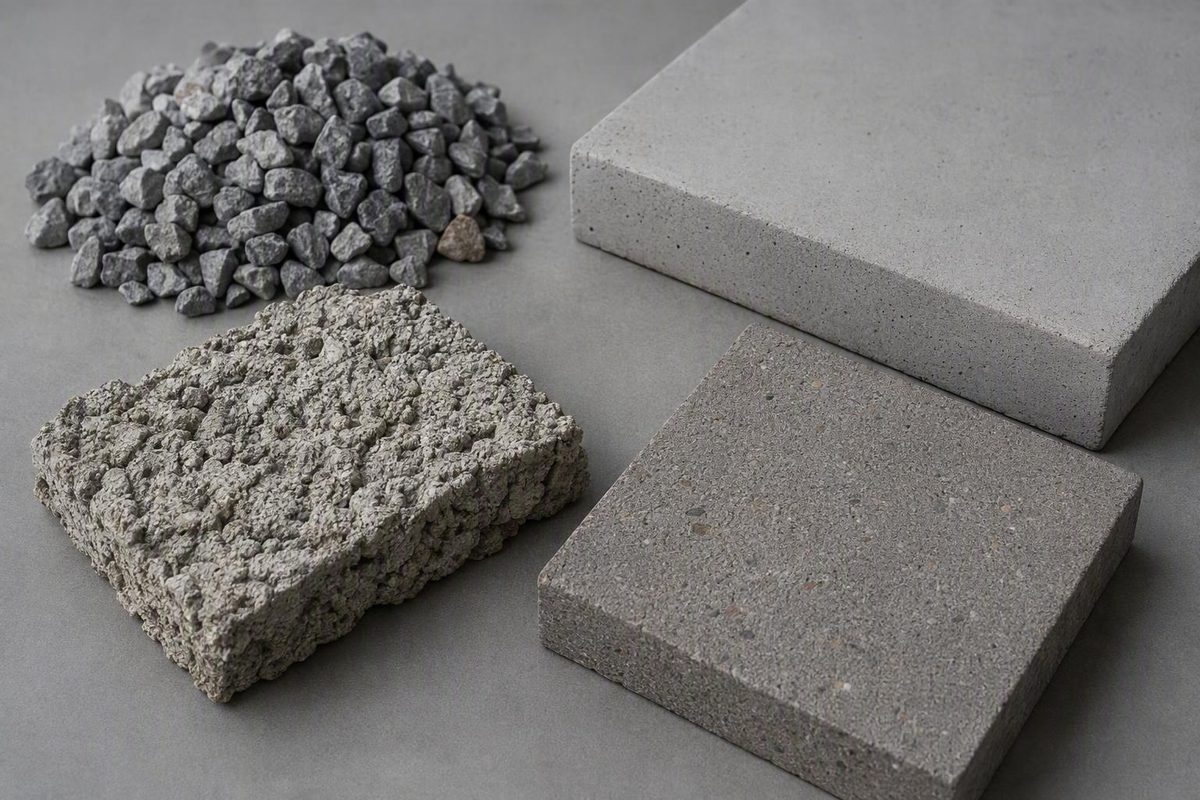
A Ferrock driveway is not a purchase-ready residential option this fall: the available evidence identifies no consumer price, standard installation system, or established supplier network. Geopolymer “greencrete” is available only in limited markets at $8–$20 per square foot, while installed gravel averages $1.25–$1.80 per square foot—roughly one-quarter to one-sixteenth of that price—and directly addresses the shifting and refill complaints when the base, grading, and drainage are rebuilt correctly. The published greencrete estimate also flags limited availability and specialized installation.
For a 600-square-foot driveway, those published rates put gravel at $750–$1,080 and geopolymer at $4,800–$12,000. Ferrock cannot be placed honestly on the same cost scale because no dependable installed residential price appears in the available evidence.
Enter your driveway area, then sort or filter the materials to see which side wins on cost and present-day availability.
The default 600-square-foot example uses only published figures supplied with this comparison. A dash means the evidence does not provide a dependable installed price.
| What the Evidence Supports | |||
|---|---|---|---|
| Gravel / Crusher RunEstablished loose aggregate surface | $750–$1,080$1.25–$1.80/sq. ft. | Yes | Usually locally quotable; grading, drainage and replenishment affect performance. |
| Recycled Concrete AggregateCrushed demolition material | —No supplied installed rate | Regional | Can serve as granular surface or base where gradation, quality and permitted use are verified. |
| Chip SealRequested comparison row | —No supplied installed rate | — | The supplied evidence gives neither a price nor an availability finding. |
| AsphaltConventional asphalt row | —No supplied installed rate | — | The supplied evidence does not provide a conventional asphalt price or orderability finding. |
| Conventional ConcreteEstablished rigid pavement benchmark | $2,400–$9,000$4–$15/sq. ft. | Yes | Established supply and installation channels; local scope still governs the quote. |
| Geopolymer “Greencrete”Not Ferrock; separate binder technology | $4,800–$12,000$8–$20/sq. ft. | Limited | Published consumer estimate; specialized installer and limited availability flagged. |
| FerrockEmerging iron-rich material | —No dependable residential price | No | No identified consumer driveway system, standard quote, price list or multi-year residential record. |
At 600 sq. ft., gravel is $3,720–$11,250 less than the published geopolymer range when opposite ends of the two ranges are compared.
National rates are comparison benchmarks, not guaranteed local bids. Excavation, base correction, drainage and site access can change the total.
Sources: Bob Vila gravel and concrete cost figures; House Digest geopolymer cost and availability guidance; House Digest Ferrock availability discussion; peer-reviewed Ferrock-infused concrete study. Unknown values are shown as —.
The Case for Ferrock Is Stronger Than Mere Hype
The received view has a legitimate foundation. Ferrock uses iron-rich industrial waste, commonly described as steel dust, and reacts with carbon dioxide during curing to form solid iron carbonate. That chemistry creates credible potential to retain carbon in the hardened material while diverting waste-derived ingredients from disposal.
Consumer coverage presents Ferrock as a stronger, potentially carbon-negative alternative to ordinary concrete or loose gravel. The widely repeated claim is that it can have up to five times concrete’s tensile strength. Molded pavers could, in principle, avoid gravel migration and provide a solid vehicle surface. Those are understandable reasons for homeowners to investigate it.
The same coverage, however, concedes that Ferrock is not a mainstream building material, depends on access to steel dust, and may require specialized carbon-dioxide curing. It names no residential manufacturer, installer, price list, vehicle-rated specification, warranty, or completed driveway with a documented service history. House Digest’s Ferrock overview contains both the ambitious performance pitch and the availability caveats.
The consensus is therefore right about Ferrock’s technical promise. It gets ahead of the evidence when it treats that promise as something a homeowner can order like gravel, asphalt, or conventional concrete.
Ferrock Fails the Three-Supplier Phone Test
An estimator’s phone test is simple: can three local suppliers quote the same defined product for the same driveway? A workable quote must identify the material, installed thickness, base, curing process, labor, testing, warranty, and repair method.
The available Ferrock evidence does not identify even one broadly orderable residential system. That does not prove that no custom batch or demonstration project can be arranged anywhere. It means a homeowner cannot start with a recognized product, obtain competing bids, and compare equivalent scopes in the normal way.
The first call must establish what “Ferrock” means. The name can refer to a cement-free experimental binder, a molded unit, a precast paving concept, or Portland-cement concrete containing a percentage of a Ferrock mixture. Those are not interchangeable products.
A supplier invoking the name should provide the exact composition, manufacturing location, curing method, vehicle-load rating, complete test reports, installation instructions, quality-control procedure, safety information, replacement-material availability, and written warranty. A contractor should be able to identify installations using that exact formulation and explain how joints, edges, repairs, weather interruptions, and curing will be handled.
Local acceptance is a separate gate. Product availability does not eliminate permitting, driveway-apron, drainage, runoff, or pavement requirements. The supplier and installer need to present the exact product data and construction method to the relevant authority before material is ordered or a deposit becomes nonrefundable.
If three suppliers cannot quote a defined vehicle-bearing product, there is no competitive market price to estimate. A laboratory ingredient cost plus an ordinary concrete labor rate is not a Ferrock driveway quote.
The Strongest Study Tested Ferrock-Infused Concrete
The strongest cited research does not document an all-Ferrock driveway. It examined M30-grade Portland-cement concrete in which Ferrock replaced part of the cement. The laboratory program measured slump, compressive strength, split tensile strength, flexural behavior, rebound-hammer response, rapid chloride penetration, elevated-temperature performance up to 600°C, and microstructure.
Among the Ferrock percentages tested, the 10% replacement mixture produced the best overall mechanical performance. Performance declined as the replacement percentage increased beyond that level. The same 10% mixture also returned favorable chloride-permeability and elevated-temperature results relative to the other Ferrock mixtures in the experiment. The peer-reviewed study reports the formulations, methods, performance results, and sustainability assessment.
That is encouraging evidence for further concrete-mix development. It does not validate a cement-free Ferrock slab, a molded Ferrock paver, or every concrete mixture containing 10% Ferrock. The result is tied to the study’s ingredients, proportions, specimen preparation, curing conditions, ages, and test methods.
It also does not establish performance under years of turning tires, edge loading, abrasion, settlement, freeze-thaw cycles, deicing salts, oil, sunlight, wet-weather traction, or water entering field joints and cracks. No full-scale residential Ferrock driveway monitored over multiple years under regular vehicle traffic appears in the cited evidence.
The “five times stronger” line is especially weak as a purchasing specification. Strength could mean tension, compression, flexure, impact, or fatigue. Without a named comparison mix, specimen age, curing method, and directly connected primary test results, the multiplier cannot determine slab thickness, reinforcement, warranty terms, or service life.
A Driveway Still Depends on Its Base and Drainage
A stronger binder cannot prevent movement caused by weak soil, inadequate compaction, trapped water, erosion, poor grading, or unsupported edges. Those are pavement-system failures, not problems that disappear when the surface chemistry changes.
This is where the viral comparison with gravel loses focus. Gravel can migrate, wash out, form potholes, create dust, complicate snow removal, and require periodic leveling or replenishment. Those complaints are real, and Ferrock should not be dismissed merely because gravel is cheaper.
But recurring gravel trouble often calls for a gravel reconstruction rather than an experimental binder: correct the grade, remove unsuitable material, stabilize the separation between soil and aggregate where needed, rebuild the compacted aggregate section, and restore a properly shaped crusher-run surface. Drainage must move water away without sending loose material with it.
The published national gravel benchmark is $1.25–$1.80 per square foot installed, with an average project figure of about $1,500 for a 16-by-38-foot driveway. Site condition, drainage, labor, material source, and region can move the actual quote substantially. Bob Vila’s gravel cost guide provides those figures and describes the maintenance limitations.
That range should not be treated as a guaranteed price for excavation, fabric, drainage structures, and a complete base replacement at every property. It is the usable market benchmark that Ferrock presently lacks. A local gravel quote can itemize every layer; a Ferrock estimate cannot be verified until an actual product and installer exist.
The Cost Gap Is Large Even Before Ferrock Gets a Price
Only three relevant surfaces have usable per-square-foot figures in the supplied evidence.
| Surface | Installed Price/Sq. Ft. | 600 Sq. Ft. | Availability |
|---|---|---|---|
| Gravel | $1.25–$1.80 | $750–$1,080 | Usually locally quotable |
| Concrete | $4–$15 | $2,400–$9,000 | Established |
| Geopolymer | $8–$20 | $4,800–$12,000 | Limited |
| Ferrock | — | — | No identified consumer system |
Concrete’s cited range is $4–$15 per square foot. It costs more than gravel but has established batching, placement, design, repair, and contracting channels. Geopolymer may reduce Portland-cement use, but it is a separate alkali-activated material rather than another name for Ferrock. Its specialized installer requirement and limited availability remain part of the purchase decision.
The supplied evidence gives no dependable installed figures for recycled concrete aggregate, chip seal, asphalt, or Ferrock. Those entries remain dashes in the comparator rather than estimates assembled from unrelated projects.
At 600 square feet, even the lowest published geopolymer total exceeds the highest gravel total by $3,720. At the opposite ends of the ranges, the gap reaches $11,250. Ferrock has no price with which to demonstrate that a claimed durability or maintenance advantage would recover its initial cost.
Any future Ferrock quote would need separate charges for removal, excavation, compacted base, drainage, the exact Ferrock product, transport, controlled curing, placement, structural details, testing, engineering, local review, warranty coverage, and future repair mobilization. An unsupported premium added to a concrete quote is not a reliable substitute.
Carbon Uptake Does Not Prove a Carbon-Negative Driveway
Ferrock’s iron-bearing chemistry can consume carbon dioxide during curing. Waste-derived ingredients may also reduce demand for virgin material, and partial replacement can reduce the Portland cement used in a documented concrete mix.
Those facts support lower-impact potential, but carbon uptake, carbon neutrality, and carbon negativity are different claims. A material can bind some carbon dioxide and still produce net emissions after feedstock processing, additives, transportation, curing equipment, installation, maintenance, demolition, and disposal are counted.
The peer-reviewed study reported reductions in embodied energy, global-warming potential, and material-use cost as Ferrock was incorporated. Its assessment used a cradle-to-site boundary covering materials and transportation to the project site. It did not assess driveway use, repairs, maintenance, demolition, recycling, or disposal.
A product-specific environmental product declaration or independently reviewed lifecycle assessment would need to state the formulation, recycled content, transportation assumptions, carbon-dioxide source, curing energy, declared unit, geographic scope, carbon-uptake calculation, and lifecycle boundary. No such commercial residential-driveway document appears in the evidence reviewed here.
Ferrock can therefore be described as having credible carbon-uptake and waste-reuse potential. The evidence does not establish that every completed Ferrock driveway removes more greenhouse gas than the whole project produces.
Ferrock Becomes Viable Only When the Missing Links Exist
A genuine residential offer would change the verdict. It would need a defined vehicle-bearing product, product-specific testing, controlled manufacturing, a practical curing method, an engineered pavement design, local acceptance, trained installers, an itemized price, replacement material, and meaningful product and workmanship warranties.
Until that chain exists, Ferrock belongs in research, product development, and carefully controlled demonstration work—not in an ordinary driveway budget. Geopolymer is somewhat closer to the market but remains expensive and geographically limited.
For the homeowner trying to stop gravel from shifting, washing out, or demanding frequent refills, the immediate comparison is not Ferrock versus neglect. It is an unavailable experimental surface versus a properly scoped rebuild using locally supplied aggregate, corrected drainage, adequate separation and base material, and controlled compaction. The latter can be quoted, inspected, repaired, and completed this fall.