
Caulk Driveway Joints That Carry Water, Not Every Line
Seal open expansion joints that let water reach the base; consider control joints only after they crack or carry runoff. Intact grooves can be monitored.
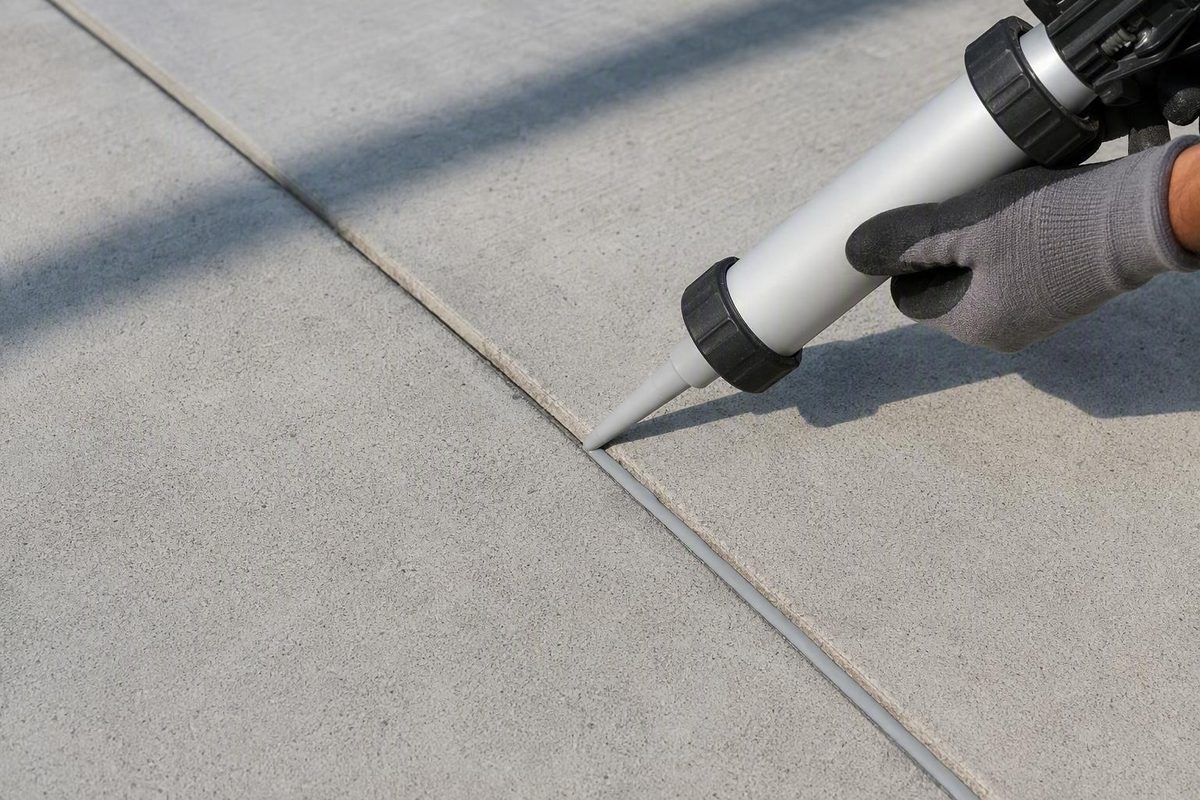
The short answer: caulk the water pathway, not every line in the driveway
Generally, yes: seal an open, full-depth expansion joint when rain or runoff can pass through it toward the material supporting the driveway. Use a flexible sealant made for exterior horizontal concrete joints. Do not fill a designed movement joint with rigid mortar or grout.
Control joints require a more selective decision. An intact, shallow control groove does not automatically need caulk. If a crack has formed within the groove and the joint now collects water or channels it beneath the slab, sealing becomes reasonable preventive maintenance. Control joints establish planned locations for shrinkage cracks; expansion joints provide space for movement between concrete sections or between concrete and another structure. A-1 Concrete Leveling, a contractor that sells concrete repair and caulking services, similarly recommends concentrating sealing efforts where water can get beneath the slab. See its explanation of control and expansion joints.
“Water joint” is not a standard joint category in the supplied guidance.
- A full-depth expansion joint
- A saw-cut or formed control joint
- A random crack
- A deteriorated opening where old filler or sealant is missing
- An unidentified line between separately placed areas of concrete
The name alone does not determine the repair. You need to understand what the opening does, whether it must accommodate movement, how deeply it appears to extend, and where the water goes. If an unidentified line separates separate concrete placements, base the decision on its movement and water behavior rather than trying to classify it from appearance alone.
Caulking reduces one route for water and debris to enter. It does not waterproof the driveway. Concrete remains porous across its exposed surface, and moisture may also arrive through slab edges, random cracks, adjoining soil, or below the concrete. A sealed joint therefore cannot guarantee that the driveway will never crack, settle, tilt, or suffer freeze-thaw deterioration.
Treat joint sealing as preventive maintenance, not structural repair. Before buying caulk:
- Identify the opening as closely as practical.
- Observe how water behaves during rain or washing.
- Inspect the adjoining slabs for movement, voids, or loss of support.
- Decide whether to seal, monitor, or seek an assessment.
- Choose a flexible product suited to the joint, driveway slope, traffic, and existing materials.
If the only problem is an open movement joint admitting water, caulking may be an appropriate DIY project. If one slab has moved vertically, muddy water pumps from the opening, or a crack keeps widening, another bead of sealant may hide the symptom without correcting the cause.
Identify the opening before deciding what to seal
Concrete driveways can contain several kinds of lines and openings. Their names are sometimes used loosely in DIY and commercial guidance, so make the maintenance decision according to function and water behavior rather than the label alone.
Control joints
A control joint—also called a contraction joint—is a partial-depth groove intended to influence where concrete cracks as it shrinks. It may be formed while the concrete is wet or saw-cut after placement. Instead of allowing a random crack to wander across the slab, the groove creates a planned weak location.
A crack may eventually develop at the bottom of the groove. That is not necessarily evidence that the joint failed; guiding the crack is its purpose. The practical question is whether the resulting opening now carries water below the slab.
An intact control joint that merely becomes wet at the surface may gain limited benefit from sealing. A control joint with a visible crack that swallows runoff, follows a low point, or drains toward another opening is a stronger candidate.
Expansion joints
An expansion joint is a gap that allows movement between concrete sections or between concrete and another structure. You may find one:
- Between two separately placed slabs
- Where a driveway meets a garage slab
- Along a foundation, curb, column, or other fixed structure
- At another location where adjoining concrete needs room to move independently
These joints commonly contain—or once contained—a compressible filler. Unlike a shallow control groove, the separation may continue through the slab toward the base. QUIKRETE’s manufacturer guidance describes expansion joints as full-depth separations and recommends flexible sealing to limit water penetration while preserving movement capacity. See QUIKRETE’s expansion-joint guidance.
That movement requirement is critical. Joint sealant is designed to stretch or compress within its rated limits.
Random cracks
An irregular crack crossing the slab outside a planned groove should be evaluated separately. A minor, stable crack may sometimes accept a compatible flexible concrete sealant, but caulking should not be the automatic response to every crack.
Stop and investigate when a crack is:
- Continuing to widen
- Vertically displaced, with one side higher than the other
- Reappearing after repeated repairs
- Associated with settlement or a rocking slab
- Surrounded by loose, broken, or deteriorated concrete
- Connected to a deep void or visibly unsupported edge
- Being forced open by roots or continuing ground movement
Sealant can close a surface opening. It cannot pull slabs back into alignment or restore support below them.
A practical inspection sequence
Clean only enough loose debris from the top to see the opening clearly. Then inspect it without assuming that any single visual clue proves what kind of joint it is.
- Look for compressible filler. Fiberboard, foam, rubber-like material, or remnants of an old seal may suggest a movement joint.
- Look at what the opening separates. A gap between a driveway and a garage, foundation, curb, or separate slab is more likely to accommodate independent movement.
- Examine shallow grooves. A uniform saw-cut line with a crack at the bottom is likely functioning as a control joint.
- Check the broader crack pattern. A jagged line crossing the field of a slab is more likely to be a random crack.
- Observe the driveway during rain. Determine whether water merely wets the opening, ponds in it, flows along it, or disappears beneath the concrete.
- Compare slab elevations. Look across the opening from a low angle to see whether adjoining surfaces remain aligned.
- Watch for material coming out. Muddy discharge, sand, or fine soil appearing when vehicles cross the area may indicate movement and loss of support.
You may encounter old filler, compacted dirt, backer rod, or debris rather than the bottom. If the construction remains uncertain, decide according to the opening’s location, movement, and water behavior—or obtain an on-site assessment.
What sealing can—and cannot—do about water
A driveway slab depends on reasonably uniform support. When an opening repeatedly carries water below the concrete, the supporting soil or fine base material has an opportunity to become saturated, move, erode, or be pumped out as vehicles load and unload the slab. Loss of support can contribute to tilting, settlement, edge movement, and additional cracking.
That does not mean every unsealed joint will produce these problems. Drainage, soil, base construction, traffic, climate, and the amount of concentrated runoff all affect the outcome.
A properly installed flexible sealant can help by:
- Reducing direct entry of water and debris through the opening
- Continuing to accommodate movement instead of forming a rigid connection
- Keeping dirt, seeds, weeds, gravel, and other material out of the joint
The freeze-thaw benefit is limited, not absolute
In a cold climate, reducing water held in and immediately beside a joint may reduce localized freeze-thaw exposure. It may also reduce one route by which water reaches susceptible soil or fine base material below the opening.
But caulking joints does not prevent the rest of the slab from getting wet. Concrete is porous, and moisture can enter through the exposed surface, slab edges, adjoining soil, random cracks, or below. Manufacturer guidance on concrete sealing likewise notes both the porosity of concrete and the role of freezing moisture in deterioration, while directing users to product-specific procedures. See GE Sealants’ concrete guidance.
Avoid two overstatements:
- “Caulking prevents freeze-thaw damage.”
- “An unsealed joint guarantees frost damage.”
The defensible conclusion is narrower: limiting water at a joint may reduce localized exposure and may help protect the support below that opening, but it cannot eliminate freeze-related risk across the driveway.
Sealant is only one part of water management
If a roof downspout empties beside the driveway, the grade directs runoff toward the garage, or water ponds over the same joint after every storm, sealing addresses the final opening—not the volume or direction of the water.
Look for:
- Downspouts discharging onto or beside the slab
- Soil or landscaping pitched toward the driveway
- A low spot that retains water
- Runoff from a neighboring hard surface
- A joint acting as a channel toward the lowest slab edge
- Erosion around the driveway perimeter
- Water trapped against a garage, curb, or foundation
The joint may still merit sealing, but it should not function as the drainage system.
A decision guide for expansion joints, control joints, and wet cracks
Use three possible outcomes: seal as maintenance, monitor and reassess, or stop and seek an assessment.
Seal as maintenance
Sealing is generally appropriate when:
- A full-depth expansion joint is open to rain or runoff.
- Existing sealant is cracked, missing, detached, or deteriorated.
- Compressible filler remains below the surface but the protective top seal is gone.
- Water appears able to travel through the opening toward the base.
- A control joint has cracked and now collects or channels runoff.
- A minor, stable crack is suitable for the selected flexible concrete sealant.
- The concrete edges are sound enough to support adhesion.
- The slabs remain reasonably aligned without clear evidence of continuing settlement.
A full-depth gap between driveway slabs that fills during rain is a straightforward example. Clean it, inspect for support problems, install backer rod if the product and joint dimensions require it, and apply an exterior sealant that can tolerate movement and traffic.
Monitor and reassess after rain
Monitoring can be reasonable when:
- A shallow control joint remains intact.
- The opening becomes damp but does not appear to drain beneath the slab.
- Rainfall and concentrated runoff are minimal.
- The joint is inside a dry garage.
- The groove is shallow and does not lead into an open joint or crack.
- You cannot yet tell whether water is ponding, passing through, or merely darkening the concrete.
- The likely benefit appears small relative to the required preparation.
Preventive sealing of an uncracked control joint is optional and site-dependent. Climate, rainfall, joint depth, driveway slope, freeze-thaw exposure, and runoff concentration all influence the value of the work.
Monitoring does not mean ignoring the joint. Observe it during meaningful rain and again after the driveway dries. Photographs taken from the same position can help reveal widening, seal loss, or changes in slab elevation.
Stop and seek an assessment
Do not treat caulking as the primary repair when you find:
- Vertical displacement between slabs
- Recurring or progressive settlement
- Muddy water, sand, or fine soil pumping from the opening
- A large, widening, or repeatedly returning crack
- Deep voids or visibly unsupported concrete
- Hollow or rocking slab areas
- Loose or deteriorated joint edges
- Active root movement
- Recurring seal failure caused by substantial movement
- Evidence that runoff has washed out support
- A broader drainage problem affecting several slabs
These symptoms do not prove a particular structural diagnosis, but they justify further investigation before the opening is concealed. Tremco’s manufacturer guidance cautions that sealants are not long-term repairs for large structural cracks and identifies concrete condition, movement, moisture, traffic, preparation, and compatibility as important selection factors. Review Tremco’s concrete-caulking considerations.
Active roots deserve particular caution. A flexible bead may temporarily exclude water, but continuing root or soil movement can pull the joint apart again. Recaulking without addressing the movement may become a recurring maintenance cycle.
Persistent ponding also requires more than surface closure. Once one opening is sealed, the redirected water may find a crack, slab edge, garage threshold, or another low point. Address the runoff source wherever practical.
Choose a sealant that can move with the concrete
Look for a flexible exterior sealant specifically labeled for horizontal concrete joints. Confirm that it suits the expected joint width, movement, slope, traffic, weather exposure, concrete condition, and any old material that cannot be completely removed.
Do not choose by chemistry alone. Both polyurethane and silicone products appear in manufacturer guidance, but the evidence does not establish either as universally superior for every driveway. One product may tolerate certain movement or traffic conditions but require dry concrete, primer, limited application temperatures, or complete removal of another sealant. Another may have different adhesion, tooling, moisture, or curing requirements.
The current product data sheet and installation instructions should control the choice.
Self-leveling versus non-sag sealant
A self-leveling sealant flows after application, helping it form an even surface in a sufficiently level horizontal joint. That behavior can simplify finishing, but it creates a problem on sloped concrete: the material may run downhill, become too thin at the high end, and collect at the low end.
Use:
- Self-leveling sealant on level or nearly level joints when the manufacturer permits it.
- Semi-self-leveling or non-sag sealant on sloped driveway sections or wherever the bead must remain precisely in place.
Family Handyman’s driveway-joint instructions make the same practical distinction and emphasize complying with the selected product’s weather and application requirements. See its driveway expansion-joint resealing guide.
Do not assume the entire driveway has the same slope. A joint may run across a driveway and remain nearly level even when the driveway falls toward the street. A joint running downhill may have a much more consequential grade.
Why rigid fillers are usually wrong for movement joints
Mortar, grout, concrete patch, and other rigid materials may be suitable for some concrete repairs, but they are generally the wrong concept for an expansion joint. The opening exists because adjoining concrete needs to move. A rigid bridge across it may crack, debond, crumble, or transfer stress into the slab edges.
Even flexible sealant must have sufficient movement capacity. If the joint moves beyond what the product or installed bead can accommodate, the sealant may pull away from the concrete or tear.
A performance classification such as ASTM C920 may be relevant when comparing sealants for a moving or traffic-exposed joint, but the classification alone does not prove that a product fits a particular driveway. Joint width, expected movement, application temperature, traffic, exposure, concrete condition, moisture, compatibility, and any primer requirement must still be checked against the current technical data. Tremco outlines these product-selection and application factors.
What backer rod does
Backer rod is a compressible foam cord installed beneath the sealant in a sufficiently wide or deep opening. It:
- Supports the wet bead
- Controls sealant depth and shape
- Prevents wasting sealant in a deep opening
- Helps the sealant adhere to the two joint faces rather than the bottom
- Leaves room for the bead to stretch and compress more predictably
Choose a rod that fits snugly without being forced excessively. Published instructions commonly describe a rod slightly wider than the opening and, in some examples, placement that leaves approximately 1/4 to 1/2 inch for sealant; this is not a universal specification, and the selected sealant’s instructions govern bead depth and geometry. Family Handyman provides this example range.
Backer rod is not automatically required for every hairline crack or shallow groove. It is most relevant where an opening would otherwise accept an excessively deep bead or where the product specifies a supported joint profile.
Some products require primer on concrete or under particular exposure conditions. Old silicone, polyurethane, asphaltic filler, coatings, oil, or unidentified residue may create adhesion or compatibility problems. If compatibility is not documented, remove the old material as completely as practical or select a replacement system whose manufacturer confirms the intended use.
How to prepare and caulk a driveway joint
Preparation often determines whether the repair bonds to concrete or merely rests on dirt. Before starting, assemble the necessary materials and confirm that the weather and site conditions suit the chosen product.
Materials and conditions checklist
You may need:
- Flexible sealant rated for exterior horizontal concrete joints
- Backer rod in the required size and type
- A caulking gun or manufacturer-specified dispensing equipment
- Hand tools for lifting weeds and failed filler
- A stiff nylon brush and vacuum
- Suitable equipment for removing incompatible old sealant
- Cleaning supplies permitted by the manufacturer
- Primer, if required
- Gloves and any other protection listed on the label
- Barriers to keep people and vehicles away from the repair
Also confirm:
- The joint edges are sound enough for adhesion.
- The concrete can be dried to the product’s requirement.
- Application temperatures will remain within the permitted range.
- Rain or washing will not occur during the stated protection period.
- The repair can cure before foot or vehicle traffic resumes.
- A self-leveling product will remain in place on the actual joint slope.
Product instructions are authoritative for primer, joint dimensions, application temperature, moisture tolerance, rain exposure, cure time, and traffic readiness.
Step 1: Remove weeds, debris, and failed material
Remove vegetation, dirt, stones, loose concrete, failed filler, and deteriorated sealant. Sound compressible filler may sometimes remain below the intended bead if the new system permits it, but loose, contaminated, or incompatible material should not become the bonding surface.
Work carefully around the concrete edges. The goal is to expose sound joint faces, not reshape the slab unnecessarily.
Step 2: Clean both joint faces
Sealant needs to adhere to the sides of the opening. Brush and vacuum both faces thoroughly rather than cleaning only the visible top.
Remove:
- Dust
- Soil and sand
- Plant residue
- Loose cement paste
- Oil or automotive contamination
- Soap and cleaning residue
- Incompatible old sealant
- Standing water
A wet rinse may be suitable for some preparation systems, but rinsing creates a drying requirement. QUIKRETE’s expansion-joint instructions, for example, call for debris removal, cleaning, rinsing, and drying before sealing. Review the manufacturer’s preparation sequence.
Do not introduce water immediately before applying a product that requires dry concrete.
Step 3: Let the joint dry as required
Do not assume every sealant tolerates damp concrete. Moisture may interfere with adhesion, curing, or appearance, depending on the product.
Drying involves more than waiting until the top looks pale. Follow the manufacturer’s required substrate condition rather than relying on a universal waiting period.
Step 4: Inspect what cleaning revealed
Before hiding the opening, look for evidence that the problem extends below the sealant zone:
- A deep cavity beneath a slab edge
- Missing supporting material
- Mud or fine soil in the opening
- Water pumping when the slab is loaded
- Broken or visibly unsupported concrete
- Substantial differences in slab elevation
- Continuing root pressure
- Movement when a vehicle crosses the area
Stop the DIY sealing project if cleaning exposes an apparent support or movement problem. Filling a deep void with caulk, loose sand, improvised foam, or another convenient material does not restore a properly supported base. Sealant guidance also distinguishes minor joint or crack sealing from repairs involving larger structural damage. GE’s guide advises considering professional work when conditions extend beyond a routine sealing project.
Step 5: Install backer rod where required
Use the rod size and placement specified for the sealant and joint dimensions. Press it evenly into place with a blunt tool that will not puncture the foam.
The rod should be snug enough to remain in position, but it should not be driven so deeply that the required bead geometry becomes impossible. Avoid stretching, twisting, or puncturing it.
If the opening is too irregular for conventional backer rod, consult the sealant manufacturer’s details rather than improvising a support that may react with the product or trap moisture.
Step 6: Apply a continuous bead
Cut the nozzle to suit the joint and dispense the sealant continuously, maintaining contact with the opening rather than dropping a thin skin across the top. Fill the specified space without leaving gaps or air pockets.
Use a self-leveling material only where it can remain within the joint. On a sloped joint, use a compatible non-sag or semi-self-leveling formulation.
Avoid smearing sealant broadly across the driveway.
Step 7: Finish and protect the repair
Some sealants should be tooled; others level themselves and should be left alone. Follow the instructions for finishing method and timing.
Protect the repair from:
- Rain
- Washing and sprinklers
- Dust and yard debris
- Foot traffic
- Tires and vehicle turning
- Pets or wildlife
- Landscaping work
Cure claims vary substantially by product and conditions. Do not transfer one manufacturer’s temperature limit, rain window, cure time, or traffic restriction to another product.
Why a new seal can fail
Common causes include:
- Inadequate cleaning
- Damp or contaminated joint faces
- Bonding to dust instead of sound concrete
- Incompatible old and new materials
- Missing required primer
- Incorrect bead dimensions
- Application outside the permitted temperature range
- Rain or washing before the sealant is ready
- Foot or vehicle traffic too early
- Movement beyond the product’s capacity
- Deterioration of the concrete itself
- Weathering and loss of flexibility with age
Failure may appear as a bead pulling away from one joint face, tearing through its center, remaining soft, bubbling, or taking concrete fragments with it. The pattern helps distinguish an adhesion or application problem from excessive movement or deteriorating concrete.
Inspect the repair and address the reason water reaches it
There is no reliable universal lifespan or fixed resealing schedule for driveway-joint sealant. Performance varies with product selection, preparation, joint movement, concrete condition, weather, sunlight, traffic, moisture, bead geometry, and material compatibility.
Inspect the repair periodically and after severe weather, unusual runoff, or noticeable slab movement. Replace or investigate the bead when you see:
- Cracking through the sealant
- Peeling or separation from either joint face
- Missing or worn sections
- Hardening and loss of flexibility
- Tearing within the bead
- Bubbles, voids, or incomplete cure
- Broken concrete along the bond line
- Open gaps that again admit water
Compatible resealing may sometimes be possible, but applying new sealant over old material without checking compatibility can reproduce the failure. The existing bead may need to be removed so the replacement can bond to clean concrete.
Inspect the driveway while it is raining. A dry-weather view will not reveal the complete drainage pattern. Observe where water begins, how it crosses the concrete, and where it collects. Look for roof runoff, downspout discharge, ponding, flow along a joint, and entry at slab edges.
If the same opening repeatedly fills despite successful resealing, reduce or redirect the runoff where feasible. Repeated caulking is not a substitute for grading or drainage work.
Seek an experienced concrete or drainage contractor—and, for significant movement or structural uncertainty, an appropriately qualified engineer—when you find vertical displacement, repeated movement-related seal failure, large cracks, soil pumping, hollow or unsupported areas, deep voids, or active roots. These symptoms require diagnosis before cosmetic closure.
A sound flexible seal over properly prepared concrete can be useful maintenance. It cannot lift a settled slab, replace washed-out support, stabilize moving soil, or permanently restrain active roots.
Frequently asked questions
Do all control joints in a concrete driveway need to be caulked?
No. An intact, shallow control joint does not automatically need caulk. Its primary purpose is to create a planned location for shrinkage cracking, and the groove may perform that function without becoming a significant water pathway.
Consider sealing after a crack opens within the joint and water collects there, follows it, or appears to drain beneath the slab. Preventive sealing of an uncracked groove is optional and depends on rainfall, runoff, freeze-thaw exposure, joint depth, slope, and whether the groove directs water into another opening.
A dry garage joint or an exterior groove with little water exposure may gain less from sealing than a cracked control joint carrying concentrated runoff.
Can caulking driveway joints prevent freeze-thaw damage?
It may reduce localized exposure by keeping some water out of the joint and away from the material immediately below it, but it cannot prevent all freeze-thaw damage.
Concrete remains exposed across its porous surface, and moisture can enter through slab edges, random cracks, adjoining soil, or below. Joint sealing is one water-management measure, not a way to freeze-proof or waterproof the entire driveway.
Should I use self-leveling caulk on a sloped driveway?
Usually not where the joint itself slopes enough for uncured material to flow. Self-leveling sealant can run downhill, leaving an undersized bead at the high end and excess material at the low end.
Choose a non-sag or semi-self-leveling product labeled for the joint’s orientation and exposure. Check the slope of the individual joint rather than judging only the driveway as a whole.
When is backer rod needed in a concrete driveway joint?
Backer rod is commonly used when a joint is too wide or deep to fill efficiently with the correct sealant geometry. It supports the bead, controls depth, reduces wasted material, and helps the sealant adhere to the joint sides rather than filling the entire opening.
The rod should fit snugly and sit at a depth that leaves room for the manufacturer-specified bead. Joint width, sealant type, expected movement, and product instructions determine whether it is required and how it should be installed.
Can I caulk a joint if one driveway slab is higher than the other?
You may be able to close the opening temporarily, but a height difference means the problem is no longer only an open joint. One slab may have settled, heaved, lost support, or been displaced by roots or moving soil.
Sealant cannot realign the slabs or restore the base. Have the cause assessed, especially if the difference is growing, the slab rocks under traffic, muddy water pumps from the joint, or previous seals repeatedly tear.
The practical rule is simple: seal an expansion joint that lets water toward the base, and consider sealing a control joint once it has cracked or begun carrying runoff. Use a flexible, slope-appropriate concrete-joint sealant over clean, adequately dry joint faces, with backer rod where required. If water keeps ponding, soil pumps from the opening, slabs have shifted vertically, or the seal repeatedly fails, address drainage or base movement rather than treating another bead of caulk as the repair.