
Does Salt Damage Concrete? Driveway Risks and Safer Winter Care
Salt can damage concrete through scaling and chemical attack. Learn which deicers to avoid, how to protect new concrete, and when damage needs repair.
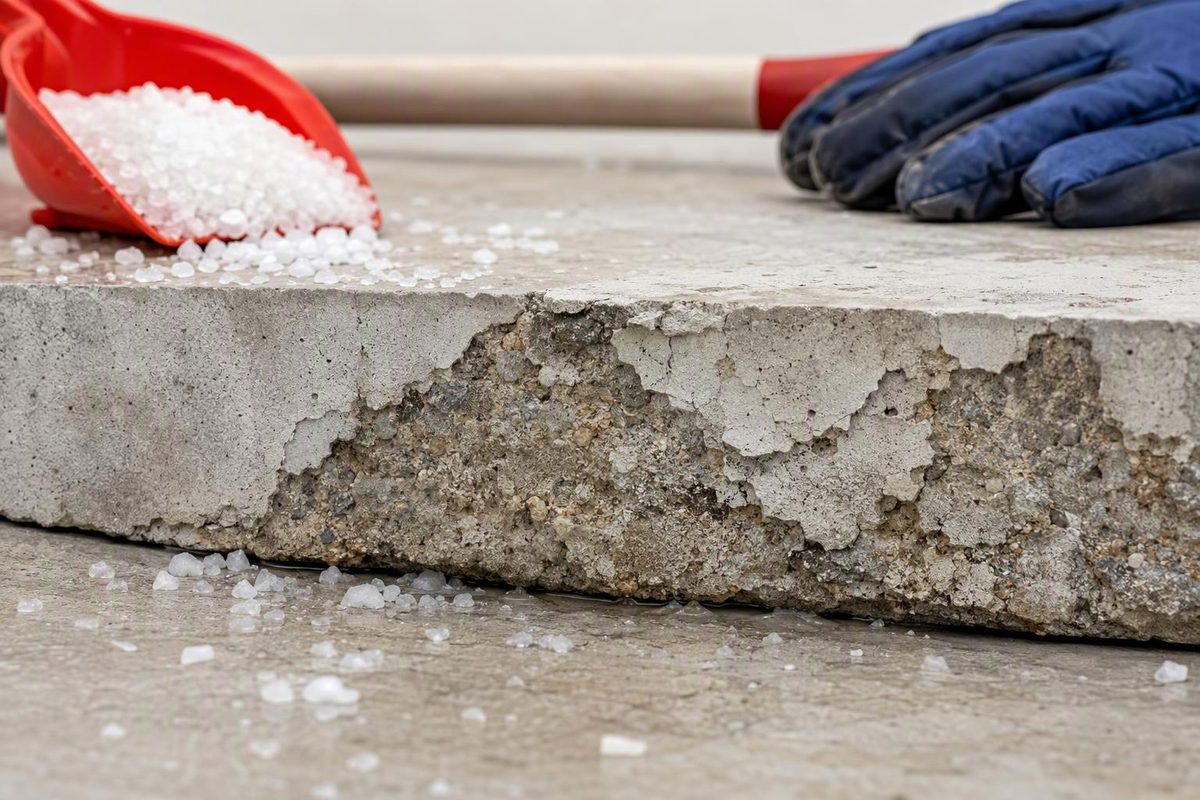
Yes—salt can damage a concrete driveway, especially when wet concrete repeatedly freezes and thaws. The usual visible damage is surface scaling: flakes of concrete peel away, leaving a rough or pitted surface. Some deicers can also chemically attack the cement paste.
Damage is not inevitable. Concrete quality, curing, drainage, age and the amount of deicer all affect the risk. For a new driveway, avoid deicing chemicals during the first winter; use clean sand for traction instead. These are key recommendations in the National Ready Mixed Concrete Association’s scaling guide.
How salt damages concrete
Concrete contains pores that can absorb water. When sufficiently saturated concrete freezes, ice formation creates internal stresses. Repeated freezing and thawing can break away the surface mortar. Deicers increase surface saturation and aggravate this process. Properly air-entrained concrete contains tiny bubbles that help relieve those stresses, but poor finishing or insufficient curing can leave a vulnerable surface. NRMCA explains these causes of scaling.
There is also a separate chemical risk. The Federal Highway Administration’s 2018 technical brief describes damaging reactions involving concentrated calcium chloride and magnesium chloride solutions. Under suitable conditions, these reactions can occur above freezing. Its pavement findings are particularly relevant to places where brine collects, such as poorly draining joints—not a prediction that one application will destroy a residential driveway.
Salt use alone does not prove why concrete is flaking. Too little entrained air, an unsuitable mix, finishing while bleed water remains, and inadequate curing can also contribute. Salt may expose an existing weakness rather than be the only cause.
Which winter material should you use?
Read the ingredient list, not just a “concrete-safe” claim on the bag. NRMCA considers sodium chloride and calcium chloride acceptable for concrete when used moderately, but warns against magnesium-based salts and ammonium sulfate or nitrate. FHWA’s later findings add an important qualification: concentrated calcium chloride brines can cause chemical distress too. Neither source supports treating a chloride deicer as risk-free. NRMCA guidance; FHWA technical brief.
| Material | Practical driveway judgment |
|---|---|
| Clean sand | Adds traction without chemical deicing. It does not melt ice; the preferred starting point for new concrete. |
| Sodium chloride—rock salt | An option for established, sound concrete when used sparingly. It can still aggravate freeze-thaw scaling. |
| Calcium chloride | Not a damage-proof substitute for rock salt. Avoid heavy applications and retained, concentrated brine. |
| Magnesium chloride or magnesium-based blends | Avoid on concrete under NRMCA’s guidance because of chemical attack risk. |
| Ammonium sulfate or ammonium nitrate | Do not use as concrete deicers. |
Temperature matters as well. The University of Minnesota’s homeowner winter-salt guide says sodium chloride works best between 15°F and 32°F. Below that range, adding more rock salt is not a reliable answer; sand provides traction without relying on melting.
Reduce damage without leaving an unsafe driveway
- Remove snow first. Shovel, blow or plow before traffic packs it down. Physical removal reduces how much deicer you need.
- Treat necessary areas rather than blanket the driveway. Prioritize a walking route and hazardous patches. Avoid piles of salt, and sweep up excess crystals for reuse.
- Fix recurring ice sources. Redirect a downspout that discharges across the driveway and repair leaking gutters. Repeatedly salting the same puddle treats the symptom, not the drainage problem.
These practices follow the University of Minnesota’s homeowner guidance.
For added protection, NRMCA recommends considering a breathable silane- or siloxane-based concrete sealer, applied to reasonably dry concrete according to its manufacturer’s directions. A sealer is an additional measure—not a replacement for good concrete or drainage. When conditions permit without creating an icing hazard, rinse off accumulated road salt deposited by vehicles. That tracked-in salt matters even if you never spread deicer yourself. NRMCA maintenance guidance.
If you are commissioning a new driveway in a freezing climate, ask the contractor to specify air-entrained concrete suitable for the exposure, proper finishing and curing, and drainage that prevents ponding. Our concrete driveway quality-control guide covers what to put in the contract.
If the surface is already flaking
Minor scaling may be cosmetic and need no immediate repair. Light to moderate damage can sometimes receive a bonded resurfacing treatment, but only after loose material is removed and the remaining concrete is sound. Excessive, progressing scaling may not be practical to repair, according to NRMCA.
Before buying an overlay, establish the depth and extent of deterioration. Use our scaling versus spalling guide to distinguish surface loss from deeper cavities. Sealing cannot restore concrete that has already broken away.