
Concrete Cure and Seal: When It Fits a New Driveway
Learn when concrete cure and seal fits a new driveway, how ASTM C309 and C1315 differ, and what coverage, timing and traction details to specify.
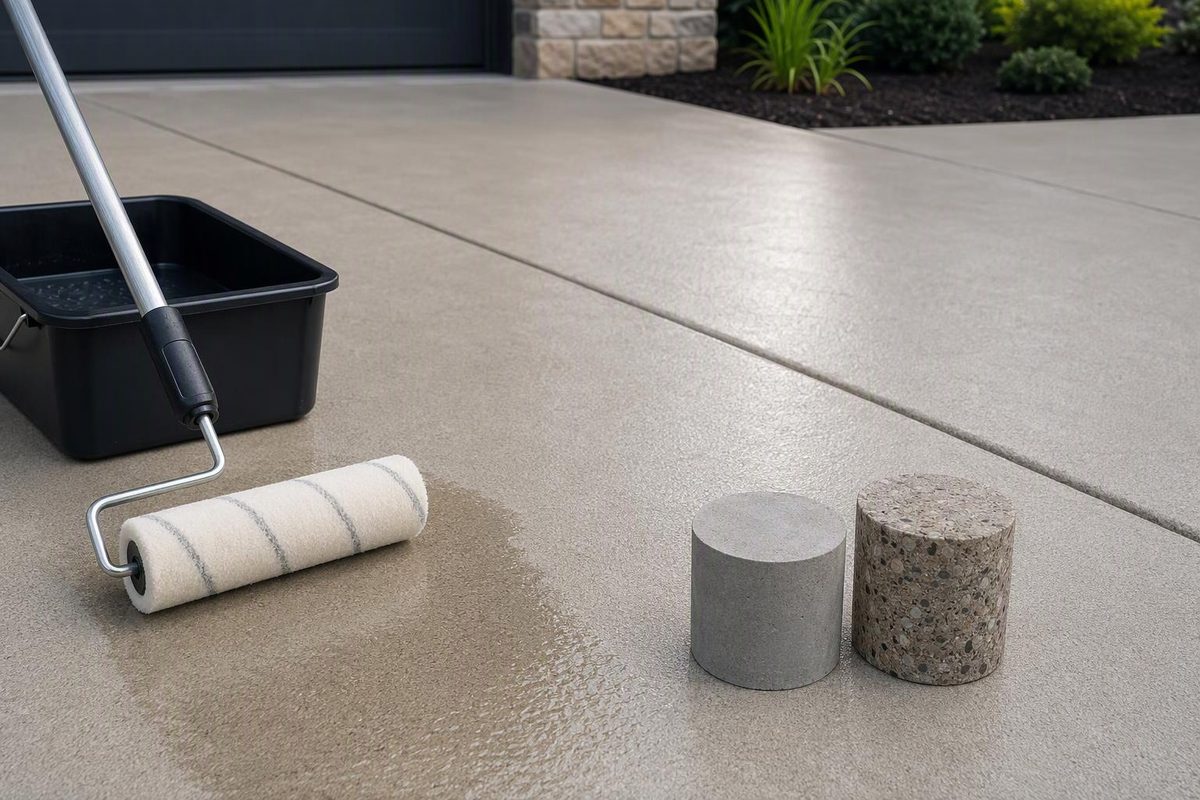
Concrete cure and seal can be a sensible one-product choice for a new driveway when you want membrane curing plus a clear film finish. Specify an exact product suitable for exterior, broom-finished concrete, verify its ASTM claims, and require application at the manufacturer’s stated rate.
It is not a substitute for the right concrete mix, slab support, drainage, joints or adequate driveway thickness. It may also be the wrong curing method if you plan to apply a penetrating sealer, coating or bonded overlay later.
What cure and seal does
Cement hardens through a reaction with water called hydration. Hydration continues during curing, and retaining suitable moisture helps concrete develop strength and durability. A membrane-forming curing compound limits evaporation from the fresh surface (American Cement Association).
A cure-and-seal membrane has two jobs:
- During early curing: Reduce water loss from the fresh slab.
- After curing: Leave a film that can add sheen and some resistance to dirt, abrasion and staining.
Two ASTM standards commonly appear on product data sheets:
- ASTM C309 covers liquid membrane-forming compounds intended to reduce water loss during early hardening (ASTM C309).
- ASTM C1315 covers membrane-forming liquids used both to cure fresh concrete and seal hardened concrete. It includes additional performance requirements and classifications for yellowing and resistance to ultraviolet degradation (ASTM C1315-25).
For a product sold as both a curing compound and a sealer, full C1315 compliance is more informative than a C309 claim alone. Neither standard, however, tells you the finished gloss, wet-weather traction, suitability for your driveway finish or compatibility with a later treatment. Check those points on the exact product’s current data sheet.
When a combined product makes sense
Cure and seal is a practical fit when:
- the driveway is newly placed;
- a clear or color-enhancing film is acceptable;
- the product is rated for exterior concrete and complies with local VOC rules;
- no incompatible coating, penetrating treatment or bonded overlay is planned; and
- the installer can apply a uniform coat at the specified coverage rate.
Consider a separate curing method when you want a natural, film-free appearance or expect to apply another treatment. Cure-and-seal membranes can obstruct adhesion or penetration. Euclid Chemical’s selection guidance advises against cure and seal where concrete will later receive a densifier, penetrating sealer, coating, flooring or topping unless compatibility has been established (Euclid Chemical). Removing an acrylic film later can require chemical stripping or mechanical preparation.
Water-based versus solvent-based acrylic
Both types can retain moisture and leave a protective film, but they differ in appearance and working conditions.
| Choice | Likely advantages | Points to check |
|---|---|---|
| Water-based acrylic | No strong solvent odor, nonflammable carrier and soap-and-water cleanup while wet | Cool, humid conditions can prevent proper film formation and leave a whitish appearance; commonly lower-gloss |
| Solvent-based acrylic | Commonly deepens color and produces a glossier or “wet” appearance | Strong odor, flammability, solvent cleanup and local VOC restrictions |
With solids content, application and concrete condition held equal, Euclid says water- and solvent-based films can have comparable toughness. Appearance and application conditions are usually the more useful distinctions (Euclid Chemical).
A lower-sheen water-based product may be less conspicuous on plain broom-finished concrete. A solvent-based product may give colored or stamped borders the desired color enhancement. Either can reveal finishing variations or look mottled, so ask for a test area when appearance matters.
Application timing depends on the product
The usual application point is after final finishing, once bleed water has disappeared and the surface is firm enough to walk on without damage. Applying a compound while bleeding continues can harm the surface. FHWA’s curing guidance says application should follow completion of finishing and disappearance of the water sheen (FHWA).
Do not convert that principle into a universal number of hours. Weather, concrete mixture and the selected product control the timing. For example:
- W. R. Meadows directs users to apply its water-based VOCOMP-20 on the day of placement after surface water has disappeared and workers can walk without marring the concrete (VOCOMP-20 data sheet).
- Sika’s solvent-based SikaCem-100 Clear Guard also requires no bleed water and a surface firm enough to walk on. Its data sheet calls for a second application at least two weeks later to obtain maximum sealing and dustproofing benefits (SikaCem-100 Clear Guard data sheet).
These are product examples, not interchangeable instructions. The contractor should follow the current data sheet for the material delivered to the job.
Check gallons as well as the product name
A quote that says only “cure and seal driveway” leaves out the application rate that determines whether the membrane can perform as intended.
For a 600-square-foot driveway, if the selected data sheet specifies 300 square feet per gallon per coat, the basic quantity is:
- 600 ÷ 300 = 2 gallons for one coat
- 4 gallons for two coats at that same rate, before allowing for texture, overspray or waste
Do not use 300 square feet per gallon as a default. One published water-based example specifies 200 square feet per gallon for curing fresh concrete and 300–400 for sealing existing concrete; it also recommends a second application on broom-finished concrete to meet its cited water-retention standards. Texture, porosity and weather can change actual consumption (W. R. Meadows).
Ask the bid to state:
- manufacturer and exact product;
- ASTM C309 and/or C1315 compliance;
- water- or solvent-based formulation;
- coverage rate for curing fresh, broom-finished concrete;
- number and timing of coats;
- total gallons allocated to the measured area;
- allowable air and slab temperatures;
- expected sheen and whether a mockup is included;
- pedestrian and vehicle reopening times; and
- compatibility with future joint sealants or surface treatments.
Keep the compound off surfaces that must later form a bond unless the relevant manufacturers approve the assembly. FHWA’s review of ACI curing guidance cautions that curing compounds can act as bond breakers. That is particularly relevant if you later seal driveway joints that carry water.
Prevent blotching, bubbles and poor traction
More material is not better. Heavy or uneven application can cause bubbles, whitening, peeling, roller marks and dark blotches. Hot concrete and direct sun can promote bubbling, while cool, damp conditions can disrupt a water-based film. Thin, even coverage without puddles is the consistent manufacturer direction.
Settle traction before the work begins, especially on a sloped driveway or adjoining walk. A manufacturer-approved traction additive can texture many water- and solvent-based film-forming sealers, but it does not make a surface universally “non-slip.” The additive’s own instructions call for a test application and warn that it may alter color or dull the finish (W. R. Meadows).
Finally, expect maintenance rather than permanence. Acrylic films wear under tires, turning traffic, sunlight and weather. Euclid gives a typical cure-and-seal life of roughly one to three years and advises against recoating until previous material has worn away or been removed (Euclid Chemical). Actual life depends on the product, film thickness, exposure and use.
A complete driveway quote should therefore identify the curing method, exact product, fresh-concrete coverage rate, appearance, traction plan and future maintenance—not merely promise “sealer.”