
Gravel Driveway Repair for Potholes, Ruts and Washouts
Diagnose potholes, ruts and washouts, restore proper drainage and crown, choose repair stone, calculate volume and recognize base failure.
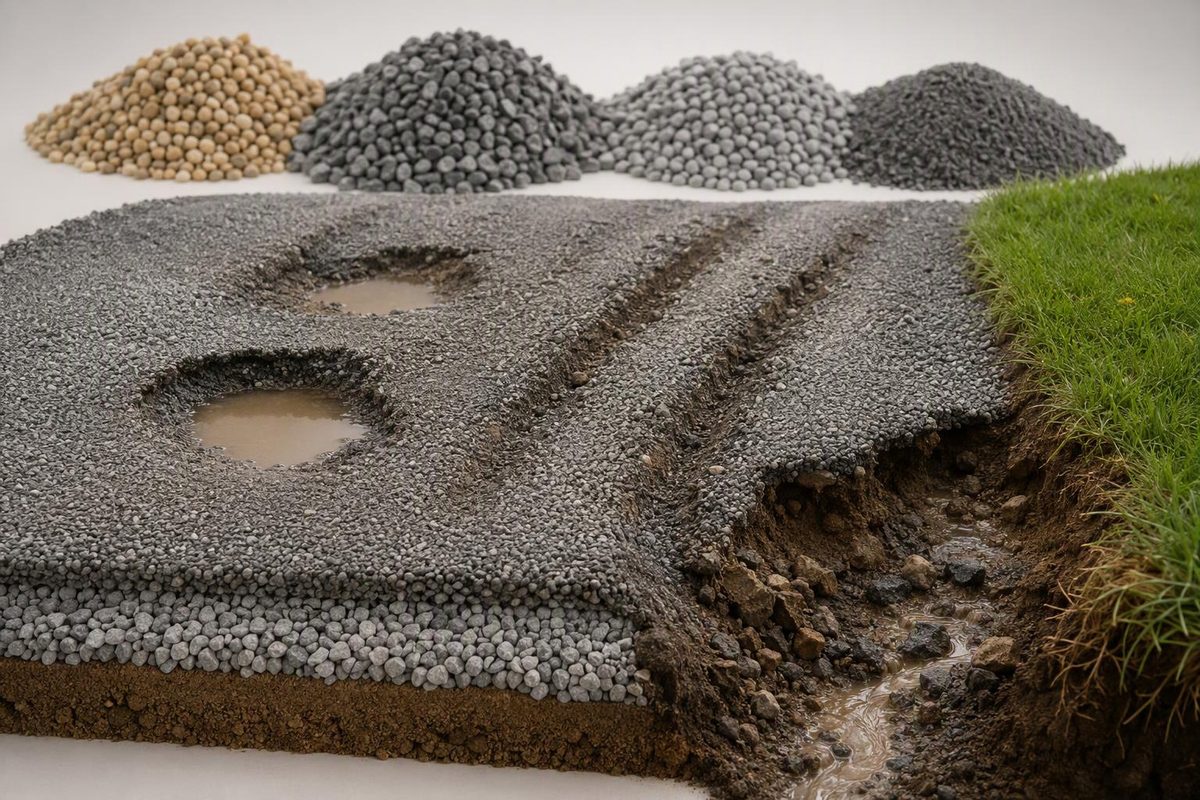
Repair drainage and restore the driveway’s shape before adding gravel; otherwise, a smooth-looking patch will usually be temporary. For a straight surface that drains to both sides, a practical field target is about a 4% crown—roughly a 1/2-inch rise per horizontal foot from either edge to the center—according to the Federal Highway Administration’s gravel-road guide.
Enter the repair area and compacted depth to estimate how much gravel it needs.
Gravel Quantity Calculator
The default example covers a 50-by-12-foot area with a 3-inch compacted layer.
Delivery Estimate Setting: 1.11 Example Multiplier
Change this only if the supplier gives you a different loose-volume factor. Leave it blank if the factor is unknown.
Estimated Quantity
5.56 compacted yd³
~6.2 delivered yd³
Using the example 1.11 loose-volume multiplier.
Cubic yards = length × width × compacted depth ÷ 324.
Source note: The volume formula uses the dimensions entered above. The 1.11 delivery multiplier comes from the Maine camp-road manual’s worked example and is not universal.
The appropriate repair depends on whether damage is confined to the wearing surface or extends into a wet, weak base. One isolated pothole may justify a compacted patch. Repeating potholes, deep wheel ruts and broad soft areas call for grading, drainage work or reconstruction.
Diagnose the Failure Before Ordering Gravel
Inspect the driveway during or immediately after rain. Water movement usually makes the cause clearer than the dry surface does.
| What You See | Likely Cause | Appropriate Repair |
|---|---|---|
| One or two shallow potholes without standing water | Localized loss of surface material | Loosen the failed area, add compatible dense-graded aggregate, reshape and compact |
| Potholes returning in the same place | Flat surface, blocked edge drainage or unsuitable aggregate | Correct the crown and drainage outlet before patching |
| Parallel wheel ruts | Wet or thin surface or base, weak subgrade or heavy loads | Drain, scarify and regrade; add suitable material and compact |
| Washboarding | Loose material with poor cohesion, often aggravated by speed, braking or acceleration | Scarify below the corrugations, remix, reshape while damp and compact |
| Gravel washed downhill or across the yard | Concentrated runoff moving along or across the driveway | Redirect the water, restore the surface and stabilize the outlet |
| A soft spot that pumps mud under tires | Saturated base or subgrade | Excavate and rebuild the section after correcting the water source |
Potholes are associated with excessive moisture, inadequate crown and poorly graded aggregate. Rutting can also indicate inadequate surface thickness, heavy loads or weak support—not merely missing top gravel—as the 2024 Vermont Better Roads Manual explains.
Patch an Isolated Pothole
Do not pour loose stone into a water-filled depression. Repair the full failed area instead.
- Work when the surface is damp but firm. Moist aggregate reshapes and compacts better than dusty material. Do not grade saturated ground or work immediately before forecast rain. Vermont recommends grading after rainfall and avoiding dry periods.
- Give water an exit. Remove leaves, sediment and edge berms that prevent runoff from leaving the driving surface. Confirm that any ditch, swale or culvert has an unobstructed, non-eroding outlet.
- Loosen the entire failed area. Scarify the pothole and its edges below the bottom of the depression. Filling the bowl without disturbing it leaves the existing low profile in place.
- Add compatible surface aggregate. Use crushed, well-graded material containing coarse particles, smaller particles and enough fines to bind. Clean, uniformly sized drainage stone will not knit into a dense driving surface.
- Blend and reshape the repair. Feather it into the surrounding driveway rather than leaving a steep-sided mound. Preserve the overall cross-slope so the patch does not become another low spot.
- Compact while moisture is present. Use a vibratory plate for a small patch or a roller for a larger area. Compact all disturbed material, not only the middle of the hole.
If potholes cover much of the driveway’s width, full-width grading is normally more effective because it restores one continuous profile.
Grade Ruts and Washboarding Instead of Covering Them
New gravel spread over ruts may hide them briefly, but traffic can press it into the same channels. Scarify below the deformation, remix the loosened material, restore the cross-slope and compact it. Vermont gives the same basic sequence for washboarding: scarify while damp, regrade, recrown and roll.
A box blade or landscape rake can handle light maintenance if the operator can control the slope. A motor grader is the better choice when the entire driveway has flattened, high shoulders trap water or substantial material must be recovered from the edges. A drag that only clips the peaks can improve the appearance while leaving the drainage defect intact.
Choose Repair Gravel by Specification, Not Its Local Name
“Road base,” “crusher run,” “¾-inch minus” and “driveway mix” can mean different materials at different quarries. Ask the supplier for a gradation or sieve analysis and explain whether the material is for a compacted surface or a free-draining base.
As one regional reference, the Maine camp-road manual specifies crushed surface material with a maximum particle size of 2 inches and 7%–12% fines, while its base specification allows no more than 7% fines. This is not a universal residential specification. It illustrates the distinction: a surface needs a well-graded blend that packs and sheds water, while the base needs strength without retaining too much water.
Angular crushed particles also interlock better than rounded bank-run gravel. For choices by site condition, see best gravel for driveways and the distinctions in crusher run gravel.
Restore the Crown and Open the Edges
A 4% crown is approximately a 1/2-inch rise per horizontal foot. On a 12-foot-wide surface draining from the center to both sides, each half is 6 feet wide, making the center about 3 inches higher than either edge. The calculation is 6 feet × 0.5 inch per foot = 3 inches.
This is a field target, not a universal design. Curves, hillside drives, garage aprons and surfaces intended to drain one way may need a continuous cross-slope instead. Too much crown can also make steering and winter travel less stable; FHWA advises against exceeding 6%.
The shoulders must continue sloping away from the travel surface. A ridge of displaced gravel, sod or plow debris can act like a curb and hold water against an otherwise well-crowned driveway.
If runoff must be collected rather than released as sheet flow, choose the outlet before excavating. A ditch or pipe without a stable discharge point merely relocates the erosion. The driveway drain guide compares channels, catch basins, French drains and culverts by the water problem they address.
Calculate Gravel After Correcting the Shape
For a uniform compacted layer, cubic yards equal length in feet × width in feet × compacted depth in inches ÷ 324.
A 50-by-12-foot section receiving 3 compacted inches needs 50 × 12 × 3 ÷ 324 = 5.56 cubic yards compacted.
The loose quantity delivered must be greater because the material becomes denser during placement. Maine’s worked example uses a 1.11 multiplier; applied here, that produces an order estimate of about 6.2 cubic yards. Treat 1.11 as an example, not a universal factor. Confirm the quarry’s density, expected compaction, truck capacity and whether it sells by volume or weight.
Do not spread a uniform layer until existing ruts, potholes and shape defects have been corrected. New gravel is not a substitute for scarification and grading.
Rebuild a Wet or Structurally Weak Base
Recurring ruts and mud pumping through the gravel indicate that a surface repair may not be enough. Bring in an experienced grading or excavation contractor when:
- ruts return soon after dry-weather grading;
- mud pumps through the gravel;
- the driveway sits below the surrounding ground;
- water crosses the driveway or runs along it during storms;
- a culvert is crushed, undersized or repeatedly blocked;
- the surface has lost shape across most of its width; or
- heavy vehicles have pushed material into the shoulders.
Severe soft spots may require excavation, drainage improvement, separation fabric and a rebuilt base. Vermont describes geotextile beneath at least 6 inches of crushed gravel as a possible treatment for severe ruts or soft spots, while Maine emphasizes matching the fabric and installation to the soil and application.
Fabric can separate weak soil from aggregate and help distribute loads, but it cannot replace a drainage outlet, adequate cover or competent base material.
For a quote, ask contractors to separate drainage work, scarification depth, imported material type and quantity, finished crown or cross-slope, compaction equipment and disposal. Those line items distinguish a structural repair from a load of gravel spread over the existing failure.