
Sand Filter Media: Pool Sand and Drainage Media Differ
Filter media must match the application. Compare a documented pool-filter sand specification with stormwater-filter requirements before ordering.
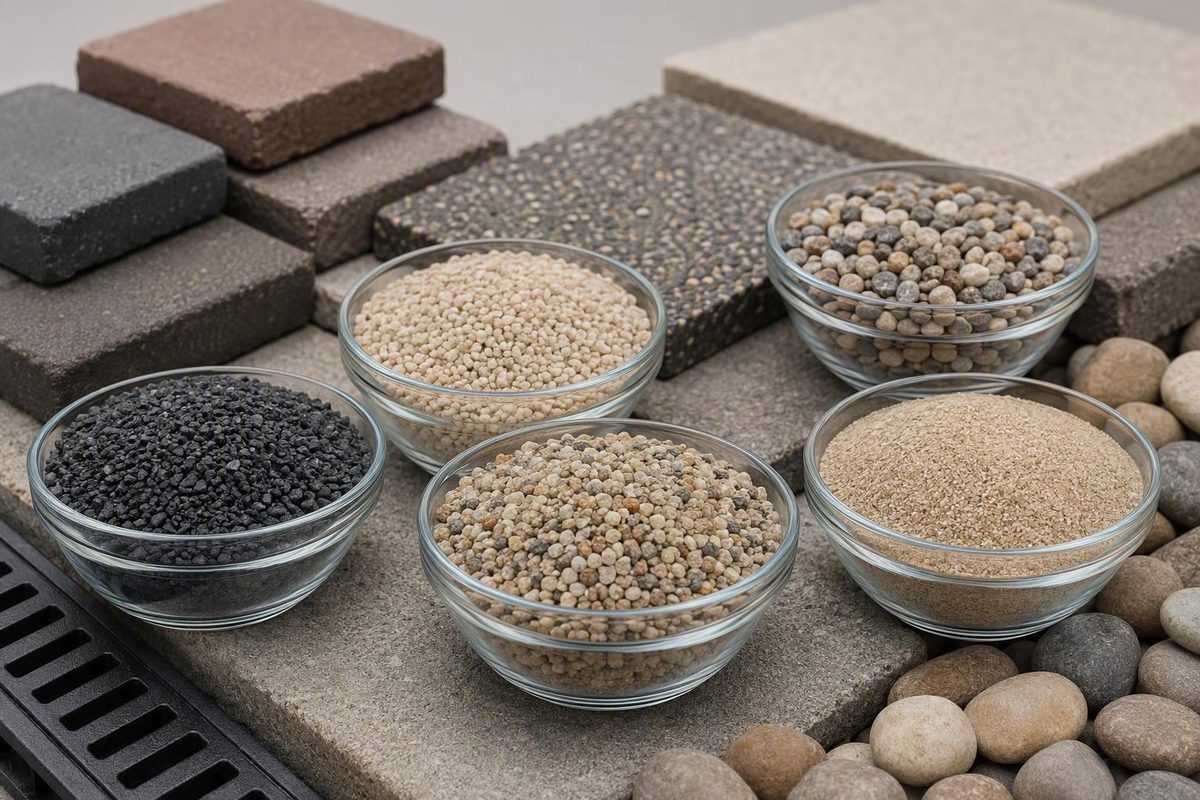
Sand filter media must match the filter’s job. Pool-filter sand, stormwater-filter sand, and septic-filter media are not interchangeable specifications. For driveway runoff, start with the drainage design. For a pool, start with the filter model and manual.
Two Real Specifications
| Application Example | Published Media Requirement | What It Does Not Establish |
|---|---|---|
| Pentair Sand Dollar / Cristal-Flo II pool filters covered by the cited guide | No. 20 silica sand, 0.45–0.55 mm particle size, maximum uniformity coefficient 1.75; quantity from the tank label | Suitability for a stormwater bed or a different pool model |
| Minnesota Stormwater Manual media-filter design | Clean, washed medium sand meeting ASTM C-33, with an 18-inch filter layer in the described design | A universal specification for every site or jurisdiction |
Sources: Pentair filter manual, Minnesota filtration design criteria.
The stormwater example is why “never use construction sand in any filter” is too broad: a design may explicitly require a concrete-sand grading. The bag’s everyday name is not enough. Match the actual grading and cleanliness requirements.
What a Driveway Runoff Filter Does
A stormwater sand filter captures runoff, passes it through a sand bed, and usually collects the treated water in an underdrain. Minnesota’s manual describes good removal of sediment and pollutants attached to it, but limited removal of dissolved pollutants without modifications. Filtration does not automatically reduce the volume of runoff. Minnesota sand-filter overview.
That matters for a driveway: a filter intended to improve water quality is not necessarily a solution to ponding, insufficient pipe capacity, or a missing outfall. The design must address where the water goes after filtration and where excess flows bypass the bed.
Minnesota’s design guidance also calls for pretreatment of runoff and provision for flows exceeding the design capacity. Sand placed loose in a drainage trench is not equivalent to that complete treatment system. Media-filter design criteria.
Ordering the Right Amount
Use the approved bed dimensions and specified media bulk density. For a simple rectangular bed:
Volume = length × width × media depth.
A hypothetical 10-foot-by-4-foot bed with 1.5 feet of sand requires 60 cubic feet, or 2.22 cubic yards, before a project-specific allowance. That is a geometry example, not a recommended filter size. Do not convert it to tons using an invented density; ask the supplier for the material’s quoted basis.
For a pool filter, use the manufacturer’s stated loading quantity instead of filling the tank to the top. Headspace and internal components are part of its design.
Check the Delivery Before Installation
Match the delivery ticket to the specified material, obtain the grading or sieve analysis when required, and keep support gravel separate from filter sand. Do not substitute play sand, mixed fill, recycled glass, or another media solely because it is cheaper or looks similar.
If the purpose is drinking water or wastewater treatment, use the applicable approved design and material requirements. This pool-versus-stormwater comparison does not establish that any listed sand makes water safe to drink.