
Driveway Drainage Solutions: Match the Fix to the Water
Compare grading, channel drains, French drains, swales, culverts and permeable paving—and learn what a driveway drainage quote should include.
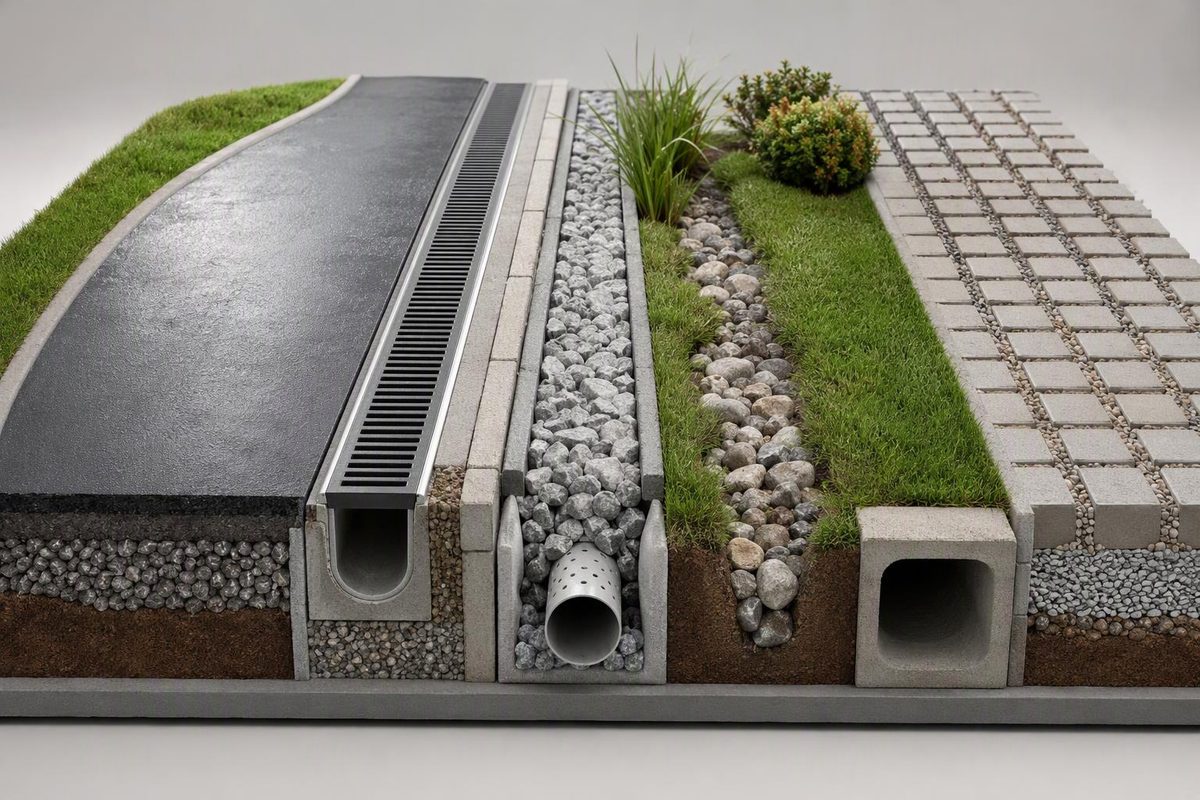
The right driveway drainage solution depends on where water comes from, how it crosses the driveway and where it can safely go. A channel drain can intercept runoff headed toward a garage; a French drain can collect subsurface seepage. Neither solves the problem if its outlet cannot drain.
Before buying a drain or accepting a paving quote, separate the water problem from the surface damage it leaves behind.
Trace the water before choosing the fix
During rain, observe from a safe location and photograph:
- The source: rain on the driveway, a roof downspout, an uphill yard or a roadside ditch.
- The route: water flowing across the pavement, along wheel ruts, beneath an edge or toward the garage.
- The restriction: a low spot, raised shoulder, blocked inlet or clogged culvert.
- The destination: an existing drainage system, a suitable downhill outlet or an area designed for infiltration.
Also note whether the area dries after rain or remains wet between storms. Persistent wetness warrants investigation rather than automatically adding a surface grate.
Start with the outlet. Northern Virginia’s soil and water conservation guidance warns that discharging to an unsuitable location simply moves the drainage problem downhill and can harm neighboring properties. Check local discharge and connection rules before redirecting flow. Runoff-control guidance
Match the drainage solution to the problem
| What you see | Solution to investigate first | Main trade-off or limitation |
|---|---|---|
| Water collects in driveway depressions or cannot escape over the edge | Regrading, restoring gravel crown or correcting pavement elevations | Surface work must create a continuous route to an outlet; it may require removal rather than an overlay. |
| A broad sheet of runoff heads toward a garage | Channel or trench drain across the flow path | Requires an outlet pipe, vehicle-rated components and proper structural support. |
| Surface runoff collects at one low point | Catch basin with an outlet pipe | Surrounding grades must direct water into the inlet. |
| An uphill strip beside the driveway stays wet or seeps into the base | French drain or designed edge underdrain | Depth and position must intercept the water; a buried pipe is not automatically a fast surface-water inlet. |
| Runoff travels beside a long or rural driveway | Vegetated or stone-lined swale; culvert where the route crosses beneath the drive | Needs space, erosion protection and access for maintenance. |
| There is no convenient gravity outlet | Tested and sized infiltration system, such as a dry well or rain garden | Poorly draining soil, high groundwater or shallow bedrock can make infiltration unsuitable. |
| You are replacing the driveway and want to manage runoff within its footprint | Engineered permeable pavement | Requires a water-storage base, suitable drainage and sediment-control maintenance—not just different surface units. |
These are starting points, not interchangeable products. The drainage functions of swales, French drains and catch basins are described in Northern Virginia’s runoff guide; channel drains intercept broad surface flow, according to manufacturer NDS.
Where driveway drainage projects go wrong
A drain is added without correcting the driveway shape
For gravel drives, check the crown, shoulders, ditches and culvert openings before ordering more stone. FHWA guidance for unpaved roads emphasizes both shaping the surface and opening drainage routes so water can leave during rain. Adding material without restoring that route leaves a key problem unresolved. FHWA road-preparation guidance
On asphalt or concrete, ask the contractor to show existing and proposed elevations. If settlement has created the low spot, the quote should explain whether the affected pavement and support need rebuilding—not merely specify a drain nearby. For recurring gravel ruts and washouts, see our gravel driveway repair guide.
The drain is not designed for traffic or the water source
A driveway channel drain needs more than a strong-looking grate. NDS advises selecting for both expected water volume and vehicle loading, with concrete support in traffic areas and installation according to the specific system’s instructions. Ask for the channel and grate models, load rating and installation detail. Do not treat one manufacturer’s concrete dimensions as a universal specification. NDS installation guidance
For a French drain, ask what water it will intercept and at what depth. The quote should identify the perforated collection section, aggregate, filter or separation materials, outlet route and maintenance access. An ordinary shallow landscape drain should not be assumed suitable beneath vehicle traffic; WSU Extension warns that heavy machinery can compact soil, crush pipe and damage these drains. WSU drainage guidance
Infiltration is assumed instead of tested
A dry well stores water temporarily; it does not make impermeable soil absorb water faster. Northern Virginia guidance recommends an infiltration test and identifies high groundwater and shallow bedrock as potential constraints. It also advises against locating these systems next to foundations. Use local setback requirements rather than a generic distance. Infiltration suitability guidance
Size storage for the whole contributing area, not only the driveway. As a volume illustration, one inch of rain over a 1,200-square-foot driveway equals 100 cubic feet, or about 750 gallons, before accounting for runoff losses. This is not a design storm or a recommended tank size. Roof or uphill runoff adds to that load. Ask where excess water goes when storage fills.
Sediment matters too. WSU Extension recommends dry wells for runoff with little sediment or pollution. For driveway runoff, ask how sediment will be intercepted and removed before it reaches the infiltration system. WSU dry-well guidance
Permeable paving needs the same whole-system thinking. EPA describes a permeable surface over aggregate storage layers, with underdrains or other design measures where soil or site conditions require them. Fine sediment can clog the surface; EPA recommends periodic sediment removal and avoiding sand for winter traction. Ordinary pavers with ordinary joints are not equivalent to a designed permeable system. EPA permeable pavement guidance
What the drainage quote should include
Compare complete scopes, not just a price per foot of drain. Request:
- Diagnosis and layout: contributing drainage area, proposed grades, inlet locations and outlet elevation.
- Excavation and restoration: pavement cutting, removal, disposal, trench backfill, compaction and replacement surface.
- Drainage components: channel or basin model, pipe type, diameter, length, slope, fittings and access points.
- Support and filtration: vehicle-load installation details, drainage aggregate and specified fabric where needed. Our driveway drainage rock guide explains the stone checks.
- Discharge and overflow: destination, erosion protection, connection approvals and the route water takes if the system is overwhelmed.
- Maintenance: how to remove leaves and sediment, inspect the outlet and access buried components.
For a culvert at a public-road entrance, contact the road authority before purchasing pipe. Requirements are local: in Camden County, Georgia, for example, Public Works inspects the site, determines culvert size and requires a final inspection for driveway work at county roads. That is not a nationwide sizing rule. Camden County driveway permit process
In the United States, contact 811 before excavation and allow the required time for utility marking; waiting periods vary by state. Confirm who will make the request before work begins. 811 before-you-dig guidance
Resolve the grades, outlet and any base repairs before finalizing the paving scope. The useful quote is the one that explains the complete water route—not merely the drain being installed.