
Best Gravel for Driveways by Slope, Soil and Traffic
About 3/4-inch angular stone over a suitable compactable foundation is a useful residential starting point, not a substitute for site-specific design.
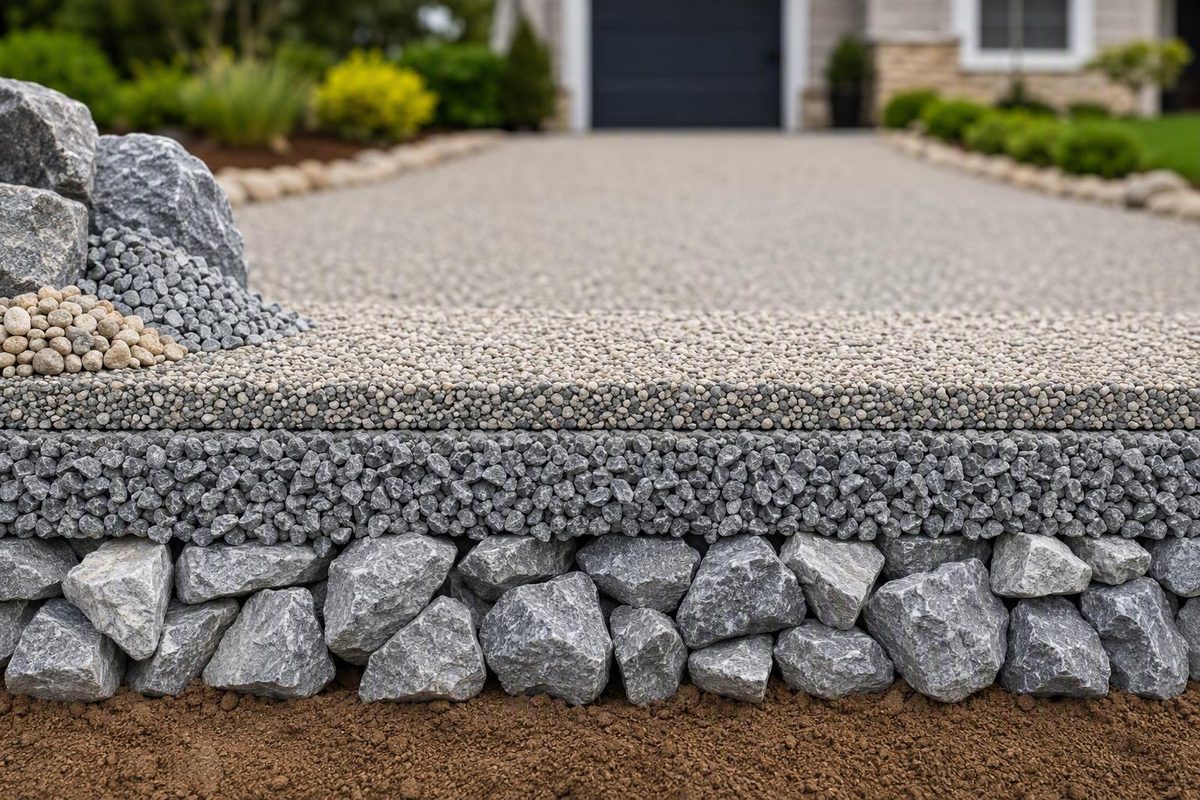
The short answer: the best driveway uses more than one aggregate
There is no single best gravel for every driveway. A dependable residential starting point is a layered assembly of angular crushed aggregate:
- A prepared, stable subgrade.
- A compactable crushed-aggregate foundation selected for the soil and expected loads.
- An optional intermediate course where larger base stone must transition to smaller surface stone or where internal drainage is needed.
- An approximately 3/4-inch angular wearing course, often sold locally as #57 stone. Commercial listings commonly describe #57 products as approximately 1/2 to 1 inch, but local availability and gradation vary (see representative #57 driveway aggregate listings).
Angular particles resist traffic-related movement better than rounded stone because their fractured edges interlock. The lower layers distribute vehicle loads, while the surface must provide traction and tolerate turning, braking, snow removal, and routine regrading.
Treat this as conditional industry guidance, not a universal specification. The available guidance comes predominantly from aggregate sellers, contractors, retailers, and equipment distributors rather than independent comparative testing. Soil strength, drainage, slope, rainfall, freeze-thaw exposure, snow removal, vehicle load, existing base condition, and the quarry’s actual gradation can all justify a different assembly.
| Site or priority | Conditional starting approach | Main risk to address |
|---|---|---|
| Typical residential use on firm soil | Compactable angular base with a medium-size angular surface | Rutting and surface migration |
| Steep grade | Dense-graded crusher run or road base at the surface, combined with controlled runoff | Gravel moving downhill and erosion |
| Weak, wet, or muddy soil | Correct drainage; consider separation fabric and a thicker coarse structural layer | Aggregate sinking or mixing with soil |
| Repeated RV, work-truck, or farm traffic | Thicker structural section with larger angular stone below | Base deformation and deep rutting |
| Drainage-first design | Clean angular stone where water must move through a layer, connected to a working outlet | Water becoming trapped below a permeable surface |
| Decorative finish | Thin, contained decorative veneer over a stable crushed-stone base | Spreading, rutting, and frequent replenishment |
Two surface strategies are defensible:
- Clean angular stone such as #57: suited to projects where a clean appearance, relatively low dust, and freer movement of water through the surface are priorities.
- Dense-graded crusher run or road base: suited to projects where a tight, compactable surface and resistance to migration matter more.
Neither strategy works without adequate support and drainage. A free-draining surface over saturated soil can still fail. A tightly compacted surface without a crown, cross-slope, ditch, or outlet can collect water in wheel paths and potholes.
Why shape, gradation and fines matter more than the product name
“Gravel” may refer to naturally rounded stone, mechanically crushed rock, or a graded mixture containing stone dust. Those products behave differently even when suppliers use similar size labels.
Angular crushed stone is rock mechanically fractured into pieces with irregular faces and edges. Under traffic and mechanical seating, the pieces wedge against one another. That interlock generally makes angular stone more resistant to lateral movement than rounded pea gravel or river rock.
Rounded stone has smoother contact points and rolls or slides more readily under tires. It can be used decoratively, but it usually needs firm edge containment, a stable base, a thin application, and acceptance of additional raking and replenishment. Pea gravel is commonly about 3/8 inch and rounded, while crushed stone is irregular and available across a much wider size range (compare the sizes, shapes, and uses of crushed stone and pea gravel).
Gradation—the distribution of particle sizes—is as important as shape:
- Clean stone contains relatively few fine particles. When its particles are reasonably uniform in size, interconnected voids remain between them.
- Dense-graded aggregate combines coarse stone, smaller particles, and fines. With suitable moisture and compaction, the smaller material fills spaces between larger pieces and forms a denser mass.
- Open-graded stone primarily seats and interlocks. It should not be described as reaching maximum density in the same way as crusher run because it lacks enough smaller material to fill most voids.
This creates the central driveway trade-off. Fines improve packing and surface firmness, but they reduce open void space and can produce dust when dry. Clean stone allows water to move more freely through the layer, but loose particles can remain more mobile under turning, braking, or plowing.
Surface infiltration is not a complete drainage system. Water that passes through clean stone still needs a stable lower structure and somewhere to go. If it reaches saturated soil, a low enclosed area, or a blocked outlet, it can weaken the driveway even though the top appears permeable.
| Material | Traffic stability | Drainage through material | Dust potential | Migration risk | Appearance | Typical role |
|---|---|---|---|---|---|---|
| Angular crushed stone | Good when supported and properly sized | Moderate to good, depending on fines | Low to moderate | Moderate | Functional, textured | Base, intermediate, or surface |
| Crusher run or road base | High after suitable compaction | Lower than clean stone | Moderate to high when dry | Relatively low | Tight, utilitarian | Base or wearing course |
| Clean #57 stone | Good interlock but does not densify like crusher run | High when connected to an outlet | Low | Moderate | Clean, consistent | Intermediate, drainage, or surface |
| Pea gravel | Low without containment or stabilization | High through the loose surface | Initially low | High | Smooth and decorative | Thin, contained veneer |
| River rock | Low for regular vehicle traffic | High between particles | Low | High | Natural and decorative | Landscaping or contained accent |
| Decorative angular chips | Varies with shape and size | Usually moderate to high | Usually low | Moderate | Color-focused finish | Thin wearing veneer |
Product names alone do not reveal these properties. “Three-quarter-inch” could mean washed clean stone, angular chips, or a minus blend containing everything from the nominal top size down to dust. The complete gradation and fines content determine how the aggregate will behave.
What belongs in the base, intermediate and surface layers
A gravel driveway should be treated as a small pavement structure, not as one load of stone spread over soil.
                 crown or cross-slope
/\
edge restraint ________/ \________ edge/shoulder
                wearing surface
             optional intermediate course
              structural aggregate base
           optional separation geotextile
        prepared and shaped native subgrade

ditch, swale, culvert, or other protected runoff outlet →
Each component has a distinct function:
- Prepared subgrade: supports the assembly and is shaped so it does not trap water.
- Optional geotextile: separates vulnerable soil from aggregate where conditions justify it.
- Structural aggregate: distributes loads and supplies depth over weak areas.
- Optional intermediate course: transitions between coarse and fine stone or provides an internally draining layer.
- Wearing surface: provides traction and resists traffic-induced movement.
- Crown or cross-slope: moves surface water out of wheel paths.
- Edges or shoulders: limit lateral spread.
- Outlet: receives and conveys runoff without allowing it to remain in the driveway section.
For weak or wet subgrade, one commercial industry guide suggests a 4- to 6-inch structural lift of larger angular material, including locally specified #3 or #5 stone. The same guide describes #57 as having about a 1-inch top size, #67 as having about a 3/4-inch top size, and typical residential aggregate sections as approximately 6 to 10 compacted inches, depending on soil and loading (review the source-specific layer and thickness guidance). These figures are conditional guidance, not a design standard. They may be excessive over a sound existing base and insufficient over saturated clay, deep fill, recurring springs, or severe loading.
Clean #57 or #67 stone can serve as an intermediate or drainage-oriented course. The numbering is not universal, so the local quarry’s gradation controls.
Dense-graded aggregate is the most confusing category because regional names include:
- Crusher run
- DGA or DGABC
- Road base
- Dense pack
- 21A
- Item 4
- 2A modified
- Modified gravel
- Quarry process
These are graded mixtures rather than single-size stones. Depending on local specifications and practice, a particular product may serve as a compactable base, a wearing course, or both.
For the surface, choose between competing priorities:
Clean angular surface: A medium-size angular stone such as local #57 is a common residential option where appearance, lower dust, and freer drainage through the wearing layer matter. It needs a stable foundation and containment at vulnerable edges.
Dense-graded surface: Crusher run or another road-base mixture can create a tighter driving surface and resist migration on slopes or under turning traffic. Its fines can become dusty in dry weather, and the material does not pass water as freely as clean stone.
Commercial sources disagree about which material belongs on top. Ottr Landscape Supply recommends dense pack below and a 2- to 3-inch layer of 3/4-inch crushed stone above, while other commercial guidance places clean stone in an intermediate layer and dense-graded aggregate at the surface (see Ottr’s proposed base-and-surface sequence). The disagreement reflects different priorities rather than one correct sequence for every property.
A sound existing base may require only resurfacing. Weak soil, severe frost, excavation through fill, or repeated heavy loads may require substantially more structural depth or local professional design.
Match the driveway assembly to slope, soil, climate and traffic
Begin with the failure most likely at the site. An attractive stone that cannot remain on a steep grade is a poor choice, as is a permeable surface placed over saturated soil without a working outlet.
| Site condition | Material and construction response | What not to assume |
|---|---|---|
| Firm, dry, well-drained soil | Prepare and shape the subgrade; use a compactable crushed base and angular surface | That soil strength is uniform along the entire drive |
| Weak or muddy soil | Correct water problems; consider undercutting, separation, and added coarse structural aggregate | That a new surface layer will stop sinking |
| Steep grade | Favor dense-graded, compactable material; strengthen edges and control runoff | That compaction alone prevents washouts |
| Heavy rainfall | Provide a crown or cross-slope, side drainage, protected outlets, and erosion-resistant transitions | That clean stone automatically drains the entire structure |
| Freeze-thaw exposure | Limit saturation and trapped water; maintain drainage before freezing conditions | That one rock type is universally frost-proof |
| Snowplowing | Use a stable angular surface and clearly defined edges; avoid an excessively loose decorative layer | That rounded stone will remain in place under a plow |
| Repeated RV or truck traffic | Increase structural depth and use larger angular aggregate in lower layers | That a light residential section can carry repeated heavy loading |
| Appearance-driven project | Use a thin, contained decorative veneer over a structural crushed-stone assembly | That decorative gravel can replace the base |
On steep grades, several commercial suppliers favor crusher run or another dense-graded mixture because its range of particle sizes can form a tighter, less mobile surface. One rural-driveway supplier, for example, recommends crushed road base over uniformly sized rounded gravel for sloped or heavily used drives (read the crushed-stone and rounded-gravel comparison). Even so, compactable aggregate cannot replace ditches, cross-drains, culverts, or a suitable discharge point. Concentrated runoff can erode a compacted surface.
On weak or wet ground, investigate the source of the water before changing the surface. Separation fabric can reduce mixing between soil and aggregate, but it does not lower a water table or create an outlet. Added structural stone may help distribute loads, yet persistent saturation can still produce deformation.
In freeze-thaw climates, focus on limiting saturation and trapped water rather than searching for “frost-proof” gravel. Keep drainage paths open and avoid enclosed pockets where infiltrated water can remain within the driveway.
Heavy vehicles require wheel loads to be distributed through the aggregate before they reach the soil. A thicker structural section and larger lower-layer aggregate are reasonable general responses. Frequent loaded trucks, farm machinery, buses, or commercial traffic warrant local engineering rather than an extrapolation from a passenger-car driveway.
For snow removal, favor stable angular material and clearly marked edges. Loose rounded finishes and thin decorative veneers are more vulnerable to displacement. Obtain operating guidance from the equipment provider or snow-removal contractor rather than relying on one universal blade setting.
Chronic springs, standing water, saturated clay, recurring washouts, unstable fill, severe frost movement, or frequent heavy trucks are warning signs. Those conditions may require assessment by a drainage contractor, geotechnical professional, or civil engineer.
Installation details that determine whether the gravel performs
Before construction, ask the relevant local authority and qualified contractors what approvals, utility-location procedures, drainage controls, and site-specific design are needed.
Material selection cannot compensate for poor preparation. A general installation sequence is:
- Inspect the route and subgrade. Identify soft areas, organic soil, buried debris, standing water, and places where runoff crosses the drive.
- Remove unsuitable material where necessary. Topsoil, mud, or unstable fill may need to be removed or treated according to site conditions.
- Establish drainage. Shape the subgrade, define the crown or cross-slope, prepare necessary drainage features, and identify where water will discharge.
- Install separation fabric where justified. Select and place it according to the project or manufacturer’s requirements.
- Place aggregate in manageable layers. Do not assume that rolling the top can correct loose or yielding material far below it.
- Compact or seat each layer appropriately. Dense-graded aggregate is mechanically compacted under suitable conditions. Open-graded stone is seated and interlocked rather than densified in the same manner.
- Finish the surface and edges. Preserve the drainage shape, support vulnerable shoulders, and protect transitions from erosion.
Geotextile can be useful over wet, silty, disturbed, fines-rich, or frost-prone soil because it separates native soil from aggregate.
Fabric is not automatically required over every firm, dry, gravelly subgrade. It also cannot correct standing water, replace insufficient aggregate depth, or create a missing drainage outlet. Selection should consider filtration as well as strength so that water can pass without excessive soil migration.
Traffic should not be placed directly on exposed geotextile unless the applicable product and project instructions allow it. One commercial guide recommends at least 6 inches of aggregate cover before traffic or compaction over the fabric; that is a source-specific recommendation rather than a universal rule. The same guide reports estimating ranges of 1.4–1.5 tons per cubic yard for dense-graded aggregate, 1.3–1.4 for #57 or #67, and 1.25–1.35 for #3 or #5, while warning that local materials vary (review the fabric and density guidance).
Ask the quarry or contractor how the selected dense-graded product should be placed. Open-graded stone requires a different approach because it lacks the fines needed to densify like crusher run.
Drainage features serve different purposes:
- A crown sends water toward both sides.
- A cross-slope sends it consistently toward one side.
- Ditches and swales carry water parallel to the drive.
- Cross-drains and culverts move water beneath it.
- Entrance protection manages flow near the public-road connection.
- Edge restraints or stabilized shoulders limit lateral aggregate spread.
- A protected outlet reduces erosion where water leaves the system.
Before delivery, use this project-planning checklist:
- Ask which utility-location procedure applies before excavation.
- Confirm that the supplier considers the route suitable for the proposed truck size, turning movement, unloading method, and overhead clearance.
- Identify where excavated material will go and ask whether local disposal requirements apply.
- Confirm that the drainage route and outlet are included in the design.
- Ask whether culverts, ditches, or entrance work require local approval.
- Define the fabric type and its purpose if fabric will be used.
- Specify every layer by compacted depth, not only loose delivery depth.
- Confirm that suitable placement and compaction equipment can reach the work.
- Include edges, gates, garage thresholds, shoulders, and road transitions in the scope.
- Order aggregate by actual gradation and intended use, not only by nickname.
How to order the right material from a local quarry
Do not ask only for “driveway gravel.” That phrase may mean clean #57 stone in one market, crusher run in another, and naturally rounded bank gravel somewhere else.
Regional labels such as #57, #67, DGA, DGABC, 21A, Item 4, 2A modified, dense pack, modified gravel, road base, and crusher run are useful only after the local product has been defined.
Verify:
- Nominal top size
- Full particle-size distribution
- Whether the material is washed, clean, open graded, or dense graded
- Approximate fines content
- Angularity
- Rock type or recycled content
- Intended local application
- Supplier density or compacted-yield information
- Any governing quarry, municipal, or state specification
Nominal #57 is commonly described as roughly 1/2 to 1 inch or as having an approximately 1-inch top size. That does not guarantee identical gradation between quarries. Crusher run is even less uniform as a category: it is a graded mixture extending from a stated top size through smaller particles and fines, not one stone size.
Use this call script:
“I’m building or resurfacing a residential driveway. I need aggregate for the [structural base/intermediate layer/wearing surface]. What product do you recommend for that use locally? Is it clean or dense graded? What are its top size, full gradation, angularity, and fines content? Can you send the gradation sheet or local specification? For a required compacted depth, what coverage or yield should I use, and how do you convert the design quantity to delivered tons? What is the delivered price, minimum load, and maximum truck size? Are spreading, split loads, or partial loads available, and what site-access restrictions apply?”
Crushed concrete can be a practical recycled alternative for a base and, in some markets, a wearing course. Check:
- Gradation and fines
- Cleanliness and unwanted debris
- Processing consistency
- Durability
- Appearance
- Local acceptance for the intended use
- Density or compacted yield compared with virgin aggregate
Supplier guidance describes crushed concrete as a potentially lower-cost material with a more rugged appearance, but suitability depends on processing quality and the local product (compare crushed concrete with dense pack and crushed stone).
Do not assume limestone, granite, trap rock, or recycled concrete is universally superior. A durable local aggregate with a suitable gradation may be a better choice than a fashionable stone hauled from far away. If durability is a concern, ask what local specification or quality requirements the product meets.
Calculate cubic yards, tons and delivered project cost
Calculate each layer separately. The basic compacted design-volume formula is:
Cubic yards =
(length in feet × width in feet × compacted depth in feet) ÷ 27
This formula converts cubic feet to cubic yards; commercial quantity guidance uses the same length-by-width-by-depth method (see the driveway-volume method).
Convert inches to feet first:
depth in feet = depth in inches ÷ 12
Do not multiply the entire driveway by one combined depth if different products will be used. Separate calculations tell the supplier how much structural, intermediate, and surface aggregate is required.
Hypothetical example—not a design recommendation
Assume a driveway is:
- 100 feet long
- 12 feet wide
- Planned with a hypothetical 6-inch compacted base
- Planned with a hypothetical 2-inch compacted surface
Base calculation
6 inches ÷ 12 = 0.5 feet

100 × 12 × 0.5 = 600 cubic feet

600 ÷ 27 = 22.22 cubic yards
The required compacted in-place base volume is approximately 22.2 cubic yards, before accounting for the relationship between delivered loose material and compacted yield.
Surface calculation
2 inches ÷ 12 = 0.1667 feet

100 × 12 × 0.1667 ≈ 200 cubic feet

200 ÷ 27 ≈ 7.41 cubic yards
The required compacted in-place surface volume is approximately 7.4 cubic yards on the same basis.
The combined mathematical volume is about 29.6 cubic yards, but the quantities must remain separate because they represent different products.
Do not automatically multiply compacted design volume by a loose delivered density. Loose volume and compacted in-place volume are not interchangeable. Ask the supplier for one of the following:
- A coverage factor for the required compacted depth
- A compacted unit weight appropriate to the product
- A supplier-recommended loose-to-compacted yield factor
- A delivered-tonnage recommendation based on the calculated compacted volume
If the supplier provides an appropriate tonnage factor that already accounts for the specified condition, use:
tons = applicable cubic-yard quantity × supplier factor in tons per cubic yard
For example, if the supplier confirms that 1.45 tons per cubic yard is appropriate for converting the hypothetical compacted base quantity—not merely the density of a loose stockpile—the calculation would be:
22.22 cubic yards × 1.45 = 32.22 tons
If the supplier confirms an appropriate factor of 1.35 tons per cubic yard for the hypothetical surface:
7.41 cubic yards × 1.35 ≈ 10.00 tons
These results are valid only under the supplier’s stated assumptions. Moisture, gradation, rock type, placement losses, subgrade irregularity, and the distinction between loose and compacted volume can change the delivered tonnage.
Commercial guides suggest allowances ranging from approximately 10% to 20% for factors such as compaction, settling, irregular subgrade, waste, or delivery tolerance. Do not add a fixed percentage automatically. Ask whether the supplier’s coverage factor or tonnage recommendation already includes compaction or yield.
The project cost includes more than aggregate:
- Base, intermediate, and surface materials
- Delivery charges and minimum loads
- Excavation and disposal
- Removal or treatment of unsuitable soil
- Drainage structures and outlet protection
- Geotextile
- Grading equipment and operator time
- Mechanical compaction
- Edge restraints or shoulder stabilization
- Culvert and entrance work
- Future regrading and replenishment
National price lists are poor substitutes for local bids. Material type, local geology, fuel, haul distance, minimum-load rules, access, drainage work, and excavation can produce substantial differences. Published cost comparisons are best used to identify expense categories, not to set a final budget (see the discussion of regional gravel-cost variation).
When comparing lifecycle cost, property owners who want a tighter upgraded surface may also wish to compare a recycled-asphalt driveway with gravel. The base condition, drainage work, local material supply, installation method, and future maintenance still need to be evaluated separately.
Prevent and diagnose mud, potholes, rutting and washouts
Repeatedly adding surface stone can hide a failure without correcting it. Diagnose the likely cause before ordering another load.
| Symptom | Likely causes | Bounded corrective response |
|---|---|---|
| Mud appearing through stone | Saturated subgrade, inadequate structural depth, soil-aggregate mixing, unresolved drainage | Investigate the water source and failed depth; obtain site-specific advice on drainage, separation, undercutting, or rebuilding |
| Stone sinking into soil | Weak subgrade, mixing, concentrated wheel loads | Assess softness and drainage; consider an appropriate structural layer and separation where justified |
| Recurring potholes | Trapped water, low spots, weak base pockets, inadequate compaction | Repair the full affected area, restore drainage geometry, and compact suitable material rather than filling only the depression |
| Rutting | Weak base, rounded surface stone, repeated heavy loads, turning traffic | Investigate structural support, surface selection, containment, and traffic loading |
| Edge spread | Weak shoulders, absent containment, traffic near unsupported edges | Rebuild or stabilize shoulders and keep the usable driving path away from unsupported edges |
| Washboarding | Loose surface, repeated traffic, ineffective regrading or compaction | Rework enough of the surface to remove the pattern rather than filling only the troughs |
| Washouts | Concentrated runoff, blocked drainage feature, failed outlet | Correct the water route and outlet before replacing lost aggregate |
| Excessive dust | Dense-graded surface with exposed dry fines | Ask the supplier or contractor about locally accepted management options and their effect on stability |
| Loose stone after plowing | Surface displacement, excessive loose material, rounded finish | Recover displaced stone where practical, regrade, and review future snow-removal methods |
The subgrade may be saturated, the structural section may be too thin, or native soil may be mixing with the aggregate.
Rounded stone, sharp turns, repeated heavy loads, and unsupported shoulders can all contribute.
For washouts, address the water route first. Inspect ditches, culverts, cross-drains, and outlets, and identify uncontrolled roof or hillside runoff. Replacing aggregate before correcting concentrated flow leaves the new material exposed to the same failure.
Dense-graded surfaces can become dusty because they contain fines. The appropriate trade-off depends on slope, traffic, traction, appearance, and maintenance priorities.
Inspect the driveway after heavy rain and freeze-thaw periods. Look for blocked drainage features, developing depressions, migrated surface stone, weak shoulders, and erosion near outlets. No gravel selection eliminates maintenance, and no fixed service life can be promised without knowing the site, traffic, climate, and construction quality.
Is #57 stone or crusher run better for a driveway?
Neither is universally better.
Choose clean angular #57 stone when a clean-looking, relatively low-dust surface with open voids is the priority. It needs a stable base and a drainage route for infiltrated water.
Choose crusher run when a tightly compacted, less mobile surface is more important, particularly on grades or under turning traffic. Its fines improve packing but can increase dust and reduce infiltration.
The materials can also be combined. The appropriate order depends on drainage, slope, local practice, and the actual gradations supplied.
Is pea gravel suitable for a driveway?
Pea gravel is generally a poor primary driving surface because its small, rounded particles move under tires and spread at uncontained edges. Landscaping guidance likewise favors angular crushed stone for vehicle areas and reserves rounded stone mainly for decorative applications (compare pea gravel, crushed stone, and river rock).
Pea gravel can be used as a thin, contained decorative veneer over a firm crushed-stone base on a flat, lightly used drive. Expect more migration, raking, and snow-removal difficulty than with an angular surface.
How deep should a residential gravel driveway be?
There is no universal depth. Commercial industry guidance commonly places residential aggregate sections in the general range of 6 to 10 compacted inches, but soil, existing base condition, drainage, frost exposure, excavation depth, and vehicle loading can move the design outside that range.
A resurfacing course over a sound established base may require only a few inches. A new driveway over weak soil may need undercutting, separation, a coarse structural layer, and considerably more total depth. Repeated heavy trucks or severe conditions should be evaluated locally rather than sized from a generic residential detail.
Do I need geotextile fabric under driveway gravel?
Not always. Fabric is most useful where it separates aggregate from wet, silty, disturbed, fines-rich, or frost-prone soil.
A firm, dry, gravelly subgrade may not require it. Fabric cannot drain standing water, replace missing structural depth, or compensate for an absent outlet. Select it according to the soil, filtration needs, loading, and the applicable manufacturer or project specification.
What gravel is best for a steep or wet driveway?
For a steep driveway, dense-graded crusher run or road base is often preferable to loose, clean, or rounded surface stone because it can form a tighter course. It still requires effective grading, side drainage, erosion-resistant edges, and an appropriate runoff outlet.
For a wet driveway, begin below the surface. Identify the water source, correct drainage, assess unsuitable material, and consider separation plus additional angular structural aggregate where conditions justify it. Clean stone can move water through a layer only when that water has somewhere to go.
Choose the driveway assembly in three steps
- Correct subgrade and water problems first.
- Choose angular aggregate according to the job each layer must perform.
- Verify the quarry’s actual gradation instead of relying on a product nickname.
Approximately 3/4-inch angular stone over a suitable compactable foundation remains a useful residential starting point—not a substitute for site-specific design.