
Can a Concrete Driveway Buckle in Extreme Heat?
Learn how clogged or missing joints let hot concrete lift, calculate slab expansion, and distinguish a heat heave from settlement or base failure.
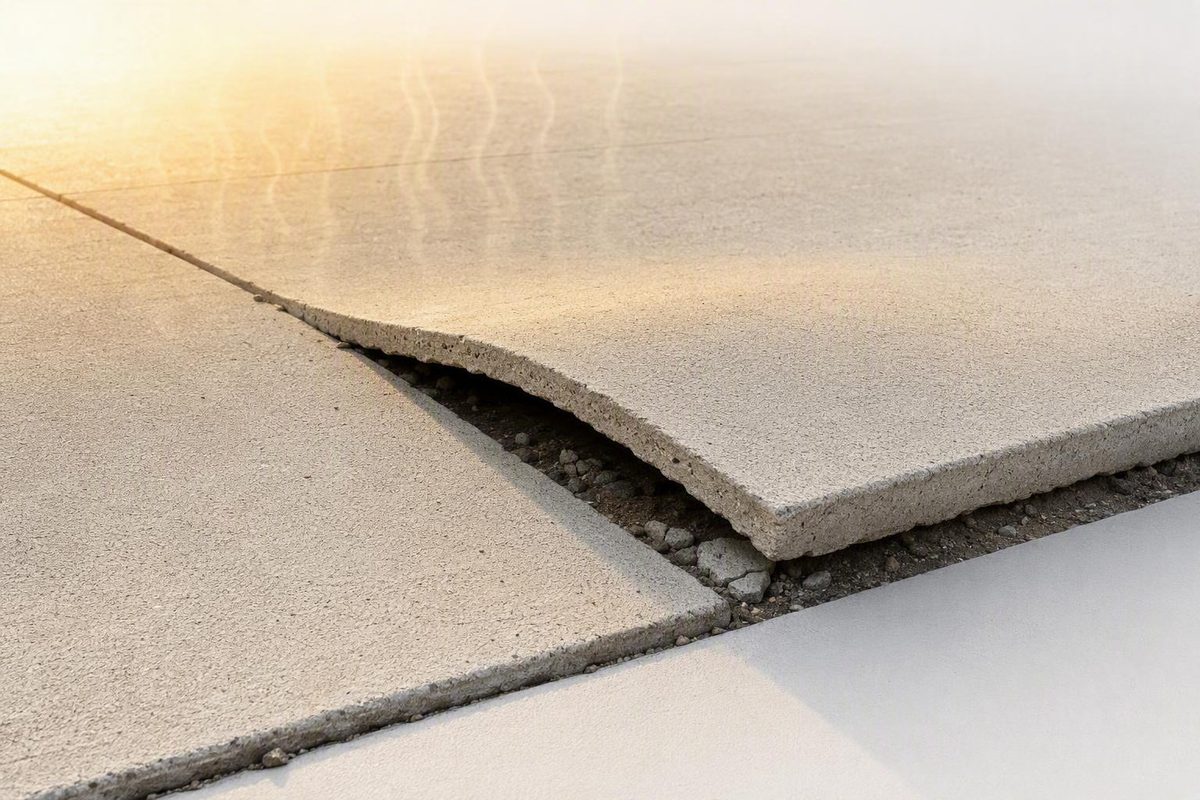
Yes—but a properly jointed concrete driveway does not buckle merely because the day is hot. A heat blowup requires thermal expansion plus restraint, usually because movement space is missing, tightly closed, or packed with incompressible debris. If debris is the problem and the slab remains sound, restoring the joint’s movement space may address the cause without replacing the driveway. A raised, fractured, or broadly tilted slab needs a cause-based assessment first.
Transportation agencies document this mechanism in concrete roads. The Minnesota Department of Transportation explains that warming pavement expands and can buckle or “blow up” when the spaces between sections cannot accommodate the movement, particularly in older or weaker pavement (MnDOT pavement-buckle guidance). The same material behavior applies to residential concrete, but published evidence does not establish how often residential driveways experience heat blowups.
Enter your driveway dimensions, temperatures, joint capacity, and expansion rate; the calculator shows whether the entered gaps can absorb the movement.
This estimates linear thermal growth and compares it with the total usable gap entered. Blank values remain unknown rather than using an invented residential default.
| Output | Value | What It Means |
|---|---|---|
| Temperature change | — | Peak slab temperature minus reference temperature |
| Calculated expansion | — | Simplified growth over the entered driveway length |
| Interior joints | — | Estimated from length and spacing |
| Total usable gap | — | Entered usable gap multiplied by interior joints |
| Unabsorbed movement | — | Expansion exceeding entered gap capacity |
| Slab thickness | — | Inspection context; not part of this linear formula |
Joint Spall
Fresh chips at tightly contacting edges are consistent with compression, but old deterioration can look similar.
Tented Slab
An abrupt ridge centered at a closed joint is the pattern most consistent with a heat blowup.
Corner Crack
A dropped, rocking, or broadly tilted corner points more strongly toward support or base movement.
Pattern note: select the closest visible symptom. Surface patterns organize an inspection but do not establish the cause.
Source: user-entered dimensions and project values; mechanism and symptom distinctions summarize the MnDOT and FHWA guidance cited in the article. No residential frequency, default expansion rate, or default joint-gap figure was available.
The calculator needs a project-specific thermal-expansion rate and usable joint-gap measurement because the available sources do not provide a residential default for either figure. Its result is a screening estimate, not a diagnosis. Slab thickness is recorded for the inspection summary but does not change the simplified linear-expansion calculation.
Buckling Requires Expansion Plus Restraint
Concrete remains hard while it expands. If neighboring sections can move into open, compressible joints, the change may produce no visible damage. If that movement is blocked, pressure concentrates where two sections meet or where the driveway contacts another restraint.
The sequence is straightforward:
- Sunlight raises the concrete’s surface temperature.
- Each section expands by a small amount along its length.
- Open joints absorb some of that movement.
- A missing, closed, or debris-filled joint runs out of usable space.
- Adjoining edges press together.
- The edges chip, fracture, or rise to relieve the pressure.
Engineering commentary reported by NPR describes concrete road panels expanding into one another after their joints can no longer accommodate movement. The panels may then break and deform (NPR’s explanation of heat-related road buckling).
The Federal Highway Administration also recognizes blowups as a concrete-pavement distress category. Its classification does not, however, prove the cause of an individual raised slab (FHWA Distress Identification Manual).
A driveway can contain several kinds of joints, repaired areas, variable slab dimensions, reinforcement, and transitions to a garage, sidewalk, curb, or apron. A visible line is not necessarily a movement joint. Its function must be identified before it is cut, widened, or cleaned aggressively.
A Heat Wave Does Not Create One Buckling Temperature
There is no universal air temperature at which a concrete driveway buckles. The result depends on the temperature change within the slab, its length, available movement space, joint condition, restraint, existing damage, sun exposure, and support beneath the concrete.
Air temperature is not slab temperature. A weather station also cannot reveal whether a driveway joint contains usable space or hard-packed sand and stones.
The summer 2026 highway events demonstrate the mechanism without establishing a residential threshold. Near-100°F weather accompanied a reported blowup on U.S. Highway 69 in Greenville, Texas. The pavement reportedly rose approximately two feet at a joint (report on the U.S. Highway 69 blowup). That event does not mean a driveway will fail at 100°F, nor that a residential buckle would reach a comparable height.
NOAA reports that the contiguous United States averaged 76.9°F in July 2026, making it the warmest month in the national record dating to 1895 (NOAA July 2026 climate assessment). Those national figures establish the unusual heat, not the cause of movement at a particular property.
The temperature change matters more than a single reported high. The simplified expansion relationship is expansion equals the material’s expansion rate multiplied by driveway length and temperature change. Even a calculated movement estimate cannot show how much pressure developed, whether an end could move freely, or whether the base had already shifted.
Joint Condition Determines Whether Expansion Becomes Damage
A visible gap is not necessarily usable movement space. Sand, stones, old patching material, or other relatively incompressible material can occupy the space needed when adjoining sections expand.
Debris is especially relevant when the rise is concentrated at a joint and the adjoining edges appear tightly pressed together. Fresh chips, crushed edges, or loose fragments strengthen the case for recent compression, though none proves heat was the sole cause.
Existing weakness also changes how pressure is released. Vulnerable areas can include:
- Chipped or spalled adjoining edges
- Separating patches or previous repairs
- A joint that appears tightly closed
- Old cracks that recently widened
- Sections that were already displaced
Older or weaker highway pavement is more susceptible to blowups according to transportation guidance. Age alone does not predict residential failure. An older driveway may have functional joints, while a newer slab can have restrained transitions or obstructed movement space.
Joint spacing and slab dimensions also affect how movement is distributed. The calculator estimates how many interior joints occur at the spacing entered, but it cannot identify the joint type or account for free movement at the driveway ends.
Crack Patterns Separate Heat Heave From Base Movement
A heat-related blowup usually presents as a localized, abrupt displacement at or near a joint. Soil or support problems more often affect the slope or elevation of a wider section. These are screening patterns rather than diagnostic rules.
| Pattern | More Consistent With | Context | Limitation |
|---|---|---|---|
| Tented ridge at a joint | Restrained expansion | Intense heating; closed joint | Hidden joint construction is unknown |
| Freshly crushed joint edges | Compression at adjoining slabs | New chips or fragments | Earlier damage can look similar |
| One depressed or tilted panel | Uneven support or settlement | Gradual, broad movement | Heat and settlement can coexist |
| Corner crack with rocking or drop | Support loss near a corner | Movement extends from the corner | Surface view cannot confirm the base |
| Recurring movement across panels | Soil moisture movement | Dry and wet cycles | Thermal cycling may contribute |
| Widespread spalling or patches | Existing deterioration | Damage predates the heat | Weakness may affect the final failure |
Drought-related soil shrinkage can let a slab settle or tilt. Alternating wet and dry conditions can move several sections and change cracks over time. Repeated temperature cycling can also enlarge existing cracks without producing a dramatic ridge.
The timing of discovery is therefore not enough. Damage noticed during a heat wave may have developed earlier or may reflect heat and base movement acting together.
A narrow ridge with newly crushed edges points more strongly toward restrained expansion than a panel that slopes gradually from one side to the other. A corner crack accompanied by a dropped or rocking corner points more strongly toward a support problem. A professional may still need to examine both the joints and the base.
Joint Cleaning Can Be the Fix When Debris Is the Restraint
A heat heave does not automatically require a new slab. If an inspection confirms that otherwise serviceable sections are pressing against debris-filled movement joints, removing the incompressible material and restoring the joint’s intended movement space addresses the restraint directly.
That is different from assuming every groove should be opened. A control joint, construction joint, crack, and movement joint do not perform the same function. Existing sealant may also conceal the material below it. The appropriate work depends on the joint type, edge condition, and original construction.
Joint cleaning alone is unlikely to be a complete repair when:
- A slab has already fractured or remains sharply tented
- Joint edges are extensively crushed or missing
- One or more sections have settled or lost support
- A patch or transition physically restrains the slab
- Movement is widespread, recurring, or unrelated to a narrow joint
- The driveway lacks the movement space its configuration requires
Cooling weather is not a repair. Some thermal movement may reverse as the slab cools, but fractures, chipped edges, altered alignment, and base problems can remain. The available evidence does not establish a predictable recovery pattern for raised residential slabs.
A Newly Raised Slab Should Be Isolated First
An abrupt ridge, broken edge, or loose section is a pedestrian and vehicle hazard. MnDOT advises motorists to avoid driving over road buckles where possible; no driveway-specific safe-height threshold is provided.
Keep vehicles, bicycles, mobility devices, and pedestrians away from a substantially raised or unstable area. Do not use a vehicle or body weight to test whether it will move. Make the obstruction visible in poor light.
Photograph the entire affected area from both approaches, then capture the joints, cracks, chips, and loose fragments from stable ground. If it can be done without stepping onto the damaged section, include a ruler or tape for scale.
Record when the change was first noticed and whether it appeared within hours, over several days, or gradually. Note recent intense sun, extreme heat, drought, heavy rain, alternating wet and dry conditions, impact, excavation, lifting, or patching. Also record whether the movement is near a garage, curb, sidewalk, apron, or earlier repair.
A concrete professional can inspect the joint, adjoining edges, transitions, slab alignment, and visible support conditions. Substantial, recurring, unexplained, or widespread movement may justify an engineer with expertise suited to the suspected problem.
The assessment should determine whether the displacement is centered at a joint, whether the line is actually a movement joint, whether edges were compressed, and whether multiple panels are tilted or depressed. Some answers will remain hidden without further investigation.
Repair the Movement Mechanism, Not Just the High Point
Grinding down a ridge may remove a trip point without restoring joint capacity. Lifting a settled panel will not resolve compression between slabs. Cutting or widening the wrong joint can damage concrete without addressing the source of movement.
The repair should follow the observed mechanism:
- Confirmed debris restraint calls for appropriate joint cleaning and restoration.
- Crushed or fractured edges may require concrete repair after movement space is restored.
- A missing or inadequate movement detail requires a design appropriate to the actual slab configuration.
- A tilted or depressed panel requires investigation of support and soil conditions.
- A failed patch or restrained transition requires correction of that local detail.
A jointed driveway heaves from heat only when its expansion is restrained. Where the restraint is removable debris, joint cleaning—not automatic slab replacement—is the direct response. Where the pattern shows settlement, support loss, extensive fracture, or missing movement provisions, cleaning alone will not solve the problem.