
Concrete Removal for Driveways: Cost, Disposal and Quote Checks
Compare driveway concrete removal costs, calculate debris volume, and check demolition, hauling, disposal, utility locating and base-work exclusions.
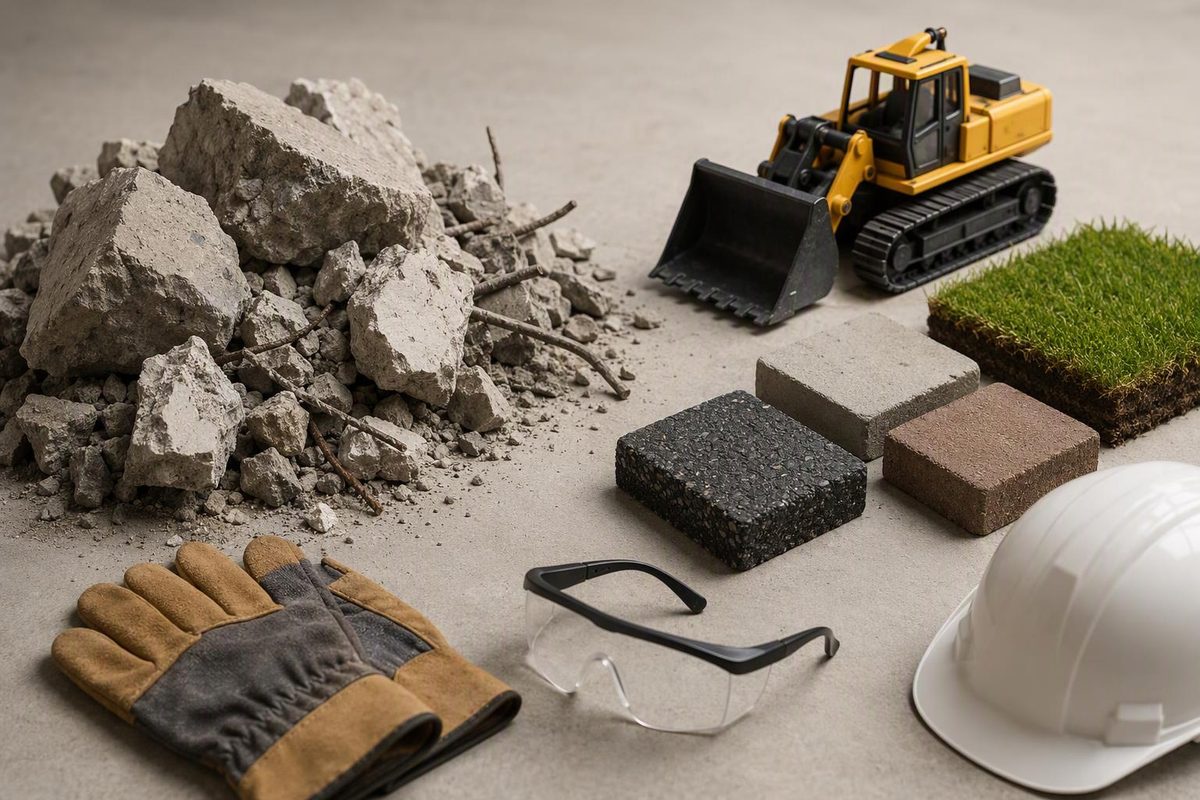
A concrete removal quote should cover more than breaking the slab. Before comparing prices, confirm the removal area, assumed thickness, reinforcement, haul-away, disposal and the condition in which the contractor will leave the driveway.
Removal-only is not a prepared base for new paving. If another contractor will install the replacement surface, agree on that handoff before demolition starts.
Define what the removal quote includes
Give each bidder the same dimensions and mark which sections stay. Ask for these items to be identified—even if the contractor offers one bundled price:
| Quote item | What to confirm |
|---|---|
| Removal limits | Measured square footage; whether the apron, sidewalk crossing and adjoining paths are included |
| Slab assumptions | Thickness, known reinforcement and treatment of unexpectedly thick sections |
| Saw cutting | Cut locations beside retained concrete, the garage and other structures |
| Breaking and loading | Equipment, access route and protection of retained surfaces and landscaping |
| Hauling and disposal | Included loads or tonnage, receiving facility and overage charges |
| Cleanup | Removal of fragments and exposed steel; collection of cutting slurry |
| Excavation and base work | Whether existing aggregate stays; whether soil removal, grading or compaction is included |
| Permits and locating | Who handles local approvals, the 811 request and any private-line locating |
A low demolition price can become an expensive job if trucking is extra or the paving crew later has to remove debris and correct grades. Conversely, don’t add separate hauling charges to a quote that already includes them.
Concrete removal cost: use benchmarks, not a promised rate
Two U.S. consumer cost guides publish different removal ranges. Both describe disposal as included in their headline square-foot rates, but their scopes and other figures vary. Treat them as starting points—not directly comparable local bids.
Cost ledger
| Source and date | Published removal benchmark | Basis and limits |
|---|---|---|
| Angi, updated September 16, 2026 | $2–$6 per sq. ft. | General U.S. concrete removal guidance; includes labor and dumping fees. Its area table covers slabs 3–6 inches thick. New concrete is excluded. The page also publishes higher regional rates. |
| HomeGuide, dated May 27, 2025 | $3–$8 per sq. ft. | General U.S. removal guidance; includes disposal. Its area table covers slabs 3–6 inches thick, from unreinforced to reinforced concrete. |
Benchmarks checked October 14, 2026. Neither is a dated, itemized quote for your driveway, and the two ranges should not be averaged into a supposedly more precise price.
For a 20-by-30-foot driveway, the area is 600 square feet:
- At Angi’s benchmark: 600 × $2–$6 = $1,200–$3,600.
- At HomeGuide’s benchmark: 600 × $3–$8 = $1,800–$4,800.
These calculations are for removal, not replacement. Thick sections, reinforcement, restricted access and longer disposal trips can increase the work required. HomeGuide also notes that small jobs tend to cost more per square foot. Ask bidders to explain those conditions rather than treating a published range as a ceiling. Source: HomeGuide
If you’re budgeting the complete project, use the separate guide to removing and replacing a concrete driveway.
Thickness changes the hauling calculation
Square footage alone doesn’t tell you how much concrete must leave the property. Calculate the slab’s solid volume:
Cubic yards = area in square feet × thickness in inches ÷ 324
For the same 600-square-foot driveway:
| Assumed thickness | Solid concrete volume |
|---|---|
| 4 inches | 7.4 cubic yards |
| 6 inches | 11.1 cubic yards |
The 6-inch slab contains 50% more concrete. This calculation excludes thickened edges and other deeper sections; broken rubble also occupies more space than the intact slab because of gaps between pieces.
For a dumpster, confirm both the included tonnage and the provider’s safe loading limit for concrete. Dense debris can reach a container’s weight limit before it is physically full, and excess tonnage can trigger overage fees. Don’t select a container solely by its advertised cubic-yard capacity. Source: Dumpsters.com
If using a trailer, confirm its payload limit as well. Ask what happens if the slab is thicker than quoted and require approval before extra charges accrue.
Arrange disposal before breaking anything
Concrete recycling may be an option, but “clean concrete” is a receiving-facility specification—not a universal promise of free disposal.
For example, Zero Waste Sonoma’s California recycling directory says some locations accept clean concrete at no cost. Its listings also show differing rules: some accept rebar or wire, while another specifies chunks three feet or smaller with no steel. Those are local examples, not national rates or acceptance standards.
Have the contractor confirm:
- Whether the facility accepts your concrete and reinforcement.
- Maximum chunk size and contamination restrictions.
- Whether soil, asphalt or other debris must be kept separate.
- Disposal charges, minimum fees and trucking costs.
Keeping materials separate may preserve a recycling option. A free drop-off still leaves breaking, loading and transportation to pay for.
DIY or hire a contractor?
DIY deserves consideration for a small, isolated section only when you have suitable equipment, safe access and a confirmed hauling plan. A full driveway, reinforced slab or work close to retained structures is a stronger case for professional removal.
Compare the complete DIY bill: breaker and saw rental, equipment delivery, dust-control equipment, protective gear, container or vehicle rental, disposal and your time. Renting only a jackhammer is not a complete removal budget.
Resolve utility locating before demolition starts. For any excavation, follow your state’s 811 notification and waiting requirements. The national 811 service advises contacting it before every dig and confirming with your contractor who will make the request. Source: 811
Also check privately owned lines. Illinois’ JULIE service explains that member utilities do not locate private installations such as sprinkler lines, septic systems and electrical lines beyond the meter; private locating may be needed. Confirm the limits of locating with your local service. Source: JULIE
Ask how the crew will control dust and collect slurry. OSHA’s construction silica standard specifies water-fed concrete-cutting saws and water delivery or qualifying dust collection for jackhammers under its Table 1 approach; respiratory protection depends on the task, setting and duration. These are employer requirements, not a complete DIY safety checklist. Source: OSHA
Keep cutting slurry out of storm drains. Portland’s municipal guidance explains that slurry can clog drains and harm aquatic life, and recommends containing and collecting it. Follow local disposal rules rather than washing residue toward the street. Source: Portland Environmental Services
Specify the handoff to the paving crew
Before removal, have the replacement installer identify the required excavation level and intended drainage grades. After the slab is lifted, arrange a review of the exposed base before covering it.
The contract should distinguish demolition complete from base ready for paving. Put any allowance for soft areas, extra excavation or replacement aggregate in writing, with a price basis and an approval step. Removing the old slab gives you access to the support beneath it; it doesn’t automatically correct that support or the driveway’s drainage.