
How Much Does Concrete Lifting Cost? Driveway Budget Guide
Budget driveway concrete lifting by method, repair area and settlement depth. Check minimum charges, extra-material fees and when replacement makes more sense.
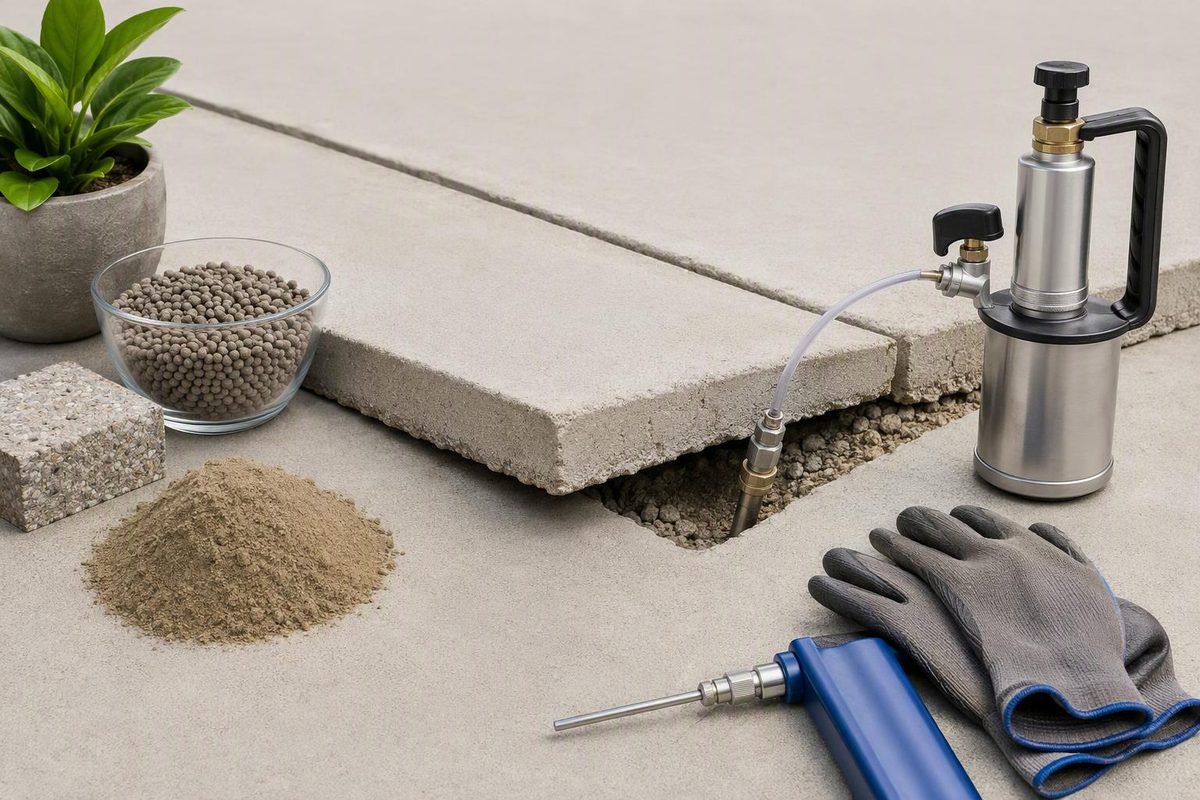
A concrete lifting quote should identify which driveway slabs will be raised, the intended finished height, and what happens if more fill is needed. It should not automatically price every square foot of your driveway.
For an initial U.S. driveway budget, A-1 Concrete Leveling publishes project ranges spanning roughly $800–$5,700, depending on method and scope. A small, straightforward repair may sit near the lower end; multiple slabs with deep voids can exceed these ranges. These are one contractor network’s planning figures, not a local bid or a price ceiling. A-1’s 2026 guide gives the driveway-specific ranges below.
Concrete lifting prices by method
Concrete lifting raises settled slabs by injecting material underneath through drilled holes. Mudjacking uses a pumped slurry; polyjacking uses expanding polyurethane foam. Some contractors offer stone slurry grout as a separate option. A-1 explains these methods.
| Method | Published driveway project range | Main purchasing consideration |
|---|---|---|
| Traditional mudjacking | $810–$3,780 | Generally the lowest upfront price |
| Stone slurry grout | $900–$4,200 | A separately marketed slurry option; ask for the actual material specification |
| Polyurethane foam lifting | $1,215–$5,670 | Generally higher material cost; smaller injection holes and quicker curing |
Cost ledger: These are A-1’s published driveway ranges in its U.S. contractor guide, checked October 26, 2026—not itemized local quotes. The table does not specify slab area, settlement depth or a consistent package of extras. Confirm whether joint sealing, drainage corrections and any saw cutting are included. Range and scope factors; foam and mudjacking feature comparison.
The table does not guarantee that a local foam bid will exceed a slurry bid. Compare the proposed lift, support beneath the slab, patched-hole appearance, warranty and permitted return-to-driving time. A faster-curing material is useful, but it does not remove the need to investigate unstable soil or water erosion.
Why square-foot estimates can disagree
HomeGuide publishes broad benchmarks of $4–$9 per square foot for mudjacking and $8–$25 for polyurethane lifting. Those figures can help screen a budget, but surface area alone does not measure the work underneath. Mudjacking benchmark; polyjacking benchmark.
For example, two affected 10-by-10-foot driveway panels total:
2 × 10 × 10 = 200 square feet
Applying those benchmarks gives:
- Mudjacking: 200 × $4–$9 = $800–$1,800.
- Foam lifting: 200 × $8–$25 = $1,600–$5,000.
But Chicago-area contractor Concrete Hero publishes an illustration of raising two 10-by-10-foot driveway sections that have settled 2 inches along the garage for $800–$1,200 using polyurethane. Its example is undated and is not a current quote. It illustrates the disagreement between published pricing guides—not a reason to expect that lower price today. Published driveway example; contractor service area.
A tilted panel may need one edge raised rather than its entire area lifted equally. Existing voids can also extend beyond the visible low spot. A-1 explains that contractors consider void depth and required lift, not just square footage. Pricing explanation.
What changes the final bill?
Minimum service charge. Travel, equipment setup and labor apply even to one slab. A-1 reports contractor minimums ranging from $300 to $2,000 depending on company and region. Ask for the minimum before calculating a tiny repair by square foot. If several areas genuinely need repair, ask whether completing them together reduces separate mobilization costs. Minimum-charge explanation.
Fill quantity and extra-material fees. Some foam contractors charge more when actual material use exceeds the estimate. Require the included allowance, additional unit price and approval procedure in writing. Concrete Hero warns that these overages can materially increase the original price. Overage-fee guidance.
Access, cutting and crack work. Restricted access and slabs requiring saw cuts or mechanical assistance increase labor. Joint and crack sealing may be separate from lifting; do not assume either is included. Contractor scope guidance.
Drainage and ground conditions. Raising the slab does not stop an overflowing gutter or downspout from washing out its support. Continuing soil movement and erosion can cause renewed settlement. Include the necessary water-management work in your repair budget, and ask how freeze-thaw movement affects the recommendation in a cold climate. Causes of repeat settlement; HomeGuide’s drainage guidance.
When lifting is worth pricing—and when to replace
Lifting is most promising when an otherwise serviceable slab has settled. It does not restore a worn surface or remove dips formed during the original pour. Crumbling or heavily broken-up slabs may not withstand lifting pressure and are better candidates for replacement. Concrete leveling limitations.
If the lifting bid is substantial, obtain a replacement price for the same affected panels, including demolition, disposal, base correction and drainage—not an unrelated whole-driveway price. Our remove-and-replace cost guide explains that scope. If settlement is not the main problem, compare the options in our concrete driveway repair cost guide.
Before accepting a lifting quote, get these points in writing:
- A slab sketch or marked photos, with target elevations and drainage direction.
- The injection material, included fill allowance and overage terms.
- Hole patching, saw cuts, crack sealing and joint sealing inclusions.
- Separate drainage or soil work, if needed.
- Return-to-driving instructions and warranty terms, including exclusions and any re-lifting charge.
The useful comparison is the complete repair cost for a defined result—not the lowest advertised price per square foot.