
Concrete Removal Cost: Driveway Math and Quote Checks
Estimate concrete driveway removal costs by area and thickness, then check hauling, disposal, saw cuts, access and quote exclusions.
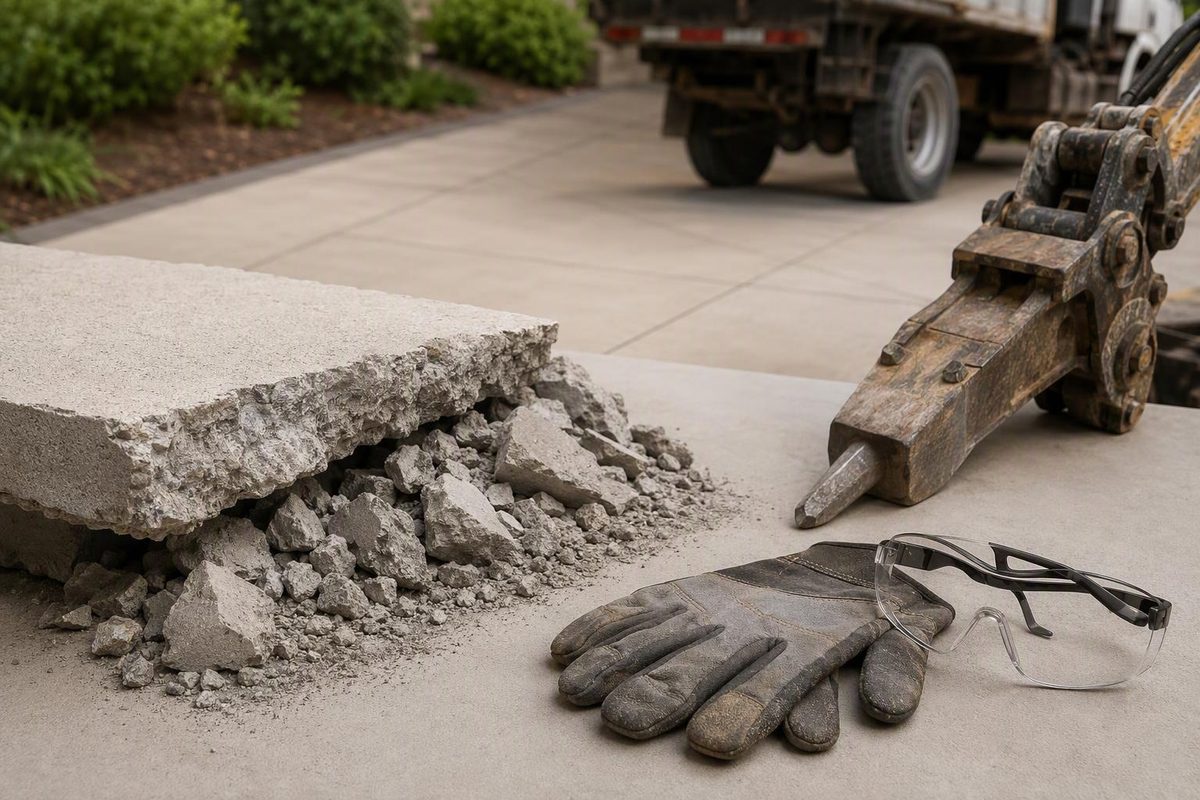
A concrete removal quote should cover breaking the slab, cutting any reinforcement, loading the rubble, hauling it away and disposing of it. Check those items before comparing square-foot prices. A demolition-only bid is not comparable to one that leaves the driveway cleared of debris.
For preliminary U.S. budgeting, $3–$8 per square foot including disposal is a useful published benchmark—not a local quote or a ceiling. HomeGuide lists that range; Angi publishes a lower $2–$6 per square foot baseline for labor and dumping. Neither includes a new driveway. Thickness, reinforcement and equipment access can push your job beyond the baseline. (HomeGuide, Angi)
Cost ledger: what the benchmarks cover
Prices checked October 14, 2026. Amounts are U.S. dollars.
| Source and publication date | Geographic basis | Published removal rate | Scope and limits |
|---|---|---|---|
| HomeGuide, May 27, 2025 | General U.S. cost guide; not a local bid | $3–$8/sq. ft. | Includes disposal; area table covers slabs 3–6 inches thick, from unreinforced to reinforced |
| Angi, September 16, 2026 | National guide; not a driveway-specific local bid | $2–$6/sq. ft. | Labor and dumping; area table covers slabs 3–6 inches thick; new concrete excluded |
These are separate planning ranges, not prices to average together. Angi also publishes regional figures spanning $6–$14 per square foot, without clearly reconciling them with its lower baseline. Its national rate should not be treated as a dependable local price. Have contractors price the actual slab.
Measure the driveway and show the math
For a rectangular driveway:
Area = length × width
Measure widened parking areas and turnarounds separately, then add them. Identify whether the removal includes the apron at the street, adjoining paths or only the private driveway.
For a 20 × 30-foot driveway, the area is 600 square feet:
- At HomeGuide’s $3–$8 benchmark: $1,800–$4,800.
- At Angi’s $2–$6 benchmark: $1,200–$3,600.
Those totals are arithmetic illustrations, not itemized contractor estimates. Do not add another disposal allowance if disposal is already included. Keep permits, base excavation, drainage changes, landscaping and replacement paving outside the removal subtotal unless the written bid expressly includes them.
For the full rebuild budget, use our separate guide to the cost to remove and replace a concrete driveway.
Thickness changes the hauling job
Square footage describes the surface, but thickness determines how much concrete must leave the property. Using the 150 pounds per cubic foot estimating density published by disposal operator Dumpsters.com:
Estimated U.S. short tons = area × (thickness in inches ÷ 12) × 150 ÷ 2,000
For the same 600-square-foot driveway:
| Slab thickness | Solid concrete volume | Estimated concrete weight |
|---|---|---|
| 4 inches | 7.4 cubic yards | 15 tons |
| 6 inches | 11.1 cubic yards | 22.5 tons |
These estimates assume uniform thickness and exclude reinforcing steel, underlying gravel and any additional concrete in thickened edges. Breaking concrete creates gaps between pieces, increasing its loose volume; it does not reduce the total weight of the slab. (Dumpsters.com)
A six-inch slab has 50% more concrete than a four-inch slab of equal area. That does not automatically mean a 50% higher demolition bill, but it changes loading and transport requirements. Ask the contractor to state the assumed thickness and the price adjustment if thicker sections are found.
What moves a quote up or down?
Rebar or wire mesh. Embedded steel adds cutting and handling. HomeGuide estimates reinforced removal at $1–$3 per square foot more than unreinforced work. Treat that as an explanation of the cost difference, not an automatic surcharge on a range that already includes reinforced slabs. (HomeGuide)
Machine access and haul distance. A crew able to load rubble beside the slab has a different job from one moving pieces through a narrow side yard. HomeGuide identifies small-job size, thickness and longer disposal travel as cost factors; Angi identifies steep or difficult access as another reason prices rise. (HomeGuide, Angi)
Selective removal. If you are retaining part of the driveway, ask for the saw-cut boundary and protection of adjacent concrete to be specified. HomeGuide lists concrete cutting separately at $5–$15 per linear foot for labor and equipment, excluding disposal, with minimum service fees commonly $125–$400. Confirm whether cutting is bundled before adding it to your budget. (HomeGuide)
The disposal destination. Clean concrete and mixed rubble may have very different gate fees. At Sacramento County’s Kiefer Landfill, rates effective January 1, 2026 list qualifying clean concrete without rebar, dirt or trash, in pieces no larger than 36 inches, at no fee. Mixed inerts meeting its acceptance rules cost $28.45 per ton; oversized pieces or concrete with excessive rebar can fall into the $144.90-per-ton bulky-material category. Those are one facility’s rules—not national rates—and free acceptance still leaves loading and transport costs. (Sacramento County)
Get comparable bids—and a usable cleared site
Ask each contractor to put these items in writing:
- Removal limits: measured area, assumed thickness, reinforcement and any apron or sidewalk work.
- Included work: equipment delivery, saw cutting, breaking, loading, hauling, disposal and cleanup.
- Extras: permit responsibility, private utility locating, excess thickness and unexpected buried material.
- Protection: garage threshold, retained slabs, landscaping and the equipment travel route.
- Dust control: the method for demolition and cutting, plus slurry cleanup.
- Handover condition: rubble-free site only, or excavation, grading and compaction ready for the next surface?
If excavation is involved, arrange utility locating before work and identify private lines separately. For example, Minnesota’s Gopher State One Call warns that private facilities such as outbuilding electrical lines and septic systems are not marked by public utility companies. Follow your own state’s process. (Gopher State One Call)
Is DIY removal worth pricing?
Price the whole job, not just a jackhammer rental: tools, loading equipment, delivery, hauling, disposal, protective equipment and your time. Confirm the container’s included tonnage and safe hauling limit; concrete can exceed a weight limit while a dumpster is only partly full. (Budget Dumpster)
Dust control is essential. OSHA identifies jackhammering concrete as a source of respirable crystalline silica and describes continuous water at the impact point or a suitable vacuum-shroud system as controls. Simply wetting the slab beforehand is insufficient. Its construction guidance also requires respiratory protection for this work indoors or in enclosed areas, and outdoors for more than four hours per shift—even with those controls. Water-based controls require electrical precautions, including GFCIs and watertight connectors for electric tools. (OSHA)
For a full driveway, compare an all-in professional bid against your complete DIY cost, with hauling capacity and dust-control arrangements settled before work starts.