
Concrete Driveway Resurfacing Cost: Budget and Quote Checks
Budget concrete driveway resurfacing by area, prep and finish. Compare basic overlays, decorative work and DIY materials—and know when replacement is better.
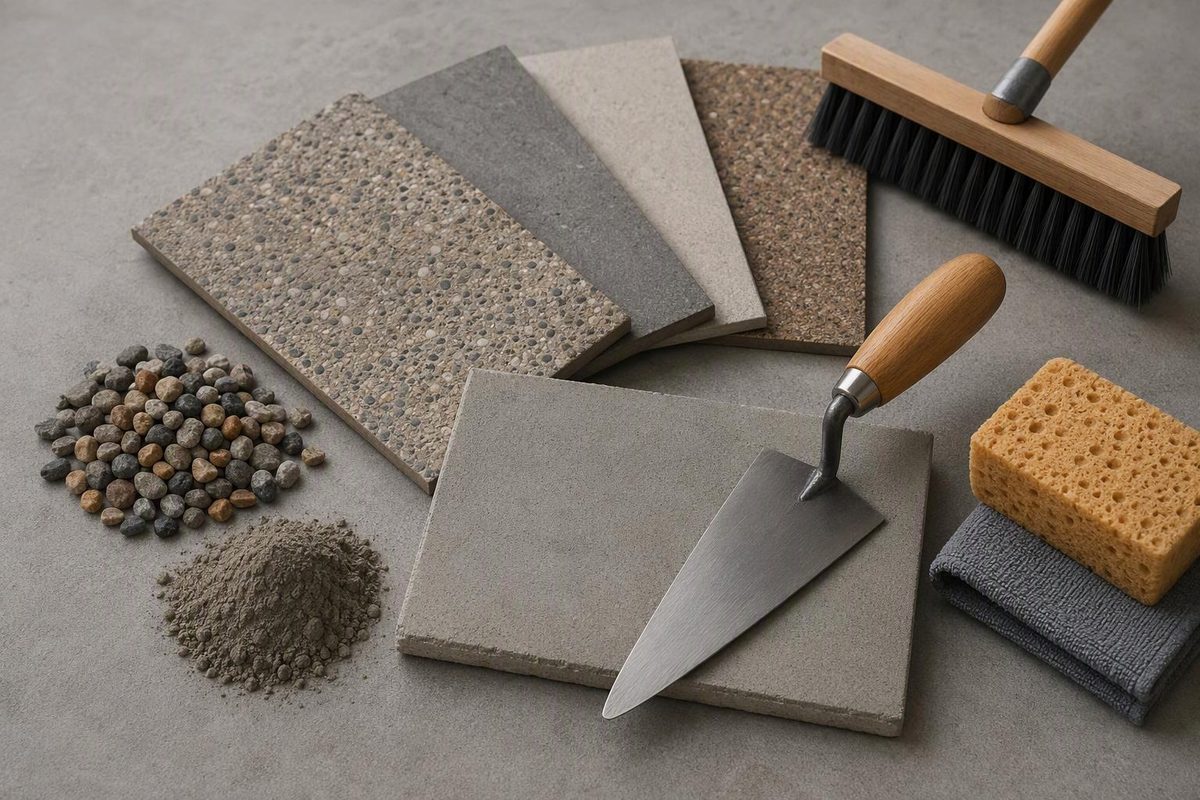
A concrete driveway resurfacing quote should cover more than spreading a new layer: it needs surface preparation, compatible repairs, a specified overlay thickness, finishing and curing. Establish that scope before comparing prices.
For a stable driveway needing modest surface renewal, $3–$5 per square foot is a reasonable U.S. planning benchmark for basic professional resurfacing. Published driveway estimates extend to $3–$9 per square foot, with more demanding preparation and repairs pushing costs upward. These are national guide ranges, not local bids: HomeGuide lists basic driveway resurfacing at $3–$5, while Angi’s July 9, 2026 guide lists driveway projects at $3–$9.
Resurfacing here means a thin bonded overlay on existing concrete—not sealer alone, a new full-depth slab or a repair to the soil underneath.
Break the quote into these parts
Ask each contractor to identify what is included in the square-foot rate and what is charged separately.
| Quote component | What to establish |
|---|---|
| Measured area | Driveway square footage, including any apron, widening or walkway |
| Surface preparation | Removal of loose concrete, oil, old sealer or paint; cleaning and the surface profile required by the overlay |
| Repairs | Which cracks and pits are included, repair quantities, and how deeper defects will be priced |
| Overlay | Product name, suitability for outdoor vehicle traffic, thickness and number of coats |
| Finish | Plain broom texture, color, stencil or stamped pattern; a sample for decorative work |
| Joints and edges | Preservation of existing joints and treatment at garage thresholds, drains and adjoining pavement |
| Curing and protection | Weather limits, rain protection, return-to-traffic instructions and any specified sealer |
| Other charges | Mobilization, disposal, taxes and exclusions for leveling, slab replacement or drainage work |
Preparation is not an optional upgrade. For example, Quikrete’s Re-Cap technical sheet requires rigorous cleaning, repairs before resurfacing and application to bare concrete—not painted or sealed surfaces. Existing control and expansion joints must remain functional. Other systems may require different preparation, so the contract should follow the named product rather than a generic “pressure wash and coat” description.
Cost by driveway size and finish
Measure each rectangular section as length × width, then add the sections together. A 20-by-30-foot driveway is 600 square feet.
| Driveway area | Basic resurfacing at $3–$5/sq. ft. | Wider planning range at $3–$9/sq. ft. | Stamped overlay at $7–$20/sq. ft. |
|---|---|---|---|
| 400 sq. ft. | $1,200–$2,000 | $1,200–$3,600 | $2,800–$8,000 |
| 600 sq. ft. | $1,800–$3,000 | $1,800–$5,400 | $4,200–$12,000 |
| 1,000 sq. ft. | $3,000–$5,000 | $3,000–$9,000 | $7,000–$20,000 |
These totals are area multiplied by the published rates, not independently observed project prices. The wider range overlaps the basic column; it is not an extra charge. For colored or lightly textured decorative overlays, HomeGuide publishes $6–$10 per square foot, compared with $7–$20 for stamped overlays. Those ranges overlap too: finish names alone do not determine the price.
Cost ledger
- Basis: U.S. national consumer cost guides from HomeGuide and Angi; checked October 1, 2026. Angi’s page is dated July 9, 2026.
- Use: Preliminary professional resurfacing budgets, separated by scope and finish—not a city-specific estimate.
- Scope limits: Published ranges do not establish identical inclusions. Confirm whether preparation, repairs, sealer, taxes and minimum service charges are included. Do not assume they cover structural correction, drainage changes or removal and replacement.
For example, a hypothetical 600-square-foot bid at $4 per square foot gives a $2,400 surface-work subtotal. That is only the project total if every required item is included. Add separately quoted work once; do not add cleaning or repairs again when they are already in the rate.
When resurfacing is worth pricing—and when it is not
A stable slab with shallow surface wear is the useful starting point. Resurfacing can renew appearance without removing the entire driveway, but a thin coating does not correct failed support or ongoing movement.
Brickform’s driveway guidance identifies structurally sound concrete as the overlay candidate and flags heaving, settlement, excessive moisture transmission and contamination that cannot be removed as reasons replacement may be warranted.
Before accepting an overlay bid, get the cause assessed if you see:
- Cracks with one side higher than the other.
- Panels that have sunk or heaved.
- Deep or widespread crumbling beneath the surface.
- Ponding associated with settlement or poor drainage.
- Cracks that keep reopening after repairs.
In freezing climates, investigate moisture and drainage rather than treating recurring surface damage as cosmetic. Brickform describes freeze–thaw deterioration and poor-drainage-related cracking and heaving. Our guides to scaling versus spalling and choosing a driveway drainage fix help separate those questions.
Do not buy a promise that resurfacing permanently hides every crack. Quikrete warns that reflective cracking cannot be completely prevented, particularly with settlement or inadequate control joints. Ask how existing cracks will be treated and what the warranty excludes.
If the slab needs structural correction—or a decorative overlay quote approaches replacement pricing—request a separate replacement bid. Include demolition, disposal, support repairs, drainage and a new slab specification so the comparison is fair.
DIY material cost: thickness changes the math
Bag coverage is not a fixed square-foot number. Quikrete specifies approximately 65 square feet per 40-pound Re-Cap bag at 1/16 inch, but only 16 square feet at 1/4 inch. Use the manufacturer’s thickness-based yield, not a retailer’s unqualified coverage figure.
For a 600-square-foot driveway, rounding up to whole bags:
| Nominal thickness | Bags before waste or patching | Resurfacer-only cost |
|---|---|---|
| 1/16 inch | 10 | $359.90 |
| 1/4 inch | 38 | $1,367.62 |
The price example uses Anderson Lumber’s listed $35.99 per 40-pound bag, checked October 1, 2026, for its Alcoa, Tennessee store. It excludes tax, waste, patch material, equipment, delivery and labor. Uneven surfaces consume more material, and a second coat changes the quantity.
Thickness also affects the application method. Quikrete’s instructions specify a nominal 1/16–1/8 inch for squeegee application and 1/16–1/4 inch for trowel application. Re-Cap has about 20 minutes of working time at 73°F at squeegee consistency; for trowel application, the manufacturer says to mix only what can be used in 10 minutes. It recommends work sections no larger than about 144 square feet, using existing joints as natural breaks. Follow the product’s placement instructions, including its weather and curing requirements.
A cheap bag price does not make a whole driveway an easy solo project. Before buying, settle the slab’s condition, preparation method, thickness and weather window—the same items that make a contractor’s quote worth comparing.