
How Long Does Asphalt Take to Dry?
Compare wait times for new hot-mix asphalt, sealcoat and cold patch, then adjust for heat, humidity, heavy vehicles and contractor directions.
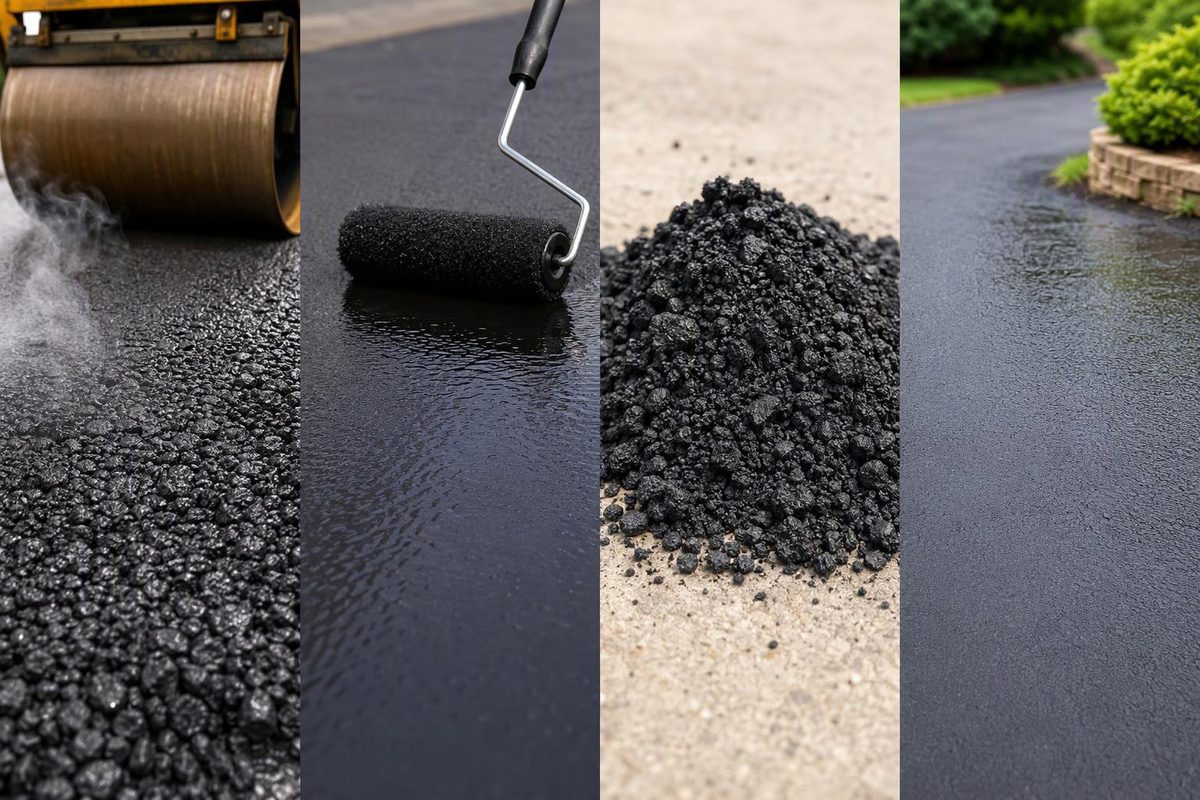
For a newly paved residential asphalt driveway, wait at least 48–72 hours before driving on it unless the paving contractor specifies a longer closure. Hot-mix asphalt hardens as it cools rather than “drying,” but the extra waiting time helps protect fresh pavement from tire scuffs, tight turns and concentrated loads.
The answer changes if the work was sealcoating or a cold-patch repair:
| Work Completed | Practical Wait Before Use |
|---|---|
| New hot-mix asphalt driveway | 2–3 days before vehicle traffic |
| Asphalt sealcoat | Often 24–48 hours after the final coat; check the product |
| Cold-patch repair | Follow the product label |
These materials harden through different processes. A waiting period intended for one should not automatically be applied to another.
Choose the work completed and any caution conditions to see the applicable waiting rule.
Asphalt Use-Time Guide
Practical waiting time
48–72 hours
Keep ordinary vehicle traffic off for 2–3 days. Follow any longer closure specified by the paving contractor.
Sources: Maine Asphalt Pavement Association for new-driveway care; Gardner and Latex·ite for cited sealcoat examples; Asphalt Institute for hot- and cold-mix distinctions.
Hot-Mix Asphalt Cools Rather Than Dries
A conventional asphalt driveway consists of aggregate bound by asphalt cement. Unlike a water-based surface coating, the pavement does not become usable because water evaporates from it. The asphalt mixture hardens as its temperature falls.
An Asphalt Institute engineer explains that hot-mix asphalt rapidly hardens as it loses heat and reaches full strength upon cooling to ambient temperature. It can support traffic within minutes in typical road applications, although thick lifts and unusual conditions can extend cooling to hours. The interior of a lift thicker than 2 inches can remain hotter than its surface, so touching a cool surface does not prove the entire layer has cooled (Asphalt magazine).
Federal Highway Administration guidance similarly says a compacted hot-mix patch can open to traffic after the mat has cooled to 140°F or the agency’s required temperature (Federal Highway Administration). That guidance concerns road patches, not every residential driveway. It explains why a roadway may reopen soon after paving without establishing the correct homeowner waiting period.
The distinction matters because “cool enough to carry traffic” is not the same as “protected against every mark a homeowner wants to avoid.” A road agency may accept traffic once a specified mat temperature has been reached. A residential owner is usually trying to preserve an even surface and clean appearance while the pavement is most susceptible to scuffing or localized deformation.
For that reason, the practical residential recommendation is more conservative than the minimum cooling interval suggested by some road operations.
A New Driveway Should Remain Closed for 48–72 Hours
The Maine Asphalt Pavement Association advises keeping traffic off a new driveway for at least two or three days. It also notes that new asphalt is especially vulnerable to marking during warm, sunny weather (MAPA).
That makes 48–72 hours the appropriate default for ordinary vehicle traffic on a newly paved residential driveway. Use the later end of the range when conditions are unfavorable, and follow the installer if the required closure is longer.
This waiting period should not be interpreted as a precise moment when asphalt suddenly changes from wet to dry. Cooling is continuous, and conditions vary across a driveway. The surface exposed to air may cool before material lower in the pavement. Areas in direct sun may also respond differently from shaded areas.
Nor does the recommendation override job-specific instructions. The installer knows the asphalt mixture, pavement thickness, weather during placement and compaction achieved. Those details are not visible to a homeowner checking only the surface.
If a contractor placed a barrier or gave a written reopening time, leave the driveway closed until that time even when 48 hours have already passed. The 48–72-hour range is a general residential-care default, not permission to shorten a contractor’s restriction.
Heat, Heavy Vehicles and Unsupported Edges Require More Caution
Warm, sunny weather can make fresh asphalt more vulnerable to impressions and tire marks. A driveway that has passed the basic waiting period may still need careful use when its surface is hot. The issue is not that the pavement has returned to its original paving temperature; it is that heat can make the asphalt more susceptible to marking.
Temperature also affects paving and compaction before the waiting period begins. Those job conditions are covered in Is It Too Hot to Pave a Driveway?.
Vehicle weight changes the risk as well. A dumpster truck, moving van, RV or heating-oil truck places a greater load on the driveway than an ordinary passenger car. The general 48–72-hour recommendation should not be treated as automatic approval for a heavy vehicle. Ask the paving contractor before arranging that access.
Concentrated loads deserve similar care. Kickstands, jacks, ladder feet and other narrow supports place weight on a small area and can leave impressions. A board beneath a concentrated load spreads that weight over a larger area. This precaution is particularly relevant while the pavement is fresh or hot.
Driveway edges are another vulnerable area. The center of the pavement is surrounded by more supporting material, while an unbacked edge can deform or crack if a tire runs along it. Ask the contractor when the shoulders should be backed up and avoid driving close to an unsupported edge in the meantime.
These conditions do not produce a reliable universal number of additional hours. The source material supports a two- to three-day residential closure and greater caution in warm weather, but it does not establish one extension that applies to every mix, pavement thickness, vehicle and climate. When any of these factors are present, the installer’s direction is the useful deciding rule.
The First Drive Should Avoid Scuffing the Surface
Once the approved closure has ended, drive slowly and keep the wheels moving while steering. Avoid spinning the tires, making sharp turns or turning the steering wheel while the vehicle is stationary.
A stationary tire twists against one small part of the surface when the steering wheel is turned. Allowing the car to roll while steering distributes that movement instead. This is most relevant on warm pavement and during the early period after installation.
Park normally rather than repeatedly adjusting the wheels in place. If a vehicle must remain parked during hot weather, look for impressions or displaced material after it moves. Visible marking is a reason to stop placing similar loads there and contact the installer rather than assuming more elapsed time will correct the cause.
The same caution applies after the driveway first reopens: expiration of the closure period permits normal use, but it does not make sharp tire action, heavy trucks or narrow supports harmless under every condition.
Sealcoat Often Needs 24–48 Hours After the Final Coat
Sealcoat is a liquid surface treatment, not the structural asphalt layer beneath it. Water-based asphalt-emulsion sealers dry as water leaves the coating. Humidity, shade, temperature and coat thickness can therefore change the time required before vehicles return.
Gardner says vehicles can generally return 24–48 hours after the last coat. Its guidance also warns that shade, cooler conditions, high humidity, deep cracks and thick coats can extend the time (Gardner).
A Latex·ite sand-mix sealer data sheet specifies a 24–48-hour cure at 70°F and 50% relative humidity. It warns that thick coats can cause tracking and curing problems (Latex·ite). Those temperature and humidity figures apply to that product’s stated conditions; they are not a universal promise for every sealer.
Count the sealcoat waiting period from the final coat, not from the beginning of the job. If the label or sealing contractor requires a longer interval, use that instruction. Cool, damp, cloudy or shaded conditions are reasons not to assume the shortest published time will be sufficient.
Before allowing vehicles back, look for material that remains soft or tacky and areas that could track onto tires. Elapsed time alone is less informative when drying conditions have been poor.
If rain arrived after sealing, the number of hours since application does not by itself show whether the coating survived. Let the surface dry and inspect for runoff, streaks, bare areas and pooled material using the checks in Rain 12 Hours After Sealing: Is It Ruined?.
Cold Patch Uses the Manufacturer’s Opening Time
Bagged cold-mix patch does not follow the same hardening process as newly placed hot mix. Depending on the formulation, water or solvent may need to evaporate, and traffic may help compact some products. The Asphalt Institute therefore distinguishes cold-mix curing from the cooling of hot-mix pavement (Asphalt magazine).
Do not automatically keep a cold-patch repair closed for 48–72 hours merely because that is the recommendation for a newly paved driveway. Some formulations and installation methods differ, and the draft evidence does not provide one opening time that covers every cold-patch product.
Check the bag or technical data sheet for the permitted lift depth, required compaction, temperature limits and opening time. Follow those directions together rather than taking the opening time out of context. A patch placed too deeply or without the required compaction has not necessarily been installed correctly just because the stated waiting period has elapsed.
For new hot-mix pavement, the dependable residential default remains 48–72 hours before vehicle traffic. Sealcoat commonly calls for 24–48 hours after the final coat under the manufacturer’s stated conditions, while cold patch requires the specific product label. In every case, a longer written restriction from the installer or manufacturer controls.