
How Much a Cubic Yard of Gravel Weighs by Type
A full cubic yard of ordinary gravel commonly weighs 2,400-3,400 pounds and may exceed the remaining payload of a light-duty pickup.
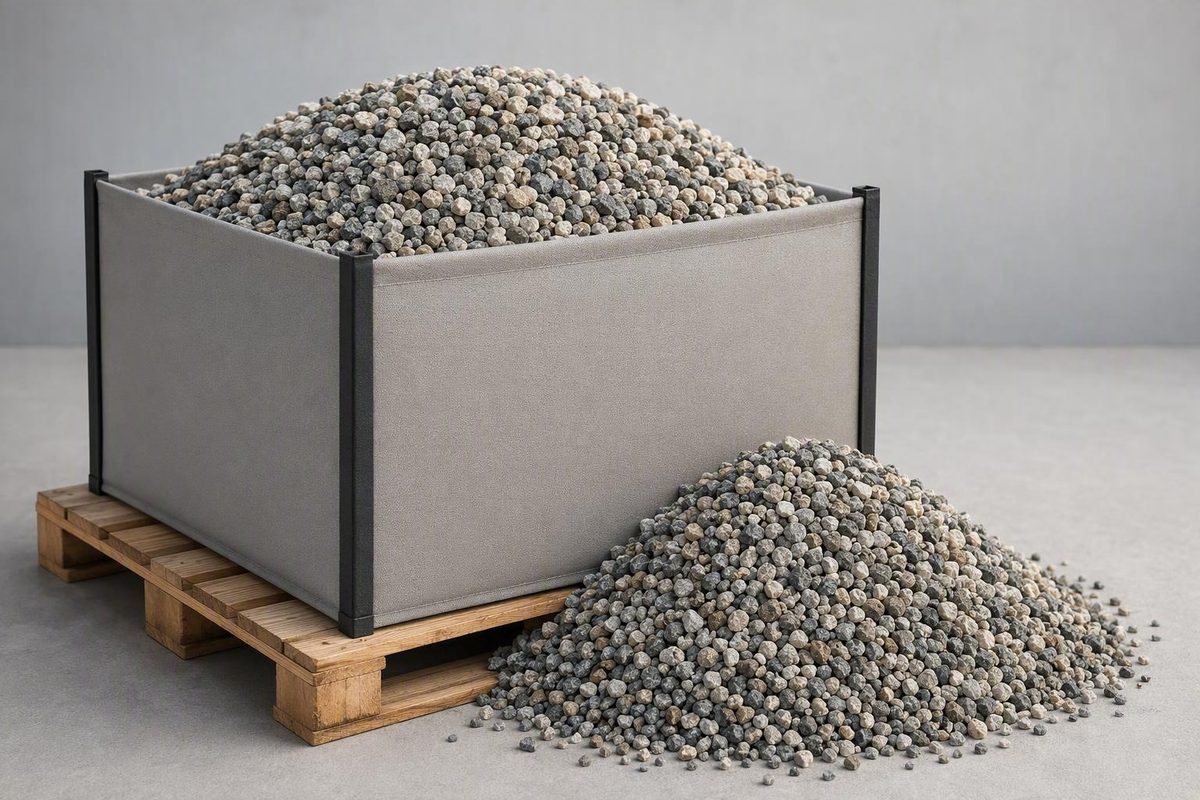
The quick answer: about 2,400–3,400 pounds per cubic yard
One cubic yard of typical gravel weighs approximately 2,400–3,400 pounds, or about 1.2–1.7 US short tons. The lower end is consistent with supplier estimates around 2,400 pounds, while gravel calculators place many common products as high as 3,400 pounds per cubic yard (compare Earth Haulers’ gravel range). For an early estimate, 2,800 pounds per cubic yard—or 1.4 short tons—is a useful planning figure, not a universal weight (see Inch Calculator’s gravel ranges).
Therefore:
- 2,400 pounds = 1.2 short tons
- 2,800 pounds = 1.4 short tons
- 3,000 pounds = 1.5 short tons
- 3,400 pounds = 1.7 short tons
Quick estimate using 2,800 pounds per cubic yard
Gravel volume Estimated pounds Estimated short tons ½ cubic yard 1,400 lb 0.7 ton 1 cubic yard 2,800 lb 1.4 tons 2 cubic yards 5,600 lb 2.8 tons 5 cubic yards 14,000 lb 7.0 tons
The box uses the cited 2,800-pound planning density and simple multiplication. It is suitable for preliminary budgeting and delivery comparisons, but not for approving a vehicle load near its rated limit.
Published general estimates extend from roughly 2,200 to 3,400 pounds per cubic yard because sources may be describing different products, particle sizes, moisture conditions, and loading assumptions. One regional supplier, for example, uses approximately 2,200 pounds as its general gravel estimate (compare Bray Topsoil & Gravel’s estimate).
For ordinary quantity planning, 2,800 pounds per cubic yard is a reasonable starting point. For preliminary payload planning, use the upper plausible weight for the named product, especially if it contains fines or may be wet. Do not select the lowest published estimate merely because it fits the capacity you hope to have.
What a cubic yard measures—and why a yard is not a ton
A cubic yard is a unit of volume. It describes a space measuring:
- 3 feet long
- 3 feet wide
- 3 feet high
That space contains 27 cubic feet:
3 ft × 3 ft × 3 ft = 27 cubic feet
Cubic yards describe how much space the gravel occupies. Pounds and tons describe how heavy it is. The two measurements are related through the product’s bulk density, but they are not interchangeable.
One cubic yard of clean drain rock, pea gravel, and crusher run occupies the same nominal volume. The products can nevertheless have different weights because their mineral composition, particle size, shape, moisture, and gradation determine how much stone and water fit within that volume.
Bulk density also differs from the density of solid rock. A gravel pile contains individual particles plus voids between them. Those voids may hold air or water. The weight of a cubic yard is therefore the combined mass of the stone, fines, and moisture present—not the weight of a solid cube cut from the parent rock.
A useful estimate should identify three conditions:
- The exact product: pea gravel, washed stone, crushed limestone, crusher run, road base, or another gradation.
- The moisture condition: dry, damp, or wet.
- The volume condition: loose, settled, or compacted.
Without those details, a pounds-per-cubic-yard figure is only a planning approximation. Volume calculations begin with length × width × depth, and cubic feet are converted to cubic yards by dividing by 27 (review Washington Rock’s calculation method).
How the supplier sells the material also matters. A cubic-yard order is based on nominal volume, while a short-ton order is based on weight. If a supplier sells by weight, ask which product-specific conversion it uses and whether that conversion reflects typical stockpile moisture.
Weight comparison by gravel type and condition
The following figures are estimating ranges rather than engineering specifications. Local stone composition, gradation, moisture, and loading practices can move an actual load outside the listed range.
| Product or condition | Approximate pounds per cubic yard | Approximate short tons per cubic yard | Estimating note |
|---|---|---|---|
| General gravel | 2,400–3,400 lb | 1.2–1.7 tons | Synthesized planning range, not a product specification |
| Pea gravel, broad estimate | 2,500–3,000 lb | 1.25–1.5 tons | General calculator range; composition and moisture still matter |
| 1B pea gravel | 2,410 lb | 1.21 tons | Product-specific published density |
| Crushed rock or fine-rich road base | 3,000–3,400 lb | 1.5–1.7 tons | Mixed sizes and fines can produce a higher bulk weight |
| Dry gravel example | 2,565 lb | About 1.28 tons | Approximate load-table value |
| Wet gravel example | 3,375 lb | About 1.69 tons | Approximate load-table value, not a universal wet weight |
| Porous lava rock | Around 1,200 lb | Around 0.6 ton | Lightweight specialty rock outside the usual gravel range |
The broad gravel and pea-gravel figures come from calculator guidance listing common gravel at 2,800–3,400 pounds per cubic yard and pea gravel at 2,500–3,000 pounds per cubic yard. The wider general range also accounts for lower supplier estimates discussed above.
The 1B figure is narrower because it applies to a named product. Its calculator lists a density of 2,410 pounds, 1.21 short tons, or 0.8 cubic yard per ton (see Gravelshop’s 1B pea-gravel density). Another supplier’s 1B gravel may not have precisely the same bulk density.
Crushed base tends to sit toward the upper end because a mixture of coarse particles, small fragments, and dust can fill spaces that would otherwise contain air. Commercial calculator guidance places pea gravel and lighter clean stone near 1.4 tons per cubic yard and crusher run or similar base products around 1.5–1.7 tons per cubic yard (compare BuildVision’s density guidance).
The dry and wet entries come from one approximate load table, which lists dry gravel at 2,565 pounds and wet gravel at 3,375 pounds per cubic yard. The same source warns that material densities can vary greatly (see SCS Manufacturing’s load table).
Porous specialty aggregates can be much lighter than ordinary gravel. One supplier places lava rock near 1,200 pounds per cubic yard, illustrating why the product name must be established before estimating weight (see Select Sand & Gravel’s material comparison).
The practical lesson is simple: do not treat gravel, pea gravel, drain rock, crushed stone, crusher run, and road base as density-equivalent products. Ask for the current conversion for the material you intend to buy.
Why the weight changes from one load to another
Two loads can each occupy one cubic yard and still have different scale weights. Several variables may act together.
Mineral composition
“Gravel” describes aggregate particles rather than a single mineral. Granite, limestone, quartz-rich stone, sandstone, and porous volcanic rock do not have identical material densities. The parent rock therefore affects particle mass before packing and moisture are considered.
This explains why porous specialty rock may fall well below the normal gravel range. A lightweight aggregate and a dense crushed base are different materials, not conflicting measurements of the same product.
Particle size, shape, and gradation
Particle arrangement determines how much stone fits into a cubic yard. Small particles can settle into spaces between larger pieces, increasing the proportion of stone and reducing the proportion of air.
Large clean stone can behave differently. Larger pieces may leave substantial voids, so the cubic yard contains more air and less actual rock. Angular crushed material can interlock, while rounded particles may rearrange and settle differently. Shape does not determine weight by itself, but it affects packing in combination with particle size and gradation.
Fines
They fill voids between coarser pieces and help create a compactable base. That same gap-filling action can make crusher run or road base heavier per loose cubic yard than clean washed stone.
Product descriptions help identify this distinction. Those materials should not automatically receive the same weight factor.
Moisture
Water adds weight by coating particles, filling voids, or being absorbed by porous stone and fines. Some supplier guidance estimates that wet material may weigh roughly 10%–15% more than bone-dry material, but this is not a universal adjustment. Drainage, absorption, saturation, and gradation all affect the result.
Do not combine that rough percentage automatically with the separate dry and wet load-table values. They are different estimating approaches, not parts of one standard moisture formula. Damp, free-draining stone may behave differently from saturated crushed base containing abundant fines.
When material is sold by weight, wetter gravel can conditionally produce less stone volume for a fixed purchased tonnage. Ask whether the supplier’s tons-per-yard figure represents average stockpile conditions or another stated moisture basis.
Settling and vibration
A freshly loaded pile contains loose particles and relatively open voids. During transport, vibration may allow the particles to rearrange and nest together. The pile can occupy less volume without losing mass.
Four terms should remain distinct:
- Loose bulk density: Weight divided by volume before deliberate compaction.
- Settled density: Density after gravity or vibration has rearranged the particles.
- Compacted density: Density after rolling, tamping, or vibration has reduced voids.
- Delivered wet scale weight: The measured mass of the stone, fines, and moisture in the load.
Confirm which condition a supplier means when quoting a weight or volume. That distinction affects both coverage and the amount that must be ordered.
How to convert cubic yards of gravel to pounds and tons
Once the project volume and product density are known, the conversion is straightforward.
Cubic yards to pounds
Estimated pounds =
cubic yards × pounds per cubic yard
For 3 cubic yards at an assumed 3,000 pounds per cubic yard:
3 × 3,000 = 9,000 pounds
Cubic yards to short tons
Estimated short tons =
cubic yards × short tons per cubic yard
For 3 cubic yards at 1.5 short tons per cubic yard:
3 × 1.5 = 4.5 short tons
Alternatively, divide pounds by 2,000:
9,000 ÷ 2,000 = 4.5 short tons
These are derived calculations. Their accuracy depends on the density chosen for the product.
Pounds per cubic foot to pounds per cubic yard
Because one cubic yard contains 27 cubic feet:
Pounds per cubic yard =
pounds per cubic foot × 27
For a loose bulk density of 105 pounds per cubic foot:
105 × 27 = 2,835 pounds per cubic yard
Convert that result to short tons:
2,835 ÷ 2,000 = 1.4175 short tons per cubic yard
For planning, report this as approximately 1.42 short tons per cubic yard. Extra decimal places do not make an uncertain density more accurate.
Rule-of-thumb example
Using the cited 2,800-pound planning density:
2 cubic yards × 2,800 lb/yd³ = 5,600 pounds
Then:
5,600 ÷ 2,000 = 2.8 short tons
Product-specific pea-gravel example
Suppose the measured volume is 2.5 cubic yards and the chosen 1B pea-gravel density is 2,410 pounds per cubic yard:
2.5 × 2,410 = 6,025 pounds
That equals:
6,025 ÷ 2,000 = 3.0125 short tons
Report the result as approximately 6,025 pounds or 3.01 short tons before any ordering allowance.
This figure is independently calculated from the published rounded density. The density-based calculation above should not be presented as the calculator’s displayed result.
Conservative hauling example
If a particular product could weigh 3,200 pounds per cubic yard, one-half cubic yard would weigh:
0.5 × 3,200 = 1,600 pounds
That is the estimated gravel weight only. It does not represent the complete loaded weight of a vehicle or trailer.
For densities of 2,800–3,400 pounds per cubic yard, the reverse conversion is approximately 0.59–0.71 cubic yard per short ton:
2,000 ÷ 3,400 ≈ 0.59 cubic yard per ton
2,000 ÷ 2,800 ≈ 0.71 cubic yard per ton
If the broader 2,400-pound lower density is used, the conversion rises to approximately 0.83 cubic yard per ton. A supplier-specific conversion remains preferable.
Avoid false precision. If product density and moisture are unknown, “about 6,000 pounds” is usually more useful than reporting an exact calculator result to the pound.
How to calculate the cubic yards your project needs
Project estimating has two separate steps:
- Calculate the required volume in cubic yards.
- Apply the relevant product density to estimate weight.
For a rectangular driveway, pad, walkway, or landscape bed:
Cubic yards =
length in feet × width in feet × depth in feet ÷ 27
If the depth is measured in inches:
Depth in feet = depth in inches ÷ 12
Example: 24 feet by 8 feet at 4 inches deep
Convert the depth:
4 ÷ 12 = 0.333 foot
Calculate the volume:
24 × 8 × 0.333 ≈ 64 cubic feet
64 ÷ 27 ≈ 2.37 cubic yards
This documented project example produces approximately 2.37 cubic yards (see Earth Haulers’ dimensional calculation).
Now apply an explicitly chosen density range. At 2,800–3,200 pounds per cubic yard:
Low estimate:  2.37 × 2,800 = 6,636 pounds
High estimate: 2.37 × 3,200 = 7,584 pounds
That is approximately 3.32–3.79 short tons, before any separate allowance for uneven grade, waste, settlement, or compaction.
Irregular project areas
For an irregular driveway or landscape bed:
- Divide the area into smaller rectangles.
- Calculate each rectangle’s cubic yards.
- Add the results.
- Estimate triangular or curved sections separately.
- Apply the product density only after establishing total volume.
For sloped or rutted surfaces, take several depth measurements. A single assumed depth may miss low areas that require more material.
Coverage per cubic yard
The geometric coverage formula is:
Square feet covered per cubic yard =
324 ÷ depth in inches
| Placed depth | Geometric coverage from 1 cubic yard |
|---|---|
| 1 inch | 324 sq ft |
| 2 inches | 162 sq ft |
| 3 inches | 108 sq ft |
| 4 inches | 81 sq ft |
| 6 inches | 54 sq ft |
The formula and values are derived from the 27-cubic-foot volume of one cubic yard.
Coverage and weight remain separate. One cubic yard has the same theoretical coverage at a given depth whether the selected product weighs 2,500 or 3,300 pounds. Density enters only when converting the volume to pounds or tons.
Compaction, settling, and how much gravel to order
Compaction does not create additional mass. Aside from moisture changes or lost material, 5,000 pounds of gravel still weighs 5,000 pounds after rolling. Compaction reduces the volume by rearranging particles and closing voids.
That creates three separate quantities:
- Weight per loose cubic yard: The density of material as loaded or delivered.
- Loose quantity ordered: The amount delivered before settlement or compaction.
- Finished compacted volume or depth: The required result after installation.
If a design calls for 4 inches of compacted base, placing exactly 4 loose inches may not leave 4 inches after rolling. More loose material can be necessary because the layer becomes thinner as voids close.
Some commercial guidance suggests a 15%–20% allowance for compacted material, but it also advises setting the factor from project history and site conditions rather than treating it as universal (review BuildVision’s allowance method). The appropriate allowance depends on the product, initial looseness, required finished density, placement method, equipment, subgrade condition, and handling loss.
Clean decorative stone does not behave like crusher run. Rounded pea gravel may settle and shift, while fine-rich base products are intended to pack into a denser layer.
Keep the calculations separate:
- Calculate the required finished project volume.
- Establish a suitable ordering allowance for the product and installation.
- Convert the adjusted loose order quantity to tons using the supplier’s loose bulk density.
Do not increase both density and volume by the same compaction percentage unless the supplier or project specification clearly requires both adjustments. Doing so can double-count the effect.
When requesting a quote, state whether the specified depth is:
- Loose placement depth
- Expected settled depth
- Required finished compacted depth
Also ask whether the material is sold by cubic yard or scale weight, whether its conversion is based on loose or compacted volume, and what moisture condition the conversion assumes.
Can your pickup or trailer safely haul a cubic yard?
A full cubic yard of ordinary gravel commonly weighs 2,400–3,400 pounds and may exceed the remaining payload of a light-duty pickup. Do not decide from marketing labels such as “half-ton,” “three-quarter-ton,” or “one-ton.” Use the ratings and current loading details for the specific vehicle and, if applicable, trailer.
Available payload can be represented as:
Remaining payload =
rated payload
− passengers
− tools and accessories
− existing cargo
− applicable hitch or tongue weight
A preliminary material-volume ceiling is:
Maximum estimated fraction of a cubic yard =
remaining payload ÷ assumed pounds per cubic yard
Suppose the verified remaining payload is 1,500 pounds and the assumed gravel density is 3,200 pounds per cubic yard:
1,500 ÷ 3,200 = 0.469 cubic yard
This arithmetic does not authorize loading 0.469 cubic yard. It addresses only the stated payload inputs and does not resolve measurement uncertainty, load placement, or any other applicable manufacturer or road limit.
Before hauling, consult the labels, manuals, and specifications for the exact setup and verify every applicable limit, which may include:
- Vehicle payload and gross vehicle weight
-
Front and rear axle ratings
-
Trailer gross rating and payload after empty weight
-
Local highway, bridge, or road restrictions
Approximate material tables should not replace manufacturer specifications or scale measurements. SCS Manufacturing likewise advises checking vehicle limits, applicable highway restrictions, and truck-scale weights because listed material weights are approximate (review its hauling cautions).
An unevenly positioned load can affect individual components differently even when a rough total-weight calculation appears acceptable. Follow the loading instructions and limits issued for the specific vehicle, tires, hitch, and trailer.
If the estimate approaches any applicable vehicle, trailer, axle, tire, hitch, combined-weight, or road limit, use supplier delivery or a suitably rated hauling setup. When safety depends on whether the gravel weighs 2,800 or 3,200 pounds per cubic yard, obtain the supplier’s current product density and use scale weights.
Frequently asked questions
How many tons are in one cubic yard of gravel?
One cubic yard of typical gravel is approximately 1.2–1.7 US short tons. A convenient preliminary estimate is 1.4 short tons, equivalent to about 2,800 pounds.
The correct conversion depends on the product. Clean stone and some pea gravel may be near the lower or middle portion of the range, while fine-rich crushed base may approach 1.5–1.7 short tons per cubic yard.
How much does a cubic yard of pea gravel weigh?
A broad planning range for pea gravel is approximately 2,500–3,000 pounds per cubic yard, or 1.25–1.5 short tons. One supplier uses about 2,800 pounds, or 1.4 short tons, as an average while acknowledging variation from moisture, parent rock, particle size, voids, and settling (see Select Sand & Gravel’s pea-gravel guidance).
A named product may differ. The 1B pea-gravel example above uses a published density of 2,410 pounds per cubic yard, but that figure should not automatically be applied to every pea-sized gravel.
How much heavier is wet gravel than dry gravel?
There is no universal percentage. Some supplier guidance estimates that moisture can add roughly 10%–15% over bone-dry material, but absorption, drainage, fines, and saturation vary.
One approximate load table compares dry gravel at 2,565 pounds per cubic yard with wet gravel at 3,375 pounds, a difference of 810 pounds. Treat those figures as one source-specific comparison rather than a standard adjustment for every gravel product.
Does compacted gravel weigh more than loose gravel?
Compaction does not add mass to the gravel already present. It reduces void space, allowing the same material to occupy less volume.
However, one compacted cubic yard can contain more gravel than one loose cubic yard. Its bulk weight per occupied cubic yard can therefore be higher, and more than one loose cubic yard may be required to produce one cubic yard at the specified compacted condition.
How much area does one cubic yard of gravel cover?
Use:
Square feet per cubic yard = 324 ÷ depth in inches
One cubic yard geometrically covers approximately:
- 324 square feet at 1 inch
- 162 square feet at 2 inches
- 108 square feet at 3 inches
- 81 square feet at 4 inches
- 54 square feet at 6 inches
For field estimating, about 100 square feet at a 3-inch depth is a convenient rounded rule. Finished coverage may be lower because of uneven grade, settlement, waste, or product-specific compaction.
The bottom line
For an early estimate, use approximately 2,800 pounds or 1.4 US short tons per cubic yard. Expect typical gravel to fall within a broader range of roughly 2,400–3,400 pounds per cubic yard.
Before ordering or hauling, identify the exact product, obtain the supplier’s loose bulk density and moisture basis, calculate the full project volume, and keep ordering or compaction allowances separate from the density itself. If you plan to haul the material, verify the resulting load against every applicable rating and use a scale when the estimate is close to a limit.