
Concrete Driveway Repair Cost by Repair Type
Compare crack sealing, slab lifting, resurfacing and replacement costs, with a repair calculator, scope limits and checks for comparable contractor quotes.
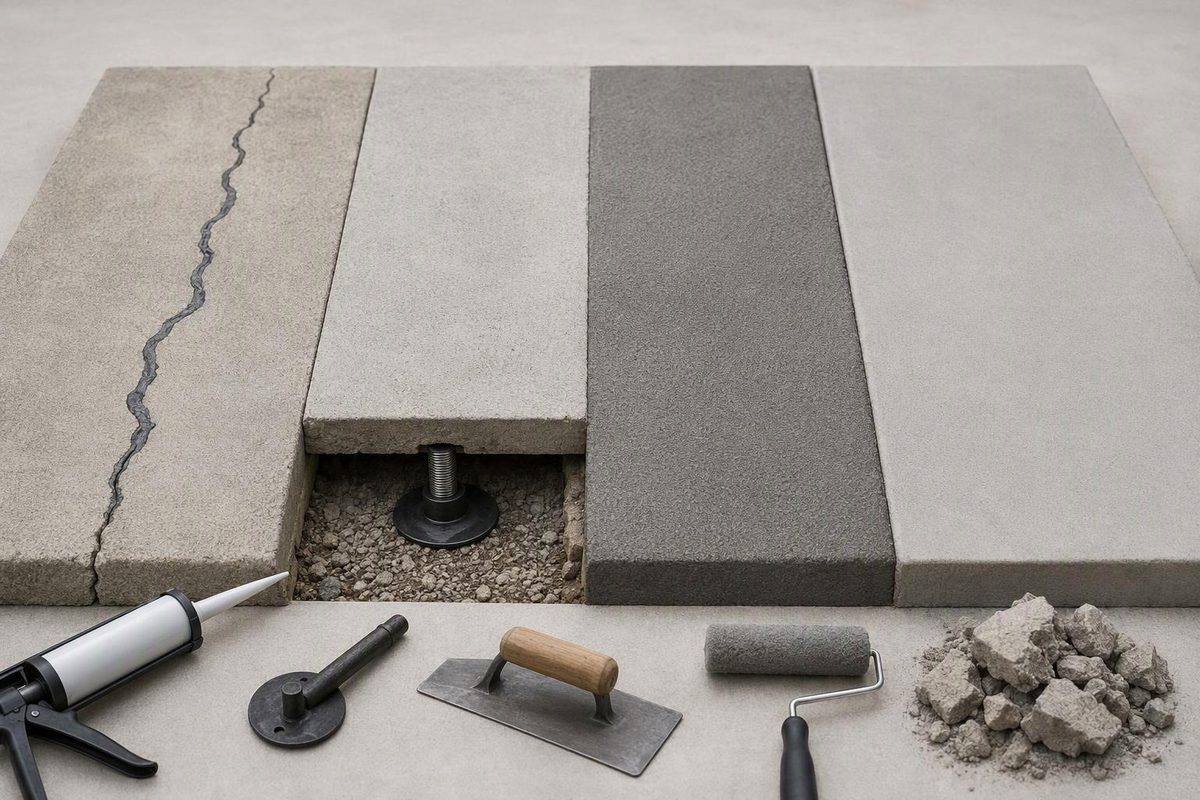
Concrete driveway repair cost depends on the failure: published U.S. benchmarks put professional crack caulking at $5–$10 per linear foot, basic resurfacing at $3–$5 per square foot, and slab lifting at $900–$5,670 per project, depending on the injection method. Removing and replacing standard gray concrete has a calculated planning range of $8–$16 per square foot. These are not interchangeable repairs: sealing keeps water and debris out, lifting raises settled concrete, and resurfacing needs a sound slab underneath.
Choose a repair and enter its measured quantity; use the result as a planning range, not a bid.
Repair Budget Calculator
Enter a measured quantity greater than zero.
Calculated Planning Range
60 linear feet × $5–$10.
May 2024 contractor benchmark. Preparation and minimum charges can change the total; sealing does not restore slab support.
What These Ranges Leave Out
Drainage improvements, substantial base reconstruction, permits and decorative finishes are not assumed included. Small panel replacement may not follow a whole-driveway rate.
Replacement combines $6–$10/sq. ft. installation and $2–$6/sq. ft. removal; it is not an all-in quote. Lifting ranges have no stated area and cannot be scaled by square feet.
Sources: A-1 caulking guide (May 2024) and leveling guide (2026); HomeGuide resurfacing, driveway installation and removal estimates. U.S. planning benchmarks, not local bids.
Published Costs Use Different Pricing Units
These are U.S. planning benchmarks, not local bids. A-1 and Acme publish contractor estimates, not itemized quotes for the same job; HomeGuide figures are national estimates. The caulking benchmark is older than the leveling guide.
| Work | Published Price Basis | Scope Limit |
|---|---|---|
| Professional crack and joint caulking | $5–$10 per linear foot | A-1’s May 2024 benchmark; preparation and gap width affect cost. |
| Stone-slurry slab lifting | $900–$4,200 per project | A-1’s 2026 guide; no stated driveway area. |
| Polyurethane-foam slab lifting | $1,215–$5,670 per project | Same guide; not a per-square-foot allowance. |
| Basic driveway resurfacing | $3–$5 per square foot | HomeGuide’s thin-overlay estimate; preparation and minimum fees can add cost. |
| Remove and replace standard gray concrete | $8–$16 per square foot, calculated | Combines separate installation and removal allowances; not an all-in quote. |
Sources: A-1 caulking pricing, A-1’s 2026 leveling guide, HomeGuide resurfacing pricing and HomeGuide installation and removal allowances.
A-1 says to expect a few hundred dollars minimum for professional caulking. Its lifting ranges depend on void depth, lift height and access. The foam range does not establish a guaranteed premium over another local contractor’s slurry method.
Do not treat drainage improvements, substantial base reconstruction, permits or decorative finishes as included unless the proposal says so. Nor should a small replacement panel be priced automatically at a whole-driveway unit rate. The draft’s sources provide no separate allowance for those extras.
Crack Sealing Costs Follow Length And Preparation
For 60 linear feet, the older A-1 benchmark gives a planning calculation of 60 × $5–$10 = $300–$600.
Removing failed filler, cleaning excessive debris or opening a crack for sealant can increase the price. A short repair may instead be governed by the contractor’s minimum charge. A-1 identifies these preparation and minimum-charge factors in its caulking guide.
Specify the intended repair. Keeping water and debris out is not the same as restoring structural support. An elastic sealant can accommodate movement; it cannot raise a settled slab.
Sika’s driveway-rated Sikaflex-411, for example, remains elastic but requires clean, sound joint surfaces and proper backing in working joints. It is also not for sloped surfaces, a limitation when choosing this self-leveling product for a driveway. Sika’s application instructions illustrate why the named product belongs in the repair scope.
A few accessible, minor cracks may suit DIY work. Budget for preparation tools, backing material where required and the actual sealant volume—not just one cartridge. The sources here do not provide a DIY material-cost figure. If the proposal specifies a rigid bonding repair, see when concrete crack repair epoxy fits a driveway.
Slab Lifting Cannot Be Priced By Area Alone
Lifting is worth pricing when concrete is reasonably intact but has settled. It does not renew a worn surface, and broken-up slabs are difficult to lift consistently. A-1’s leveling guidance makes that distinction.
For a sized regional example, Northern Illinois contractor Acme publishes $1,000–$3,000 for its 200-square-foot driveway lifts using polyurethane foam, including assessment and cleanup. That works out to $5–$15 per square foot for that example, not a nationwide rate. Acme’s Illinois pricing also identifies slab size and underlying voids as cost factors.
A 200-square-foot area with a deep cavity can require more injected material than a larger area needing a modest lift. A useful lifting proposal identifies the slabs to be raised and their target elevations, names the injection material, and states any extra-material charges. It also specifies whether drill-hole repair and crack or joint sealing are included—and what work will stop further erosion or settlement.
A-1 publishes leveling minimums of $300–$2,000, varying by contractor and region. Those fixed costs help explain why multiplying a tiny area by a unit rate often underestimates the bill. The calculator therefore shows A-1’s project ranges for lifting rather than inventing an area-based estimate.
Resurfacing Costs Less Only When The Slab Is Suitable
For a 20 × 30-foot driveway—600 square feet—HomeGuide’s allowances produce the following calculations:
| Scope | Rate | 600-Square-Foot Budget |
|---|---|---|
| Basic resurfacing | $3–$5/sq. ft. | $1,800–$3,000 |
| Standard installation | $6–$10/sq. ft. | $3,600–$6,000 |
| Removal allowance | $2–$6/sq. ft. | $1,200–$3,600 |
| Removal plus installation | $8–$16/sq. ft., calculated | $4,800–$9,600 |
The combined replacement budget adds HomeGuide’s separate removal and installation allowances. It is not a published all-in replacement quote, and separately priced extras remain outside it.
Resurfacing buys a new wear surface, not a new foundation. CTS requires a clean, sound substrate for its concrete resurfacer. QUIKRETE requires damaged areas to be repaired first and existing joints to be maintained. It also warns that cracks can reflect through the new surface when the underlying slab moves. CTS’s technical sheet and QUIKRETE’s resurfacer instructions support those product-specific limits.
For localized damage, request a separate panel-replacement option rather than assuming the entire driveway needs rebuilding. For surface deterioration, distinguish concrete scaling from deeper spalling before accepting a thin-overlay proposal.
Comparable Quotes Need The Same Measured Scope
Ask each contractor to price the same marked-up driveway plan. Record crack length, patch area and depth, slab count, or replacement area so that differences in quantities are visible rather than buried in a total.
The preparation scope should identify removal of old filler, loose concrete, coatings and contaminated material. For settlement, the proposal should state the suspected cause, proposed base work and where runoff will go. If a slab is still moving or runoff is washing out its support, make the cause part of the repair scope. Use the driveway drainage guide to frame that discussion.
Materials should be named, not described only as “concrete repair.” For replacement, compare slab thickness, reinforcement, joints and curing. For every method, check mobilization, disposal, permits, material-overage terms, return-to-traffic timing and warranty exclusions.
A lower total is meaningful only after those quantities and inclusions match. A crack-sealing bid cannot substitute for restoring lost support, and a thin-overlay price cannot substitute for rebuilding a failed slab.