
Price to Pave a Driveway and What Changes It
Basic asphalt paving budgets at $5–$12 per sq. ft.; a qualifying overlay is $3–$7. Measure your area, then price removal, base work and drainage separately.
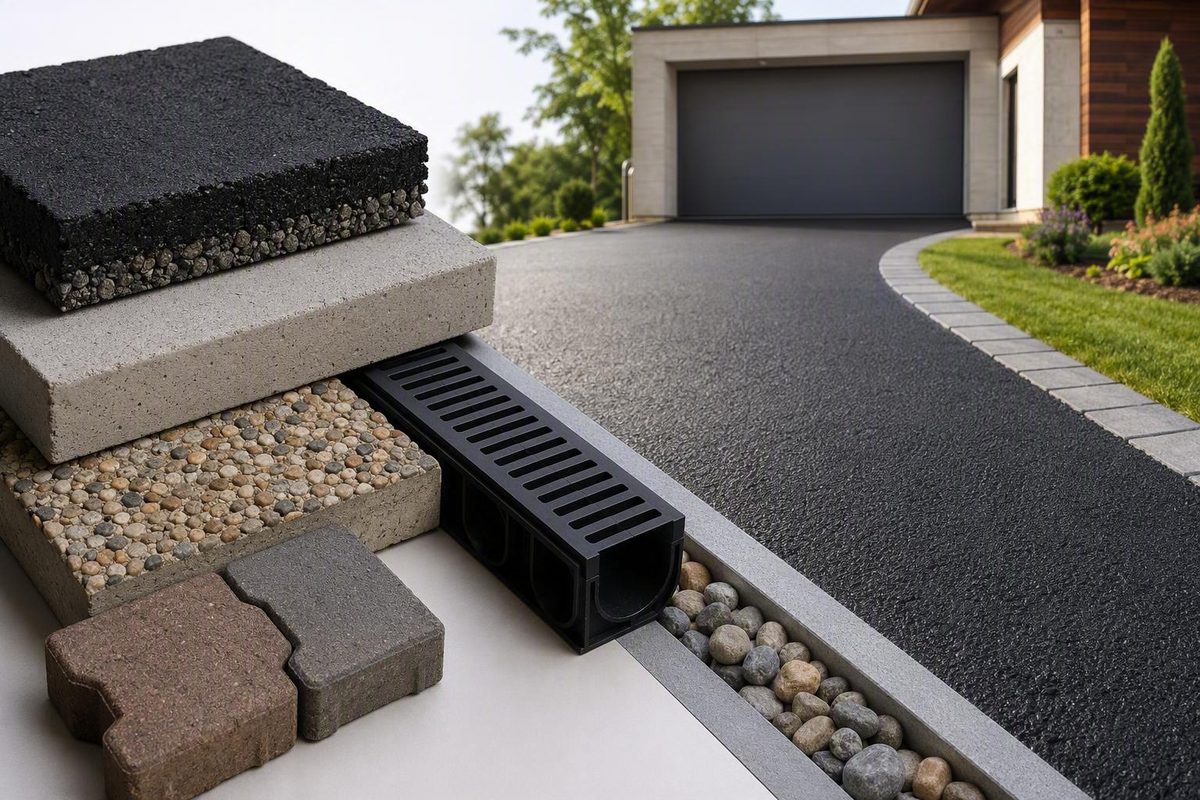
The price to pave a driveway starts with square footage multiplied by an installed rate, but that calculation is only a first-pass budget. The final quote also depends on whether the job is a new installation, full replacement, or overlay; whether the existing base can remain; and how much excavation, grading, drainage, hauling, and access work the property requires.
For preliminary U.S. planning, use approximately $5–$12 per square foot for asphalt, $6–$18 for concrete, $1–$6 for gravel, and $10–$30 or more for pavers. These are synthesized budgeting ranges, not property-specific quotes. HomeGuide supports the asphalt range and the lower part of the concrete range, while a separate 2026 planning guide supports concrete up to $18, gravel up to $6, and pavers up to $30 per square foot (HomeGuide’s asphalt and concrete cost comparison; 2026 driveway cost ranges).
The source set behind these figures includes editorial cost guides, commercial calculators, contractors, and a manufacturer. Their definitions of “installed” and their geographic assumptions differ. The ranges are therefore best used to establish an order-of-magnitude budget before obtaining local, itemized proposals.
Driveway paving costs at a glance
The following table compares the principal driveway materials. It keeps basic installed-price planning separate from material-only prices, overlay rates, and complete replacement costs.
| Material | Preliminary installed range | General cost position | Commonly excluded work |
|---|---|---|---|
| Gravel | $1–$6 per sq. ft. | Usually the lowest upfront cost | Major excavation, difficult grading, drainage systems, permits, edging, extensive hauling |
| Asphalt | $5–$12 per sq. ft. | Commonly the least expensive permanent paved surface | Removal, failed-base reconstruction, major drainage correction, permits, specialty finishes |
| Concrete | $6–$18 per sq. ft. | Usually higher upfront than asphalt | Demolition, extensive excavation, difficult access, drainage, decorative treatments, permits |
| Pavers | $10–$30+ per sq. ft. | Usually the premium option | Major site correction, demolition, drainage, intricate borders or patterns, permits |
Table scope: These synthesized U.S. planning ranges draw on published installed figures that do not all include the same work. A separate cost calculator likewise identifies gravel as the cheapest option and asphalt as the cheapest permanent option, while listing higher costs for concrete and pavers (driveway material and installation estimates).
Gravel generally has the lowest initial price. Asphalt is commonly the lowest-cost choice when the owner wants a continuous, permanent paved surface. Pavers usually occupy the premium end because they require a prepared supporting system plus labor-intensive placement, cutting, and alignment.
The word installed still needs qualification. In one estimate, it may mean material and basic labor on a prepared site. In another, it may include ordinary grading and base preparation. A replacement proposal may also include demolition and disposal. Drainage, permits, extensive excavation, curbs, edging, sealing, taxes, and landscape restoration may remain outside every one of those definitions.
That is why material-only prices, overlay rates, basic installations, and full replacements should never be blended into one national average. A low asphalt rate might describe resurfacing over a sound existing structure, while a much higher proposal could include removal, hauling, and base reconstruction. The rates are not comparable until the project type and inclusions are labeled.
Published prices also conflict because of:
- Geography: Labor, aggregate, asphalt, concrete, disposal, and transportation costs differ by market.
- Publication date: Fuel, wages, material inputs, and contractor workloads change.
- Project type: New construction, overlay, and full replacement require different operations.
- Inclusions: Some estimates include ordinary base preparation; others separate it.
- Site assumptions: A level, accessible driveway on stable ground is different from a steep, restricted site with weak soil or poor drainage.
- Project size: Small jobs can carry a higher unit price because mobilization and crew costs are spread over fewer square feet.
- Design: Curves, islands, decorative borders, and multiple parking areas add labor and waste.
Regional examples show why local context matters. A New Jersey contractor lists approximately $7–$15 per square foot for full asphalt installation or replacement and $3–$7 for an eligible overlay (New Jersey asphalt planning ranges). A Minneapolis contractor publishes local ballparks beginning at $3.95 per square foot, with a listed clay-soil installation scenario reaching $9.90 per square foot (Minneapolis asphalt driveway cost examples). Neither local schedule should be treated as a national rule or applied automatically in another city.
National ranges and online calculators are useful for deciding whether a project is likely to cost a few thousand dollars, tens of thousands, or more. An actionable price requires an inspection and a written local estimate identifying what will be removed, repaired, rebuilt, installed, and excluded.
Calculate a rough total from your driveway dimensions
For a rectangular driveway:
Length in feet × width in feet = square feet
A driveway measuring 20 feet long by 20 feet wide has an area of:
20 × 20 = 400 square feet
For an L-shaped, curved, circular, or otherwise irregular driveway, divide the layout into simple measurable sections. Calculate each rectangle or other manageable shape, then add the sections together. Do not estimate only from the widest length and width, because that can count areas outside the actual driveway.
Once you know the area, use:
Total area × applicable installed-price range = preliminary surface budget
Then estimate demolition, disposal, base correction, drainage, permits, and optional features separately unless the selected rate expressly includes them.
Using the cited asphalt planning range, a 20-by-20-foot driveway produces:
- Area: 400 square feet
- Low allowance: 400 × $5 = $2,000
- High allowance: 400 × $12 = $4,800
- Preliminary asphalt budget: approximately $2,000–$4,800
This is arithmetic based on a broad U.S. planning range. It is not a contractor quote and should not be assumed to include removal, failed-base reconstruction, drainage correction, permits, taxes, or unusual site charges.
The same method produces the following preliminary totals:
| Driveway area | Asphalt at $5–$12 | Concrete at $6–$18 | Gravel at $1–$6 | Pavers at $10–$30 |
|---|---|---|---|---|
| 400 sq. ft. | $2,000–$4,800 | $2,400–$7,200 | $400–$2,400 | $4,000–$12,000 |
| 600 sq. ft. | $3,000–$7,200 | $3,600–$10,800 | $600–$3,600 | $6,000–$18,000 |
| 800 sq. ft. | $4,000–$9,600 | $4,800–$14,400 | $800–$4,800 | $8,000–$24,000 |
| 1,000 sq. ft. | $5,000–$12,000 | $6,000–$18,000 | $1,000–$6,000 | $10,000–$30,000 |
| 1,500 sq. ft. | $7,500–$18,000 | $9,000–$27,000 | $1,500–$9,000 | $15,000–$45,000 |
Table basis: Every total is simple multiplication using the cited synthesized ranges. The figures are preliminary surface allowances, not quotes or guarantees that all preparation and installation work is included.
A straightforward project with easy access and a reusable base might remain within the applicable surface range. A replacement project on weak or wet soil could exceed it after demolition, excavation, base construction, and drainage work are added.
Keep the working budget in separate lines:
- Surface installation: Area multiplied by the relevant installed rate.
- Removal and disposal: If an existing driveway must be demolished.
- Excavation, grading, and base work: Based on actual soil and support conditions.
- Drainage: Swales, drains, grading changes, or another site-specific response.
- Permits and inspections: If required locally.
- Options: Borders, decorative finishes, edging, sealing, or added parking.
- Contingency: For soft areas or hidden conditions discovered during excavation.
An asphalt quantity calculator can refine the expected material amount by converting area, compacted thickness, density, and waste into volume or tonnage. It cannot determine a complete installed price unless local preparation, labor, equipment, transportation, minimum-load, disposal, drainage, tax, and permit costs are also entered (how asphalt quantity and cost calculations work).
That distinction matters. Estimated tonnage does not reveal what it will cost to remove an old slab, correct a wet subgrade, bring equipment through restricted access, or restore a disturbed shoulder.
New installation, replacement, and overlay are different jobs
Before comparing prices, classify the project. Three driveways with identical dimensions can have substantially different costs because they require different work.
New installation means paving previously unpaved ground or creating a new driveway layout. It usually requires clearing or excavation, grading, construction of an appropriate base, and installation of the selected surface. It may also require drainage work and carefully built transitions to a road, garage, sidewalk, or parking area.
Full replacement means removing the existing surface, hauling or disposing of it, correcting failed areas, rebuilding the base where needed, and installing a new surface. Replacement can cost more than paving a well-prepared new site because it begins with demolition and may expose hidden support or drainage problems.
Asphalt overlay, often called resurfacing, means placing a new asphalt layer over existing pavement and a supporting structure that remain suitable. Its principal economic advantage is that wholesale demolition and base reconstruction are avoided.
For preliminary budgeting, use approximately $3–$7 per square foot for a qualifying asphalt overlay. NerdWallet separately lists new asphalt at $7–$13 per square foot, replacement at $8–$15, and overlay at $3–$7, illustrating why the project type must be identified before rates are compared (asphalt costs by project type).
For a 400-square-foot driveway:
| Asphalt project | Planning rate | Preliminary arithmetic |
|---|---|---|
| Qualifying overlay | $3–$7 per sq. ft. | $1,200–$2,800 |
| Basic paving using this article’s range | $5–$12 per sq. ft. | $2,000–$4,800 |
These are not equivalent scopes. The lower overlay calculation assumes the existing pavement and supporting structure can remain in service after appropriate preparation. The basic paving range may still exclude demolition, major base reconstruction, and drainage correction, depending on how a contractor defines installation.
An overlay saves money only when it genuinely avoids removal and major foundation work.
When reviewing a resurfacing price, ask:
- Does the rate assume an intact, stable base?
- Are cleaning and surface preparation included?
- How will existing cracks, potholes, and low areas be treated?
- Are transitions at the garage, sidewalk, curb, and road included?
- Could the added elevation interfere with drainage or adjacent surfaces?
- What conditions would cause the contractor to withdraw the overlay option?
- What limitations apply to the overlay warranty?
Do not use an advertised overlay rate to budget a driveway that probably needs removal, drainage correction, or extensive base work. Have the site inspected and require the proposed project type to be identified in writing.
The site work that can move a quote beyond the headline range
The surface is often the easiest part of a driveway budget to calculate. The ground below it and the logistics around it create much of the uncertainty. Organize possible additions into unavoidable site work, project logistics, and optional upgrades.
Unavoidable site work
Subgrade and base condition: The subgrade is the soil supporting the driveway system. The base is the prepared aggregate or other supporting layer beneath the finished surface. Weak, wet, disturbed, or inconsistent areas may require excavation and replacement rather than simple grading.
Soil: Clay, loose fill, organic material, and other problematic conditions can affect support and drainage. Depending on the property and proposed surface, a contractor may recommend excavation, additional aggregate, geotextile, stabilization, or another design response. No single base specification is appropriate for every soil, climate, surface, and expected vehicle load.
Removal and disposal: Demolishing existing asphalt, concrete, pavers, or another surface adds equipment time, labor, trucking, and disposal or recycling charges. A broad synthesized planning allowance is approximately $1–$6 per square foot: one guide lists removal at $1–$3, another at $1–$4, and another at $2–$6 per square foot (driveway removal and site-cost estimates). Material type, slab thickness, reinforcing, hauling distance, and local disposal rules can materially change the price.
Grading and base preparation: Approximately $1–$3 per square foot or more can be used as a preliminary allowance where such work is priced by area. Extensive excavation or reconstruction may instead be quoted as a separate lump sum.
Slope and elevation: The finished driveway must connect sensibly with the garage, roadway, walkways, drains, and surrounding ground. Correcting grade can require excavation, imported material, transition work, retaining elements, or additional hand labor.
Drainage: Water may need to be redirected through grading, swales, channel drains, French drains, or another site-specific solution. Published planning examples include $500–$3,000 for added drainage and $1,000–$5,000 for a French drain, while grading and base preparation are listed at $1–$3 per square foot and permits at approximately $50–$500 (driveway site-work cost allowances). A minor grading adjustment and a substantial drainage system are fundamentally different projects, so a local professional must determine the appropriate scope.
Permits: Whether a permit, inspection, curb-cut approval, or other authorization is required depends entirely on the jurisdiction. A national allowance does not establish the rules or fees for a particular property.
Project logistics
Access: An open site can accommodate trucks, excavation equipment, pavers, and rollers more efficiently than a narrow driveway between buildings, retaining walls, gates, or mature landscaping. Restricted access may require smaller machinery, more hand work, or repeated material handling.
Shape and obstacles: Straight rectangular driveways are easier to measure and build. Curves, circular sections, multiple parking pads, islands, walls, utility structures, steps, gates, and landscaping can increase cutting, forming, edging, labor, and waste.
Pavement thickness and design: More material usually costs more, but the correct pavement and base design depends on the chosen surface, soil, drainage, climate, expected vehicles, and contractor specifications. Compare what each contractor proposes rather than assuming one universal thickness.
Hauling distance: Asphalt, concrete, aggregate, excavated soil, and demolition debris all carry transportation costs. Distance from a plant, quarry, recycler, or disposal facility can affect the proposal.
Local labor and equipment: Crew rates, insurance, equipment availability, and local demand vary. A national square-foot range cannot represent every market.
Mobilization and minimum loads: Contractors incur costs to transport workers and equipment even when the driveway is small. Suppliers may impose minimum order or delivery charges. A larger driveway can therefore have a lower price per square foot even though its total price is higher. The Minneapolis cost guide explicitly identifies mobilization and equipment transportation as fixed costs spread across the project area.
Schedule and sequencing: Weather, excavation, inspections, concrete curing, and coordination with other work affect how the project is performed. Do not assume that the shortest proposed schedule includes the same preparation as a longer one.
Optional upgrades
Separate structural necessities from aesthetic and convenience choices. Optional additions can include:
- Decorative paver or stone borders
- Colored asphalt or concrete
- Stamped or exposed finishes
- Custom paver patterns
- Upgraded edging
- Additional parking or turnaround areas
- Gates and landscape transitions
- Surface sealing
- Restoration beyond basic cleanup
Drainage, excavation, and adequate base preparation are not decorative upgrades when the site requires them. Borders, colors, and patterns usually are. Keeping the categories separate makes it easier to reduce cost without removing work that supports the driveway.
Compare materials by upfront price, maintenance, and fit
Price matters, but a surface that conflicts with the property’s drainage, appearance, maintenance requirements, or expected vehicle use may not provide good value. Compare the initial installation with likely upkeep and repair options.
| Material | Preliminary installed price | Maintenance pattern | Repairability | Appearance | Qualified service-life range |
|---|---|---|---|---|---|
| Gravel | $1–$6 per sq. ft. | Periodic grading, weed control, and replenishment may be needed | Loose material can often be regraded or added | Informal; many aggregate colors and sizes | Highly variable; continued upkeep can extend functional use |
| Asphalt | $5–$12 per sq. ft. | Crack repair, patching, and sealing may be appropriate as conditions warrant | Localized repairs and overlays may be possible | Generally uniform and dark, with limited decorative options | Broadly about 15–30 years |
| Concrete | $6–$18 per sq. ft. | Crack, joint, stain, and surface care may be needed | Repairs are possible, although patches may remain visible | Wide range of colors, textures, and finishes | Roughly 27.5–50 years in published estimates |
| Pavers | $10–$30+ per sq. ft. | Cleaning, joint care, weed control, and resetting may be needed | Individual units can often be lifted or replaced | Extensive pattern, color, and border flexibility | Potentially long-lived but highly installation- and maintenance-dependent |
Table basis: The price figures use the synthesized planning ranges cited earlier. Published estimates place asphalt broadly around 15–30 years. NerdWallet reports approximately 27.5 years on average for concrete and up to 30–40 years with maintenance, while a separate 2026 guide lists a broader 30–50-year planning range for concrete. These figures are not warranties.
Actual service life depends on construction quality, drainage, climate, traffic, maintenance, and site movement. Even individual cost guides publish differing estimates, so lifespan should not be treated as a fixed financial input.
Gravel
Gravel usually offers the lowest upfront cost and may be practical for long rural driveways, secondary access, or properties where a formal paved appearance is not essential. It can also be comparatively straightforward to extend, replenish, or regrade.
The tradeoff is recurring surface management. Traffic, runoff, snow removal, and turning vehicles can create ruts, displacement, and low areas. Maintenance frequency depends on aggregate selection, construction, slope, drainage, use, and climate.
Asphalt
Asphalt is commonly the least expensive permanent continuous pavement among the principal options. It provides a smooth surface and may be patched or overlaid if the supporting structure remains suitable.
Maintenance can include crack repair, patching, and sealing. No fixed schedule works for every driveway, so follow the installer’s recommendations and respond to actual conditions. Surface maintenance cannot correct weak support or continuing drainage failure.
Concrete
Concrete generally costs more upfront than asphalt but is commonly associated with a longer reported service life. It also permits greater decorative flexibility through colors, textures, borders, exposed finishes, or stamped patterns.
Concrete is not maintenance-free. Joints, cracks, stains, settlement, and surface wear can require attention, and localized repairs may remain visually noticeable.
Pavers
Pavers are typically a premium option because installation combines a prepared supporting system with substantial placement and cutting labor. Their principal advantages are design flexibility and the possibility of lifting or replacing individual units.
Performance still depends on preparation, drainage, edge restraint, joint condition, and installation quality. A premium surface cannot compensate for unsuitable support.
Recycled asphalt
Recycled asphalt pavement, also called RAP or millings, is a separate budget-oriented alternative rather than the same product as newly placed hot-mix asphalt. A contractor’s 2024 national guide listed approximately $2–$4 per square foot, but that is an older broad estimate with unclear applicability to any particular market or installation scope.
Availability, screening, binder condition, delivery, preparation, and compaction can vary substantially. Readers considering this material can review Driveway Source’s discussion of recycled asphalt driveway compaction and trade-offs. That first-party article provides practical context; it is not used here as independent evidence of market-wide pricing.
Climate is only one part of the decision
Avoid reducing the choice to “asphalt for cold climates” or “concrete for hot climates.” Temperature and freeze-thaw exposure matter, but so do material or mix design, base construction, drainage, installation quality, vehicle use, deicing practices, and maintenance.
The best value is not automatically the lowest initial rate. Choose a surface that fits:
- The desired appearance
- Your willingness to perform recurring upkeep
- The property’s slope and drainage
- Expected cars, trucks, trailers, or service vehicles
- Snow and ice management
- Repair expectations
- The quality of locally available installation
Can the driveway be overlaid, or does it need replacement?
No article or photograph can determine conclusively whether an existing driveway is structurally suitable for an overlay. The practical goal is to identify questions that require an on-site assessment.
An overlay may be realistic when:
- The existing pavement and base appear stable.
- Drainage is functioning adequately.
- Settlement or heaving is not widespread.
- Damage is limited enough to prepare and repair before resurfacing.
- Added elevation will not create problems at the garage, sidewalk, curb, road, drains, or landscaping.
- The contractor can explain how existing defects will be treated.
- The proposed warranty reflects the condition of the underlying driveway.
Conditions requiring closer professional evaluation include:
- Widespread or recurring cracking
- Repeated potholes
- Noticeable settlement
- Heaving or displacement
- Extensive crumbling
- Standing water or recurring drainage failure
- Broken or unsupported edges
- Visible movement in the pavement or surrounding ground
These signs do not establish a remote diagnosis. One crack pattern alone does not prove that the base has failed, and cosmetic wear should not automatically be treated as structural damage. The important question is whether deterioration is confined to the surface or reflects movement, moisture, or loss of support below.
Ask the contractor:
- Are the cracks confined to the surface, or do they appear to reflect movement below?
- What repairs and preparation are included before the overlay?
- Will low areas be leveled?
- How will existing joints or recurring cracks be addressed?
- Does drainage need to be corrected first?
- Will the added thickness interfere with doors, curbs, walkways, or runoff?
- Which defects are likely to remain visible or return?
- What does the overlay warranty exclude?
A lower-cost overlay is useful only when its assumptions are valid. New material placed over unstable support or unresolved drainage can improve appearance temporarily while leaving the cause untouched.
If the condition is borderline, request two written proposals: one for an overlay and one for replacement. Each should document preparation, limitations, exclusions, expected performance, and warranty. That creates a comparison between actual scopes rather than headline prices.
Compare contractor quotes on the same scope
Obtain at least three written quotes using the same measurements and project assumptions. A 2026 planning guide likewise recommends at least three written quotes and line-by-line comparison of material, depth, base, grading, removal, sealing, and finishing details.
Use this checklist for every proposal:
- [ ] Total measured area
- [ ] New installation, full replacement, or overlay
- [ ] Surface material, product, or mix description
- [ ] Finished pavement or slab thickness
- [ ] Whether thickness is stated before or after compaction
- [ ] Base material
- [ ] Compacted base depth
- [ ] Excavation included
- [ ] Grading included
- [ ] Subgrade and base compaction included
- [ ] Geotextile or stabilization, if proposed
- [ ] Drainage work included
- [ ] Edging or edge support included
- [ ] Demolition included
- [ ] Hauling and disposal included
- [ ] Permit responsibility and fees
- [ ] Delivery charges
- [ ] Equipment mobilization
- [ ] Minimum-load charges
- [ ] Taxes
- [ ] Cleanup
- [ ] Restoration of disturbed lawn or landscaping
- [ ] Initial or future sealing
- [ ] Schedule and estimated duration
- [ ] Vehicle-use instructions
- [ ] Warranty terms
- [ ] Payment schedule
- [ ] Explicit exclusions
Thickness deserves particular attention. Ask whether the stated measurement is loose or compacted, and whether it describes the finished condition. Also determine whether “base repair” is a fixed included scope, a limited allowance, or an extra charged only after excavation.
A low bid may omit:
- Existing-surface removal
- Disposal or recycling charges
- Correction of soft areas
- Adequate base preparation
- Drainage correction
- Edge work or transitions
- Permits
- Equipment mobilization
- Minimum material loads
- Cleanup and landscape restoration
- Sealing or finishing
An omission does not automatically make a proposal improper. It does make that proposal incomparable with one that includes the omitted work.
Ask each contractor to explain in writing how unforeseen conditions will be handled:
- What happens if soft soil is discovered?
- Is added excavation charged by time, area, volume, or change order?
- What material will replace unsuitable soil?
- Who determines that extra work is necessary?
- Must the owner approve the price before work continues?
- How will unexpected drainage changes be priced?
- Can material prices change after signing?
- Is disturbed landscaping restored or merely rough-graded?
Compare specifications line by line, not just total prices or square-foot rates. A higher unit rate that includes demolition, hauling, base correction, drainage preparation, and cleanup may provide better value than a lower rate excluding all five.
An online calculator cannot observe standing water, evaluate support, locate buried obstructions, inspect transitions, or determine equipment access. A written quote following an on-site assessment is therefore more useful than a calculator result.
Plan for installation, access, and future upkeep
Installation time and the point at which vehicles may use the driveway depend on the material, weather, mixture, thickness, construction sequence, and contractor instructions. Do not schedule moving trucks, deliveries, trailers, or routine parking solely from a national rule of thumb.
As qualified examples, HomeGuide suggests waiting approximately 24–72 hours before driving on new asphalt and about 7–10 days before driving on concrete (reported asphalt and concrete installation timing). These are general examples, not guarantees. The installer’s project-specific directions should control.
Gravel or pavers may become usable sooner on some projects, but access can still be restricted by excavation, compaction, edge work, joint treatment, weather, or unfinished transitions. Ask the contractor to state separately:
- When foot traffic is allowed
- When passenger vehicles are allowed
- When heavy vehicles are allowed
- Whether sharp turning or stationary loads should initially be avoided
- Which weather conditions could extend restrictions
- How the garage, street, and parking areas will be accessed during construction
Future upkeep should remain a budget line even when its timing cannot be predicted precisely.
Asphalt: Plan for inspection, crack repair, patching, and sealing when appropriate for the surface and installer’s recommendations.
Concrete: Allow for possible crack or joint work, cleaning, stain treatment, and localized repairs.
Gravel: Expect possible grading, redistribution, and added aggregate. One manufacturer-published guide estimates replenishment at $0.25–$1 per square foot every one to three years, but this is a broad publisher estimate rather than a guaranteed price or maintenance schedule (gravel driveway maintenance estimate).
Pavers: Budget for cleaning, joint maintenance, weed management, resetting displaced units, and replacing damaged units.
Precise cost-per-year comparisons are unreliable without local assumptions. Published lifespan and maintenance figures conflict, while actual performance depends on installation, support, drainage, use, climate, maintenance, and repair decisions. A low upfront price may require more frequent attention, while a premium installation can still perform poorly if its base or drainage is inadequate.
A practical driveway budget should therefore contain five parts:
- Surface installation
- Required site corrections
- A contingency for conditions discovered during work
- Optional finishes and upgrades
- Future maintenance
Frequently asked questions
How do I calculate the price to pave my driveway?
Multiply the driveway’s length by its width to calculate square footage. Divide irregular driveways into simple measurable sections, calculate each section, and add the results.
Next, multiply the total area by the applicable installed planning range. For example, 800 square feet of asphalt at the article’s $5–$12 range produces a preliminary surface budget of $4,000–$9,600. Add demolition, base correction, drainage, permits, and optional work separately unless the contractor expressly includes them.
Is it cheaper to resurface a driveway or replace it?
Resurfacing is generally cheaper when the existing pavement and base are suitable because it avoids full demolition and major reconstruction. A qualifying asphalt overlay plans at approximately $3–$7 per square foot, compared with this article’s broader $5–$12 basic asphalt paving range.
The lower price matters only if the driveway qualifies. If support is unstable, drainage is failing, or settlement is widespread, replacement may be the more appropriate scope despite its higher initial cost.
What is usually excluded from a driveway paving estimate?
Common exclusions include existing-surface removal, disposal, extensive excavation, failed-base reconstruction, drainage correction, permits, taxes, mobilization, minimum loads, edging, sealing, decorative finishes, and landscape restoration.
There is no universal list. Read the written inclusions and exclusions, then ask whether the rate covers labor, base preparation, finished thickness, hauling, cleanup, and unexpected soft areas.
What is the cheapest driveway material?
Gravel generally has the lowest upfront installed price. Asphalt is commonly the lowest-cost permanent continuous paved surface.
Gravel may require periodic grading and replenishment, so the cheapest installation is not necessarily the option requiring the least recurring attention.
How many driveway paving quotes should I get?
Give each contractor the same measurements and request the same details: project type, material, finished thickness, compacted base, excavation, drainage, demolition, disposal, permits, cleanup, warranty, payment terms, and exclusions.
Compare those specifications line by line. The best price is the proposal with the most suitable complete scope—not necessarily the lowest total or square-foot rate.
Measure the driveway first, then identify whether you are pricing new paving, full replacement, or a possible overlay. Build a preliminary range that keeps the surface price separate from demolition, base, and drainage work. Finally, obtain at least three on-site written quotes with identical specifications and choose the best complete scope—not automatically the lowest headline rate.