
Professional Tree Removal Cost Factors
Tree dimensions and condition, site access and hazards, cleanup scope, timing, and local requirements can all change a quote.
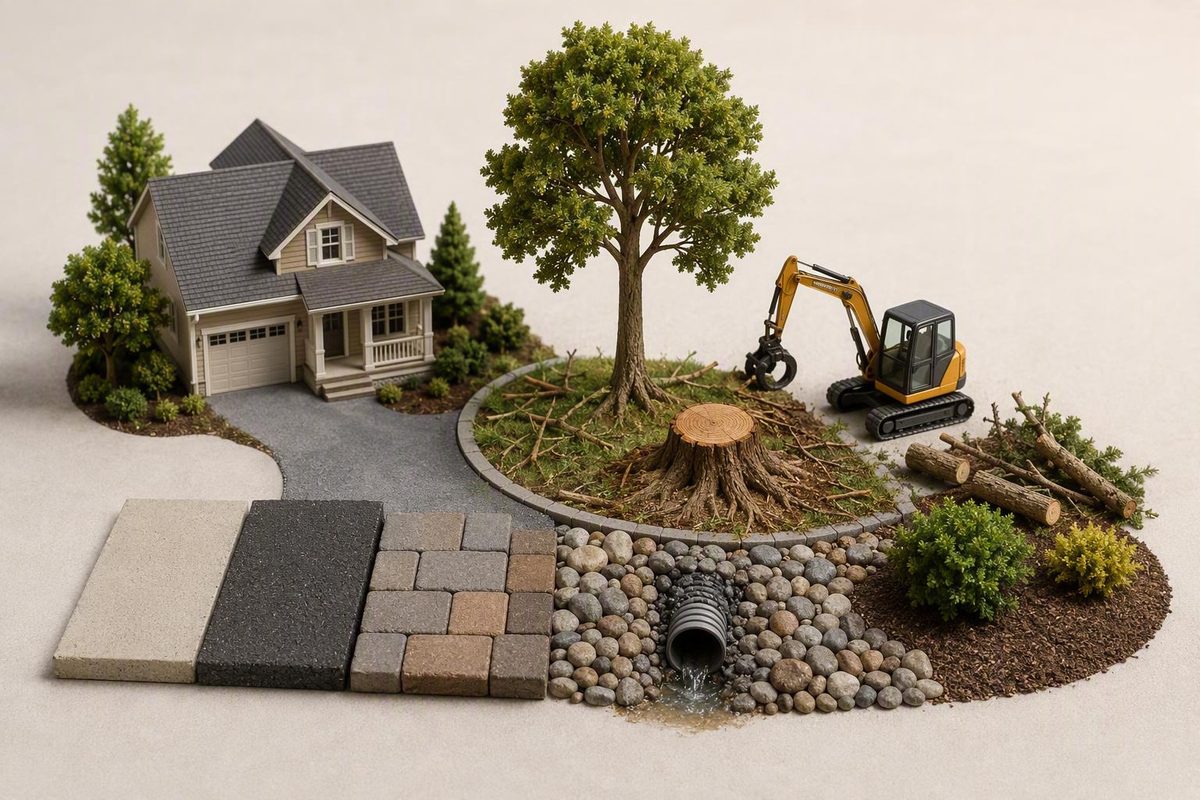
A professional tree-removal quote depends on four main cost buckets: the tree’s dimensions and condition, access and nearby hazards, the requested cleanup and restoration, and local timing or compliance requirements. Height matters, but it does not determine the price by itself. Published cost guides identify trunk and canopy size, accessibility, condition, labor, equipment, local rules, and optional stump or debris work as separate pricing variables (Thumbtack tree-removal cost guide).
For a driveway project, the practical question is broader than “What does it cost to cut down this tree?” The quote must also define whether equipment can use the existing pavement, what happens to the stump and roots, who removes grindings and organic material, and what condition the site will be left in for the paving contractor. Use national or commercial ranges only for a preliminary allowance, then compare itemized local estimates based on the same work plan.
The four cost buckets to check first
Separate each quote into four parts:
- Tree characteristics: Height, trunk diameter, canopy spread, branch structure, roots, condition, and the number of trees affect how much material the crew must cut, control, and move.
- Site constraints: Fall space, access width, slopes, soft ground, structures, pavement, fences, roads, pedestrians, and utilities determine which removal methods are practical.
- Requested service scope: Cutting, log handling, chipping, hauling, stump grinding, grindings removal, backfill, and restoration require different labor and disposal arrangements.
- Timing and local conditions: Emergency response, storm demand, travel, permits, protected-tree rules, utility coordination, traffic control, weather, and local labor conditions can affect scheduling and overhead.
This is why two similar-looking trees can receive very different estimates. One tree may have enough open space for controlled felling and ground-level processing. Another of the same size may stand beside a driveway, garage, fence, road, or utility line and need to be dismantled in small sections. Limbs and trunk pieces may have to be lowered rather than dropped, increasing the number of cuts and the coordination required.
Online ranges cannot account for the bearing capacity of an existing driveway, gate width, overhead wires, staging space, hidden decay, or the restoration standard needed for new pavement.
Cost benchmarks—and why the ranges do not agree
Published figures provide a broad starting point, but they do not establish a likely price for a particular property. The sources use different markets, project mixes, dates, and definitions of “removal.”
| Source | Reported benchmark | Date and geographic basis | Known scope notes |
|---|---|---|---|
| Thumbtack | $450–$1,450 national average range; $373–$3,300 broader range | Page displays “Last updated Tue, Jan 06” without a year beside the date; underlying collection period is not disclosed | Cutting down one tree; stump removal excluded |
| Angi | $750 average; $200–$2,000 or more typical range | Updated July 8, 2026; the displayed normal-range module is labeled McLean, Virginia, while the article’s prose presents broader estimates; sample and methodology are not disclosed | Page says to budget for stump grinding and wood disposal, but does not clearly establish whether either is included in the reported average |
Do not combine these figures into a new average. Thumbtack identifies its figures as national marketplace data for cutting down one tree, while Angi combines a location-labeled display with more generally worded estimates. Neither source supplies a bid for your tree, access conditions, local permit requirements, or driveway-related restoration.
Use the figures as an initial budget ledger, not as a target price. The more useful comparison is whether a published figure and a contractor’s estimate cover the same endpoint: cutting only, debris removal, stump grinding, or full restoration.
Tree dimensions, canopy, condition, and quantity
A contractor evaluates more than height. Trunk diameter indicates the volume and weight of wood to cut and handle. Canopy spread and branch structure affect the number of cuts, chip volume, rigging plan, and processing space. Large surface or buttress roots can also complicate stump work where the planned driveway will cross the former tree location.
The same Angi guide cited above publishes these height-based estimates:
| Tree height | Angi estimate |
|---|---|
| Up to 30 feet | $150–$450 |
| 30–60 feet | $450–$1,200 |
| 60–80 feet | $800–$1,500 |
| Over 80 feet | $1,000–$2,000 |
These bands are illustrations, not a pricing formula. A short tree with a thick trunk and broad canopy in a confined yard may require a more involved work plan than a taller, slender tree with open fall space.
Tree type, trunk and canopy size, and overall condition can influence costs 2026 Tree Removal Costs | Pros Explain Key Price Factors.
Condition requires careful treatment. Healthy, dense wood may be heavy to control and move. Dead, decayed, diseased, or storm-damaged wood may be brittle or unstable. OSHA notes that climbing a damaged or decayed tree may be unsafe and that an aerial lift or another appropriate positioning method may need to be considered (OSHA tree-care inspection guidance).
Removing several trees raises the total bill, but sharing travel, setup, and equipment mobilization may reduce the rate per tree. Treat this as a possibility to discuss with each contractor, not as a promised discount.
Access, fall space, utilities, and the removal method
The tree’s location can matter as much as its size because location determines what the crew can safely do. An open site may permit controlled felling. A confined site may require the crown and trunk to be dismantled section by section, with pieces lowered into a designated landing area.
Common constraints include:
- narrow gates or fenced backyards;
- steep slopes or soft ground;
- limited driveway width or uncertain pavement load tolerance;
- nearby homes, garages, sheds, fences, and landscaping;
- parked vehicles, roads, and pedestrians;
- overhead lines or underground utilities;
- insufficient room to stage logs, brush, or equipment.
Damage-sensitive targets can require climbing systems, ropes, rigging, controlled lowering, and additional crew coordination. Depending on the site and contractor’s plan, equipment may include an aerial lift, crane, chainsaws, chipper, stump grinder, or combinations of these. No universal equipment rule applies: a tall tree does not automatically require a crane, and equipment suitable for one property may not fit or be supportable at another.
Driveway access deserves its own line in the estimate. Ask where trucks, lifts, cranes, and chippers will enter, turn, and stand. A contractor proposing to use the driveway should explain the equipment route, pavement-protection measures, and any limits on responsibility for cracking, rutting, edge damage, curbs, or buried services.
Overhead electrical lines require separate attention. University of Florida extension guidance states that only qualified line-clearance arborists should work near electrical lines (UF/IFAS guidance on hiring the right tree professional). Ask whether the utility must perform prior work or interrupt service, who will coordinate that work, and what qualifications the assigned personnel hold. Do not assume an ordinary tree crew can treat energized lines as just another obstacle.
Roadside work can introduce permits, signs, barricades, flaggers, lane controls, or coordination with a road authority where locally required. These measures are not universal. The written estimate should identify the requirements that apply, who arranges them, and whether their cost is included.
What the quoted service actually includes
“Tree removal” can mean anything from placing a tree on the ground to restoring the area for its next use. Confirm the endpoint in writing, especially when paving work will follow.
| Service level | Typical work boundary | Items to confirm |
|---|---|---|
| Cutting only | Tree is felled or dismantled | Log lengths, branch-pile location, site access, whether any material leaves |
| Cutting plus wood and branch handling | Tree is cut and material is processed | Chipping, hauling, firewood lengths, splitting, chip retention, final cleanup |
| Removal plus stump grinding | Above-ground tree is removed and stump is ground | Grinding depth, buttress roots, grindings removal, underground-obstacle terms |
| Full restoration | Removal area is prepared for its next agreed use | Backfill, topsoil, compaction, seed, replacement planting, final grade |
Never assume stump work, chipping, hauling, firewood processing, or cleanup is included in a base cutting price. “Logs cut for firewood” may mean rough lengths rather than split, ready-to-use pieces.
Grinding reduces the stump—and sometimes specified surface or buttress roots—to an agreed depth.
That distinction matters when a driveway base will cross the former tree location. The tree and paving contractors should agree on:
- the required stump-grinding or excavation depth;
- which roots must be removed from the proposed driveway footprint;
- whether grindings and other organic debris must leave the site;
- who supplies and compacts replacement material;
- the final elevation and condition delivered to the paving crew.
A Village of Bensenville public-works specification illustrates how broad “complete” work can become: tree and debris removal, hauling, pavement cleanup, stump and buttress-root grinding below grade, grindings removal, topsoil backfill, compaction, seeding, and restoration (Bensenville tree-removal and stump-grinding specification). It is a municipal specification, not a residential price guide, but it shows why two totals carrying the same “tree removal” label may cover very different work.
For a driveway project, ask specifically:
- Where will trucks, lifts, cranes, or chippers enter and stand?
- Is the existing pavement suitable for the proposed equipment?
- What pavement or edge protection will be used?
- Who moves vehicles, gates, planters, trailers, or other obstacles?
- Who is responsible for damage to pavement, curbs, irrigation, fences, or landscaping?
- Will grinding address specified buttress or surface roots?
- Will grindings, roots, and debris remain or be hauled away?
- Is the backfill intended only for lawn restoration, or will the paving contractor complete the driveway subgrade?
Do not allow a generic lawn-restoration specification to become the driveway subgrade specification by default. Put responsibility for root removal, excavation, replacement material, grading, and compaction into the relevant contracts before either crew mobilizes.
Timing, location, and the cost of a professional operation
Planned removal with a flexible date provides more scheduling options, but no season is always the cheapest.
Geography affects pricing through labor conditions, travel distance, disposal options, weather, permits, protected-tree rules, utility coordination, and local demand. Requirements can vary by municipality and utility, so obtain current information from the authority responsible for the property rather than applying another city’s rules.
Professional pricing also supports the operation behind the cutting: trained labor, insurance, equipment purchase and maintenance, transportation, safety controls, compliance, overhead, and profit. University of Arizona Cooperative Extension identifies trucks, hydraulic booms, chippers, stump grinders, chainsaws, insurance, training, maintenance, and business costs as components of professional tree-service pricing (guidance on hiring a tree expert).
Tree work can expose workers to falls, falling objects, chainsaws and other powered equipment, vehicle strikes, and electrical contact. Those hazards help explain why the work plan may require qualified personnel, maintained equipment, controlled work zones, and protective systems. They do not establish a fixed consumer surcharge.
Residential and municipal prices are not interchangeable. Public-works contracts may include prevailing wages, formal traffic control, licensing, procurement obligations, reporting, deadlines, and detailed restoration. Such documents are useful for understanding possible scope components, but their total budgets or unit structures should not be treated as ordinary residential per-tree prices.
Possible savings strategies include scheduling ahead, bundling several trees, or coordinating nearby work so travel and equipment mobilization can be shared. Whether any of these lowers the price depends on the contractor’s schedule, equipment plan, and cost structure.
A worksheet for requesting and comparing quotes
Give every contractor the same preliminary information before the site visit:
- approximate tree height;
- trunk diameter and the measurement location used;
- canopy spread;
- visible cavities, cracks, dead sections, lean, broken limbs, or storm damage;
- distance to the driveway, house, garage, fence, road, and other targets;
- slope and visible ground conditions;
- gate and access-route width;
- overhead or nearby utility lines;
- current driveway material and condition;
- desired stump treatment and grinding depth;
- whether logs, chips, roots, and grindings stay or leave;
- desired backfill and restoration endpoint;
- photographs from several directions, including the complete access route.
A consistent trunk measurement can help contractors understand which tree is being discussed, but dimensions and photographs cannot replace an on-site inspection. Do not rely on an online calculator to determine the final price or removal method.
Obtain multiple written estimates based on an identical requested scope. Then normalize them in a comparison table:
| Bid item | Contractor A | Contractor B | Contractor C |
|---|---|---|---|
| Removal method | |||
| Crew and equipment | |||
| Driveway access plan | |||
| Pavement protection | |||
| Utility coordination | |||
| Permits | |||
| Traffic control | |||
| Wood disposition | |||
| Chipping and hauling | |||
| Stump-grinding depth | |||
| Root treatment | |||
| Grindings removal | |||
| Backfill and restoration | |||
| Schedule | |||
| Total price | |||
| Payment terms | |||
| Unexpected-work rates |
Before hiring, verify current liability insurance, workers’ compensation coverage, relevant credentials, and any qualifications required for utility-line work. Licensing, registration, and insurance rules vary by location, so confirm applicable requirements with the relevant regulator or utility.
The written agreement should explain how hidden decay, underground obstacles, blocked equipment routes, additional traffic controls, utility delays, and other scope changes will be handled. Rutgers recommends that tree-care contracts identify the tree, work details, schedule, cleanup, firewood disposition, stump handling, total cost, and rates for unexpected additional work (Rutgers guidance on hiring a tree-care professional).
Compare the work plan, not just the total. A useful estimate should show what will be cut, how the crew will access and dismantle the tree, what happens to the wood and stump, how the driveway and surrounding property will be protected, and how unexpected work will be priced. When tree removal is part of a driveway project, settle equipment access, utilities, stump and root treatment, debris removal, and the handoff to the paving contractor before finalizing the paving schedule or budget.