
Concrete Crack Repair Epoxy: When It Works on a Driveway
Learn when epoxy can bond a concrete driveway crack, when flexible sealant or slab repair is better, and what to check before buying.
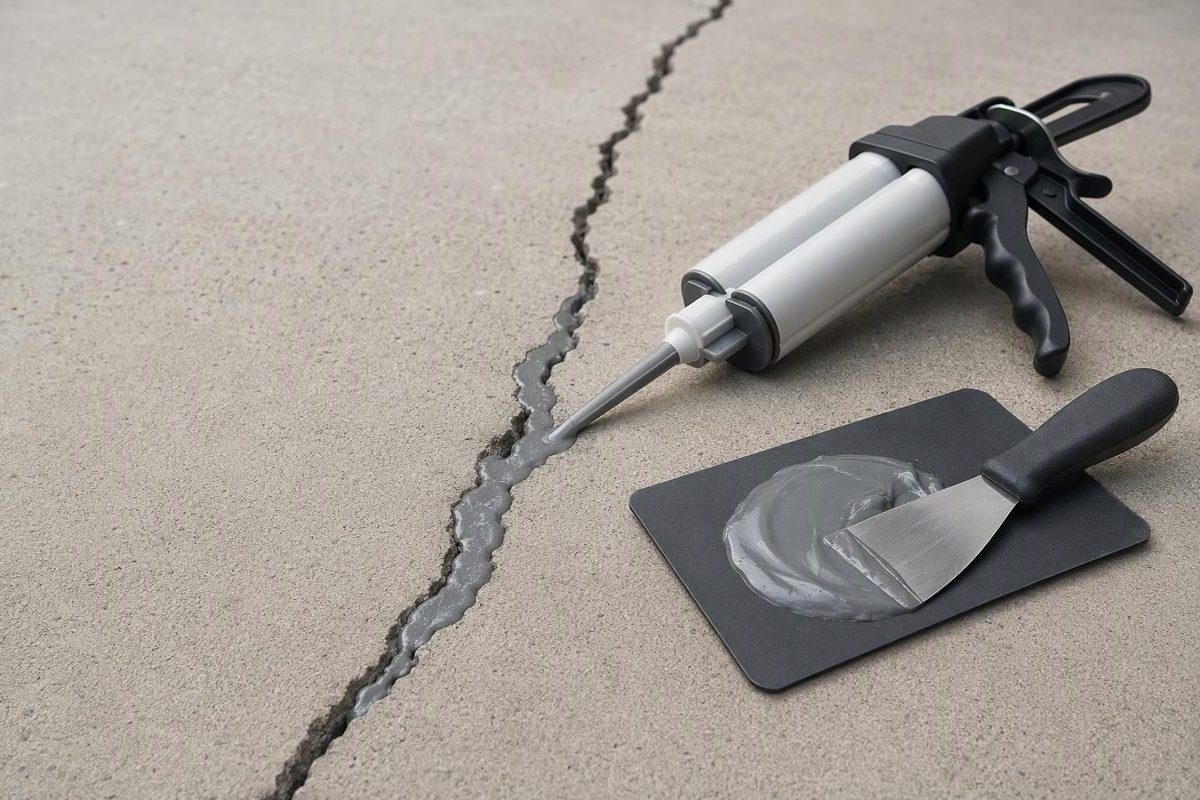
Concrete crack repair epoxy is a rigid adhesive, not a universal crack filler. It can suit a clean, sound crack that remains level and appears dormant after monitoring. It is a poor choice when the crack still opens seasonally, one side has settled, water is eroding the base, or the concrete around the opening is breaking apart.
That distinction matters more than the brand name or the strength printed on the cartridge.
Match the material to the crack
| What you see | Better starting point |
|---|---|
| Clean, level crack with no observed movement | Low-viscosity epoxy labeled for gravity-feeding horizontal concrete cracks |
| Crack that opens and closes with temperature or frost | Flexible, traffic-rated concrete sealant |
| Open expansion or isolation joint | Flexible joint sealant over correctly sized backer rod—not epoxy |
| Vertical offset, rocking slab or recurring settlement | Diagnose support, drainage and soil movement before filling |
| Broken edges, scaling or a cavity | Remove unsound concrete and use a compatible repair mortar or partial-depth repair |
| Widespread cracking or several displaced pieces | Obtain a concrete-repair assessment; replacement may be more durable |
The American Concrete Institute says the crack’s cause and the repair objective should be established before epoxy injection. If the crack will continue to move, epoxy may not be applicable; cracking caused by corroding reinforcement also requires the corrosion to be addressed first (ACI RAP-1).
Movement is often the deciding issue on a driveway. A rigid repair may hold the original crack while a new crack forms nearby if settlement, frost heave or thermal movement continues. One epoxy manufacturer similarly states that dynamic cracks caused by seasonal heaving, temperature changes or repeated overloading cannot be effectively repaired by crack injection and instead calls for a flexible material (CRACKBOND SLV-302 technical data).
An expansion joint is deliberately intended to move. Use a sealant designed for that movement, not rigid epoxy. For example, one self-leveling polyurethane is rated for ±35% joint movement and uses backer rod to control sealant depth (Sikaflex SL 1 guidance). That example identifies the material class, not a universal product choice. See also which driveway concrete joints should be caulked.
Gravity feed is not the same as full-depth injection
For an accessible horizontal driveway crack, gravity feed is the simpler epoxy method. Low-viscosity resin is placed in the prepared opening and replenished as it penetrates. Pressure injection instead uses ports and a surface cap to force resin into a crack; it is used when gravity cannot deliver the material or a specified structural repair requires deeper penetration.
Do not assume resin poured at the surface has bonded the full slab depth. TxDOT says gravity-fed epoxy effectively fills crack tops, but penetration varies and often does not exceed about 1/4 inch. Its procedure is therefore limited to shallow cracks or locations where surface protection from water and chlorides is the objective (TxDOT gravity-fed crack-repair guidance).
A through-crack that needs structural continuity is a reason to have a qualified repair contractor or engineer specify the method. A surface fill alone does not demonstrate a full-depth bond.
What to check before buying epoxy
“Concrete epoxy” is too broad a description. Read the current technical data sheet and verify:
- Intended use: The product should explicitly permit gravity-fed repair of horizontal concrete cracks.
- Crack-width range: Match the product to the measured opening. ACI recommends epoxy with viscosity of 500 centipoise or less for injection into cracks 0.010 inch or narrower (ACI RAP-1). One super-low-viscosity product permits gravity feeding from 0.0025 to 0.125 inch, but that range applies only to that formulation (CRACKBOND SLV-302 technical data).
- Moisture limits: “Moisture tolerant” does not automatically mean suitable for standing water or an actively leaking crack. One current cartridge epoxy requires a clean, dry, sound surface and prohibits application over a wet, glistening surface (Sikadur Crack Fix data sheet).
- Application temperature: Check both the air and concrete. That same product allows application from 40°F to 95°F; other formulations differ.
- Working and cure times: Pot life is the usable mixing window, not the time before a vehicle may cross the repair. Follow the return-to-service instructions at the actual slab temperature.
- Exterior appearance: Some clear or amber epoxies discolor under ultraviolet exposure and are not aesthetic finishes. Expect the repair to remain visible unless the manufacturer permits a compatible finish.
- Mixing method: A dual cartridge and static mixer simplify proportioning for a small repair. Bulk kits require exact measurement and thorough low-speed mixing.
High advertised compressive strength does not establish suitability. Penetration, adhesion, movement, moisture condition and correct mixing determine whether the product can work in the crack you have.
A practical gravity-feed sequence
Follow the selected manufacturer’s directions wherever they differ.
- Check whether the slab is stable. Look for vertical displacement, rocking under a wheel, widening ends and nearby drainage trouble. Mark and measure a questionable crack through changing weather before bonding it rigidly. The FHWA notes that moisture and loss of support can contribute to faulting and cracking; if the underlying cause remains, distress can return (FHWA Concrete Pavement Preservation Guide).
- Remove contamination and weak concrete. Oil, old sealant, dust and loose material prevent adhesion. ACI recommends wire brushing because grinding can pack dust into the crack, followed by cleaning with oil-free compressed air or a vacuum (ACI RAP-1). Cut a V-notch or reservoir only when the product instructions call for it, and use the specified dimensions.
- Meet the moisture requirement. Stop active water entry and let the concrete reach the condition stated in the data sheet.
- Prepare and mix exactly as directed. Purge a dual cartridge until the two components produce a uniform blend. For bulk material, measure rather than estimate the ratio and mix only what can be placed within the stated pot life.
- Feed the crack slowly. Replenish resin while the level drops. An ACI-hosted gravity-feed workshop calls for allowing time to penetrate, pouring until full, then checking for bubbles and dry spots before removing excess resin (ACI RAP-2 workshop). If resin drains through the slab or disappears into a void, stop: the visible opening may not be suitable for a dependable gravity-fed repair.
- Protect traction and cure time. Do not leave a broad slick film in a tire path. Use only the manufacturer-approved aggregate broadcast or finishing method, and keep vehicles off until the published cure or return-to-service requirement is met.
Wear the protective equipment required by the safety data sheet. If preparation involves powered cutting or grinding, use appropriate water delivery or a shrouded dust-collection system rather than uncontrolled dry cutting; OSHA’s construction silica standard specifies those controls for concrete saws and grinders (OSHA 29 CFR 1926.1153).
Know when filling is not the repair
Epoxy cannot raise a sunken panel, rebuild a washed-out base or stop frost heave. A crack with one side higher than the other is evidence of movement, not merely an opening that needs glue. Address concentrated runoff, downspout discharge or edge erosion before repairing the surface.
Epoxy poured over crumbling concrete also bonds to material that is already failing. If the edges are flaking or a cavity exposes coarse aggregate, identify the deterioration depth first. Our guide to concrete scaling and spalling explains when a patch may be more appropriate.
The useful buying rule is narrow: choose epoxy for a sound, stable crack that needs rigid bonding. Choose flexible sealant for expected movement, repair mortar for missing concrete, and base or slab work when the two sides no longer behave as one level panel.