
Drainage Rock for Driveways: Size, Uses and Quote Checks
Choose drainage rock for a driveway trench or base, estimate quantity, and check the stone, outlet, fabric and pipe details in a contractor quote.
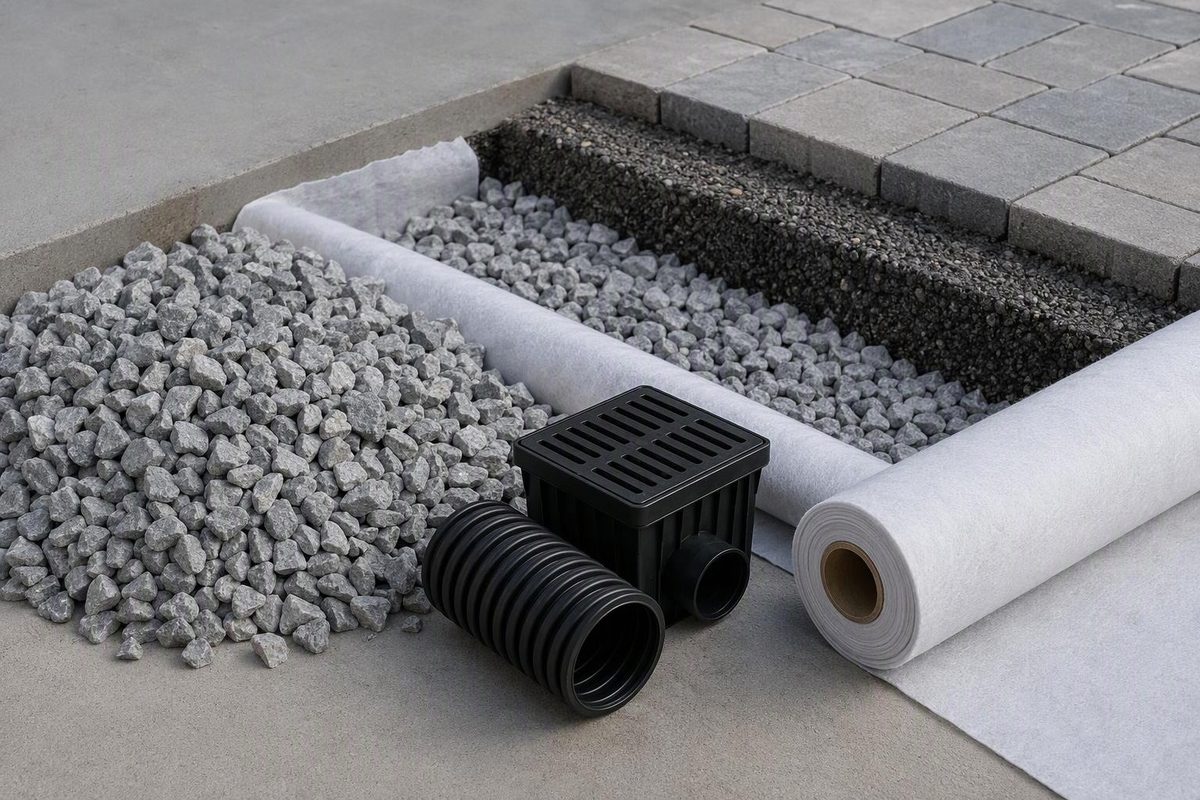
Drainage rock is typically clean, coarse aggregate with connected void space through which water can move. Around a driveway, it belongs in a designed drain, drainage layer or stabilized outlet—not automatically on top as the driving surface.
The key distinction is gradation. Open-graded or “clean” aggregate has little fine material and drains effectively, but it does not form the dense, tightly bound surface produced by well-graded material. Well-graded aggregate contains smaller particles that fill the voids, making it better suited to a firm gravel surface but less suitable for moving water through the layer, according to Penn State’s Aggregates 101 guide.
What to ask for at the quarry
For a driveway drain, clean, washed, angular crushed stone in a documented gradation is a more useful specification than simply asking for “drainage rock.” Product names vary by region and quarry.
AASHTO No. 57 is a common reference gradation, but it is not one uniform 3/4-inch stone, and “57” is not a measurement. The gradation permits a range: 95%–100% passes the 1-inch sieve, 25%–60% passes the 1/2-inch sieve, no more than 10% passes the No. 4 sieve, and no more than 5% passes the No. 8 sieve, as shown in the FHWA’s AASHTO M43 gradation table. Maryland’s stormwater construction guide describes No. 57 as typically 3/8 to 1 inch and uses it around underdrains, in stone reservoirs and beneath permeable paving systems (Maryland Department of the Environment).
No. 67 is a smaller open-graded alternative: the same FHWA table allows 100% to pass the 1-inch sieve and 90%–100% to pass the 3/4-inch sieve. It may be easier to place in a confined trench, but local availability and the project specification matter more than the label alone.
“Clean” generally refers to a gradation with very few fines. Washing removes much of the dust and residue left by crushing. For a drain, request both and ask for the quarry gradation or product data sheet. Stone dust, screenings, crusher run and road base are different materials.
Angular crushed stone generally interlocks better than rounded gravel. The Maryland guide notes that fractured stone faces knit together more stably than smooth, rounded gravel. Rounded pea gravel can convey water, but it is easier to displace and is usually a weaker choice beneath traffic.
Match the rock to the driveway job
| Driveway use | Practical starting specification | Important limitation |
|---|---|---|
| French drain or edge drain | Clean, washed No. 57; a smaller clean gradation where placement space is limited | The trench still needs suitable filter separation, grade, pipe where required and an acceptable outlet |
| Drainage layer beneath pavement | Project-specified open-graded aggregate | It must connect to an edge drain or other outlet; it does not correct a saturated or weak subgrade by itself |
| Stabilizing soft ground | Site-specific clean stone, separator and overlying base | Stone size and layer depth depend on soil conditions and vehicle loads |
| Gravel driveway surface | Usually a dense-graded, angular surfacing aggregate—not drainage rock alone | Clean stone does not form a dense, smooth wearing course and can migrate at unconfined edges |
| Ditch or pipe outlet protection | Properly sized riprap over a compatible filter layer | No. 57 may be too small to resist concentrated flow |
If the goal is a stable unpaved surface, compare drainage stone with crusher run gravel and other driveway gravel options. A layered design may use open stone where subsurface drainage is needed, with a compactable base or wearing course above it.
Rock does not fix drainage without a water path
Before ordering stone, identify where the water begins, where it should be intercepted and where it can safely discharge. A rock-filled trench with no positive fall or outlet may simply store water beside the driveway.
USDA’s heavy-use-area standard calls for positive grade in the planned direction of flow and recommends preventing clean surface water from entering the traffic area where possible (USDA NRCS). For a driveway, first consider surface shaping, a crown or cross-slope, uphill diversion and working ditches. A subsurface drain is more appropriate when water is entering through the soil or must be intercepted below grade.
Excess moisture can weaken unbound base and subgrade, contribute to movement of fines and worsen rutting, settlement and frost-related damage. The FHWA pavement drainage manual presents prevention, moisture-tolerant materials and rapid removal as complementary approaches rather than relying on one fix.
Depending on the problem, an edge-drain assembly may include:
- a trench graded toward a dependable outlet;
- filter-compatible geotextile separating native soil from stone;
- clean drainage aggregate;
- perforated pipe where needed to collect and carry flow;
- solid outlet pipe, an accessible cleanout and protected discharge point; and
- compacted driveway materials restored above or beside the drain.
Geotextile is not interchangeable with ordinary landscape fabric. Its opening size and flow properties should suit the surrounding soil, while its strength should suit installation. Maryland’s guide identifies separation of aggregate from native soil as a common geotextile role. For layouts and outlet choices, see driveway drain types and the more specific guide to French-drain gravel.
Estimate the quantity before comparing quotes
For a rectangular layer:
Cubic yards = length (ft) × width (ft) × depth (in.) ÷ 324
A 50-foot-long, 12-inch-wide trench filled to an average depth of 18 inches requires:
50 × 1 × 18 ÷ 324 = 2.78 cubic yards
That is the gross trench volume. Subtracting a small pipe’s volume rarely changes a small order much, while irregular trench walls and over-excavation can add material. Measure the actual section and ask the supplier to convert yards to tons using that product’s bulk density. Rock type, gradation, moisture and handling all affect weight; our gravel weight guide explains why the conversion is a range.
For cost comparisons, request the delivered stone price separately from excavation and installation. Freight, minimum-load charges and equipment access can matter more than a small difference in quarry price.
What a drainage-rock quote should state
A useful quote identifies more than “stone and labor.” Check for:
- aggregate source, gradation and whether it is washed;
- tons or cubic yards supplied, plus any conversion used;
- trench or layer dimensions and finished depth;
- excavation, unsuitable-soil removal and spoil disposal;
- geotextile product and installation location;
- pipe material, diameter, perforated and solid sections, fittings and cleanouts;
- slope, outlet location and outlet protection;
- overlying base or surface material;
- placement and compaction method; and
- restoration of shoulders, lawn, ditch or pavement.
Do not approve a vague proposal that promises drainage by adding several inches of clean rock to a wet driveway. The contractor should be able to show the intended flow path, discharge point and finished cross-section. If groundwater is persistently high, the driveway is sinking, or runoff threatens a building or neighboring property, seek a site-specific drainage evaluation rather than ordering more stone.