
Driveway Paver Thickness: When to Use 60 mm or 80 mm
Choose 60 mm or 80 mm driveway pavers by vehicle use, unit size and base support. Check product approval, drainage and thickness details before accepting a bid.
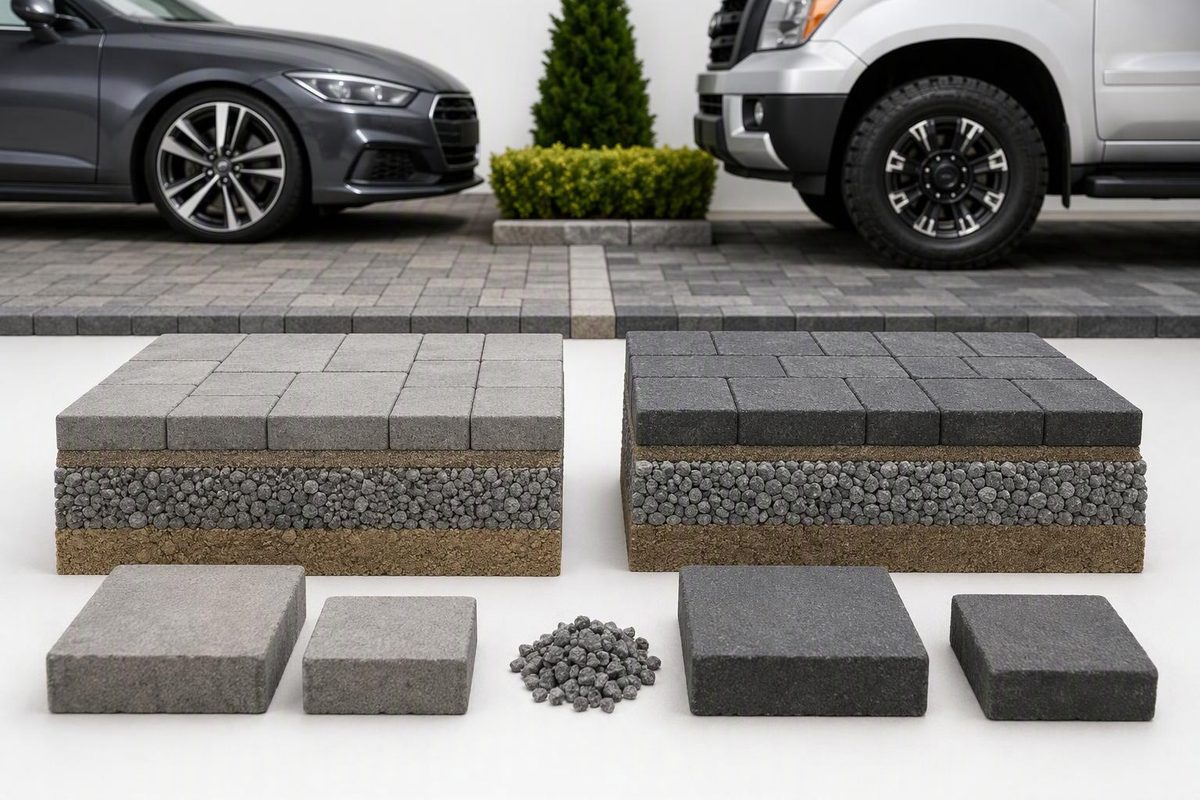
For a conventional residential driveway carrying cars and light vehicles, 60 mm (about 2⅜ inches) is the starting minimum for interlocking concrete pavers—not a guarantee that every paver that thick is suitable. For streets and industrial pavements, the Concrete Masonry & Hardscapes Association recommends at least 80 mm (about 3⅛ inches) in its construction guidance.
Choose the actual product by vehicle use, unit dimensions and the manufacturer’s installation requirements. Then specify its supporting layers separately. Thicker pavers cannot substitute for a properly prepared base.
Which thickness fits your driveway?
These recommendations concern interlocking concrete pavers and draw on CMHA’s U.S. and Canadian guidance. They do not replace local project specifications. Do not transfer them automatically to clay brick, natural stone or porcelain products.
| Driveway use or product | Purchasing judgment |
|---|---|
| Cars and light vehicles on a conventional aggregate-base driveway | Start with driveway-approved 60 mm units, checking dimensions and installation requirements. |
| Regular heavy trucks, commercial vehicles or a large motorhome | Have the pavement designed for the actual loads. Treat 80 mm as a starting point for discussion, not a complete specification. |
| Permeable interlocking concrete driveway | Start with the system specification; CMHA describes vehicular units as typically at least 80 mm thick. |
| Large-format slabs or long, narrow planks | Do not select by thickness alone. Require explicit vehicular-use approval and the corresponding assembly detail. |
| Units thinner than 60 mm | Do not accept them as a routine substitute for conventional driveway pavers. Require a documented, driveway-rated system for the proposed installation. |
CMHA’s guide specification recommends residential driveway units at least 60 mm thick with a maximum 4:1 aspect ratio. Its broader vehicular guidance references at least 80 mm and a maximum 3:1 ratio. Regular heavy-vehicle use therefore needs more than an upgrade on the paver order: the base and subgrade need review too.
For permeable paving, CMHA’s system construction guide describes different bedding and reservoir layers as well as typically thicker vehicular units. See our permeable driveway installation guide before comparing that assembly with a conventional sand-set bid.
Why paver size matters as much as thickness
Aspect ratio means length divided by thickness, using the same units. A 240 mm-long paver that is 60 mm thick has a 4:1 ratio. A 300 mm-long unit at the same thickness has a 5:1 ratio, exceeding CMHA’s residential-driveway recommendation.
That is why “2⅜-inch concrete paver” is not enough information to approve a product. Obtain the dimensions of every size in a mixed-size package, not just the smallest piece.
Large slabs and slender planks behave differently from conventional interlocking units. Belgard’s slab and plank technical note warns that vehicular loading can crack them through bending or movement in a sand bed. It generally calls for a project-specific design for vehicular use and a minimum 80 mm thickness for vehicular planks. Neither thickness nor a favorable ratio, by itself, establishes approval for a particular product.
Paver thickness is not total driveway depth
A quote should distinguish three things:
- Paver thickness: the concrete surface unit.
- Bedding thickness: the thin, uniform layer seating the units.
- Compacted base thickness: the load-supporting aggregate below the bedding.
For conventional residential driveways on well-drained soils, CMHA recommends at least 6 inches of compacted aggregate base, with thicker bases required for continually wet or weak soils in colder climates. It specifies a nominal 1-inch uncompacted concrete-sand bedding layer and says bedding sand must not be used to correct an uneven base. These are conditions and layer measurements—not a universal excavation depth. See the construction bulletin and our driveway paver base guide.
The same bulletin identifies edge restraints as a key part of maintaining interlock. An 80 mm surface over settling aggregate or inadequately restrained edges is not a sound upgrade over a properly specified 60 mm assembly.
What to put in the quote
Before paying extra for thicker pavers, ask for:
- Exact product, all unit dimensions and nominal thickness, with manufacturer confirmation of driveway suitability.
- Design traffic: normal vehicles plus any regular delivery trucks, motorhome or commercial use.
- Base material and compacted depth, bedding material and depth, and the compaction requirements.
- Drainage and finished elevations, including the garage threshold and any drains.
- Edge-restraint details and a separately priced 60-to-80 mm alternative, if both products are suitable.
If retaining an existing concrete slab, use a specific paver-over-concrete assessment, rather than assuming a thinner unit is acceptable because concrete is underneath. Choose the approved assembly first; compare the thickness premium second.