
Geotextile Fabric for a Driveway: Types and Installation
Learn when driveway geotextile helps, how to compare woven and nonwoven fabric, and what to specify for overlap, aggregate cover and cost.
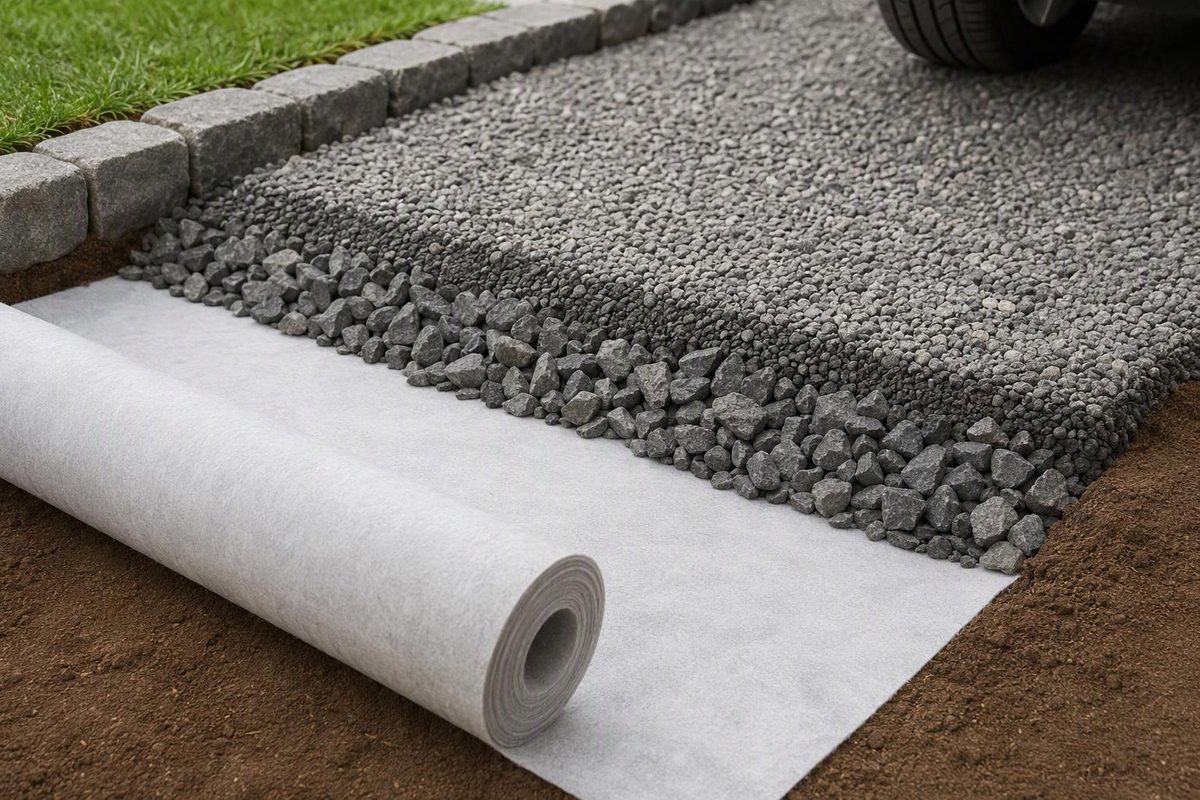
Geotextile fabric is worth considering when driveway aggregate could mix with the soil beneath it—especially over fine-grained or weak ground. Used as a separator, it keeps the stone base and underlying soil distinct under repeated vehicle loading. It is not a substitute for drainage, adequate stone depth or compaction. Both woven and nonwoven geotextiles can serve as separators when properly specified. FHWA’s pavement guidance explains these functions and selection requirements.
This guide covers fabric beneath a driveway’s aggregate base. Start by asking what the fabric needs to accomplish, rather than shopping by roll weight or a “heavy-duty” label.
When fabric helps—and when to fix something else first
A separator makes sense where the concern is contamination of the aggregate by the underlying soil. In plain terms, you want the base to remain stone, not become a mixture of stone and mud. Michigan DOT identifies prevention of this intermixing under repeated loading as a reason to use geosynthetics. It treats stabilization over inadequate soils as a separate design task. Michigan DOT construction guidance
Use these distinctions when reviewing a driveway proposal:
| Site condition | Purchasing judgment |
|---|---|
| Fine-grained soil beneath a new aggregate base | Ask for a separator suited to the soil and installation conditions. |
| Soft areas that pump water or deform under equipment | Investigate drainage and weak-soil treatment before choosing fabric. |
| Sound existing gravel base needing a surface refresh | Do not assume a new fabric layer is necessary; ask what failure it would address. |
| Recurring standing water or washouts | Resolve water movement and the outlet, not just the fabric specification. |
US Fabrics’ unpaved-road installation guide calls for replacing pockets of very weak soil and addressing areas that consistently hold water with soil replacement and drainage. It also allows smaller stone from an existing driveway to remain in place. Fabric does not automatically require excavating every existing layer. US Fabrics installation guide
For water-related failures, first compare the relevant driveway drainage solutions.
Woven versus nonwoven: neither name is a complete specification
Woven stabilization fabric is one option beneath residential driveway aggregate. For example, US Fabrics recommends its woven US 200 for typical residential driveways, while noting that unusual traffic or site conditions may require a heavier stabilization product. That is a manufacturer’s recommendation, not proof that every woven roll suits every driveway. US Fabrics driveway guidance
Nonwoven fabric is commonly used for filtration and separation. It can also be a suitable base separator: FHWA explicitly recognizes both woven and nonwoven products for that application. The decision depends on soil retention, water flow and the strength needed to survive construction—not appearance alone. FHWA separator and filter design guidance
Do not apply a blanket “woven for driving, nonwoven for water” rule. Michigan DOT warns against low-permeability woven products where vertical drainage is critical; FHWA requires hydraulic compatibility with the adjacent materials. If water must pass through the layer, check the actual product’s flow properties. Michigan DOT
Ask the supplier or contractor for:
- The manufacturer and exact product designation.
- Its stated separation, stabilization or filtration application.
- Strength and puncture-resistance data appropriate to the aggregate and equipment.
- Apparent opening size, which relates to soil retention, and permeability or permittivity, which describe water passage.
- Written installation requirements for overlap, cover and repairs.
A weed-barrier label or ounces-per-square-yard figure alone does not answer those questions. FHWA’s selection method evaluates filtration compatibility and construction survivability separately.
Geogrid is different. Its openings allow aggregate to interlock and restrain lateral movement. If a quote includes geogrid, ask whether a separate soil-separation layer is also needed. Michigan DOT’s material definitions
Installation details that belong in the quote
For a soil-to-base separator, the basic sequence is prepared ground, geotextile, then aggregate. Specify these details before stone delivery:
- Prepare the ground. Remove protruding objects that could puncture the fabric, address weak pockets and establish drainage. Avoid excavating a water-holding depression without an outlet.
- Lay the fabric flat against the prepared surface. Minimize folds and prevent movement during spreading.
- Specify overlaps in both directions. US Fabrics’ guide bases overlap and sewing requirements on measured soil strength. Weaker ground requires larger overlaps or sewn seams; do not choose a universal overlap from the roll label alone.
- Repair damage before covering it. Use the product’s repair requirements rather than leaving tears beneath the base. US Fabrics installation guide
- Protect the fabric from equipment. A conservative specification keeps vehicles off exposed fabric. Michigan DOT prohibits direct equipment travel; FHWA’s highway separator guidance calls for at least 6 inches of base/subbase between wheels and fabric at all times. These are highway construction provisions, not a universal residential specification. Agree on protective cover suitable for the product, ground and equipment—and do not confuse it with the complete driveway base-depth design. Michigan DOT · FHWA
The quote should state aggregate type, compacted thickness, placement and compaction separately. Do not accept a thinner base merely because “fabric is included” without a site-specific justification.
Calculate purchased fabric, not just driveway area
A 12-by-100-foot footprint covers 1,200 square feet, but seams and roll widths can increase the purchase.
For an illustrative layout—not an overlap recommendation—two 8-by-100-foot panels with a 2-foot longitudinal overlap cover 14 feet of width but consume 1,600 square feet of fabric. A sufficiently wide single panel could avoid that seam. Buying full rolls may leave additional unused material. Confirm the full prepared-base footprint, curves, turnouts, end overlaps and available roll sizes before ordering.
Compare quotes using:
Fabric cost = purchased quantity × quoted unit price + freight + tax
Then separate installation labor, ground preparation, drainage, aggregate and compaction. Ask whether billing is by purchased roll area or net installed coverage; square-yard quotes need conversion at 9 square feet per square yard.
Use the gravel driveway installation cost guide to compare the complete project—not a cheap fabric line that leaves necessary base work out.