
How Long Does a Paver Driveway Last?
Plan for decades of paver driveway service. Learn what affects lifespan, which defects need repair, and what to check in an installation quote.
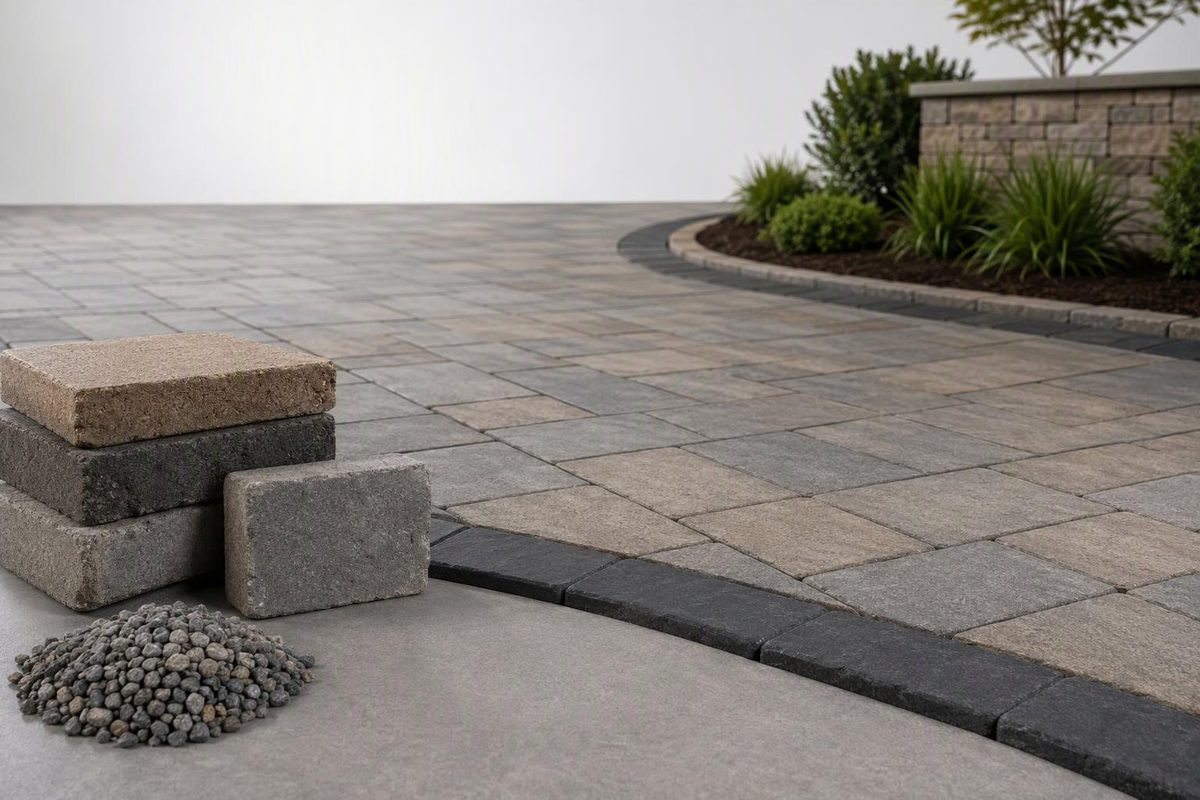
A properly built interlocking concrete paver driveway can last for decades, with maintenance and localized repairs along the way. The Concrete Masonry & Hardscapes Association (CMHA) describes properly installed concrete paver surfaces as providing an attractive surface for decades. Installer System Pavers states a minimum 25-year design expectation for its driveways. That figure is a company-specific expectation—not a universal average or a guaranteed replacement date.
The important distinction is between the life of the paving units and the life of the installation beneath them. Sound pavers may need lifting and resetting because the base settled. That is repair work—not necessarily the end of the driveway.
This guidance concerns interlocking concrete pavers. If your quote says “brick pavers,” confirm whether it means actual clay brick or brick-shaped concrete; do not assume every material or product has the same service life.
What makes a paver driveway last?
A premium surface cannot compensate for weak support. CMHA identifies inadequate compaction, saturated base or soil, excessive bedding thickness, and washed-out bedding or joint sand as causes of depressions. It also identifies insufficient base thickness or stiffness as a possible cause of major wheel-path rutting. See its maintenance and repair guide.
The details worth paying for are:
- Base preparation matched to the site. Ask for the aggregate type, compacted thickness, soil preparation and compaction method—not simply “a gravel base.” There is no single base depth that suits every soil, climate and vehicle load. Use the driveway paver base guide to check the specification.
- Drainage with a destination. The quote should explain surface grades and where water goes, including any necessary bedding-layer drainage. Persistent saturation is a support problem, not something a coat of sealer will fix.
- Stable edge restraints and filled joints. Edging keeps the perimeter from spreading; joint sand helps transfer loads between neighboring units. Losing either can let the paving pattern move. CMHA explains these roles in its structural design guide.
- Pavers selected for the actual traffic. Tell the installer about regular RV, trailer or heavy-truck use before accepting the design. Thickness, unit proportions, laying pattern and base support work together. Our driveway paver thickness guide explains what to verify.
In a freezing climate, also ask about product freeze–thaw and deicer durability. CMHA notes that ASTM C936 includes these durability criteria for concrete pavers. Durable units do not eliminate the separate risk of frost heave in the underlying soil. Both issues are covered in its maintenance guide.
Repair or replace? Look at the defect, not just the age
CMHA’s distress and repair guidance supports the following starting points:
| What you see | What to investigate | Likely scope |
|---|---|---|
| A few chipped or broken units | Local damage or inadequate support | Replace affected pavers; check support if damage recurs |
| A localized low spot | Bedding, base or soil settlement; drainage | Lift the area, correct the cause and reset sound units |
| Widening joints near the perimeter | Loose or failed edge restraint | Repair edging and reinstate adjacent pavers |
| Deep wheel-path ruts or widespread movement | Base capacity, compaction and drainage | Broader reconstruction may be needed; serviceable pavers may still be reusable |
| White haze without movement | Possible efflorescence | If confirmed as efflorescence, an appearance issue—not structural failure |
The useful repair question is: “Which layer failed, and how will you correct it?” Resetting pavers without addressing a saturated or inadequate base leaves the cause in place.
Maintenance that protects service life
For conventional sand-jointed concrete pavers, CMHA recommends spring and fall preventive maintenance:
- Sweep away dirt, leaves and leftover winter sand.
- Inspect during or just after rain for ponding, rutting and runoff entering from adjacent areas.
- Replenish lost joint sand with material appropriate to the existing joint system. Avoid pressure-washing it out. CMHA advises against using polymeric sand merely to top up partially filled joints.
- Repair raised or loose units before snow-removal equipment catches their edges.
Sealing can make stains easier to remove, but it is not a substitute for drainage, compaction or joint maintenance. Do not accept a fixed resealing schedule without checking the selected product’s instructions and surface condition.
Permeable pavers need a different maintenance plan. Their stone-filled joints can clog with sediment and lose infiltration even while the paving units remain sound. Follow CMHA’s permeable pavement maintenance guidance, rather than adding conventional joint sand.
Before signing, separate the product warranty from the installer’s workmanship warranty. Ask whether settlement, failed edging, joint-material loss and the labor to lift and relay pavers are covered. A long warranty label is less useful than a clear base specification, drainage plan and written repair responsibility.