
Stabilized Decomposed Granite Driveways: Cost & Base
See when stabilized decomposed granite works for driveways, what it costs, how much base it needs, and which drainage and snow issues matter.
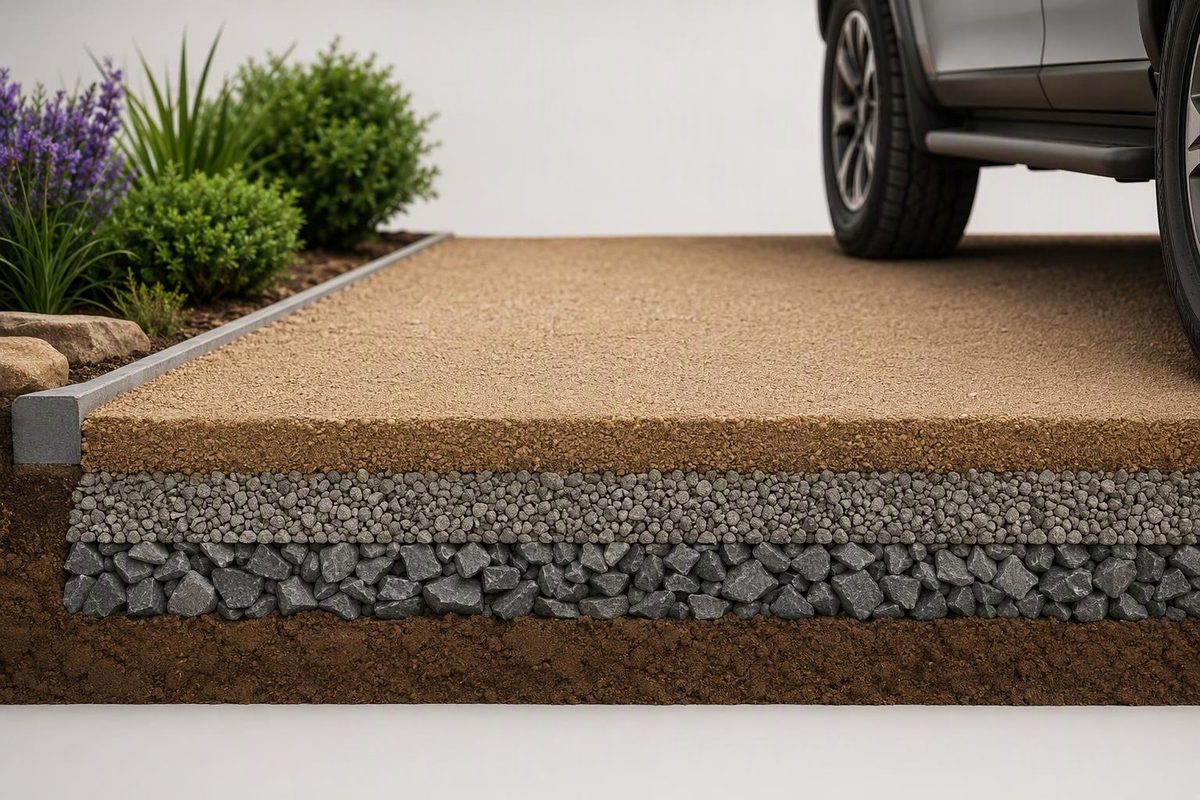
Yes—stabilized decomposed granite (DG) can make a firm, natural-looking residential driveway with less loose material than untreated DG. It works best on a low-speed, gently graded, well-drained driveway where periodic surface maintenance is acceptable. It is a weaker choice for concentrated runoff, frequent heavy vehicles or snow removal that must scrape the surface clean.
Enter your driveway area and surface depth to estimate DG volume and material cost.
DG Quantity And Material-Cost Calculator
Calculations use compacted dimensions. Ordering allowances, delivery and installation are not included.
Material benchmark
Current estimate
500 sq. ft. at a 4-inch compacted depth
Kafka’s 8–12-inch vehicular base detail would equal 12.35–18.52 yd³ at this area. That manufacturer detail is not a universal design.
Formula, assumptions and exclusions
Volume equals area × compacted depth ÷ 324. Cost results are rounded to the nearest $10 and marked as estimates. Add the supplier’s allowance for compaction and waste. Delivery, excavation, road base, drainage, edging, labor and equipment are excluded.
Source: HomeGuide 2026 national material-only price ranges; Kafka Granite vehicular detail for the 8–12-inch base reference.
The word stabilized does not by itself establish that a product is suitable for cars. The binder, aggregate grading, structural base, drainage and compaction method determine whether the finished assembly can handle vehicle traffic.
Confirm What “Stabilized” Means
Contractors and suppliers may use the term for several different materials:
- DG premixed with a dry, natural binder
- DG treated with a liquid bonding agent
- Aggregate bound or coated with a polymer or resin
- Ordinary compacted DG with no binder
These systems are not interchangeable. Kafka Granite, for example, sells a 1/4-inch-minus aggregate premixed with an organic binder and provides separate instructions for vehicular installations. By contrast, SRW’s liquid Path Stabilizer is specified for pathways and patios—not driveways—and calls for angular 3/8- to 1/4-inch-minus stone with fines. Its data sheet says a maintenance coat may be required after 12 months (Kafka Granite; SRW Products technical data).
Before comparing prices, get the exact product name and current technical sheet. Require written confirmation that the proposed system is approved for the expected vehicle loads, climate and slope. A product intended only for foot traffic should not be accepted because a quote calls it stabilized.
The DG Surface Needs a Structural Base
The DG is the wearing surface, not the entire driveway structure. Kafka’s published vehicular detail calls for 8 to 12 inches of compacted, locally approved road base under at least 4 inches of compacted stabilized aggregate. Its pedestrian detail is lighter: 4 to 6 inches of base and 3 inches of surface material (Kafka Granite). That difference is why a walkway specification should not be reused for a driveway.
Those depths are one manufacturer’s requirements, not universal design values. The appropriate section depends on subgrade strength, frost conditions, drainage and traffic. Soft clay, saturated soil, regular delivery trucks or an RV may require undercutting, additional base or site-specific design.
A credible installation plan should explain how the contractor will:
- Remove organic and unsuitable material.
- Correct soft areas and compact the subgrade.
- Place and compact the specified road base in manageable lifts.
- Install edge restraint if the selected system requires it.
- Mix or apply the binder at the specified rate.
- Place enough loose DG to achieve the required compacted thickness.
- Moisture-condition and mechanically compact the surface.
- Protect the work for the stated curing period.
Uniform binder distribution matters. A City of Moorpark stabilized-DG trail specification requires metered stabilizing emulsion, mechanical mixing until the DG is uniformly coated, placement in lifts no greater than 2 inches and mechanical compaction. It is a public-trail specification rather than a residential-driveway design, but it illustrates the process control missing from a vague promise to “spray and roll” DG (City of Moorpark specification).
Permeable DG Still Needs Drainage
Permeability varies by system. Kafka describes its organic-binder mix as permeable but its more traffic-resistant wax-coated aggregate as impermeable. The manufacturer also instructs installers to crown or grade the stabilized surface so rain cannot accumulate (Kafka Granite).
Even where water passes through the surface, the base and native soil must accept or drain it. Compacted fines, slow-draining subgrade or a high water table can limit the assembly. The driveway still needs a crown or cross-slope and a safe outlet. Roof downspouts and uphill runoff should be diverted instead of discharged onto the DG as concentrated flow.
If water must cross the driveway, select a suitable driveway drain or culvert before surfacing. If permit approval, stormwater credit or runoff calculations depend on permeability, obtain tested infiltration data for the proposed assembly and confirm that the local authority accepts it.
Stabilized DG Material Costs $100–$225 per Cubic Yard
HomeGuide’s 2026 national consumer guide lists the following material-only prices:
- Natural DG: $40–$100 per cubic yard
- Stabilized DG: $100–$225 per cubic yard
- Resin-coated DG: $250–$350 per cubic yard
Delivery and installation are excluded. The guide also characterizes resin-coated material as better suited to driveways and parking than its generic stabilized category. That reinforces the need to price a named, vehicular-rated product rather than relying on the material label (HomeGuide).
The theoretical compacted volume in cubic yards equals the area in square feet multiplied by the compacted depth in inches, divided by 324.
For a 10-by-50-foot driveway with a 4-inch compacted DG layer, the calculation is 500 × 4 ÷ 324, or 6.17 cubic yards.
At $100–$225 per cubic yard, the stabilized surface material alone is about $620–$1,390. This is not an installed-driveway estimate. It excludes additional material for compaction and waste, along with delivery, excavation, base, drainage, edging, labor and equipment.
An 8-inch base under the same 500 square feet has a theoretical compacted volume of 12.35 cubic yards, before ordering allowances. Ask whether the supplier sells by loose cubic yard or ton, then use its conversion for the actual aggregate. For base selection, see best gravel for driveways.
| Cost Item | Basis |
|---|---|
| Benchmark | $100–$225 per cubic yard for stabilized DG |
| Source basis | 2026 national consumer cost guide |
| Included | Surface aggregate and stabilizer as sold |
| Excluded | Delivery, excavation, base, drainage, edging, installation and maintenance |
| Best local check | Itemized quotes using the same area, compacted depths and named product |
Maintenance Includes Regrading and Surface Repairs
Stabilized DG is repairable, but it is not maintenance-free. A compatible natural-binder surface can often be moistened, scarified, supplemented with matching material and recompacted. Drainage defects should be corrected before eroded material is replaced.
Kafka recommends removing or redistributing loose surface aggregate when it exceeds about 1/4 inch. For snow, it advises holding the plow blade 1/4 inch above the surface using shoes or a rubber baffle (Kafka maintenance guide). That leaves a thin snow layer, so the surface may frustrate an owner who expects bare pavement after every storm.
Freeze-thaw exposure is not automatically disqualifying, but trapped water and a weak subgrade increase risk. Ask for cold-weather installation limits and a repair procedure for the exact binder rather than accepting generic assurances about DG.
The Quote Must Define the Complete Assembly
Require each bidder to list:
- Product and binder name, plus the current technical sheet
- Written approval for the expected cars, trucks or RVs
- DG grading, color and source
- Excavation depth and treatment of soft subgrade
- Base material and compacted depth
- Stabilized-DG compacted depth
- Binder rate, mixing method and moisture controls
- Compaction equipment and lift thickness
- Edge restraint
- Finished crown or cross-slope and runoff outlet
- Curing time before traffic
- Repair method, maintenance coats and warranty exclusions
- Separate quantities and prices for surface material, base, delivery and labor
A line that says only “install 4 inches of stabilized DG” is incomplete. It does not establish whether the depth is loose or compacted, whether a structural base is included, which binder will be used or where runoff will go.
Choose stabilized DG when the contractor is proposing a complete, vehicular-rated system over an adequate base and the site can drain without concentrated erosion. Favor asphalt, concrete or a specifically engineered bound-aggregate system when the driveway is steep, traffic is heavy, runoff is concentrated or close-contact snowplowing is essential.